The form a garage, a landlord or a tow company files to claim a vehicle somebody left behind, and it is here because a Maine seller can end up on the other side of it. If a buyer never registers the car and it is towed, or if a vehicle you sold is left at a repair shop and never collected, this notice is what starts the process of taking the title away from whoever the Bureau still thinks owns it - which, until the transfer went through, may still be you.
Written against MVT-28 (Rev 10-2023), issued under 29-A M.R.S. chapter 15, subchapter III. If you sold a car and the buyer never titled it, the Bureau's record still names you - and the first you may hear of any of this is a notice about a vehicle you have not seen for months. That is the practical argument for completing the assignment properly on the day: an open certificate leaves your name attached to a vehicle other people are making decisions about.
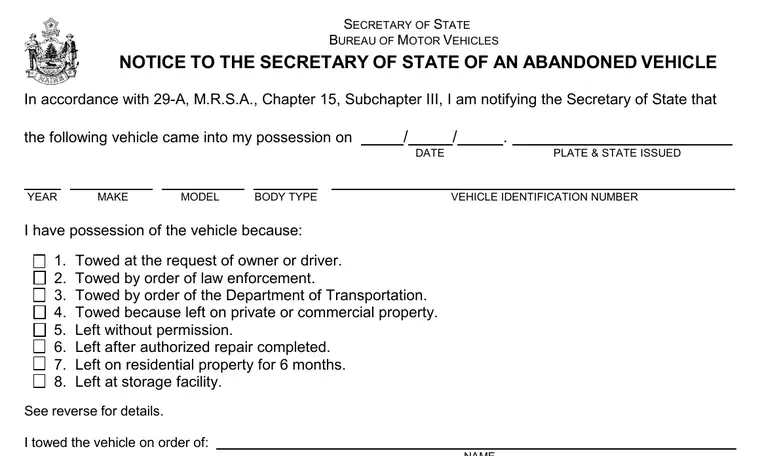
Two documents, and they are not the same thing. Take the blank MVT-28 from the maine.gov copy so you get the revision that is current today, then print our MVT-28 guide and keep it beside you while you fill theirs in.
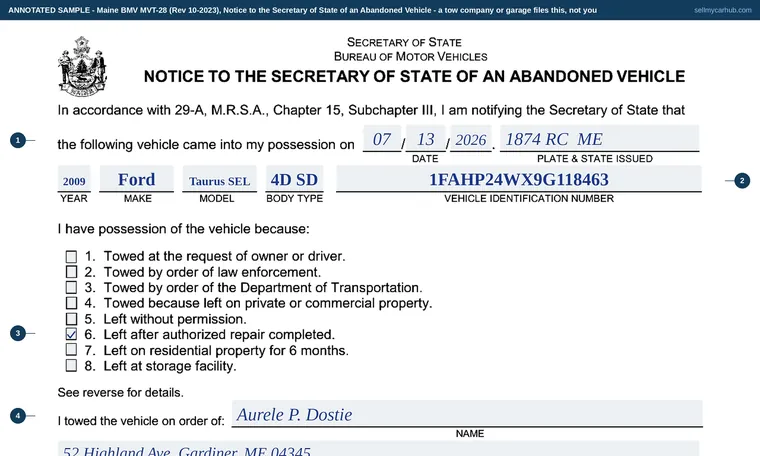
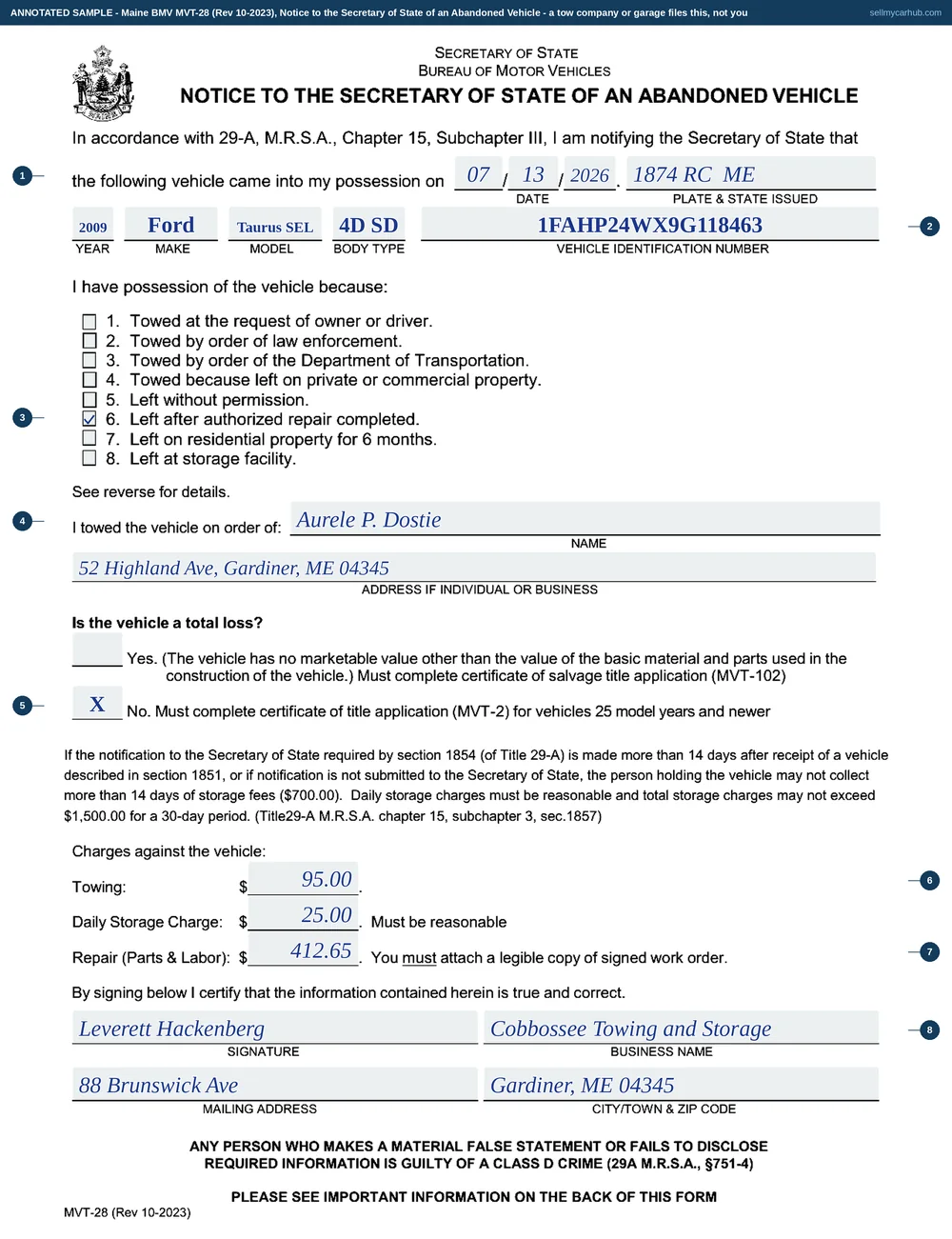
This is the actual MVT-28, rendered from the PDF the Maine Bureau of Motor Vehicles publishes and completed end to end: letterhead, every field, and the blocks at the foot.
The day the vehicle came into the claimant's hands.
Watch out: The fourteen-day notification window runs from here, and missing it caps what can be recovered in storage no matter how long the vehicle stays.
The plate and issuing state, then year, make, model, body type and identification number.
Watch out: The plate is often the only clue to who the Bureau thinks owns it, which is how a seller who never completed a transfer gets a letter.
The numbered list, expanded on the reverse of the sheet.
Watch out: Each has a precise definition on the back. Left after authorized repair completed, for instance, requires a written work order signed by the person who asked for the repair.
A name and address, individual or business.
Watch out: For a vehicle simply left somewhere, this is the property owner rather than a towing customer. It should not be left blank because nobody rang.
The answer routes to a salvage application or a title application.
Watch out: Yes means the vehicle has no marketable value beyond its basic materials and parts. It is a valuation question, not a description of the dents.
Towing, daily storage, and repair parts and labour.
Watch out: Storage has both a daily reasonableness test and a hard ceiling per thirty days, both printed on the face of the form.
A legible copy of the signed work order where repair charges are claimed.
Watch out: The word is legible. A faded thermal printout of a signature is the commonest reason a repair claim is struck off the notice.
Signature, business name, mailing address and town.
Watch out: The warning underneath covers both a material false statement and a failure to disclose required information, and both are Class D crimes in Maine.
| On the form | What to put in it |
|---|---|
| Date it came into possession | One line, and the start of the clock the form's own warning is about. |
| Plate and state issued | As found on the vehicle. |
| The vehicle | Year, make, model, body type and vehicle identification number. |
| Why it is in your possession | Eight numbered options, each expanded on the reverse: towed at the request of the owner or driver; towed by order of law enforcement; towed by order of the Department of Transportation; towed because left on private or commercial property; left without permission; left after authorized repair completed; left on residential property for 6 months; left at storage facility. |
| Who ordered the tow | A name and an address, whether an individual or a business. |
| Total loss | Yes or no, and each answer routes to a different application - a certificate of salvage where the vehicle has no marketable value other than the value of the basic material and parts used in its construction, or a certificate of title for vehicles 25 model years and newer where it does. |
| Charges against the vehicle | Three lines - towing, daily storage charge which the form itself annotates must be reasonable, and repair parts and labour, for which you must attach a legible copy of a signed work order. |
| Certification | A signature, business name, mailing address and town under a statement that the information is true and correct, with a printed warning that a person who makes a material false statement or fails to disclose required information is guilty of a Class D crime. |
Every line here was read off MVT-28 (Rev 10-2023) itself — the PDF is here — and off the Maine Bureau of Motor Vehicles pages. This is plain-language help with a form, not legal advice, and where our wording and the agency's differ, theirs governs.
Back to all Maine seller paperwork, or what selling a car in Maine involves.