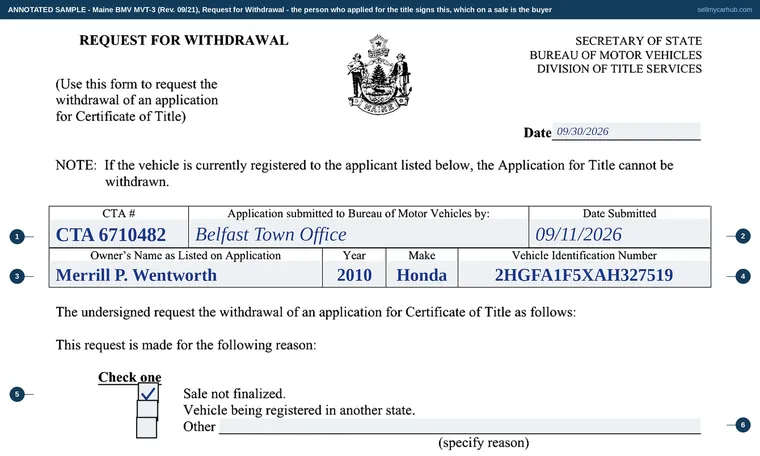
For the sale that came apart after the paperwork went in. A title application is already sitting in Augusta, the buyer has changed their mind or the money never arrived, and this is the form that pulls the application back out. Its first tick box says exactly that: sale not finalised. It is short, and it carries one warning worth reading before anybody signs it - the fee does not come back.
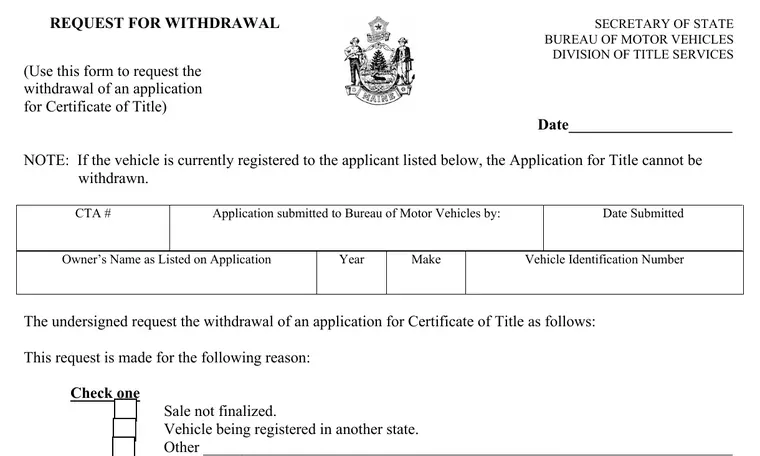
Written against MVT-3 (Rev 09/21), issued under Rules promulgated by the Secretary of State, 7 May 1979. This form exists for a sale that collapsed, and the person who usually needs it is the buyer rather than the seller - the application is in their name. If a Maine sale of yours falls through after the paperwork has gone in, the withdrawal is filed by whoever applied, and your job is to make sure the certificate comes back to you rather than staying in a stranger's file.
Two documents, and they are not the same thing. Take the blank MVT-3 from the maine.gov copy so you get the revision that is current today, then print our MVT-3 guide and keep it beside you while you fill theirs in.
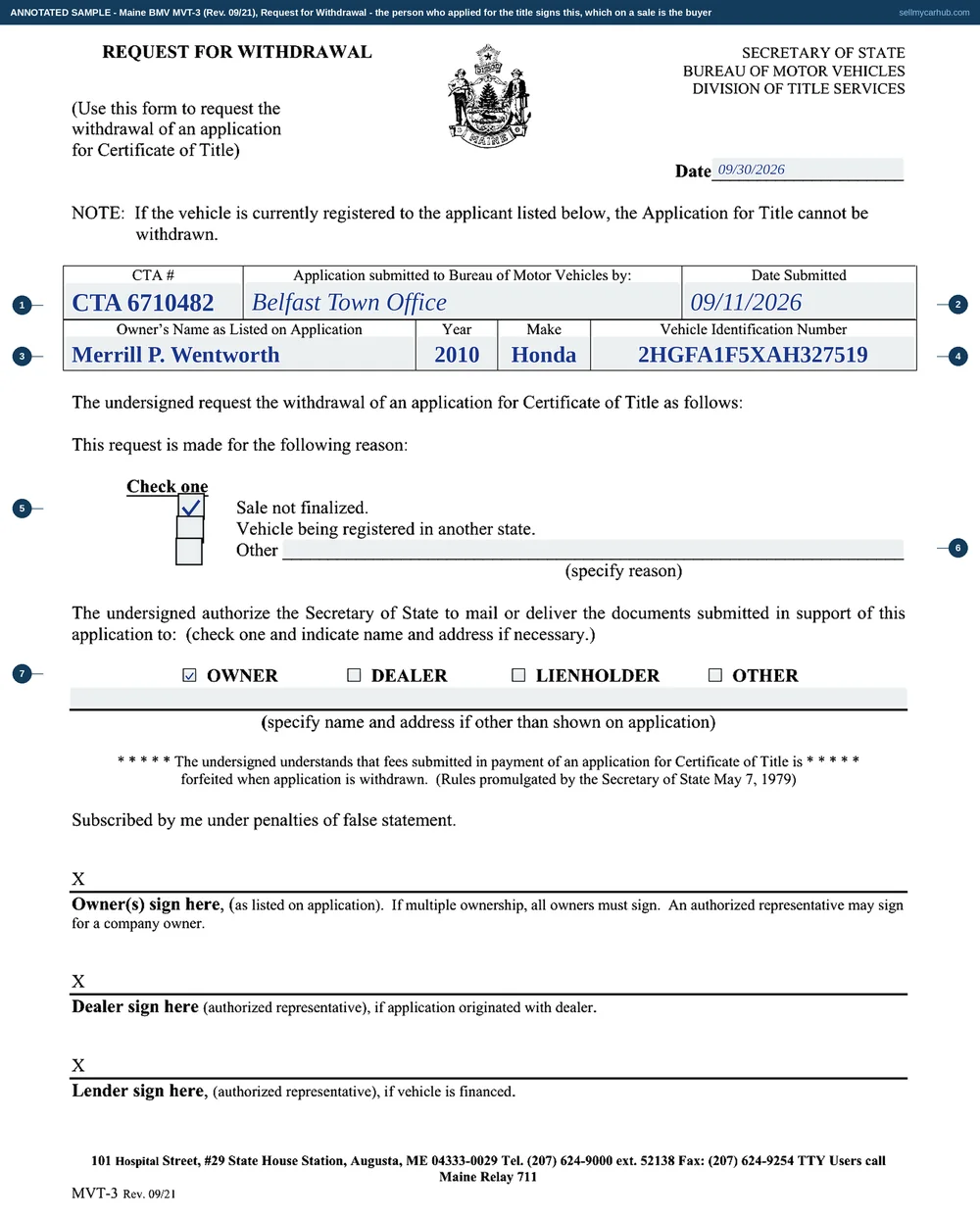
This is the actual MVT-3, rendered from the PDF the Maine Bureau of Motor Vehicles publishes and completed end to end: letterhead, every field, and the blocks at the foot.
The note at the head of the form is a condition on using it at all.
Watch out: If the buyer has already registered the car, the application cannot be withdrawn and the vehicle has to be transferred back properly instead.
The Bureau's reference number, who submitted the application, and the submission date.
Watch out: The reference number is on the receipt from wherever the application was lodged. Without it the Bureau is searching by name.
The name that went in, which on a sale is the buyer rather than the seller.
Watch out: This is the box that confuses people. The application was in the buyer's name, so the withdrawal is too.
The year and make, then the vehicle identification number in full.
Watch out: No model box and no title number box - the reference number and the identification number together are how the application is found.
Sale not finalised, being registered in another state, or Other with a specified reason.
Watch out: Sale not finalised covers a collapsed private sale, a bounced payment and a change of mind. It does not need elaborating.
Owner, dealer, lienholder or other, with a name and address if it is somebody new.
Watch out: For a collapsed sale this is the box a seller cares about most. The certificate goes wherever this points and getting it wrong means chasing your own title.
Owner, plus dealer if the application originated with one, plus lender if the vehicle is financed.
Watch out: Above them sits the notice that the fee is forfeited. Signing acknowledges that, and nobody gets it back afterwards by asking.
| On the form | What to put in it |
|---|---|
| Date | One line at the top. |
| The note above everything | Printed rather than filled in, and it is the condition on the whole form: if the vehicle is currently registered to the applicant listed below, the application for title cannot be withdrawn. |
| Application details | The Bureau's own reference number for the application, who submitted it, and the date it was submitted. |
| The vehicle and the applicant | The owner's name as listed on the application, then year, make and vehicle identification number. |
| Reason | Three boxes: sale not finalised, vehicle being registered in another state, or Other with a line to specify. |
| Where the documents go | Four boxes - owner, dealer, lienholder or other - directing who the Secretary of State should return the supporting documents to, with a name and address if it is somebody not already on the application. |
| The forfeiture warning | Set off with rows of asterisks: the undersigned understands that fees submitted in payment of an application for certificate of title are forfeited when the application is withdrawn. |
| Three signature lanes | The owner or owners as listed on the application, with all owners signing where there is multiple ownership and an authorised representative permitted for a company owner. Then a dealer signature if the application originated with a dealer, and a lender signature if the vehicle is financed. |
Every line here was read off MVT-3 (Rev 09/21) itself — the PDF is here — and off the Maine Bureau of Motor Vehicles pages. This is plain-language help with a form, not legal advice, and where our wording and the agency's differ, theirs governs.
Back to all Maine seller paperwork, or what selling a car in Maine involves.