How a vehicle that was written off gets back onto the road with a title that says what happened to it. The application does two separate jobs on one sheet: it applies for the reconstructed title, and it carries the disclosure R.S. 32:706.1 requires - salvaged, reconstructed, water damaged or hail-damaged - which is the disclosure that has to be made in writing to a buyer before any later sale closes. In a state that floods, the water damage half of this form gets more use than the rest of it put together.
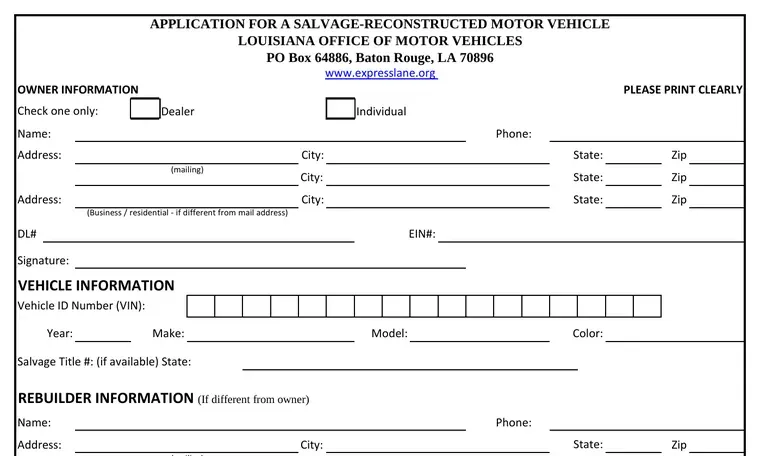
Written against DPSMV 1637 (R0213jg), issued under R.S. 32:707, salvage title; R.S. 32:706.1, disclosure of branded vehicles. The revision here reads R0213jg - a bare month and year with somebody's initials on the end, which is how one or two OMV forms are dated. The statutory citations printed on it are the thing to check against a current copy: the disclosure regime in R.S. 32:706.1 and the water damage provisions carry the penalties, and a form quoting the wrong section is worse than none.
Two documents, and they are not the same thing. Take the blank DPSMV 1637 from the public.powerdms.com copy so you get the revision that is current today.
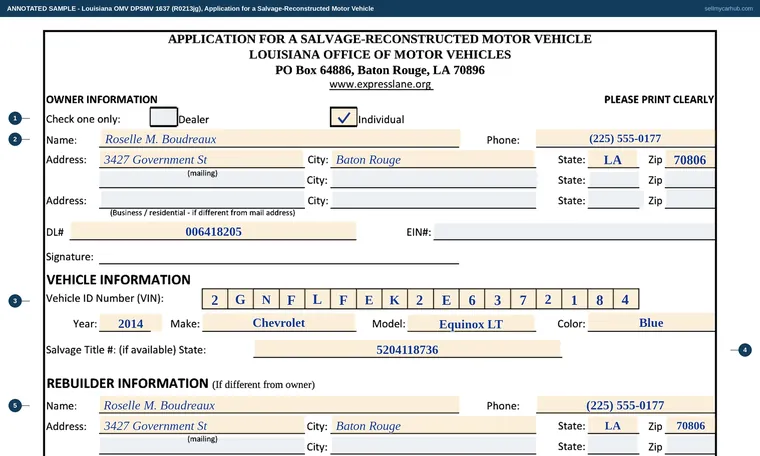
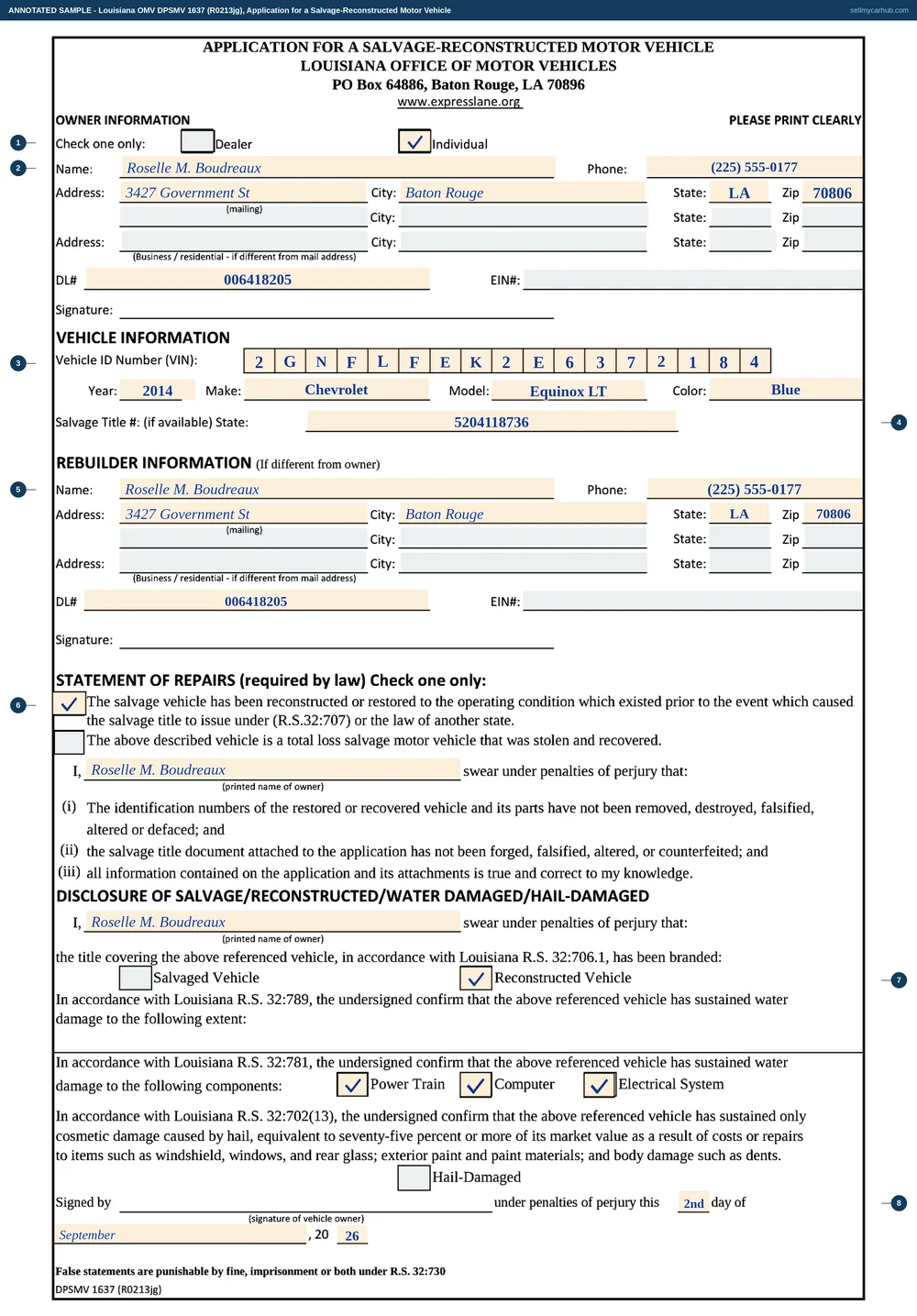
This is the actual DPSMV 1637, rendered from the PDF the Louisiana Office of Motor Vehicles publishes and completed end to end: letterhead, every field, and the blocks at the foot.
Two ticks at the very top of the owner block.
Watch out: Individual for a private owner rebuilding their own vehicle. Ticking Dealer without a licence behind it puts the application into a queue with different requirements attached to it.
First box of the owner block, with a phone number beside it and three address rows underneath.
Watch out: The person who will hold the reconstructed title. Fill the mailing address row even where it is the same as the residential one - the department posts the certificate to what is written in the mailing row.
Seventeen single-character boxes across the sheet.
Watch out: One character per box, left to right, no spaces and no dashes. Running the number together in the first few boxes is the single most common way this row goes wrong, and it is visible at a glance from across a counter.
A wide box under the vehicle description row, with a State box after it.
Watch out: The number off the salvage title the vehicle currently holds. Where the salvage title came from another state, put that state in the box beside it - the department needs to know which record it is superseding.
A second full block, headed if different from owner.
Watch out: If a shop did the work, this is the shop. If you did it yourself, repeat your own details rather than leaving it empty - the block is asking who is responsible for the repairs, and a blank is not an answer to that.
Two statements with a tick each, marked check one only.
Watch out: The first is a rebuilt vehicle; the second is a stolen vehicle that was recovered. They lead to different outcomes on the record, and ticking both makes the application internally contradictory.
Under the second printed-name blank, in the block citing R.S. 32:706.1.
Watch out: This is the disclosure half of the form and it is the half with the penalties attached. Whatever is ticked here is what has to be disclosed in writing to every future buyer, so it is worth getting exactly right rather than approximately right.
The execution line at the foot, with the penalty printed under it.
Watch out: Three separate certifications sit above this signature - about identification numbers, about the salvage document, and about the application itself. Read all three before signing, because the line underneath names fine, imprisonment or both.
| On the form | What to put in it |
|---|---|
| Check one only: Dealer / Individual | Two ticks at the head of the owner block. |
| Owner information | Name and phone, then three address rows - mailing, business or residential if different, and a third - each with city, state and zip. Then DL# and EIN#, and a signature rule with no fillable box. |
| Vehicle ID Number (VIN) | Seventeen separate single-character boxes, which is the only printed comb on any form in this section. |
| Year, Make, Model, Color | One row under the VIN comb. |
| Salvage Title #: (if available) State: | A wide box for the number of the salvage title the vehicle currently holds. |
| Rebuilder information (if different from owner) | A second identical block: name, phone, three address rows, DL# and EIN#, and its own signature rule. |
| Statement of Repairs (required by law) Check one only | Two statements, and exactly one is ticked. Either the salvage vehicle has been reconstructed or restored to the operating condition which existed prior to the event which caused the salvage title to issue under R.S. 32:707 or the law of another state; or the vehicle is a total loss salvage motor vehicle that was stolen and recovered. |
| The perjury certification | I, ______, swear under penalties of perjury that: the identification numbers of the restored or recovered vehicle and its parts have not been removed, destroyed, falsified, altered or defaced; the salvage title document attached has not been forged, falsified, altered, or counterfeited; and all information contained in the application and its attachments is true and correct. |
| Disclosure of salvage/reconstructed/water damaged/hail-damaged | The second half of the sheet. A second printed-name blank, then Salvaged Vehicle and Reconstructed Vehicle ticks under R.S. 32:706.1. |
| Water damage, two questions | R.S. 32:789 asks for the extent of water damage in free text. R.S. 32:781 asks which components: Power Train, Computer, Electrical System, as three ticks. |
| Hail-Damaged | A single tick under a paragraph citing R.S. 32:702(13): cosmetic damage caused by hail equivalent to seventy-five percent or more of market value, from repairs to windshield, windows and rear glass, exterior paint and paint materials, and body damage such as dents. |
| Signed by ______ under penalties of perjury this __ day of __, 20 __ | The execution line, with False statements are punishable by fine, imprisonment or both under R.S. 32:730 printed beneath it. |
Every line here was read off DPSMV 1637 (R0213jg) itself — the PDF is here — and off the Louisiana Office of Motor Vehicles pages. This is plain-language help with a form, not legal advice, and where our wording and the agency's differ, theirs governs.
Back to all Louisiana seller paperwork, or what selling a car in Louisiana involves.