Sell My Car Hub

How to fill out Indiana State Form 23037

For the buyer who paid for a car and never got the certificate. Indiana lets a purchaser who is unable to obtain a properly executed title apply for one on this affidavit instead of going to court - but only for a modest vehicle, and only after an evidence trail that includes a certified letter the seller never opened. Eight instructions sit above the boxes and they are the form, far more than the boxes are.
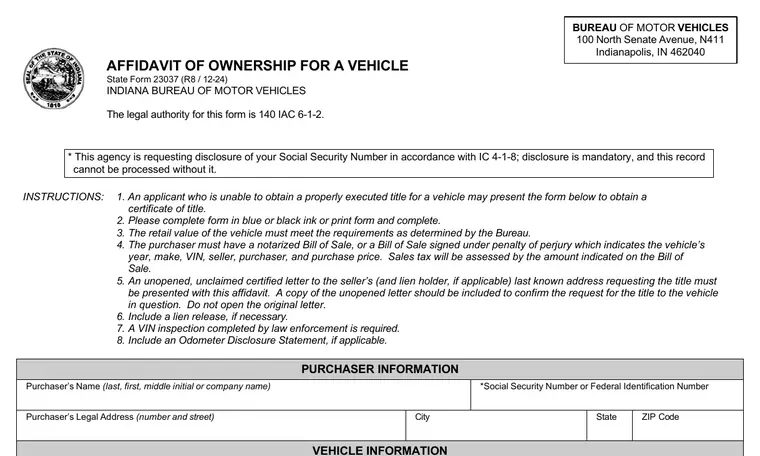
Written against State Form 23037 (R8 / 12-24), issued under 140 IAC 6-1-2. Check the value first, at NADA, before assembling any of it. The BMV asks applicants to confirm the clean or average retail value before applying, and a car over the ceiling means a court order rather than an affidavit - a different packet and a different building.

Two documents, and they are not the same thing. Take the blank State Form 23037 from the forms.in.gov copy so you get the revision that is current today.

Filled in

What a completed one looks like

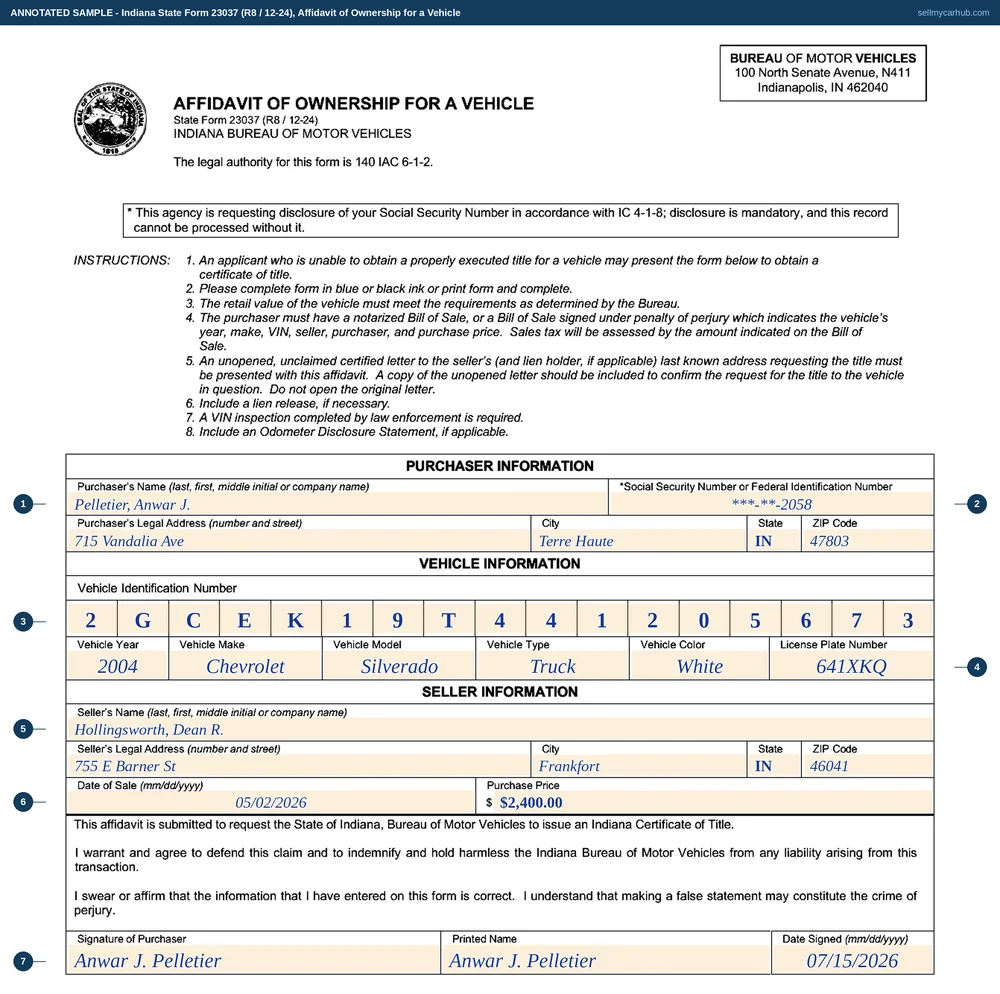
This is the actual State Form 23037, rendered from the PDF the Indiana Bureau of Motor Vehicles publishes and completed end to end: letterhead, every field, and the blocks at the foot.

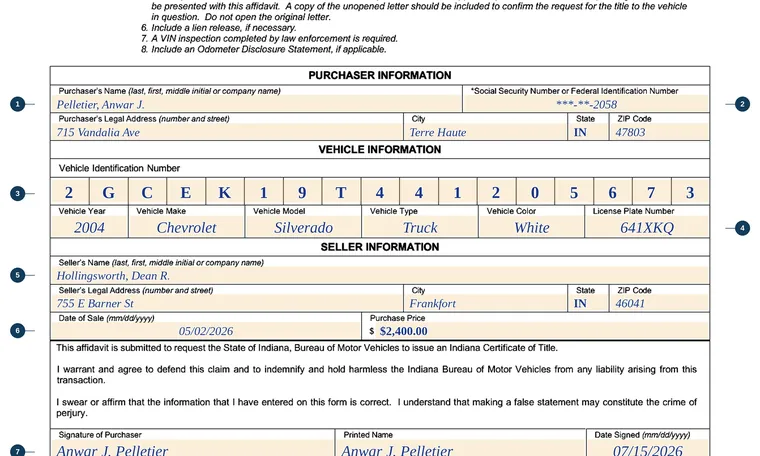
Indiana State Form 23037 filled in: purchaser Pelletier, Anwar J. of Terre Haute, a 2004 Chevrolet Silverado in white, VIN 2GCEK19T441205673, plate 641XKQ, seller Hollingsworth, Dean R. of Frankfort with a date of sale of 2 May 2026 and a purchase price of 2,400 dollars, and one purchaser signature dated 15 July 2026.
Filled in for a truck bought cheaply from a seller who stopped answering. Note that the seller block is amber even though no seller signs this page - the purchaser fills it in from whatever record of the sale exists, which is why the certified letter and the bill of sale matter so much.
Field by field

Every line, in the order you meet it

  1. 1
    The buyer fills this in

    Check the value before anything else

    The retail value of the vehicle must meet the requirements as determined by the Bureau.

    Watch out: The BMV points at NADA clean or average retail and asks you to check before applying. A truck that is worth more than the ceiling ends this route on instruction 3, before a single box is filled in.

  2. 2
    The buyer fills this in

    Send the certified letter

    A letter to the seller's last known address requesting the title, sent certified, and left unopened when it comes back.

    Watch out: This is the evidence that the seller cannot be made to produce the certificate. Do not open the original letter - a copy of the unopened envelope is what goes in the packet.

  3. 3
    The buyer fills this in

    Get a VIN inspection

    An inspection completed by law enforcement, confirming the identification number on the vehicle.

    Watch out: Instruction 7 asks for law enforcement specifically. A branch inspection is not the same thing on this particular route.

  4. 4
    The buyer fills this in

    Purchaser information

    Name in the BMV's order, the starred identification number, and your legal address.

    Watch out: The star is doing work here. Disclosure is mandatory, and this record cannot be processed without it.

  5. 5
    The buyer fills this in

    Vehicle information

    Identification number, year, make, model, type, color and the plate number if there is one.

    Watch out: Take the identification number from the vehicle rather than from the advertisement, because the police inspection is going to be compared against it.

  6. 6
    The buyer fills this in

    Seller information

    The seller's name and legal address, plus the date of sale and the purchase price.

    Watch out: Use the address you sent the certified letter to. The two have to be the same address for the letter to prove anything.

  7. 7
    The buyer fills this in

    Sign the indemnity

    One signature row, under a warranty to defend this claim and to indemnify and hold harmless the BMV.

    Watch out: That is a stronger undertaking than the ordinary affirmation on the rest of the set. You are asking the state to issue a title on your word, and this is what it costs.

  8. 8
    The buyer fills this in

    Post the packet to Central Office

    The application, the bill of sale, the unopened letter, the inspection, any lien release and an odometer statement if applicable.

    Watch out: This one does not go to a branch counter. The address is printed at the top right of the form, and the BMV publishes a packet listing every enclosure.

At a glance

What goes where

On the formWhat to put in it
PURCHASER INFORMATIONName in the order last, first, middle initial or company name, a starred Social Security or Federal Identification Number, and the purchaser's legal address.
VEHICLE INFORMATIONIdentification number in its own banded box, then Vehicle Year, Make, Model, Type, Color and the License Plate Number.
SELLER INFORMATIONThe seller's name and legal address - the person who could not be made to produce the title.
Date of Sale and Purchase PriceTwo boxes at the foot of the seller block.
The indemnityI warrant and agree to defend this claim and to indemnify and hold harmless the Indiana Bureau of Motor Vehicles from any liability arising from this transaction.
Signature of PurchaserOne signature row with a printed name and date, under the perjury affirmation. There is no seller signature anywhere on the page.

What gets this one rejected

Rules that decide whether it is accepted

Every line here was read off State Form 23037 (R8 / 12-24) itself — the PDF is here — and off the Indiana Bureau of Motor Vehicles pages. This is plain-language help with a form, not legal advice, and where our wording and the agency's differ, theirs governs.

Back to all Indiana seller paperwork, or what selling a car in Indiana involves.

Want the paperwork handled instead?

Get My Instant Offer → Online · about 2 minutes · free

Or send the details — we'll come to you

A car you own, paid for, and cannot title - that is precisely the situation to describe to us rather than to a queue.

or call/text (877) 405-1808