Not your form - and the one on this site an Illinois owner is most likely to wish they had read earlier. It is how a repair shop, a tow operator or a storage yard turns an unpaid bill into a title in somebody else's name. Understanding its timetable is the difference between collecting a car and reading about it in a newspaper advertisement.
Written against VSD 526 (VSD 526.19, March 2026), issued under 770 ILCS 50, 770 ILCS 45 and 770 ILCS 95. If you are selling a car that has been sitting at a garage, a body shop or a storage yard, settle the bill before you advertise it. A buyer cannot take a title that is already being sold out from under both of you, and this form's timetable does not pause because a sale is pending.
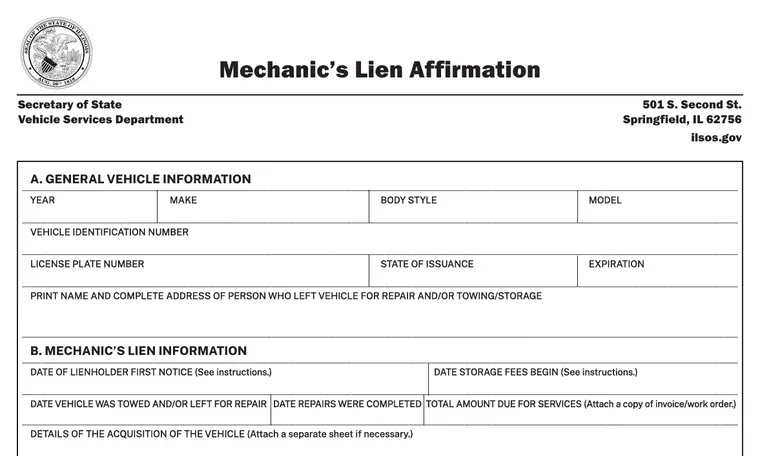
Two documents, and they are not the same thing. Take the blank VSD 526 from the ilsos.gov copy so you get the revision that is current today.
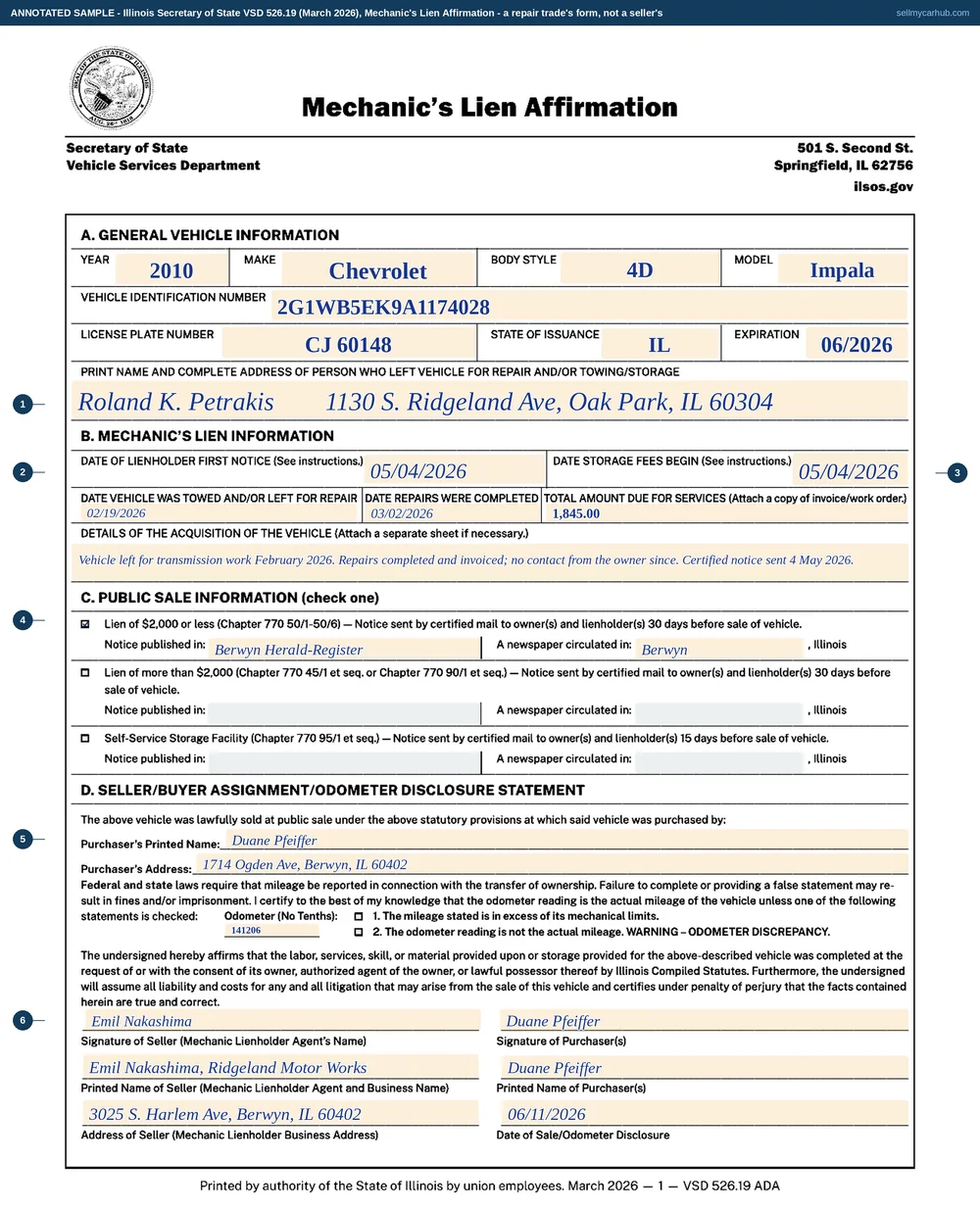
This is the actual VSD 526, rendered from the PDF the Illinois Secretary of State publishes and completed end to end: letterhead, every field, and the blocks at the foot.
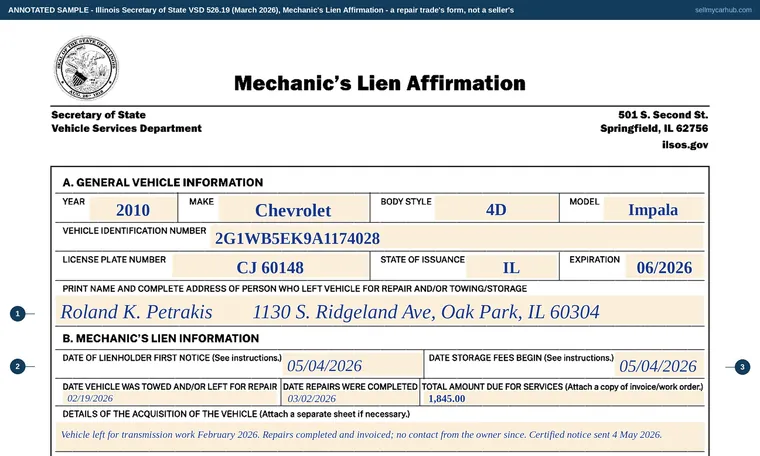
Vehicle description, VIN, plate, and the printed name and complete address of the person who left the vehicle.
Watch out: As the owner, this is the field to care about. Everything downstream is served on the address written here and on whatever the Secretary of State's records show.
Before any of it, a title search with the Record Inquiry Section to establish the owners and lienholders.
Watch out: It costs $5 a vehicle. If the office finds nothing, the instructions send the business to a nationwide commercial vehicle information service and to inspecting the vehicle for evidence of an owner.
Date of first notice, date storage fees begin, date towed or left for repair, date repairs completed, and the total due with the invoice attached.
Watch out: Date storage fees begin is the contested one. Storage cannot be charged for the period before the certified notice went to the lienholder of record.
A lien of $2,000 or less, a lien of more than $2,000, or a self-service storage facility - each with its own chapter and its own notice period.
Watch out: The first two give 30 days notice before sale; the storage route gives 15. Every one of them also requires a newspaper advertisement, and the form asks which paper and which town.
The purchaser's printed name and address, the odometer reading with no tenths, and the two exception boxes.
Watch out: A car sold this way still gets a real odometer statement. A buyer at a lien sale who signs without one has the same problem a private buyer would.
The lienholder's agent signs and prints with the business name and address; the purchaser signs and prints; and there is a date of sale and odometer disclosure.
Watch out: The affirmation above them says the work was done at the request of or with the consent of the owner, authorised agent or lawful possessor - which is the sentence an owner disputes, if they are going to dispute anything.
| On the form | What to put in it |
|---|---|
| Section A, general vehicle information | Year, make, body style, model, VIN, plate number, state of issuance and expiration - and then the printed name and complete address of the person who left the vehicle for repair and/or towing/storage. That line is you. |
| Section B, mechanic's lien information | Date of lienholder first notice, date storage fees begin, date the vehicle was towed or left for repair, date repairs were completed, and the total amount due for services with a copy of the invoice or work order attached. |
| Details of the acquisition of the vehicle | A free-text block, with a separate sheet if necessary. |
| Section C, public sale information | Three mutually exclusive routes with different statutes and different notice periods, and the name of the newspaper the advertisement ran in plus the town it circulates in. |
| Section D, seller/buyer assignment and odometer disclosure | The purchaser's printed name and address, then the same odometer certification the title carries, with its two boxes. |
| The four signature rules | Signature and printed name of the mechanic lienholder's agent with the business name and address, and signature and printed name of the purchaser, with a date of sale and odometer disclosure. |
Every line here was read off VSD 526 (VSD 526.19, March 2026) itself — the PDF is here — and off the Illinois Secretary of State pages. This is plain-language help with a form, not legal advice, and where our wording and the agency's differ, theirs governs.
Back to all Illinois seller paperwork, or what selling a car in Illinois involves.