Sell My Car Hub

How to fill out Idaho 3366

The lienholder's form, and it is on this list because a seller can find themselves on the wrong side of it. When a lender takes a financed vehicle back, this affidavit is how ownership moves to the lender without the borrower's signature: it certifies that the lienholder of record is the lawful owner by reason of a conditional sale contract, chattel mortgage or security agreement and that the vehicle was lawfully repossessed on the date shown. Its lower half doubles as an assignment, so the lender can name the person it has sold the repossessed vehicle to on the same sheet. If you are the borrower, nothing here is yours to fill in - but knowing what it says is the difference between an argument and a title stop.
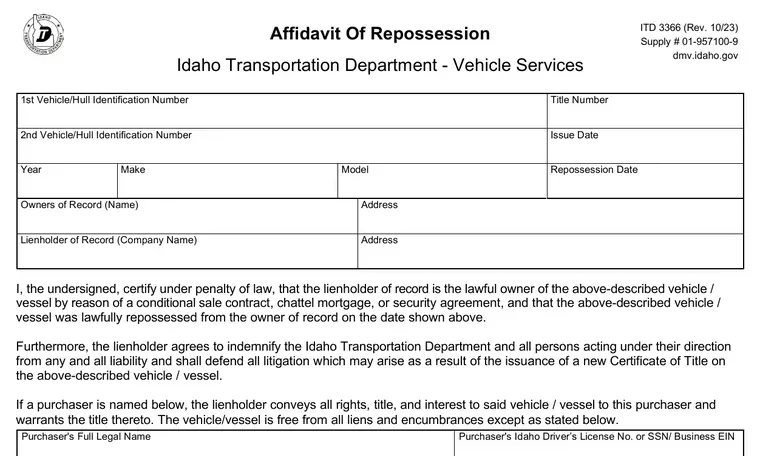
Written against 3366 (Rev 10/23), issued under Idaho Code 49-514. If a vehicle you still consider yours has been taken and you think the repossession was not lawful, the form that answers this one is not another affidavit - it is ITD 3702, the Request for Title Stop, which freezes title issuance for thirty days on payment of the statutory fee while a court filing catches up. Note that section 49-523A lists repossession by a recorded lienholder as one of the events that lifts a stop, so the timing matters.

Two documents, and they are not the same thing. Take the blank 3366 from the itd.idaho.gov copy so you get the revision that is current today, then print our 3366 guide and keep it beside you while you fill theirs in.

Filled in

What a completed one looks like

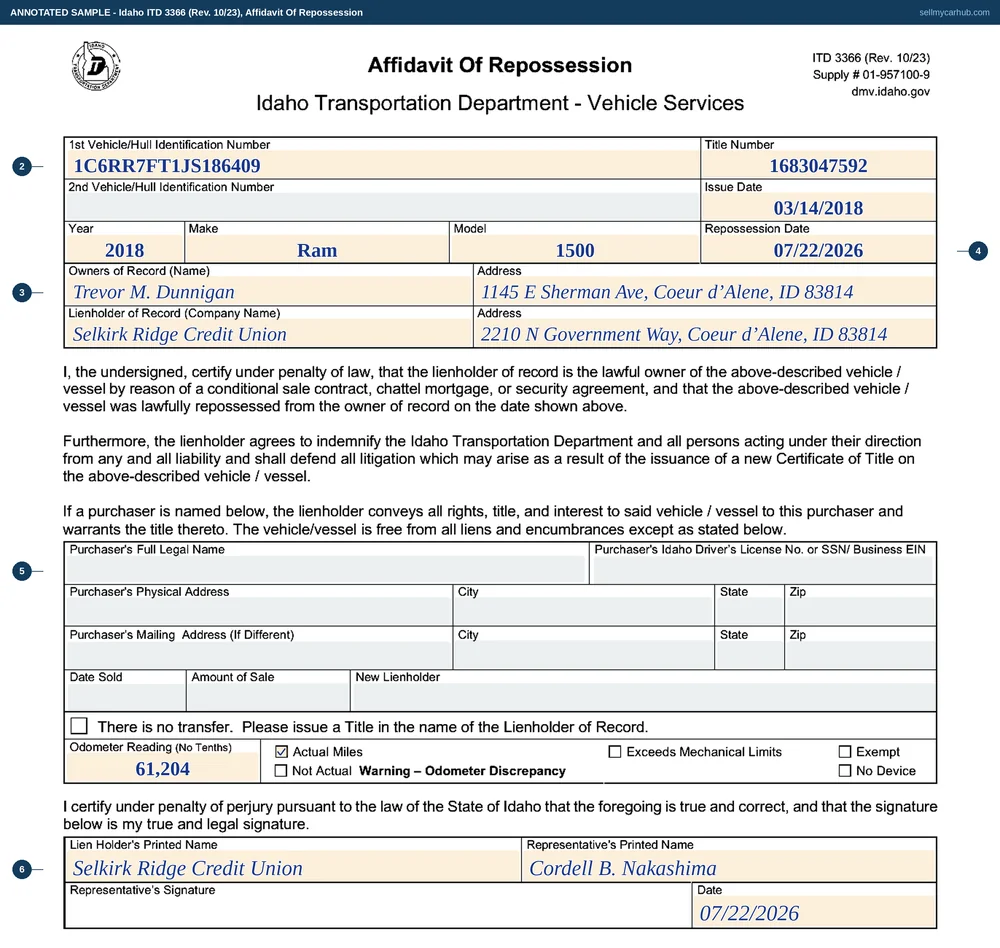
This is the actual 3366, rendered from the PDF the Idaho Transportation Department, Division of Motor Vehicles publishes and completed end to end: letterhead, every field, and the blocks at the foot.

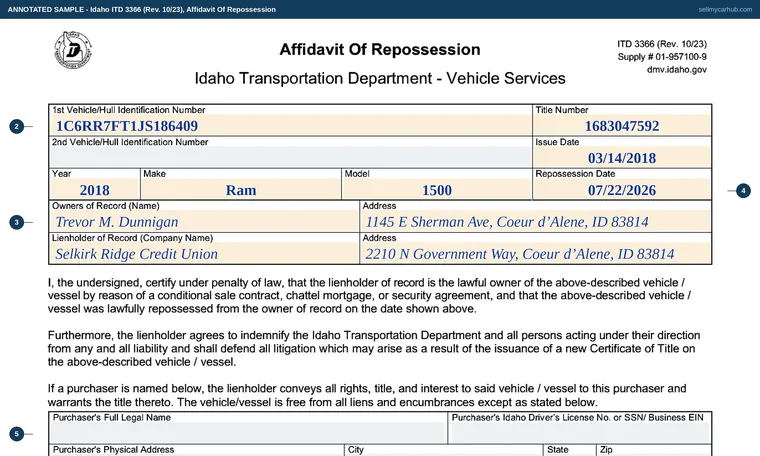
Idaho form ITD 3366, Affidavit Of Repossession, filled in by Selkirk Ridge Credit Union of Coeur d'Alene for a 2018 Ram 1500, vehicle identification number 1C6RR7FT1JS186409, repossessed from owner of record Trevor M. Dunnigan on 22 July 2026, with the purchaser block left for the lender's onward sale.
The lower half is the lender's onward assignment and is washed grey here, because on the day the affidavit is sworn the credit union has not yet found a buyer. The second VIN box is grey too - it exists for motor homes and double-wide manufactured homes.
Field by field

Every line, in the order you meet it

  1. 1
    You fill this in

    Read who signs it

    The lienholder of record and nobody else. There is no borrower signature line on this form.

    Watch out: If somebody has asked you to sign a repossession affidavit, something has gone wrong. This is not a document a borrower executes.

  2. 2
    The buyer fills this in

    The vehicle and the title

    VIN, title number, issue date, year, make and model, filled in by the lender.

    Watch out: The issue date is the date on the current certificate. A lender working from an electronic record takes it from the department's record instead.

  3. 3
    The buyer fills this in

    Owners of record and lienholder of record

    Both as the department holds them, not as either party would prefer.

    Watch out: A lender whose name has changed uses ITD 3777's Is Now Known As block to bridge the two, then attaches it.

  4. 4
    The buyer fills this in

    The repossession date

    The day the vehicle was taken back, sworn to under penalty of law.

    Watch out: This date is the one a disputed repossession turns on, which is why it sits in its own box rather than in the body of the certification.

  5. 5
    The buyer fills this in

    The onward sale, if there is one

    Purchaser's name, identifier, addresses, date sold, amount of sale and any new lienholder.

    Watch out: The lender warrants the title and warrants the vehicle free of liens except as stated. A blank here means the lender is titling it in its own name first.

  6. 6
    You fill this in

    What you do about it, if it was your car

    Nothing on this form. Your route is a title stop on ITD 3702, or a lawyer.

    Watch out: And check your own paperwork: if you had already sold the vehicle and filed a release of liability, section 49-526(2) is the sentence that keeps the storage and towing charges off you.

At a glance

What goes where

On the formWhat to put in it
1st and 2nd Vehicle/Hull Identification Number, Title Number, Issue DateThe vehicle identified twice over, with the date the current title was issued.
Year, Make, Model, Repossession DateFour boxes on one rule, and the repossession date is the one that matters legally.
Owners of Record (Name) and AddressThe borrower, as the department's record has them.
Lienholder of Record (Company Name) and AddressThe lender, which must be the lender the record names.
The certificationThat the lienholder of record is the lawful owner by reason of a conditional sale contract, chattel mortgage or security agreement, and that the vehicle was lawfully repossessed from the owner of record on the date shown, sworn under penalty of law.
The indemnityThe lienholder agrees to indemnify the Idaho Transportation Department and all persons acting under their direction from any and all liability and to defend all litigation arising from the issuance of a new certificate of title.
Purchaser's Full Legal Name and Idaho Driver's License No. or SSN / Business EINThe lower half, used where the lender is selling the vehicle on rather than titling it in its own name.
Purchaser's Physical Address, Mailing Address (If Different), City, State, ZipTwo address rules for that purchaser.
Date Sold, Amount of Sale, New LienholderThe onward sale's own three boxes, with a warranty that the vehicle is free from all liens and encumbrances except as stated.
Authorized signature blockThe lender's representative signs; the borrower does not sign this form at all.

What gets this one rejected

Rules that decide whether it is accepted

Every line here was read off 3366 (Rev 10/23) itself — the PDF is here — and off the Idaho Transportation Department, Division of Motor Vehicles pages. This is plain-language help with a form, not legal advice, and where our wording and the agency's differ, theirs governs.

Back to all Idaho seller paperwork, or what selling a car in Idaho involves.

Want the paperwork handled instead?

Get My Instant Offer → Online · about 2 minutes · free

Or send the details — we'll come to you

If the loan is the only reason the car is still sitting there, tell us the payoff figure with it - our offer can be worked out around what is owed.

or call/text (877) 405-1808