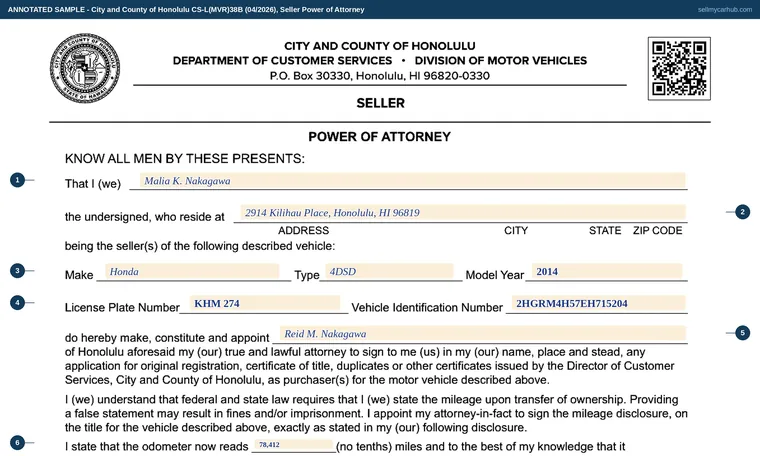
One page that lets somebody else sign a Hawaii transfer in your place, and the only document in the seller's set that Honolulu itself calls for by name outside the ordinary sale: a second buyer recording a double transfer needs a notarized bill of sale or seller power of attorney from the person who never titled the car. Its powers are drawn wide - to sign any application for original registration, certificate of title, duplicates or other certificates issued by the Director of Customer Services, City and County of Honolulu - and it ends with full power of substitution. The one thing it does not delegate is the mileage. The owner writes the odometer reading on the form itself, and the attorney-in-fact is appointed to sign the disclosure exactly as stated in that disclosure.
Written against CS-L(MVR)38B (04/2026), issued under City and County of Honolulu Department of Customer Services, Division of Motor Vehicles, sworn before a notary and appointing an attorney-in-fact to act before the Director of Customer Services. Read the appointment line before you sign it, because it is broader than a one-sale mandate. It covers any application for registration, title, duplicates or other certificates for the vehicle described, and it carries full power of substitution - meaning your appointee may pass the power on. If you want it narrower, that constraint has to be written on the document before the notary sees it.
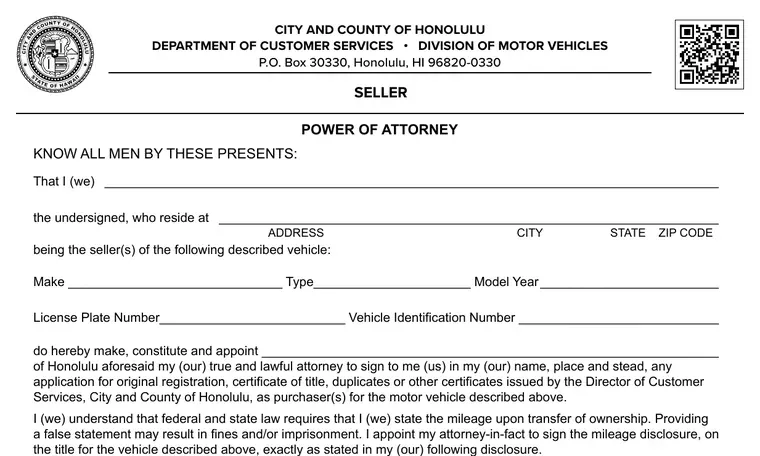
Two documents, and they are not the same thing. Take the blank CS-L(MVR)38B from the www4.honolulu.gov copy so you get the revision that is current today, then print our CS-L(MVR)38B guide and keep it beside you while you fill theirs in.
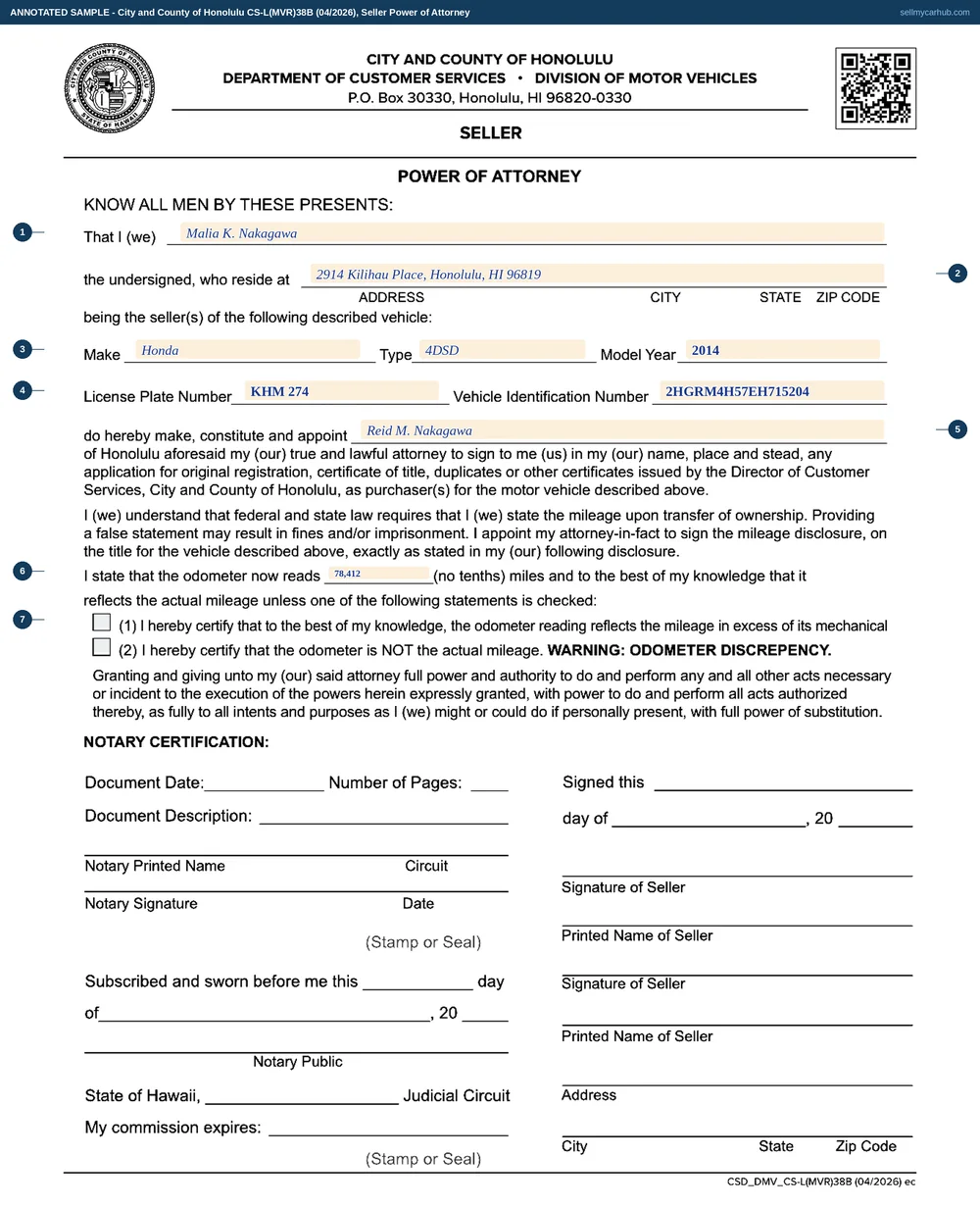
This is the actual CS-L(MVR)38B, rendered from the PDF the City and County of Honolulu Division of Motor Vehicle, Licensing and Permits publishes and completed end to end: letterhead, every field, and the blocks at the foot.
Every registered owner named on the certificate goes on this line. A jointly owned car needs both, or the agent can only sign for one.
Watch out: Write the names as the certificate prints them. A power of attorney granted by a name the county does not hold is a power of attorney from a stranger.
Address, city, state and zip on one rule, with the four sub-labels printed underneath.
Watch out: Use the address the county has on record if you can. Where the two differ, expect the counter to ask which is right.
The vehicle this power applies to. It is specific to one car - there is no general version of this form.
Watch out: Type is the county's body-style code from the registration, not the model name. This form is read alongside the certificate.
The identifying pair. The VIN is what makes the appointment unambiguous if the plate changes before the sale completes.
Watch out: Copy both from the registration certificate and check the VIN against the car. A power of attorney for the wrong VIN authorises nothing.
The attorney-in-fact, described on the form as of Honolulu aforesaid. This is the person who will sign the transfer in your place.
Watch out: Pick someone who can physically get to a satellite city hall. The whole value of the document is that they can attend when you cannot.
Whole miles, no tenths, written by you. The appointment that follows binds the agent to disclose exactly this.
Watch out: Never leave it blank on the theory that the agent will know it on the day. A blank reading turns a safeguard into a signed licence to write any number.
Mileage in excess of the odometer's mechanical limits, or a reading that is not the actual mileage - the same two declarations as everywhere else in Hawaii.
Watch out: Both stay empty on an honest odometer. The form spells the second warning out in capitals precisely because ticking it is not a small thing.
A blank block at the foot of the page, headed NOTARY CERTIFICATION. The notary completes it, not you.
Watch out: Sign in front of the notary, not before. A signature already on the page when you arrive is the commonest reason a notary declines to certify it.
| On the form | What to put in it |
|---|---|
| That I (we) | The owner or owners granting the power, at the head of the sheet. |
| who reside at | One long rule with address, city, state and zip code labelled beneath it. |
| Make, Type and Model Year | Three boxes describing the vehicle being sold. |
| License Plate Number and Vehicle Identification Number | The identifying pair, on one line. |
| do hereby make, constitute and appoint | The attorney-in-fact. The form adds of Honolulu aforesaid, so the appointee is expected to be locally placed. |
| Odometer Reading | Inside the disclosure paragraph, followed by (no tenths) miles. Written by the owner, not by the agent. |
| Statement 1, in excess of its mechanical limits | A tick box certifying the reading reflects mileage in excess of the odometer's mechanical limits. |
| Statement 2, not the actual mileage | The second box, printed with the county's own capitalised warning about an odometer discrepancy. |
| NOTARY CERTIFICATION | A blank panel at the foot of the page. The form is not complete until a notary has filled it. |
Every line here was read off CS-L(MVR)38B (04/2026) itself — the PDF is here — and off the City and County of Honolulu Division of Motor Vehicle, Licensing and Permits pages. This is plain-language help with a form, not legal advice, and where our wording and the agency's differ, theirs governs.
Back to all Hawaii seller paperwork, or what selling a car in Hawaii involves.