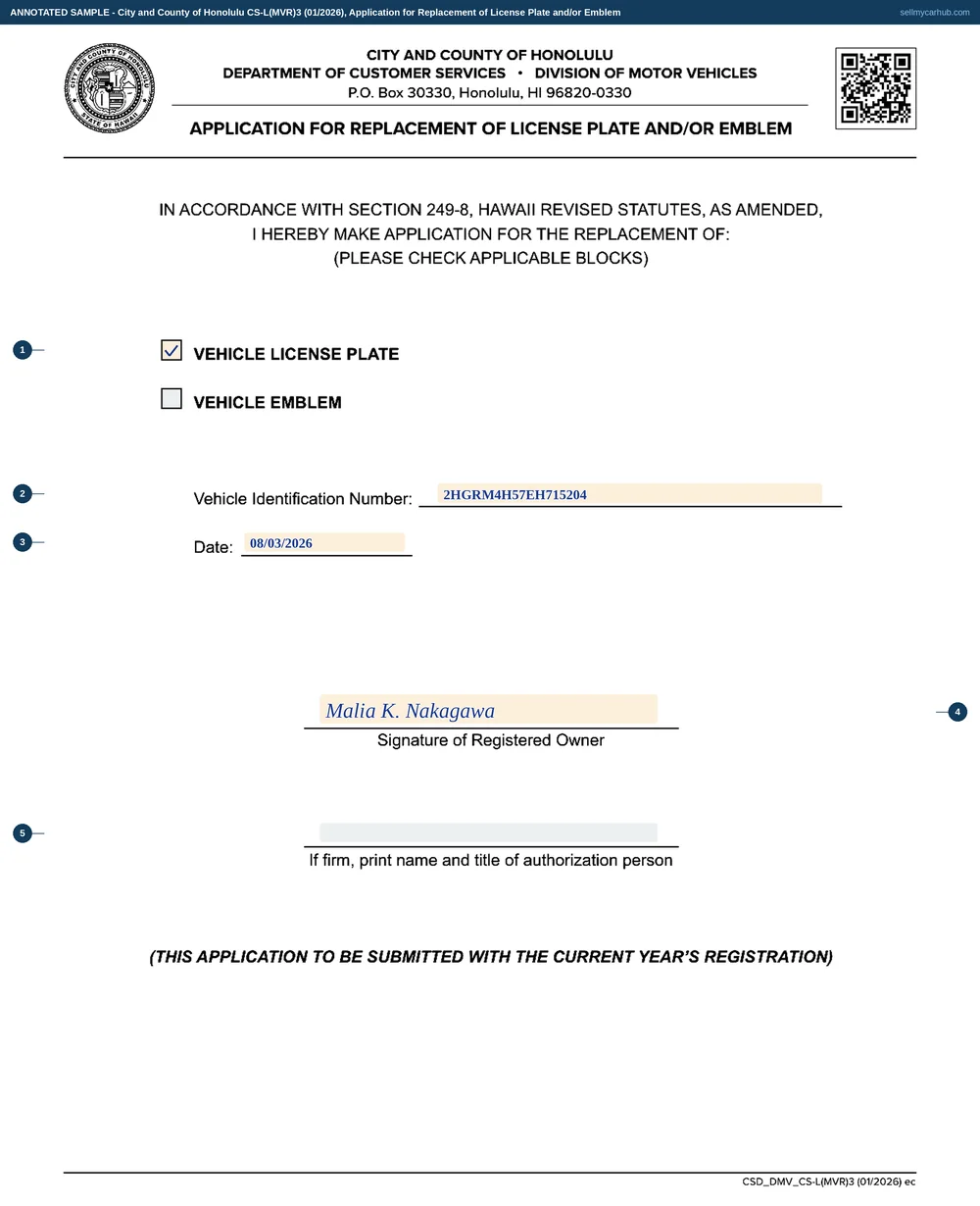
How to fill out Hawaii CS-L(MVR)3
Hawaii plates stay with the car, which makes a missing plate the seller's problem rather than something to be sorted out after the sale. This four-field application replaces a plate, an emblem, or both, under section 249-8 of the Hawaii Revised Statutes as amended. It is also the form the county's personalised-plate route relies on: an owner who wants to keep a personalised plate surrenders it at a satellite city hall and submits an application for replacement license plates with the surrendered plates, and the vehicle is issued new ones for the buyer. The instruction at the foot is the one people miss - this application is to be submitted with the current year's registration.
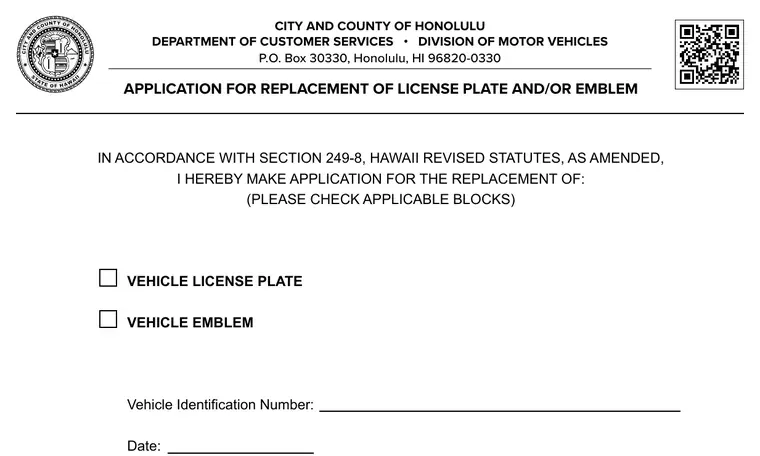 Step 1 · the form itself
Blank CS-L(MVR)3 — Application for Replacement of License Plate and/or Emblem
PDF at www4.honolulu.gov · new tab
View the blank CS-L(MVR)3
Step 1 · the form itself
Blank CS-L(MVR)3 — Application for Replacement of License Plate and/or Emblem
PDF at www4.honolulu.gov · new tab
View the blank CS-L(MVR)3
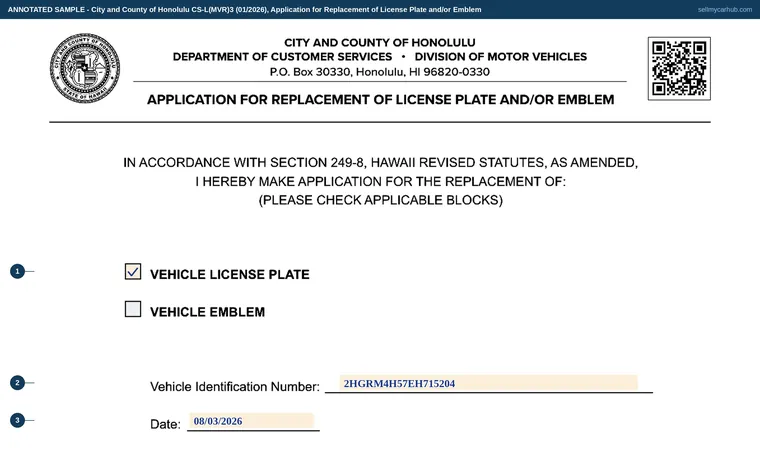 Step 2 · how to fill it in
Our filled-in CS-L(MVR)3 guide
PDF · 2 pages · 390 KB · new tab
See our filled-in example
Step 2 · how to fill it in
Our filled-in CS-L(MVR)3 guide
PDF · 2 pages · 390 KB · new tab
See our filled-in example
Two documents, and they are not the same thing. Take the blank CS-L(MVR)3 from the www4.honolulu.gov copy so you get the revision that is current today, then print our CS-L(MVR)3 guide and keep it beside you while you fill theirs in.
Written against CS-L(MVR)3 (01/2026), issued under Section 249-8, Hawaii Revised Statutes, as amended, cited in the application's own opening line. The plate is part of what the buyer is getting, because Hawaii plates belong to the car. A sale agreed on a vehicle with one plate missing is a sale the buyer will come back about, and this is a short form to file before you advertise rather than a problem to hand over with the keys.
Last updated .