The single most important thing a Georgia seller does after handing over the keys. Georgia publishes no release of liability and no notice of transfer; cancelling the registration is what takes the vehicle off your record, and until it happens the insurance database still expects a live policy on a car you no longer own.
Written against MV-18J (Rev 5/2019), issued under Georgia Code Section 40-2-3, as the form itself quotes it. This is the form Georgia sellers skip, and it is the one that generates a letter three months later. There is no other filing that takes the car off your record.
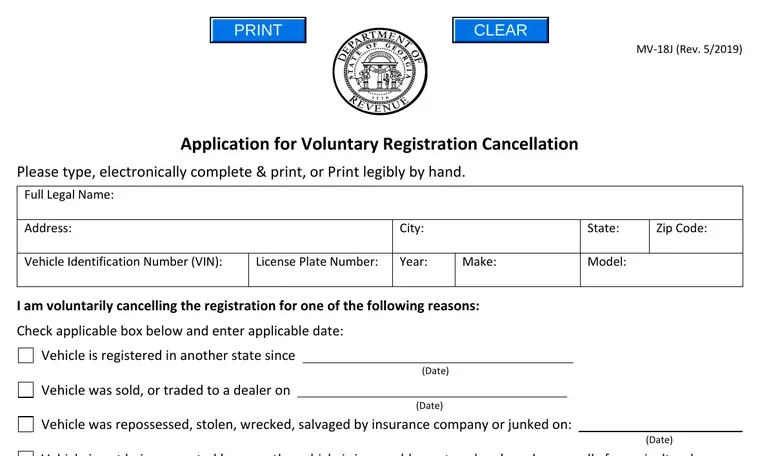
Two documents, and they are not the same thing. Take the blank MV-18J from the dor.georgia.gov copy so you get the revision that is current today.
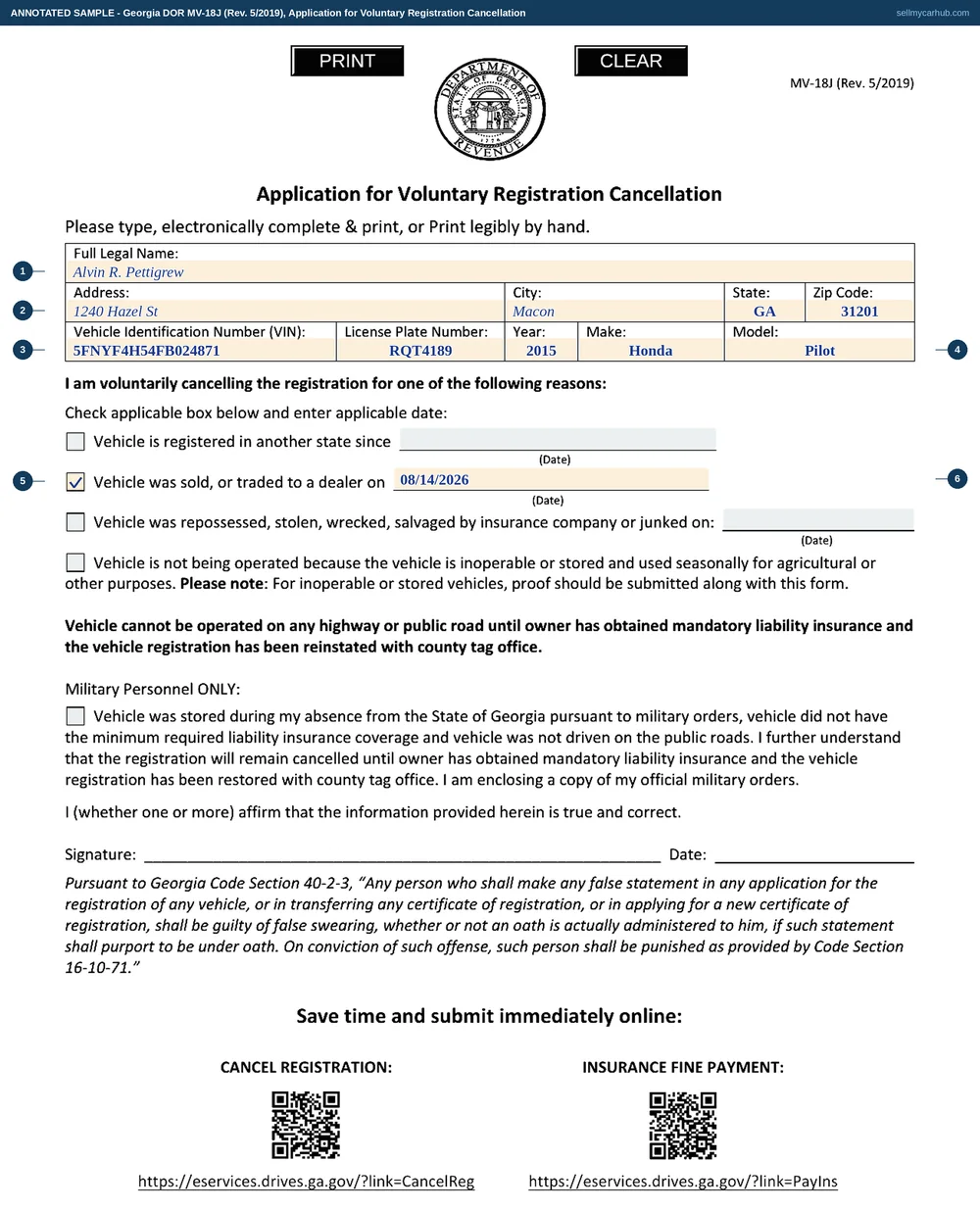
This is the actual MV-18J, rendered from the PDF the Georgia Department of Revenue, Motor Vehicle Division publishes and completed end to end: letterhead, every field, and the blocks at the foot.
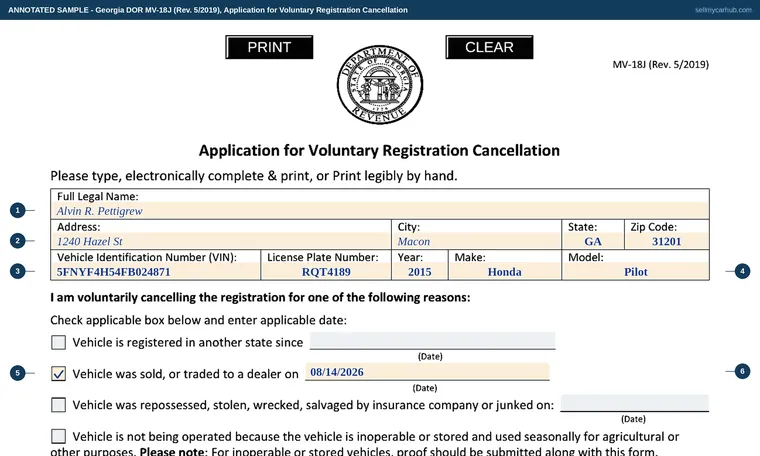
Your name as the registration has it, across the top of the form.
Watch out: As the registration has it, not as you usually write it. This form is matched against a vehicle record, and the record carries the name from the last title application.
Your current address.
Watch out: Where you live now, because the in-person route is the county tag office in the county where you live and that is decided by this line.
The seventeen-character VIN of the car you have sold.
Watch out: Take it off the title rather than the door jamb. The record being cancelled is the one this number points at.
The Georgia tag number, beside the VIN.
Watch out: The plate is still yours after the sale, and this is the number the Department's online cancellation asks for first. Have it to hand before you start either route.
Tick vehicle was sold, or traded to a dealer on. Three other reasons sit below it for a car that left your ownership another way.
Watch out: A private sale and a dealer trade share the same box. The repossessed, stolen, wrecked, salvaged or junked box is a different filing with different consequences - do not use it for an ordinary sale.
The date the car changed hands.
Watch out: This is the date the record is marked with, so it is also the date from which an insurance lapse would be measured. Do not backdate it and do not leave it until you find the paperwork.
| On the form | What to put in it |
|---|---|
| Full legal name and address | Yours, with city, state and ZIP code across the top row. |
| Vehicle identification number, licence plate number, year, make and model | One row, and the plate number matters as much as the VIN - the Department's online route asks for one or the other. |
| The reason, with a date | Four tick boxes, each with its own date field: registered in another state since; sold, or traded to a dealer on; repossessed, stolen, wrecked, salvaged by an insurance company or junked on; or not being operated because it is inoperable or stored and used seasonally. |
| The proof line | For inoperable or stored vehicles, the form says proof should be submitted along with it. A sale needs no attachment. |
| Military personnel only | A separate declaration for a vehicle stored during an absence from Georgia under military orders, uninsured and not driven, with a copy of the official orders enclosed. |
| Signature and date | Yours alone, above the false swearing warning. The buyer has nothing to do with this form. |
Every line here was read off MV-18J (Rev 5/2019) itself — the PDF is here — and off the Georgia Department of Revenue, Motor Vehicle Division pages. This is plain-language help with a form, not legal advice, and where our wording and the agency's differ, theirs governs.
Back to all Georgia seller paperwork, or what selling a car in Georgia involves.