Everything a Georgia private seller signs is on one side of one document. The reverse of the certificate carries the Assignment and Warranty of Title by Owner, and the Department of Revenue publishes a picture of a blank one; the ten markers below are its own blocks, in the order you meet them going down the page.
Last updated .
Your 9 boxes
As a private seller you complete these and nothing else:
There is no blank Georgia title to download and no dealer who can sell you one - the certificate came from the Motor Vehicle Division and yours is the only copy. What the Department does publish is a picture of the reverse and a numbered list of what goes in each block, and that is what this walkthrough is built from.
Read the red banner before the pen touches anything: any alteration voids this title.
The Department's first instruction is not about a box at all: use blue or black ink, and remember that any alteration or erasure may void the title.
The Department's own picture
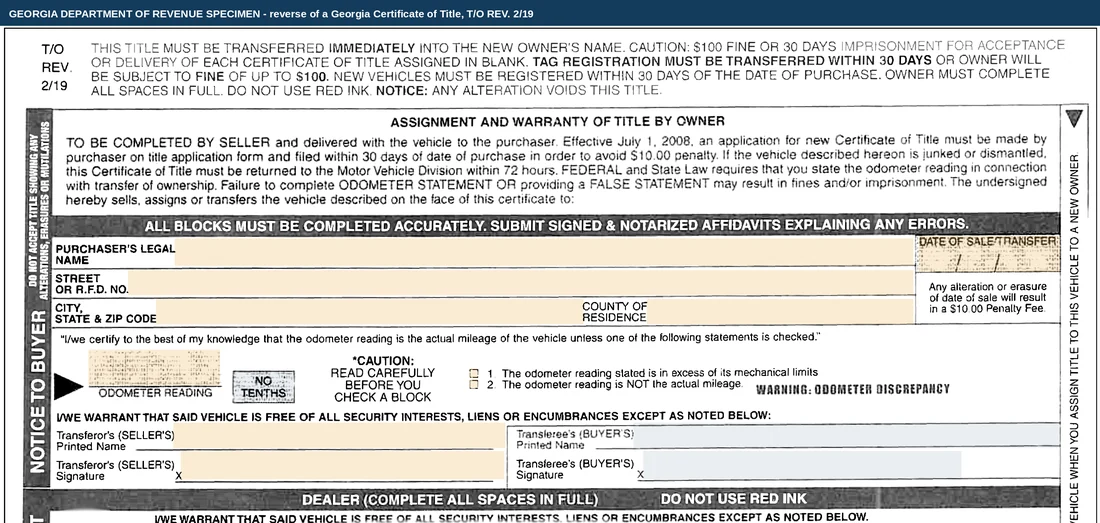
The whole reverse of a Georgia certificate, blank
This is not a drawing and not a photograph of somebody's paperwork. It is the image the Department of Revenue publishes on its own transfer page, headed Complete the back of the Title to Transfer Ownership - a blank certificate at revision T/O REV. 2/19, with no owner, no vehicle and no signature on it. The amber blocks are the ones a private seller completes; everything grey belongs to a dealer, a lender or the buyer.
Amber — you write it, in pen
Grey — not yours to fill
Numbered — matches the steps below
Click or tap the picture to open it full size.
Published by the Department of Revenue at dor.georgia.gov. Two limits worth stating: the Department publishes no picture of the front of a Georgia title anywhere, and this one is cropped a little way into the dealer reassignment block at the foot, so what you see below the red DEALER band is the start of a section a private seller never writes in.
Filled in
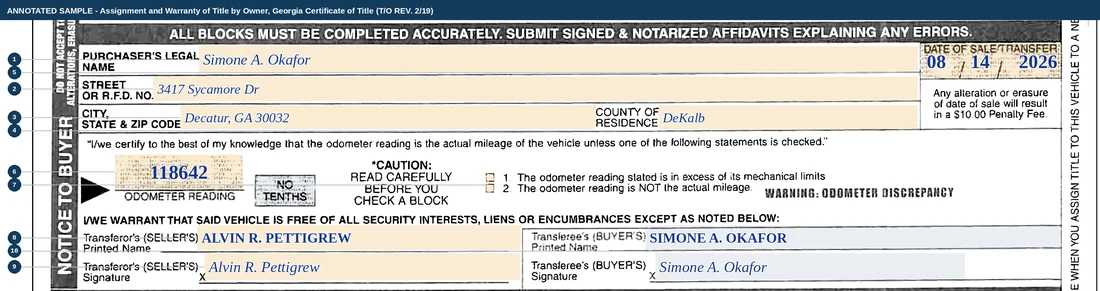
The same block, completed for one private sale
A 2015 Honda Pilot sold in Macon for $12,400 on 14 August 2026, with 118,642 miles on it. Amber is what the seller writes; grey is the buyer's half and the printed NO TENTHS box, which is an instruction rather than somewhere to write. Note what is not ticked: both mileage blocks are empty, because the reading is true and the printed sentence above them already certifies it.
Click or tap the picture to open it full size.
Ten numbered blocks, nine of them yours. The rectangles were found on the Department's image by three detectors - the block's own printed table rules, the pink security tint Georgia prints its three write-in areas on, and the widest run of ink-free columns inside each cell - rather than measured by hand.
Click or tap the picture to open it full size.
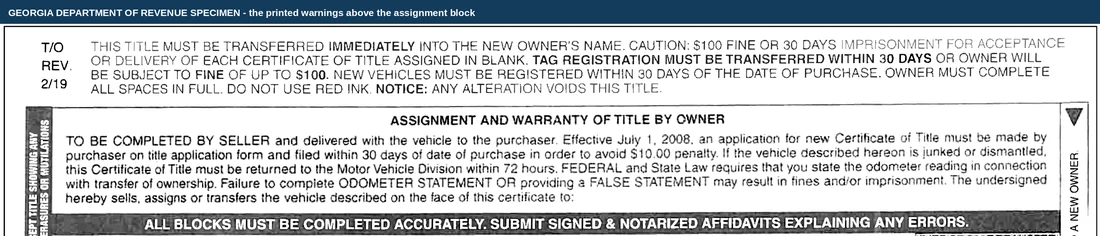
Everything above the first box you fill in. Four separate warnings live here - the blank-assignment offence, the thirty days to transfer the tag registration, the thirty days the purchaser has to apply for a new certificate before a $10.00 penalty, and the 72 hours a certificate has to go back to the Motor Vehicle Division if the vehicle is junked or dismantled.
Step by step
Every box, in the order you meet it
1
You fill this in
Purchaser's legal name
The buyer's full legal name, as it appears on their Georgia driver's licence or identification card. You write this, not them.
Watch out: This is the block the criminal offence attaches to. A certificate handed over with this line empty is assigned in blank, and the Department quotes the misdemeanor penalty for it on three separate pages.
2
You fill this in
Street or R.F.D. no.
The purchaser's current street address - the number and the road, on one line.
Watch out: Current, not the one on an old licence. This is where the Department will send the new certificate, and a title lost in the post is a form of its own.
3
You fill this in
City, state and zip code
The rest of the buyer's address, in the left half of the third row.
Watch out: Two blocks share this row and it is easy to run the address across both. The county has its own block to the right and needs to stay in it.
4
You fill this in
County of residence
The Georgia county the buyer lives in.
Watch out: It decides which tag office the application goes to and which county's emissions rule applies. Ask the buyer rather than guessing from the postcode - metro postcodes cross county lines constantly.
5
You fill this in
Date of sale/transfer
Month, day and year, in the pink block in the top right corner.
Watch out: The certificate prints its own warning under this block: any alteration or erasure of the date of sale will result in a $10.00 penalty fee. Write it once, correctly, on the day it happens.
6
You fill this in
Odometer reading
The mileage at the moment of handover, in complete miles, in the pink block.
Watch out: The small box beside it says NO TENTHS and means it. On a vehicle twenty model years old or older the word exempt goes here instead - there is no tick block for it.
7
You fill this in
The two mileage blocks
Block 1 for a reading in excess of the odometer's mechanical limits, block 2 for a reading that is not the actual mileage. On an ordinary sale both stay empty.
Watch out: The printed sentence above them certifies the reading as actual mileage unless one is checked, so an empty pair is a statement rather than an omission. Block 1 means the odometer rolled past 99,999 on five digits or 999,999 on six; block 2 means it is broken, replaced or wrong.
8
You fill this in
Transferor's printed name
Your name, printed, exactly as the front of the certificate shows it.
Watch out: Printed name and signature are two separate blocks and the Department asks for both. If the certificate names two owners, each of them prints here and signs below.
9
You fill this in
Transferor's signature
Your signature, after the printed X. Blue or black ink.
Watch out: A company seller signs in the company's name and the authorised agent adds their position after the signature. Nobody notarises this - and nobody can sign it for you without a notarised Form T-8.
10
The buyer fills this in
Transferee's printed name and signature
The buyer prints and signs in the right-hand column, which is how they acknowledge the mileage you declared.
Watch out: Watch them do it before the car leaves. An unsigned buyer block sends the application back from the tag office, and by then the car is a hundred miles away.
Before the pen
Before you drive to the tag office
Six habits, and the first one is an ink colour the certificate names twice in capitals.
Blue or black ink
The Department's instruction opens with it and the certificate says DO NOT USE RED INK twice on the same side. Red is the colour the form itself is printed in, which is exactly why.
Nothing crossed out
Alteration voids the certificate rather than correcting it. If a block goes wrong, stop - the way back is a notarised affidavit, not a second attempt in the same box.
Complete miles
The odometer block carries a printed NO TENTHS box next to it. Round nothing, add nothing after a decimal point.
The buyer's name before anything else
A certificate delivered with the purchaser line empty is an offence for both parties, and the Department prints the code section rather than paraphrasing it.
Printed name and signature both
Four blocks, not two. Each party prints in one and signs in the other, and a missing printed name is a common reason a tag office hands the package back.
A copy for you
Photograph both sides before it leaves your hands. The Department asks a seller to keep a copy of the transfer of ownership, and it is the only evidence you will have of what you handed over.
The ink rule is the Department of Revenue's own: “Use blue or black ink to complete this form. Any alteration or erasure may void the title. Alterations in the purchase date may result in a $10 penalty fee.”
— Georgia Department of Revenue, Transfer Vehicle Titled in Georgia.
Check your source
What Georgians hear about tag offices that is not true
Three things repeated confidently about selling a car in Georgia. Each one costs a seller money, a trip to a county tag office, or a letter from the insurance database, and each correction below links the Department page it came from.
"Write a low price on the bill of sale and the buyer pays less tax."
Not in Georgia. The Title Ad Valorem Tax on a used vehicle is calculated from the value in the state motor vehicle assessment manual, not from what the buyer handed you - the Department's own wording is that the fair market value is the value identified in the state motor vehicle assessment manual, averaged from current wholesale and retail values. It adds that the trade-in reduction applies when the sale was made by a dealer but not when the sale was made by a private individual. A fictional price on the bill of sale changes nothing except the offence you have both committed.
"Leave the plate on the car - the buyer needs it to drive home."
That is the rule in California and the opposite of the rule here. The Department's page for sellers lists the vehicle's licence plates among the things to keep, because these do not transfer with the vehicle to the new owner. It also warns that it is illegal to remove or transfer a plate from the vehicle it was issued for, so the plate you keep goes to a county tag office before it goes on your next car, not straight from one bumper to the other.
"If a suspension notice turns up after you have sold it, you have to sort it out."
The Department says the opposite, in as many words. Its page on the pending suspension letter asks one question - do you still own the car? - and answers no with: you do not need to do anything, please ignore the notice. The seller's page repeats it. What you should have done is cancel the registration on the day of the sale, which is what stops the letter being generated at all.
Two printed names and two signatures, in four separate blocks on the reverse of one document:
Transferor - you
Print your name and sign it. Both blocks, not one: the printed name is a separate line from the signature and the Department asks for both.
Two owners on the certificate
If jointly owned, each seller must print and sign. Neither one can sign for the other without a notarised Form T-8.
A company as the seller
The company's printed name goes on as well as the printed name and signature of its authorised agent, and the agent writes their position with the company after the signature.
Transferee - the buyer
Prints and signs under Buyer, which is how they acknowledge the mileage you declared. If two people are buying, both print and both sign.
Nobody notarises anything
Not the assignment, not the bill of sale. Notarisation in the Georgia set belongs to the affidavits - correction, inheritance, power of attorney, odometer discrepancy - and to nothing a straightforward sale touches.
A lienholder still on the record
Signs the release printed on the face of the certificate. Where that cannot happen, a Form T-4 executed by the lender before a notary does the same job.
Once it is signed
Dating the assignment starts two clocks that have nothing to do with each other. The buyer's runs at the tag office; yours runs on the insurance database, and it is the one nobody warns you about.