The form an insurer or an auction files when the owner never sent the title back. Delaware puts the restriction in the file name and repeats it on the affidavit: this form is only to be used by Insurers or Auctions applying for a Salvage Certificate to certify that a valid Certificate of Title for the vehicle acquired by the applicant is not available. A private owner keeping a written-off car does not file it - they go to a counter with the certificate, the insurer’s letter and the plate. It is on this list because it is the only thing a search for a Delaware salvage certificate turns up, and because the two certified letters it requires are letters that land on a seller’s doormat.
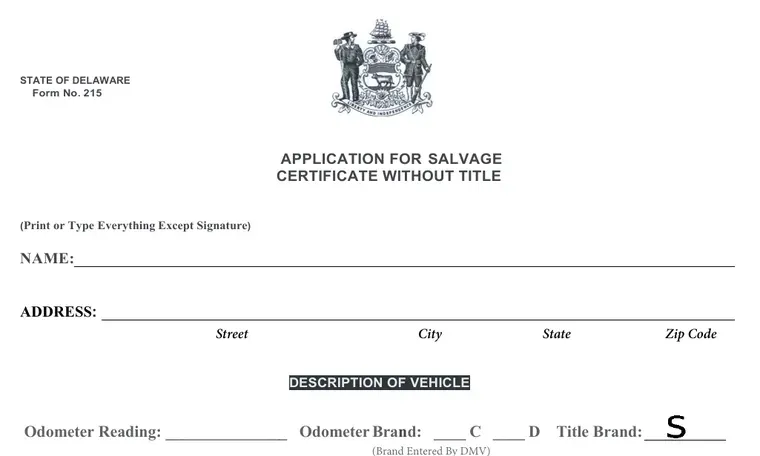
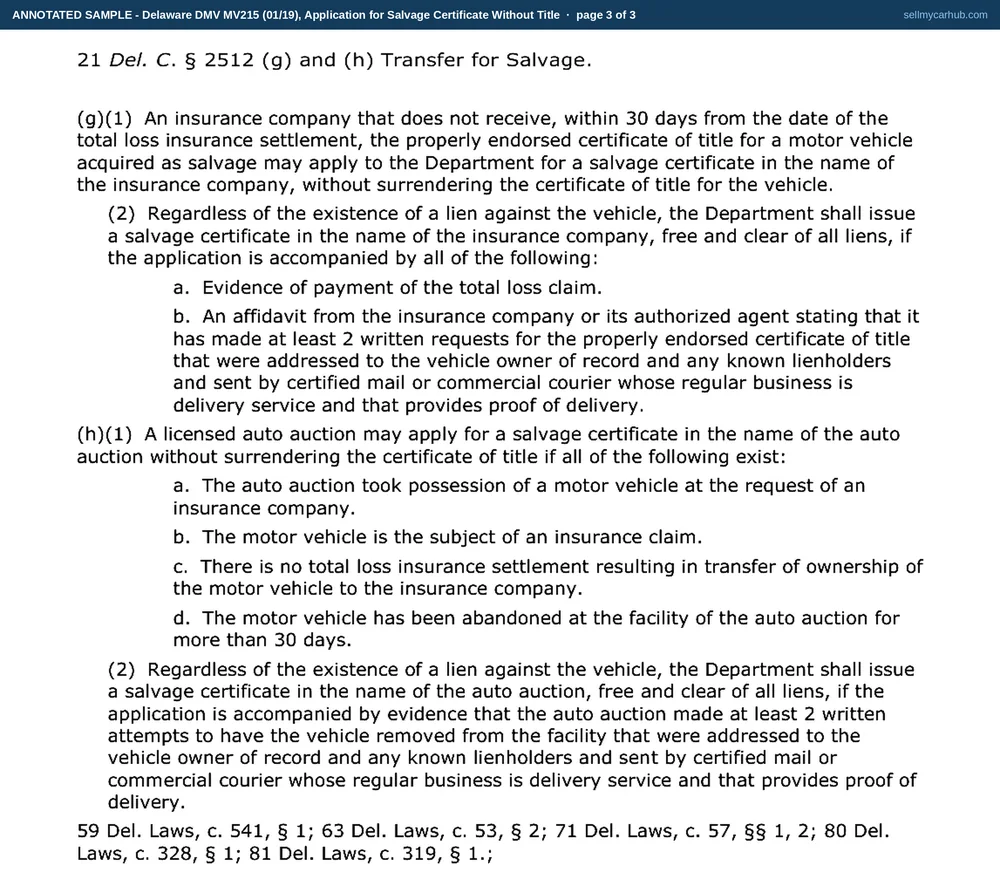
Written against MV215 (01/19), issued under 21 Del. C. s. 2512(g) and (h), reproduced in full on the form’s own last page. If a certified letter arrives asking you to send in a title for a car your insurer already paid you for, that is this form being prepared. Two of them, ignored, are enough for the Division to issue a salvage certificate in the insurer's name without your signature on anything - and the second half of that sentence is the part worth reading twice.
Two documents, and they are not the same thing. Take the blank MV215 from the dmv.de.gov copy so you get the revision that is current today, then print our MV215 guide and keep it beside you while you fill theirs in.
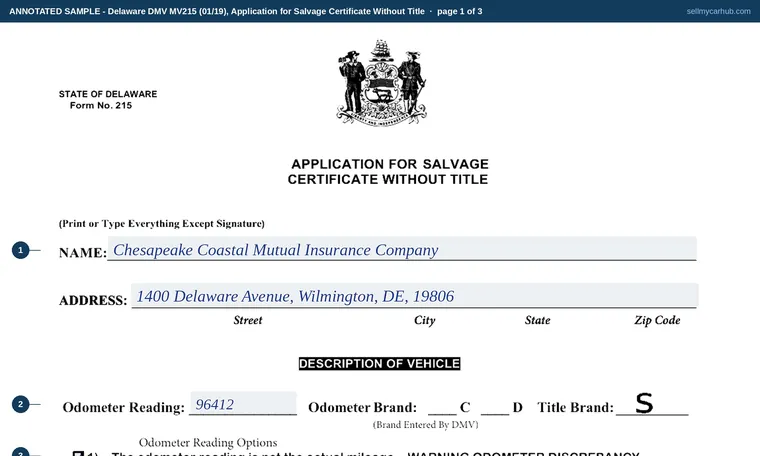
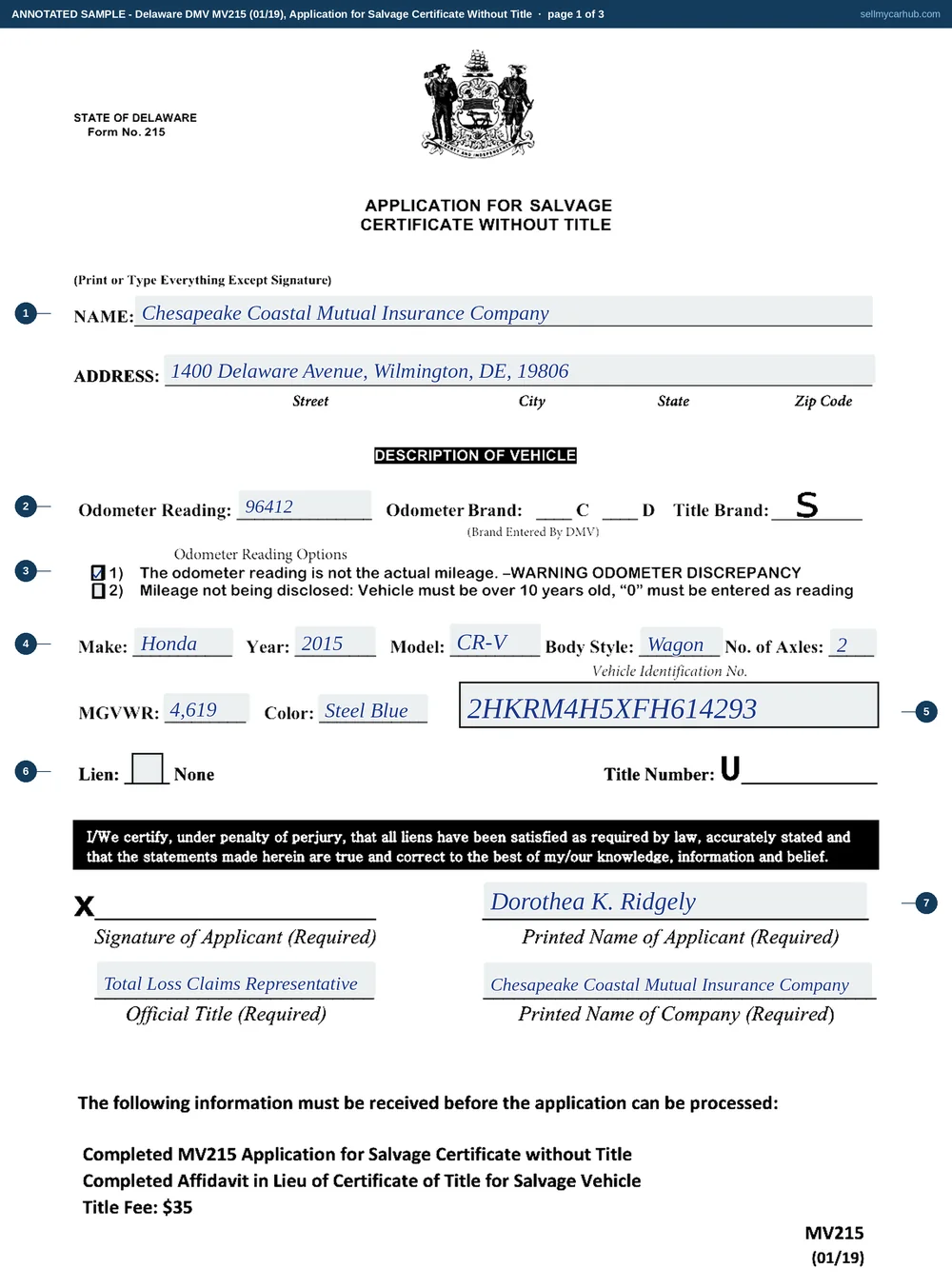
This is all 3 pages of the actual MV215, rendered from the PDF the Delaware Division of Motor Vehicles publishes and completed end to end: letterhead, every field, and the blocks at the foot.
The applicant, with street, city, state and zip labelled underneath the box.
Watch out: On a total loss this is the insurer that paid the claim, not the person who used to drive the car.
The reading, in its own box, with the brand columns beside it marked Brand Entered By DMV.
Watch out: A wrecked car still needs a disclosure. The brand columns are not the applicant's to complete - the Division enters those.
1) the odometer reading is not the actual mileage. 2) mileage not being disclosed - and for that one the vehicle must be over 10 years old and a zero has to be entered as the reading.
Watch out: These are not the two boxes printed on the back of a certificate. Option 2 has an age condition attached to it that the certificate's boxes do not.
The description row.
Watch out: Axles is on this form because Delaware salvages trailers and commercial vehicles on the same page as cars.
The second description row, with the VIN in the wide box on the right.
Watch out: The VIN is what the salvage certificate attaches to, and what the State Police Auto Theft Unit will check against the wreck if it is ever rebuilt.
A lien box with None printed beside it, and a title number box pre-printed with a U.
Watch out: The statute is what makes this box interesting: regardless of the existence of a lien, the Department issues the salvage certificate free and clear of all liens.
Four boxes at the foot of page one, all marked Required.
Watch out: Two of them ask what your job is and who you work for. A private owner has neither to write.
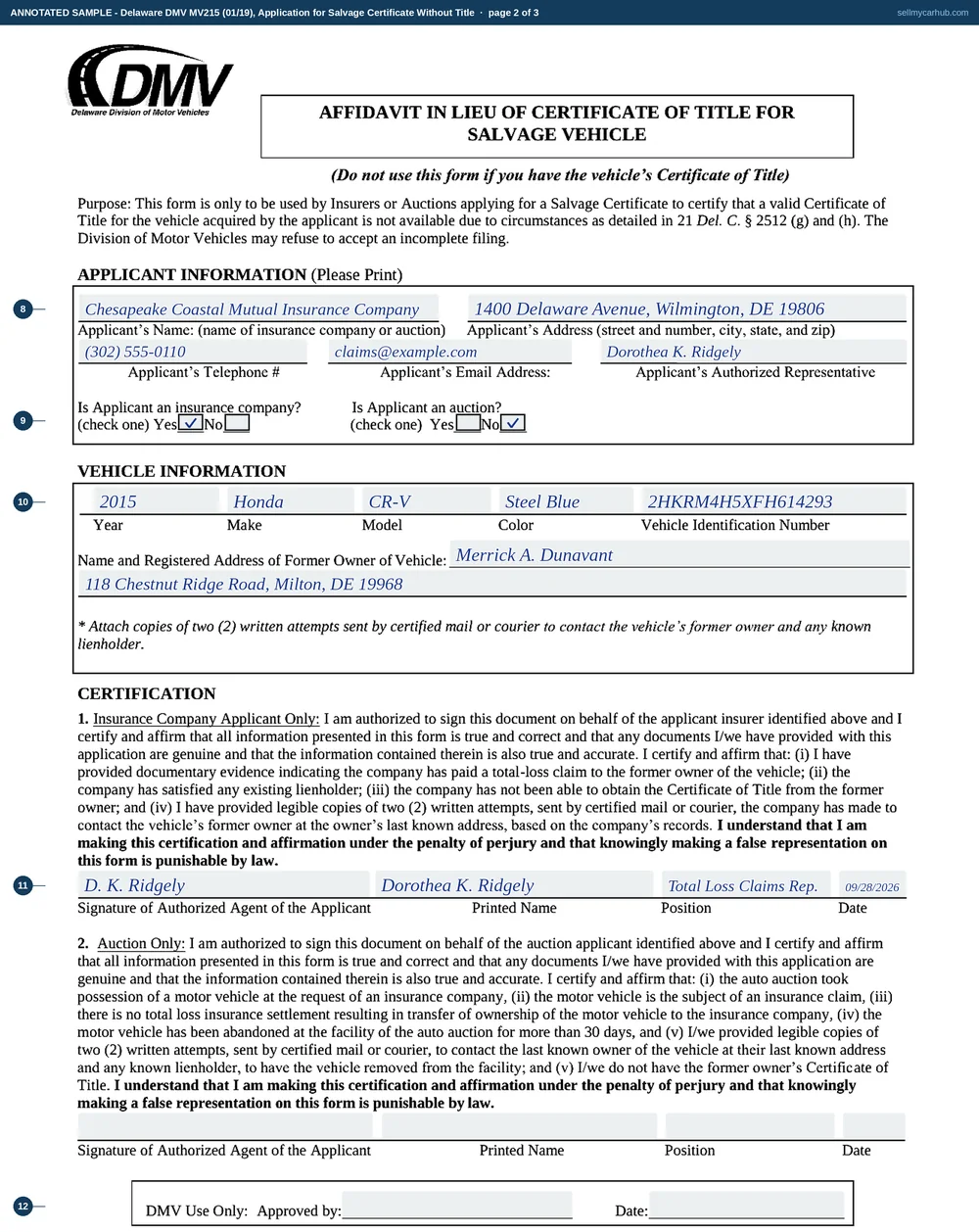
The affidavit's own header block: applicant's name - the label says name of insurance company or auction - address, telephone, email and authorised representative.
Watch out: Read the line above it before anything else: do not use this form if you have the vehicle's Certificate of Title.
Two check-one pairs.
Watch out: This is the restriction, printed as a question. There is no box for an individual owner.
Year, make, model, colour, VIN, then the name and registered address of the former owner over two lines.
Watch out: This is where a private owner appears on the form: as a name, written by somebody else, on the document that removes their title.
Paragraph 1 for an insurer, paragraph 2 for an auction, each signed with a printed name, a position and a date.
Watch out: Both certifications turn on the same evidence: legible copies of two written attempts, sent by certified mail or courier, to reach the former owner and any known lienholder.
Approved by, and a date, at the foot of the affidavit.
Watch out: Untouchable, like every DMV-use strip in the Delaware set.
| On the form | What to put in it |
|---|---|
| Name and Address, page one | The applicant, with the address split into street, city, state and zip columns under the box. Print or type everything except the signature - the instruction is at the top of the page. |
| Odometer Reading, Odometer Brand and Title Brand | The reading in its own box. The brand columns beside it are marked Brand Entered By DMV, and the title brand box is pre-printed with the letter the Division uses for a salvage record. |
| Odometer Reading Options | Two, and they are not the two on the back of a certificate. Option 1: the odometer reading is not the actual mileage - WARNING ODOMETER DISCREPANCY. Option 2: mileage not being disclosed, for which the vehicle must be over 10 years old and a zero must be entered as the reading. |
| Description of vehicle | Make, year, model, body style, number of axles, then MGVWR, colour and the vehicle identification number. |
| Lien and Title Number | A lien box with the word None printed beside it, and a title number box pre-printed with the U the Division uses for a record with no surrendered certificate behind it. |
| Signature of Applicant, Printed Name, Official Title, Printed Name of Company | Four boxes, all four marked Required. Two of them ask the signer for a job and an employer - which is the plainest statement on the page about who this form expects. |
| The affidavit, page two | A separate document with its own heading: Affidavit in Lieu of Certificate of Title for Salvage Vehicle, and under it, in brackets, do not use this form if you have the vehicle's Certificate of Title. |
| Applicant information | Applicant's name - the label says name of insurance company or auction - then address, telephone, email and authorised representative. |
| Is Applicant an insurance company? Is Applicant an auction? | Two yes/no pairs, check one each. There is no third category, and the certification you sign afterwards depends on which one you ticked. |
| Vehicle information and former owner | Year, make, model, colour and VIN, then the name and registered address of the former owner of the vehicle over two lines. |
| Certification 1, Insurance Company Applicant Only | Four sworn statements: that documentary evidence shows the company paid a total-loss claim to the former owner; that it has satisfied any existing lienholder; that it has not been able to obtain the certificate of title from the former owner; and that it has provided legible copies of two written attempts, sent by certified mail or courier, to contact the former owner at their last known address. |
| Certification 2, Auction Only | Five statements instead: that the auction took possession at the request of an insurance company; that the vehicle is the subject of an insurance claim; that there is no total loss insurance settlement transferring ownership to the insurer; that the vehicle has been abandoned at the auction's facility for more than 30 days; and that two written attempts were sent to have it removed. |
| Two signature rows | Signature of Authorized Agent of the Applicant, printed name, position and date - once under each certification. Position, again. |
| DMV Use Only: Approved by, Date | The Division's strip at the foot of the affidavit. |
| Page three | Not a form at all. 21 Del. C. s. 2512(g) and (h) reproduced in full, which is the law the whole filing runs on. |
Every line here was read off MV215 (01/19) itself — the PDF is here — and off the Delaware Division of Motor Vehicles pages. This is plain-language help with a form, not legal advice, and where our wording and the agency's differ, theirs governs.
Back to all Delaware seller paperwork, or what selling a car in Delaware involves.