Sell My Car Hub

How to fill out Connecticut R-377

Whose form is it? Not yours - and it is on this page for exactly that reason. Search for a Connecticut plate return form and this is what comes back, because that is what the department called it. Read past the title and the subtitle says LAW ENFORCEMENT AGENCY PLATE RETURN CONTROL SHEET, the header asks for a department or state police troop and the twenty rows want a case reference and a reason such as misuse or stolen. A private seller returning plates does not use this and does not need to.
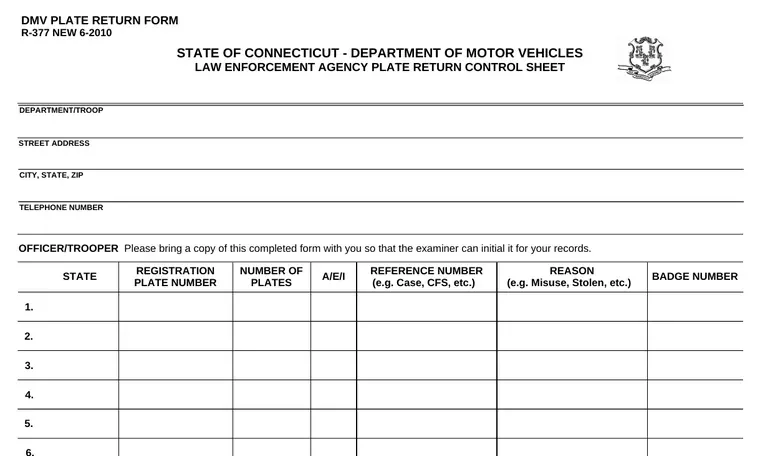
Written against R-377 (New 6-2010), issued under A Department of Motor Vehicles control sheet for law enforcement agencies returning plates seized or recovered in the course of duty. The name on this form is the problem, not the form. If you have arrived here looking for how to hand Connecticut plates back after a sale, the page you want is the registration termination - online, or on an E-159 - and this sheet has no part in it.

Two documents, and they are not the same thing. Take the blank R-377 from the portal.ct.gov copy so you get the revision that is current today.

Filled in

What a completed one looks like

This is the actual R-377, rendered from the PDF the Connecticut Department of Motor Vehicles publishes and completed end to end: letterhead, every field, and the blocks at the foot.

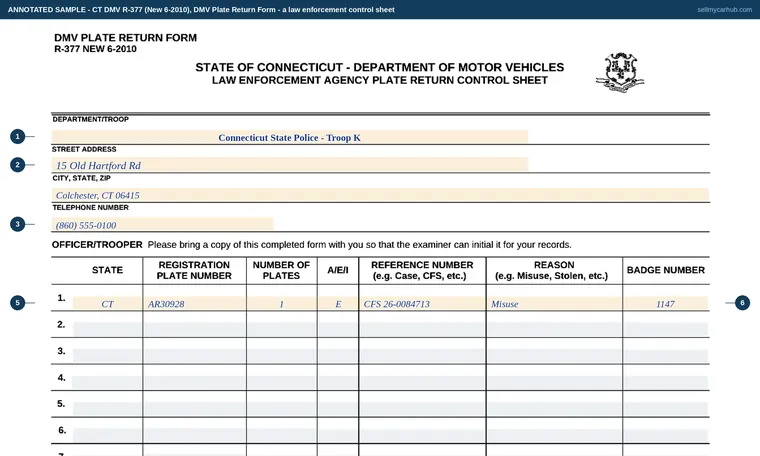
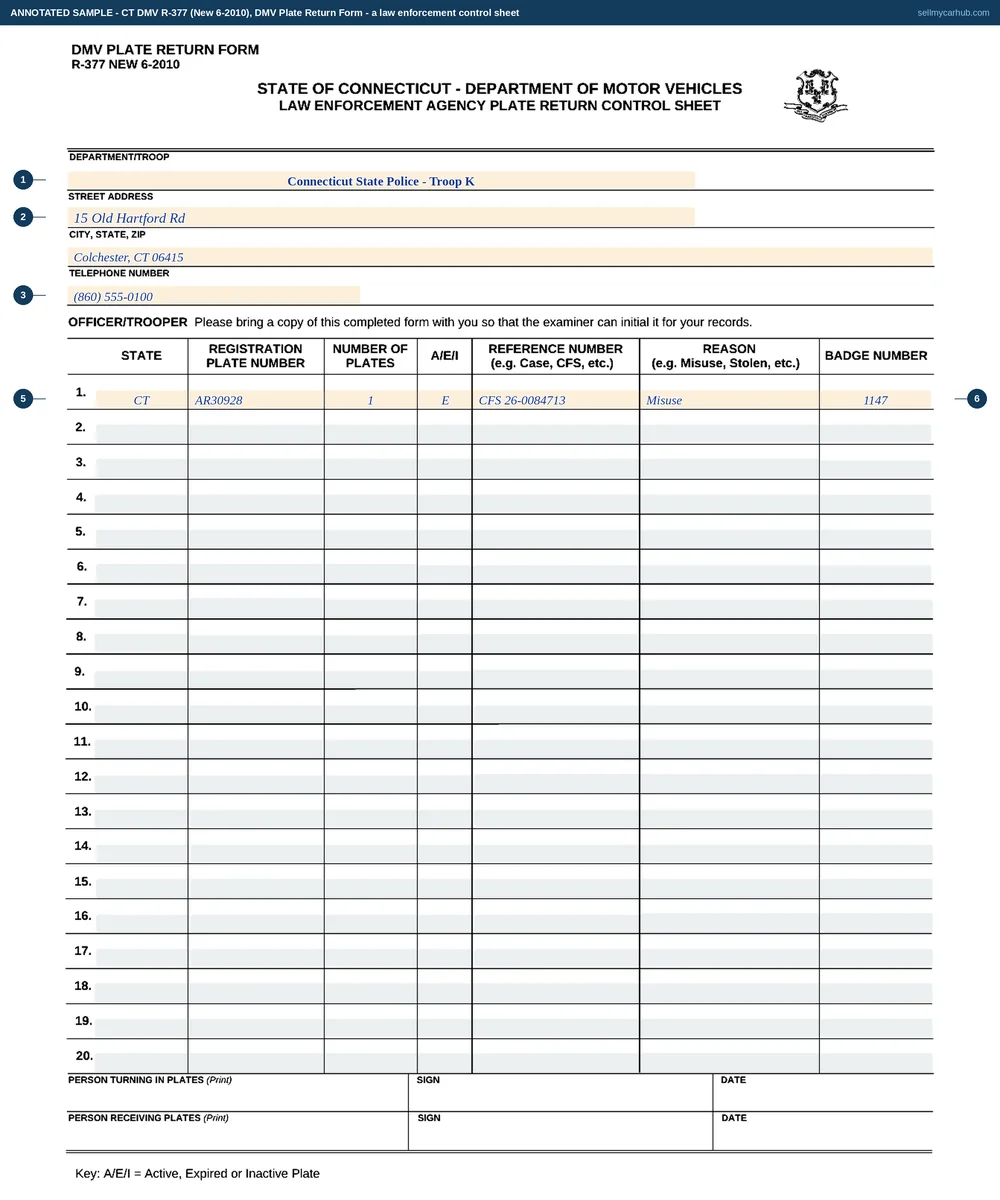
A completed Connecticut DMV Plate Return Form, R-377, shown as a law enforcement control sheet. The department and troop line reads Connecticut State Police Troop K with an address in Colchester and a telephone number. The first row of the twenty-row grid is filled in with the state CT, a registration plate number, one plate, the letter E for expired, a case reference number, the reason Misuse, and a badge number. The remaining nineteen rows and the two signature rows at the foot are shaded.
Filled in the way it is actually used - by an agency, with a case reference and a badge number. Everything shaded on this sheet is shaded for the same reason: none of it belongs to a private seller, including the row that is filled in. Every name and number here is invented for the sample.
Field by field

Every line, in the order you meet it

  1. 1
    Somebody else fills this in

    Department/Troop

    The law enforcement agency returning the plates. The first box on the form and the first sign that it is not a seller's document.

    Watch out: If you cannot fill this box in truthfully, you are on the wrong form. There is no equivalent line for a member of the public.

  2. 2
    Somebody else fills this in

    Street address, city, state and ZIP

    The agency's address, over two lines beneath the department name.

    Watch out: The address block wants a station, not a home. It is where the initialled copy is filed.

  3. 3
    Somebody else fills this in

    Telephone Number

    An agency contact number.

    Watch out: Still not yours. Three boxes in and the form has not asked about a vehicle at all.

  4. 4
    Somebody else fills this in

    Row 1: State and Registration Plate Number

    The first two of seven columns. Plates recovered in Connecticut are not always Connecticut plates.

    Watch out: There is no VIN column anywhere on the sheet. It tracks plates, not vehicles, which is the clearest sign of what it is for.

  5. 5
    Somebody else fills this in

    Row 1: Number of Plates and A/E/I

    How many plates, and whether the plate is Active, Expired or Inactive - a key the department prints at the foot of the sheet.

    Watch out: A seller's plate after a sale is none of these in any sense the department means here, because the registration behind it has expired by operation of law rather than by time.

  6. 6
    Somebody else fills this in

    Row 1: Reference Number, Reason and Badge Number

    A case or call-for-service reference, a reason such as misuse or stolen, and the officer's badge number.

    Watch out: The last three columns are the ones that settle it. What a private seller does instead is on the E-159, and the tick there is simply SOLD.

At a glance

What goes where

On the formWhat to put in it
Department/TroopThe agency returning the plates. A municipal police department or a state police troop number.
Street Address, City, State, ZIPThe agency's address, over two lines.
Telephone NumberA contact for the agency rather than for an individual.
The grid, twenty numbered rows of seven columnsState, Registration Plate Number, Number of Plates, A/E/I, Reference Number, Reason, Badge Number.
StatePlates recovered in Connecticut are not always Connecticut plates, which is why the first column exists.
A/E/IExplained in the key at the foot of the sheet: Active, Expired or Inactive Plate.
Reference NumberThe form's own example: e.g. Case, CFS, etc. A case number or a call-for-service reference.
ReasonAgain with the department's own examples: e.g. Misuse, Stolen, etc.
Badge NumberThe officer's, in the last column of each row.
Person Turning In Plates, and Person Receiving PlatesTwo rows at the foot, each with a printed name, a signature and a date.
The instruction to the officerOfficer/Trooper Please bring a copy of this completed form with you so that the examiner can initial it for your records.

What gets this one rejected

Rules that decide whether it is accepted

Every line here was read off R-377 (New 6-2010) itself — the PDF is here — and off the Connecticut Department of Motor Vehicles pages. This is plain-language help with a form, not legal advice, and where our wording and the agency's differ, theirs governs.

Back to all Connecticut seller paperwork, or what selling a car in Connecticut involves.

Want the paperwork handled instead?

Get My Instant Offer → Online · about 2 minutes · free

Or send the details — we'll come to you

Plates in a drawer, registration you are not sure you cancelled, and a car still sitting outside? Tell us where it is and we will price a collection.

or call/text (877) 405-1808