Sell My Car Hub

How to fill out California REG 166

The lender's signed statement that the loan is paid and it no longer has an interest in the car. You use it when the lienholder is still printed on the face of the title and the certificate itself cannot carry the release - typically because the title is missing, or because the lender has closed, merged or been bought.
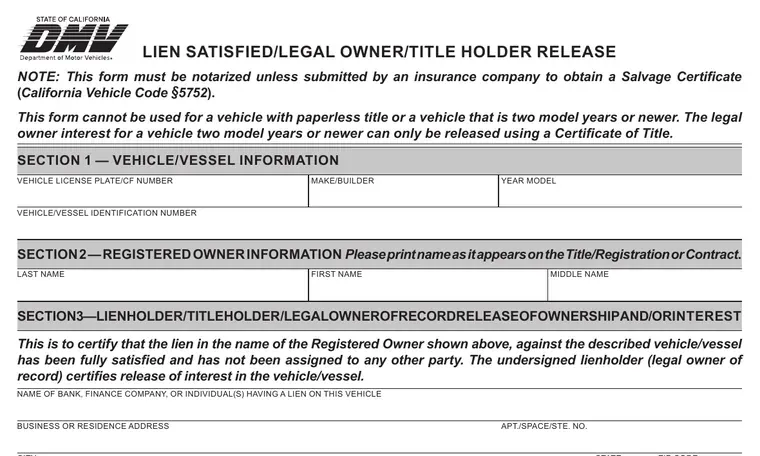
Written against REG 166 (Rev 12/2016), issued under California Vehicle Code 5752. Ask the lender for this the moment the loan clears, not the week you list the car. Getting a release notarised out of a bank's back office takes days, and the buyer is standing in your driveway.

Two documents, and they are not the same thing. Take the blank REG 166 from the dmv.ca.gov copy so you get the revision that is current today, then print our REG 166 guide and keep it beside you while you fill theirs in.

Filled in

What a completed one looks like

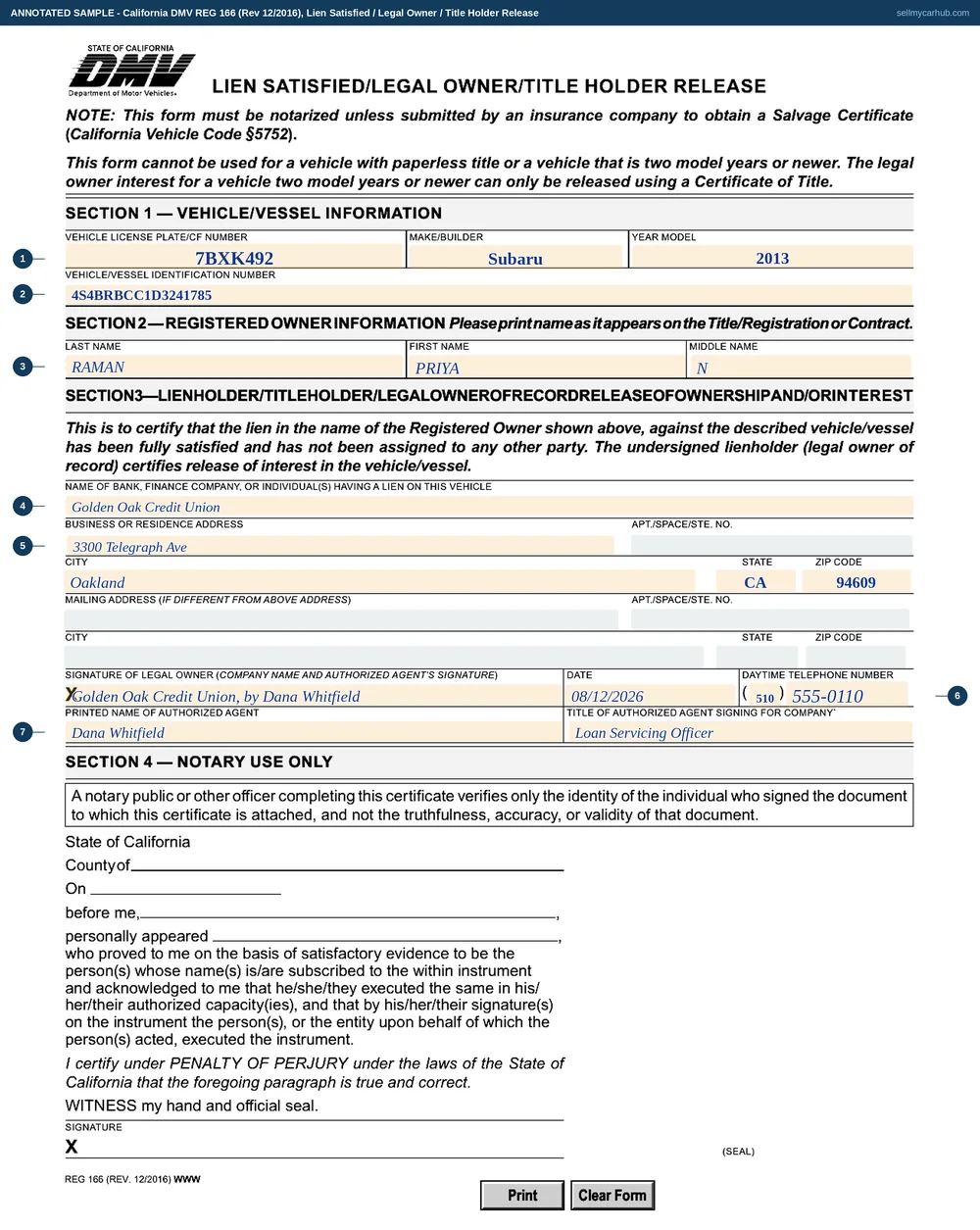
This is the actual REG 166, rendered from the PDF the California Department of Motor Vehicles publishes and completed end to end: letterhead, every field, and the blocks at the foot.

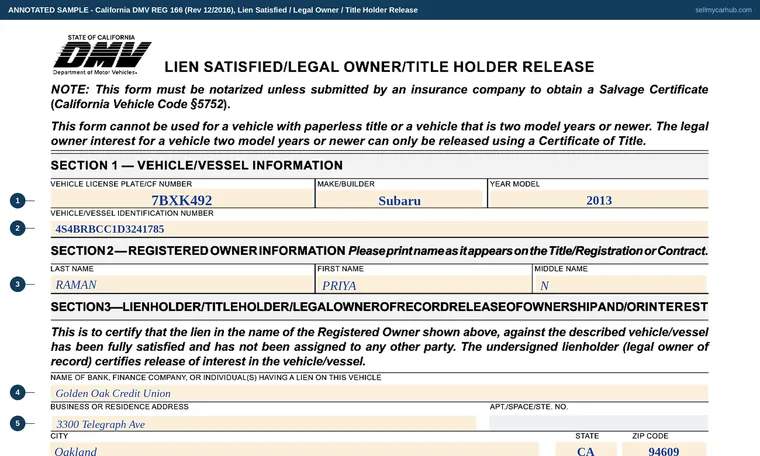
The California REG 166 lien release filled in: a 2013 Subaru Outback, registered owner Priya Raman, Golden Oak Credit Union named as the lienholder with its Oakland address, and the release signed in the company's name by loan servicing officer Dana Whitfield.
The actual REG 166. Note the signature format the form demands of a company: the company name and an authorised agent's countersignature together, with the agent's printed name and job title underneath. The notary block below this is not optional.
Field by field

Every line, in the order you meet it

  1. 1
    The lienholder fills this in

    Section 1, vehicle information

    Plate or CF number, make, year model, and the full VIN.

    Watch out: Four items, all four required. A release that does not identify the car releases nothing.

  2. 2
    The lienholder fills this in

    Vehicle identification number

    The VIN, on its own line beneath the rest of the vehicle strip.

    Watch out: Check it against the title rather than the loan statement - lenders transpose VINs too.

  3. 3
    You fill this in

    Section 2, registered owner

    Last, first and middle name, printed as they appear on the title, registration or contract.

    Watch out: That is not always how your name appears on your licence. The form asks for the version on the paperwork, and the mismatch is a real rejection.

  4. 4
    The lienholder fills this in

    Name of the lienholder

    The bank, finance company or individual holding the lien.

    Watch out: The certification above it says the lien has been fully satisfied and has not been assigned to any other party. A lender that sold your loan on cannot sign this.

  5. 5
    The lienholder fills this in

    Lienholder address

    Business or residence address, and a separate mailing address if they differ.

    Watch out: Leave the mailing block empty rather than repeating the address - the field is there for a genuine difference.

  6. 6
    The lienholder fills this in

    Date and telephone number

    The date the lender signs, with an area code and number.

    Watch out: Get this moving the moment the loan clears. Prising a notarised release out of a bank's back office takes days, and the buyer is in your driveway now.

  7. 7
    The lienholder fills this in

    Signature of legal owner

    For a company, the company name plus an authorised agent's signature, with the agent's printed name and job title beneath.

    Watch out: Then it goes to a notary. The note at the top of the form makes notarisation unconditional except for an insurance company obtaining a salvage certificate.

At a glance

What goes where

On the formWhat to put in it
Section 1, vehicle informationPlate or CF number, make, year model and the full VIN. Four items, all four required - a release that does not identify the car releases nothing.
Section 2, registered ownerLast, first, middle. The instruction says to print the name as it appears on the title, registration or contract, which is not always how it appears on your licence.
Section 3, the certificationPre-printed, and worth reading before anyone signs: it certifies the lien has been fully satisfied and has not been assigned to any other party. A lender that has sold the loan on cannot sign this.
Name and address of the lienholderThe bank, finance company or individual. Both a business or residence address and a separate mailing address if they differ.
Signature of legal ownerFor a company this is the company name plus an authorised agent's signature, with the agent's printed name and job title on the line below. A bare signature with no company name attached is not a company release.
Section 4, notaryRequired. A California notary acknowledgement, completed on the form itself.

What gets this one rejected

Every line here was read off REG 166 (Rev 12/2016) itself — the PDF is here — and off the California Department of Motor Vehicles pages. This is plain-language help with a form, not legal advice, and where our wording and the agency's differ, theirs governs.

Back to all California seller paperwork, or what selling a car in California involves.

Want the paperwork handled instead?

Get My Instant Offer → Online · about 2 minutes · free

Or send the details — we'll come to you

A lender still on the title stops most private buyers dead. It does not stop us - send us the details and we will work out what the lienholder has to sign.

or call/text (877) 405-1808