Arkansas keeps the whole transfer on the back of the certificate: DFA's instruction to a seller is to print the buyer's name in the assignment section on the back of a certificate of title, and then for seller and buyer to sign and print their names in the appropriate sections. The steps below follow that assignment in the order its blocks come up, using the wording Arkansas prints on the three forms that reproduce pieces of it - the 10-313 bill of sale, the MV 100-03 suspense authorization and TIMA Form #2.
Last updated .
Your 9 boxes
As a private seller you complete these and nothing else:
You cannot download an Arkansas certificate of title to practise on - the certificate is issued paper, and DFA publishes no specimen of it anywhere this site could find. What you can download is the 10-313, which carries the two things the assignment will ask you to get right - the price and the odometer sentence - and rehearsing them on the bill of sale first is the cheapest mistake-proofing Arkansas offers.
Scratch out a name or write over a figure and the assignment stops being acceptable - Arkansas's cure is a sworn affidavit, not a fresh pen stroke.
Every block name below is transcribed from a DFA source: the assignment-section instruction on its recent-changes page, the odometer sentence and price blocks of the 10-313, the title-number and disclosure wording of MV 100-03, the mileage-certification checkboxes of TIMA Form #2, and A.C.A. § 27-14-902(d)'s requirement of an assignment and warranty of title endorsed upon the certificate.
Drawn, and it says so
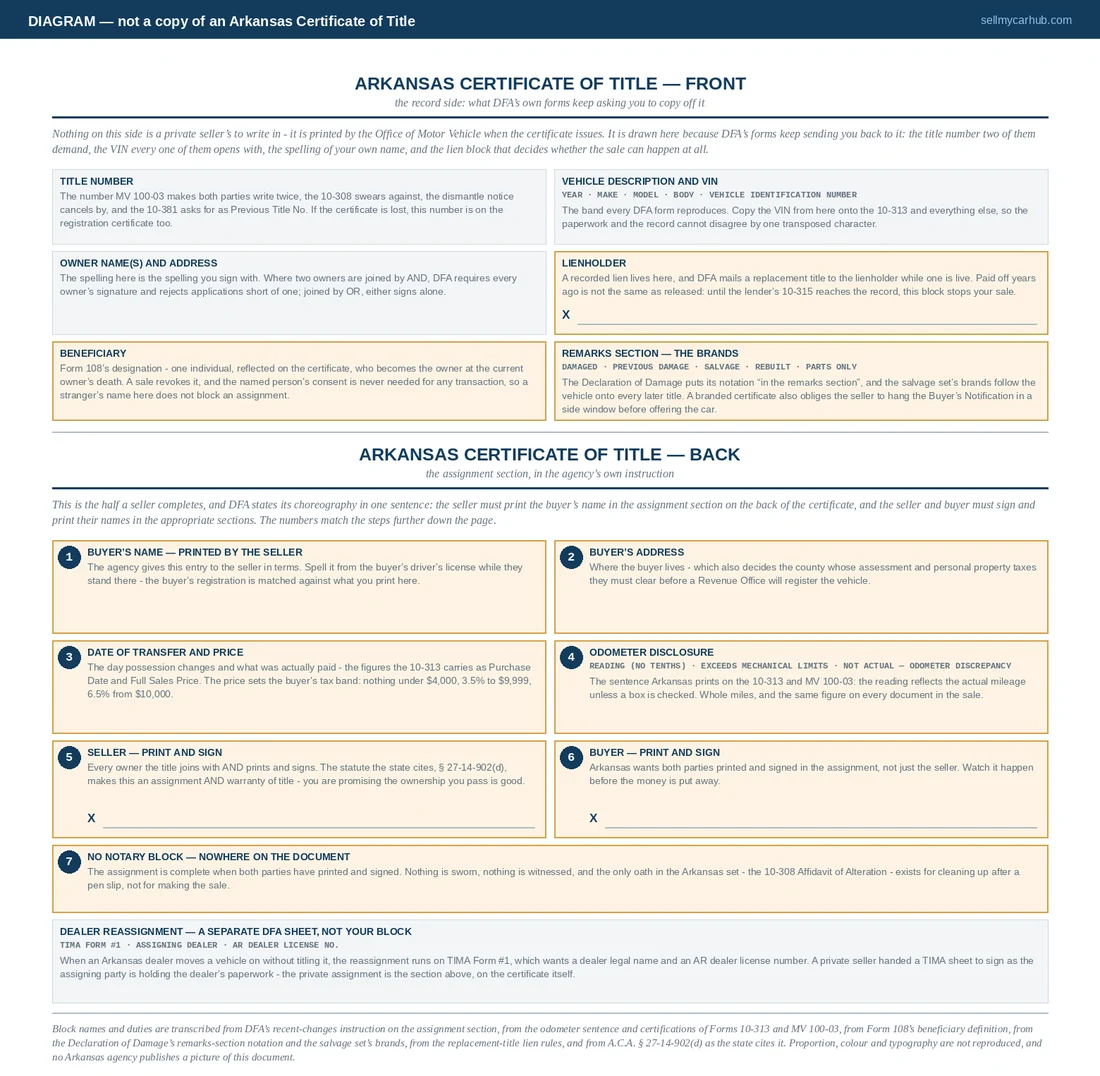
What an Arkansas certificate of title carries, front and back
This is a diagram and it is marked as one. DFA publishes no picture of an Arkansas certificate of title - not in its WordPress media library, searched through the site's own API on sample, specimen, conforming, exhibit and title; not on any motor-vehicle page read for this state, whose only images are the agency seal and icons; not in the one document matching manual, a budget analysis; and not on the two forms that reproduce the assignment machinery in print. Rather than show somebody's real title, the blocks are drawn from what DFA's own forms and instructions say the certificate carries.
Amber — you write it, in pen
Grey — not yours to fill
Numbered 1 to 7 — the assignment on the back, matching the steps below
Click or tap the picture to open it full size.
Not a copy of an Arkansas title, and not a picture of anyone's. The assignment section on the back and its two-signature rule are DFA's recent-changes instruction; the assignment and warranty of title is A.C.A. § 27-14-902(d) as the state cites it; the odometer sentence and its two checkboxes are the 10-313's and TIMA Form #2's own wording; the remarks section and its DAMAGED notation are the Declaration of Damage's; the beneficiary line is the form 108 definition; and the lienholder block follows the replacement-title instruction that a title with a live lien is mailed to the lienholder.
The real one, filled in
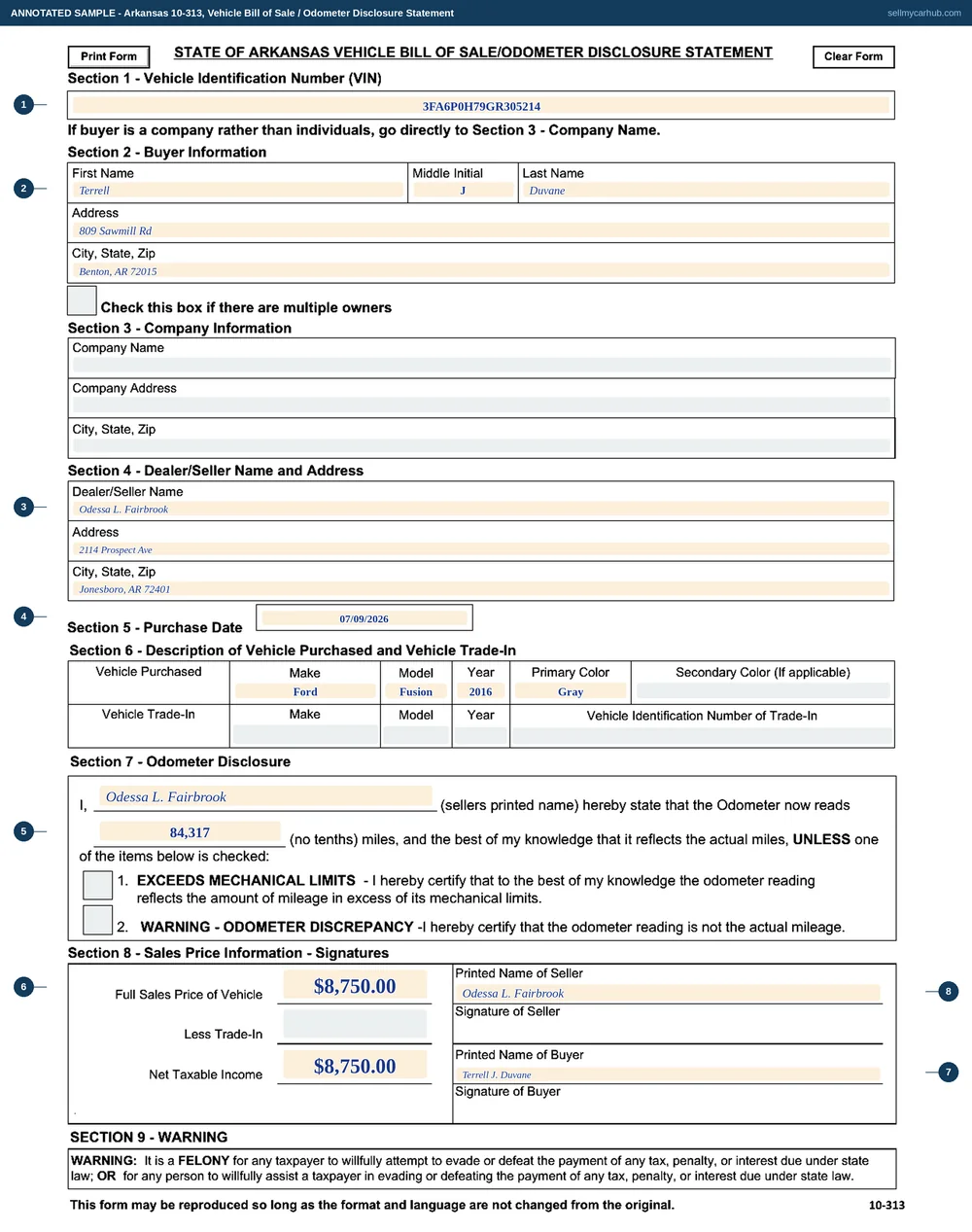
Form 10-313, the sheet that travels with every Arkansas assignment
The bill of sale and the odometer statement are one document here, and this is it - a genuine DFA form, downloaded from the agency and completed for one invented sale: a 2016 Ford Fusion SE sold in Jonesboro on 9 July 2026 for $8,750. Amber entries are the seller's pen; the grey wash marks what other hands fill in.
Click or tap the picture to open it full size.
Neither odometer box is checked, which is what an honest reading looks like - box 2 prints its own WARNING - ODOMETER DISCREPANCY label. The company block is washed grey because this buyer is a person, and the trade-in rule stays empty in a private sale.
Step by step
Every box, in the order you meet it
1
You fill this in
Print the buyer's name in the assignment section
DFA's instruction gives this job to the seller in terms: the seller/transferor must print the buyer's/transferee's name in the assignment section on the back of the certificate.
Watch out: Spell it the way the buyer's driver's license spells it, while they are standing there. The buyer's registration will be matched against this entry, and a helpful buyer filling in their own name here has put the wrong handwriting in a seller's block.
2
You fill this in
The buyer's address
Where the buyer lives, alongside the name you just printed.
Watch out: The county in that address decides where the buyer assesses and pays property tax before they can register - an out-of-county buyer's first stop is their own assessor, not the Revenue Office.
3
You fill this in
Date of transfer and the price
The day the keys change hands and what was actually paid - the same two figures the 10-313 carries as Purchase Date and Full Sales Price of Vehicle.
Watch out: The price decides the tax band: under $4,000 no state tax, $4,000 to $9,999 at 3.5%, $10,000 up at 6.5%. Rounding $4,050 down to $3,999 to do the buyer a favour is the felony the 10-313's warning section describes, in bold, on the form you are both signing.
4
You fill this in
The odometer disclosure
The reading in whole miles inside the printed sentence - it reflects the actual miles UNLESS one of the items below is checked - with the same two certifications the 10-313 and TIMA Form #2 print: in excess of mechanical limits, or not the actual mileage.
Watch out: Leave both boxes alone if the reading is simply the mileage. And make this figure match the 10-313 to the mile - two documents about one sale carrying two readings is exactly what an examiner is trained to catch.
5
You fill this in
Seller's printed name and signature
Both, in the seller's sections - sign and print their names in the appropriate sections is the agency's own phrasing, and the warranty of title the statute puts into every Arkansas assignment rides on that signature.
Watch out: Every owner joined by AND signs. If your co-owner is three counties away, the general power of attorney for vehicle transactions exists for exactly this - but it must be the actual instrument, completed before the handover.
6
The buyer fills this in
Buyer's printed name and signature
The buyer's own sections of the assignment - Arkansas wants both parties printed and signed, not just you.
Watch out: Watch it happen before the money is put away. A buyer who drives off meaning to sign later has left you holding an assignment DFA will read as incomplete.
7
You fill this in
Nothing else on the certificate
No notary block, no witness line, no county stamp. The assignment you have just completed is the whole ceremony.
Watch out: If a pen slip has already happened - a wrong name, a written-over figure - stop improving it. The Affidavit of Alteration is the sworn, notarised route for explaining an altered assignment, and it is the only time a notary enters an Arkansas sale.
8
You fill this in
The 10-313, alongside
Vehicle, buyer, seller, purchase date, price less any trade-in, and the odometer sentence again - one sheet, both signatures.
Watch out: The buyer cannot register without a bill of sale showing VIN, date, amount and both signatures, and you want a copy too: it is the document the tax credit rides on if you buy your own next car within sixty days.
9
You fill this in
The credit bill of sale, if you are buying too
DFA's two-signature bill of sale for a vehicle claimed as a tax credit toward the purchase of a replacement vehicle - the sheet that turns this sale into a trade-in for tax purposes.
Watch out: Both parties sign it, and copies go to both. Present it at the Revenue Office when registering your replacement and the tax is worked on the difference; registered already, Form 10-448 claims the refund by mail.
10
You fill this in
Then the plate, and the optional notice
Unbolt the plate before the car leaves - the registration expires with the transfer and the tag is yours to move to the next vehicle for $1.00 - and, at your option, file the Notice of Transfer of Ownership so the state's records date the sale.
Watch out: The buyer does not need your plate: a temporary tag is theirs at any Revenue Office within the first 10 days, on the bill of sale you just gave them. The notice costs nothing and is the cheap answer to every it-was-not-me letter that ever arrives.
Before the pen
Six minutes before the buyer arrives
Six things to settle before the buyer is standing in your driveway, and the first one is a date calculation.
Count sixty days before you set the date
If you are replacing the car, the sale and the purchase need to land within sixty days of each other for the tax credit. Sell first and the credit is taken at the counter; sell after registering and it becomes a mailed refund claim - same money, slower.
Check the title for a lien before you advertise
A lender recorded years ago and never released will stop the buyer's transfer cold. The cure is the lender's own signed release, and lenders that have merged or closed take weeks to chase - do it before there is a buyer waiting.
Print the 10-313 and read the odometer twice
The bill of sale and the odometer statement are one sheet in Arkansas. Whole miles, no tenths, both boxes left alone unless one is genuinely true - and the same figure on the title assignment.
Get every AND-owner into the room
Names joined by AND on the title all sign, and DFA rejects applications short a signature. A co-owner who cannot attend signs a power of attorney before the day, not after it.
Have the price story straight
The figure on the title, the 10-313 and the credit bill of sale should agree to the dollar. It sets the buyer's tax band and your credit, and it is sworn under a felony warning printed on the form.
Bring the screwdriver
The plate comes off with you - the registration expires on transfer - and one dollar moves it to whatever you drive next. The buyer's first ten days run on a temporary tag from the Revenue Office.
The ink rule is the Office of Motor Vehicle's own: “The seller/transferor of a vehicle must print the buyer's/transferee's name in the assignment section on the back of a certificate of title and the seller and buyer must sign and print their names in the appropriate sections of the title assignment.”
— DFA, recent changes in the law.
Check your source
Four things Arkansas sellers get told that are wrong
Four things Arkansas sellers get told that DFA's own pages or forms contradict. Each answer links its source.
“You'll need to get the title notarized.”
Not in Arkansas, and DFA's own instruction proves it by omission and by statement: the seller prints the buyer's name in the assignment section and the seller and buyer must sign and print their names in the appropriate sections of the title assignment - no notary named, and no acknowledgment block printed on the bill of sale, the title application or the notice of transfer. The only notarised sheet in the seller's set is the Affidavit of Alteration, which exists for cleaning up after a mistake, not for making the sale.
“Leave the tag on it - the buyer needs it to get home.”
The registration expires with the transfer, so the tag on the bumper stops being valid for the buyer the moment the car changes hands - what they actually use is a temporary tag, issued at any State Revenue Office on the bill of sale and a driver's license within the first 10 days after purchase. Your plate is worth a dollar to you: DFA's fee schedule transfers it to your next vehicle for $1.00, plus the difference if the next car registers heavier.
“Selling to the insurance company after the wreck? Same tax credit.”
DFA answers this one in bold on its own page: a sale does not occur, therefore no credit will be allowed, when the title to a damaged or stolen vehicle is transferred by a consumer to an insurance company in exchange for a cash settlement. Gifts fail the same test. The credit needs a proper transfer of title to another individual or business in exchange for cash or the equivalent of cash - a real sale, papered with a bill of sale both parties signed.
“Under $10,000 there's no sales tax on a used car.”
The line is $4,000, not $10,000, and above it the tax does not vanish - it steps. DFA's FAQ prices it exactly: $3,999 and below no sales tax due; $4,000 through $9,999 will be 3.5%; and at $10,000 the full 6.5% returns. The reduced band is state tax only - the recent-changes page adds that local tax will not be subject to the reduced state tax rate - though a motor vehicle keeps the local single-transaction cap, so city and county tax reach at most the first $2,500 of the price.
Fewer signatures than almost any state, and none of them witnessed:
Every owner the title names with AND
DFA's rule for joint ownership: names connected by AND all sign; connected by OR, either signs. It applies to the assignment, the application, the replacement title and the beneficiary request alike.
The seller, printing the buyer's name first
The instruction on DFA's own page is that the seller must print the buyer's name in the assignment section - the one entry a helpful buyer should not make for you.
The buyer, in their own sections
Seller and buyer must sign AND print their names; a signature without the printed name beside it is half an assignment.
Nobody in front of a notary
No Arkansas transfer document carries an acknowledgment block - checked across all nineteen seller-relevant forms DFA publishes. The single exception is the Affidavit of Alteration, sworn only after an assignment has been damaged.
A dealer, only on the TIMA sheet
Arkansas dealer reassignments happen on TIMA Form #1, a separate sheet marked for an assigning dealer with an AR dealer license number. A private seller who ends up holding one is looking at the dealer's paperwork, not their own.
An attorney-in-fact, only with the right instrument
The general vehicle power of attorney covers applying and collecting; mileage disclosure by proxy runs on TIMA Form #2's federal pattern, and each says which it is.
Steps 1 to 7 are the assignment on the back of the certificate. Steps 8 and 9 are the two sheets that travel with it, and step 10 is the plate and the optional notice that close the sale out.
Once it is signed
Once the title and the 10-313 are handed over, two small jobs remain: unbolt the plate - a dollar moves it to your next car - and, if you want the state's records to say so, file the free notice of transfer.