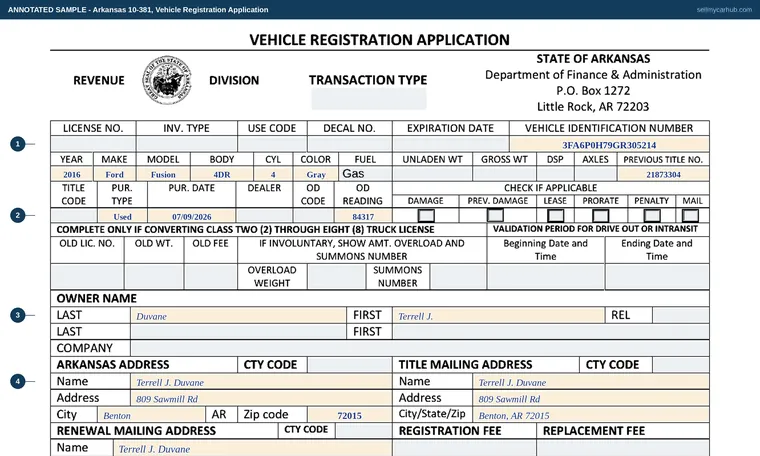
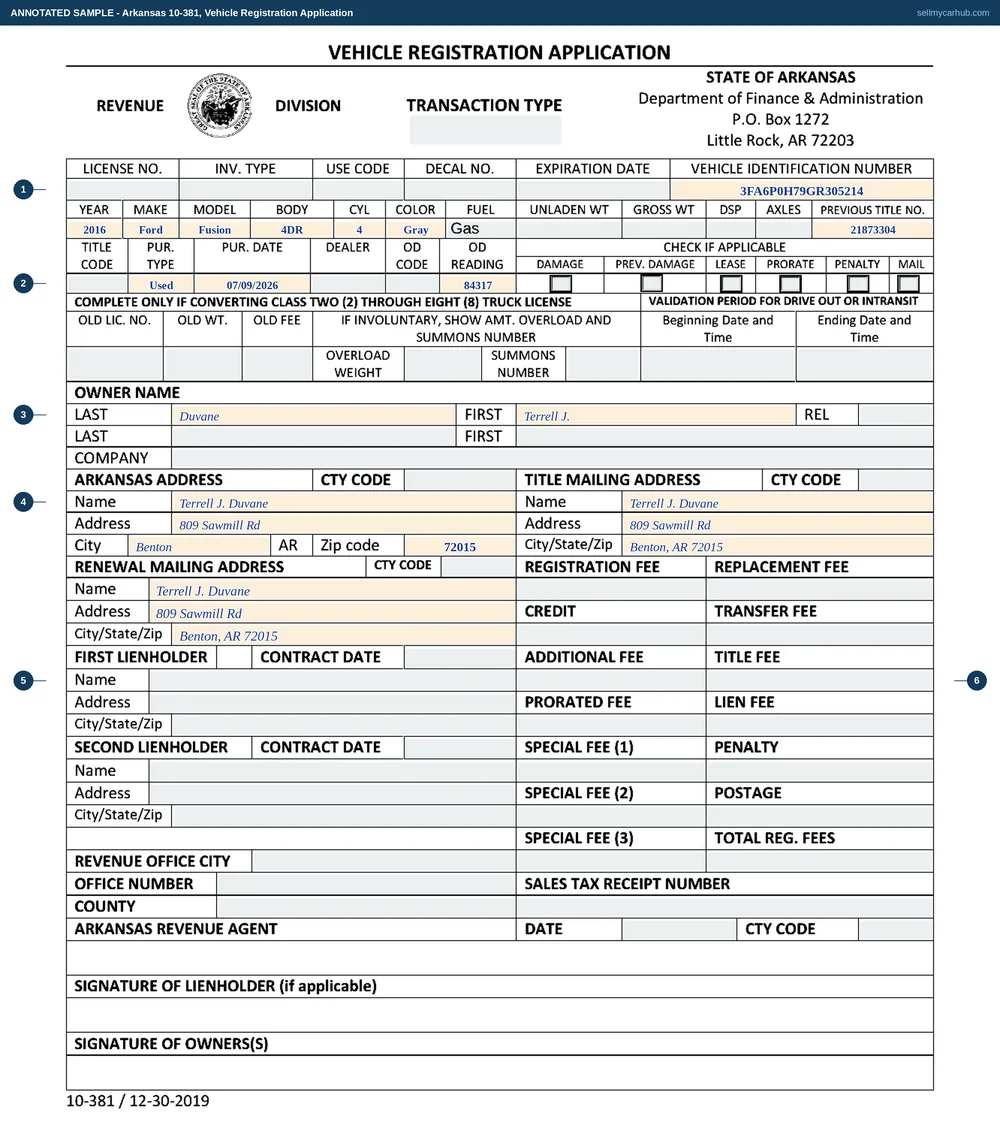
The application behind every Arkansas title - the buyer's form after your sale, and yours again the day you need a replacement title, which is why DFA's forms page files it under the double name Application for Title or Replacement Title. It is built as a working document for a Revenue Office counter: a dense vehicle grid across the top, owner and address blocks in the middle, lienholder blocks below, and a whole right-hand column of fee boxes - registration, credit, transfer, title, lien, penalty, postage - that the Arkansas Revenue Agent completes, not the applicant.
Written against 10-381 (12-30-2019), issued under Ark. Code Ann. Title 27, Chapter 14. This is a seller's page about a buyer's form for one reason: four of its answers are yours. The OD reading is your disclosure, the Previous Title No. is your certificate, the damage flags are your history to have told the truth about, and the Credit box may be carrying your buyer's own sixty-day claim. A seller who papers the sale cleanly has filled in most of this application without ever touching it.
Two documents, and they are not the same thing. Take the blank 10-381 from the dfa.arkansas.gov copy so you get the revision that is current today, then print our 10-381 guide and keep it beside you while you fill theirs in.
This is the actual 10-381, rendered from the PDF the Arkansas Department of Finance and Administration, Office of Motor Vehicle publishes and completed end to end: letterhead, every field, and the blocks at the foot.
VIN, year, make, model, body and colour, plus the Previous Title No. - all copied from the certificate the seller just assigned.
Watch out: The previous title number is on the front of the certificate. Bringing the assigned title makes this row transcription rather than research.
Purchase date, purchase type, and the odometer reading from the seller's disclosure.
Watch out: Copy the reading from the 10-313, digit for digit. This box is the third place the same figure appears in one transaction, and third is where discrepancies get noticed.
Last name first, each owner on a row, with the relationship code joining them.
Watch out: AND means every future transaction needs both signatures; OR means either alone. Decide it now, deliberately - it is the difference between one trip and two for the rest of the car's life.
Arkansas address, title mailing address, renewal mailing address, each with its county code.
Watch out: The county code drives where assessment is checked. A buyer who just moved counties should assess in the new county before this application, not after.
The lender and contract date where the purchase is financed; both blocks empty in a cash sale.
Watch out: A recorded lien means the title is mailed to the lienholder, not to you - and it will take that lender's signed release to sell the car later, as every seller stuck chasing one can testify.
Signature of owner(s) at the foot - all of them if joined by AND - while the agent completes the fee column, the sales tax receipt number and the office boxes.
Watch out: Bring the sales tax money, the title fee and the registration fee for the weight class. Presenting a credit bill of sale from a vehicle you sold within sixty days is what turns the Credit box from empty into arithmetic in your favour.
| On the form | What to put in it |
|---|---|
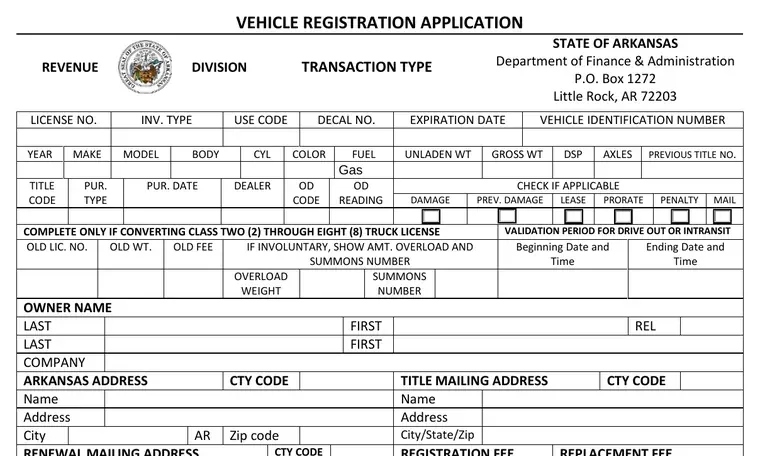
| The vehicle grid | License number, decal, expiration, VIN, then year, make, model, body, cylinders, color, fuel, unladen and gross weight, axles and Previous Title No. - the record the examiner builds the new title from. |
| Title code, purchase type, purchase date, dealer, OD code and OD reading | The transaction row: how the vehicle was acquired, when, and what the odometer said - the reading that should match the seller's disclosure exactly. |
| Check if applicable: Damage, Prev. Damage, Lease, Prorate, Penalty, Mail | Six flags. The damage boxes are how a branded history follows the vehicle onto its next title. |
| The truck-conversion and drive-out rows | Class 2-8 truck license conversion with overload and summons boxes, and a validation period for drive out or intransit - commercial rows an ordinary application leaves empty. |
| Owner Name: Last, First, REL, and Company | Two personal name rows with a relationship code between joint owners - the AND or OR that decides future signatures - and a company row used instead when a business is titling. |
| Arkansas Address, Title Mailing Address, Renewal Mailing Address | Three address blocks with county code boxes: where the owner lives, where the title should be posted, where renewal notices go. |
| First Lienholder and Second Lienholder, each with Contract Date | The lender blocks. A title with a live lien is mailed to the lienholder, and the 50-cent lien filing fee appears in the fee column. |
| The fee column | Registration fee, replacement fee, credit, transfer fee, additional fee, title fee, prorated fee, lien fee, special fees, penalty, postage, total - and a Sales Tax Receipt Number box tying the application to the tax paid. |
| Revenue office city, office number, county, Arkansas Revenue Agent, date | The counter's own identification of who processed the application. |
| Signature of Lienholder (if applicable) and Signature of Owner(s) | The two signature rules at the foot. DFA's instruction for joint owners is printed policy: connected by AND, all must sign. |
Every line here was read off 10-381 (12-30-2019) itself — the PDF is here — and off the Arkansas Department of Finance and Administration, Office of Motor Vehicle pages. This is plain-language help with a form, not legal advice, and where our wording and the agency's differ, theirs governs.
Back to all Arkansas seller paperwork, or what selling a car in Arkansas involves.