Sell My Car Hub

How to fill out Arkansas 10-313

The one sheet at the centre of every Arkansas private sale. DFA folds the bill of sale and the federal odometer statement into a single page of nine sections, and the buyer cannot register without it - the registration checklist asks for a bill of sale with the VIN, date of sale, purchase amount and both signatures, and this form carries all four plus the mileage sentence. Its closing section is a warning in bold that evading tax through a false statement is a felony, which tells you what the price blocks are really for: the figure written here is the figure the buyer's sales tax is worked from.
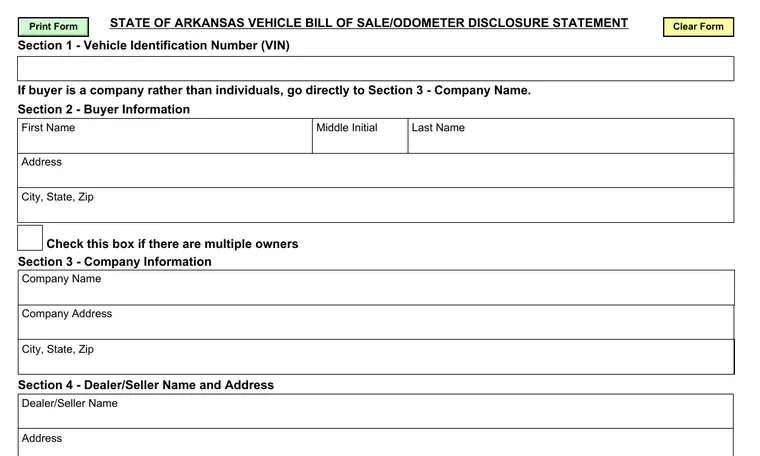
Written against 10-313 (no revision printed), issued under 49 U.S.C. § 32705 and Ark. Code Ann. § 4-90-206. Net Taxable Income is dealer arithmetic - price minus trade-in - and in a private sale it simply equals the full price. Do not treat it as an invitation to deduct anything else: the sixty-day replacement-vehicle credit is claimed at the Revenue Office with the credit bill of sale, not by writing a smaller number here.

Two documents, and they are not the same thing. Take the blank 10-313 from the dfa.arkansas.gov copy so you get the revision that is current today, then print our 10-313 guide and keep it beside you while you fill theirs in.

Filled in

What a completed one looks like

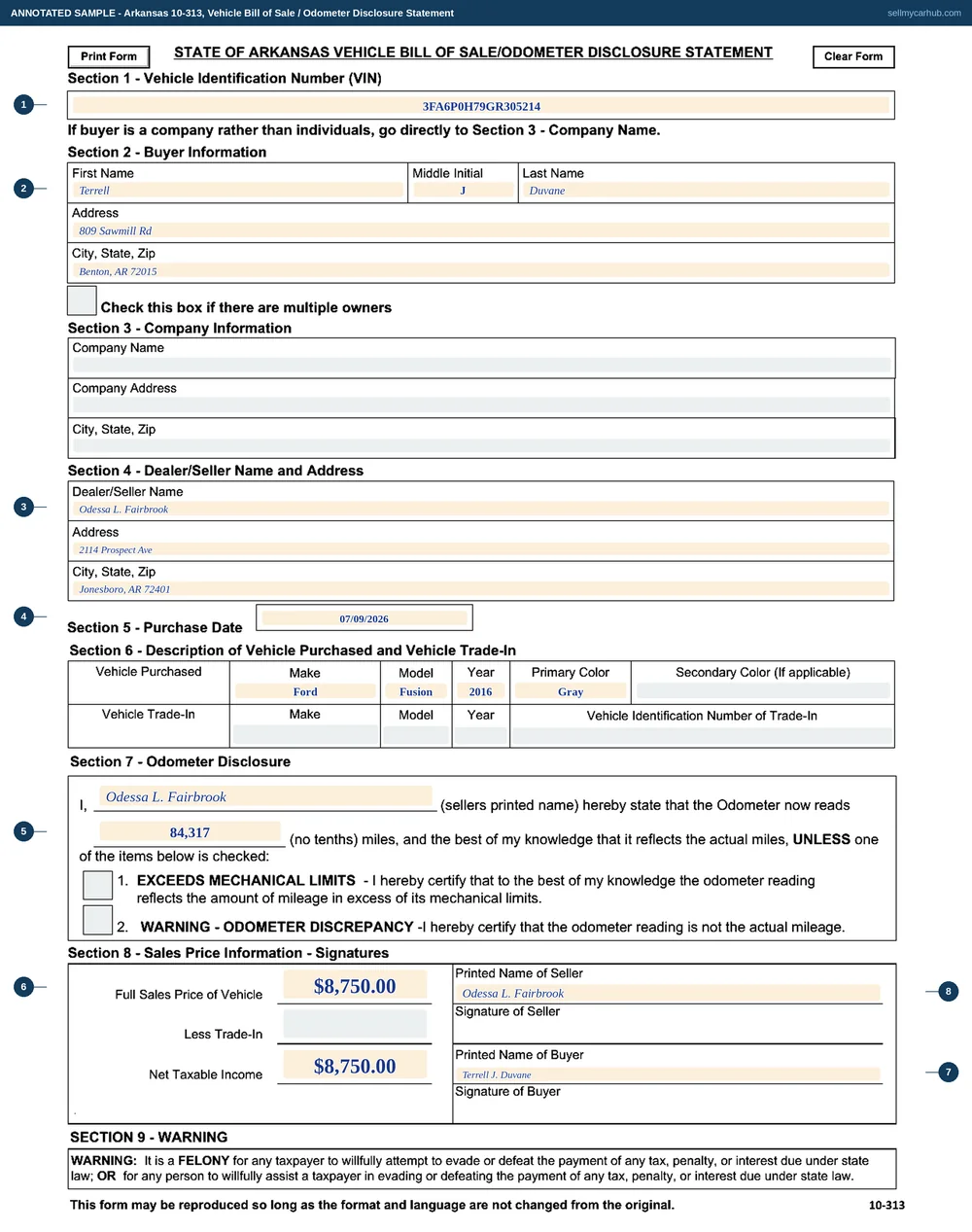
This is the actual 10-313, rendered from the PDF the Arkansas Department of Finance and Administration, Office of Motor Vehicle publishes and completed end to end: letterhead, every field, and the blocks at the foot.

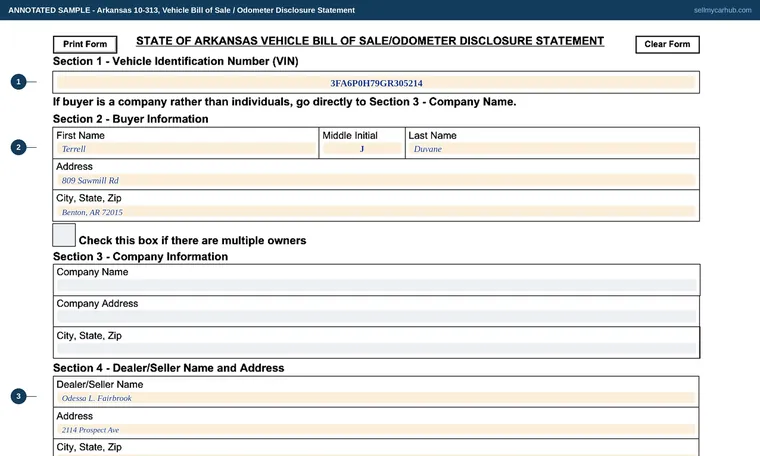
Arkansas Form 10-313, Vehicle Bill of Sale and Odometer Disclosure Statement, filled in: a 2016 Ford Fusion SE, vehicle identification number 3FA6P0H79GR305214, sold by Odessa L. Fairbrook of Jonesboro to Terrell J. Duvane of Benton on 9 July 2026 for $8,750, with the odometer declared at 84,317 miles and neither certification box checked.
A cash sale between two people, so the company block and the trade-in row are washed grey along with the Less Trade-In figure - the full price simply repeats as the net. Neither odometer box is ticked, because the reading is the mileage.
Field by field

Every line, in the order you meet it

  1. 1
    You fill this in

    Section 1: the VIN

    Seventeen characters, copied from the certificate of title rather than from the windshield.

    Watch out: Every document in this sale is matched to the others by this number. Copying it from the title means the bill of sale and the assignment cannot disagree.

  2. 2
    You fill this in

    Section 2 or 3: who is buying

    A person goes in Section 2, first name first; a company goes in Section 3 and Section 2 stays empty.

    Watch out: Spell the buyer from their driver's license and tick the multiple-owners box if two people are taking the car - how their names join on the new title decides who has to sign things for the rest of the vehicle's life.

  3. 3
    You fill this in

    Section 4: you

    Dealer/Seller Name and Address - your name as the title spells it, and where you live.

    Watch out: Use the name on the front of the certificate. If you have married or moved since the title was issued, this is a sheet for matching records, not updating them.

  4. 4
    You fill this in

    Sections 5 and 6: the day and the car

    The purchase date, then make, model, year and colours across the Vehicle Purchased row.

    Watch out: This date starts the buyer's sixty-day registration clock and anchors your own tax credit window if you are replacing the car. Make it the day possession actually changes.

  5. 5
    You fill this in

    Section 7: the odometer sentence

    Your printed name in the first blank, the reading in the second, whole miles only.

    Watch out: The sentence certifies actual miles unless a box is checked. Check box 1 only for a rolled-over odometer, box 2 only when the figure genuinely is not the mileage - it prints its own WARNING label for a reason.

  6. 6
    You fill this in

    Section 8: the money and the names

    Full sales price on the left; your printed name and signature on the right.

    Watch out: In a private sale the trade-in line stays empty and the net equals the price. The buyer's sales tax is worked from this figure under the state's banded used-vehicle rates - which is why a made-up number here is a tax matter, not a favour.

  7. 7
    The buyer fills this in

    Section 8 again: the buyer signs

    Printed name and signature on the buyer's rules, before anybody drives anywhere.

    Watch out: The Revenue Office wants both signatures on the bill of sale. Get them at the handover - a buyer chased for a signature next week is a buyer who has already registered late.

  8. 8
    You fill this in

    Copies, then the credit if you are buying

    A copy for each of you - and if you are replacing the vehicle within sixty days, this sheet plus the credit bill of sale is what the trade-in-style tax credit rides on.

    Watch out: The form may be reproduced so long as the format and language are not changed, says its own footer - so photocopy the completed sheet freely. What you cannot do is retype it with the warning left off.

At a glance

What goes where

On the formWhat to put in it
Section 1 - Vehicle Identification Number (VIN)Seventeen characters across the opening block, before the form asks who anybody is.
Section 2 - Buyer Information: First Name, Middle Initial, Last NameThe buyer as a person, with a printed instruction above it: if the buyer is a company rather than individuals, go directly to Section 3.
Address and City, State, ZipThe buyer's two address rules, with a checkbox underneath: Check this box if there are multiple owners.
Section 3 - Company InformationCompany name and address, used instead of Section 2 when a business is buying. Empty in a sale between two people.
Section 4 - Dealer/Seller Name and AddressOne block serving dealers and private sellers alike - your name and address, on the same rules a dealership would use.
Section 5 - Purchase DateThe day the vehicle changed hands, standing in its own section.
Section 6 - Description of Vehicle Purchased and Vehicle Trade-InTwo rows: make, model, year and colours for the vehicle sold, and a second row for a trade-in with its own VIN box - a dealer's row, blank in a private sale.
Section 7 - Odometer DisclosureThe printed sentence with two blanks: I, (sellers printed name) hereby state that the Odometer now reads (no tenths) miles, and the best of my knowledge that it reflects the actual miles, UNLESS one of the items below is checked.
Checkbox 1 - EXCEEDS MECHANICAL LIMITSCertifies the reading reflects mileage in excess of the odometer's mechanical limits - the rolled-over five-digit odometer case.
Checkbox 2 - WARNING - ODOMETER DISCREPANCYCertifies the odometer reading is not the actual mileage. The warning is printed into the label.
Section 8 - Sales Price Information - SignaturesFull Sales Price of Vehicle, Less Trade-In, and Net Taxable Income down the left; printed name and signature of seller, then of buyer, down the right.
Section 9 - WARNINGNo fields - a bold notice that wilfully evading tax, or helping a taxpayer evade it, is a felony under state law, and a closing line that the form may be reproduced so long as the format and language are not changed.

What gets this one rejected

Rules that decide whether it is accepted

Every line here was read off 10-313 (no revision printed) itself — the PDF is here — and off the Arkansas Department of Finance and Administration, Office of Motor Vehicle pages. This is plain-language help with a form, not legal advice, and where our wording and the agency's differ, theirs governs.

Back to all Arkansas seller paperwork, or what selling a car in Arkansas involves.

Want the paperwork handled instead?

Get My Instant Offer → Online · about 2 minutes · free

Or send the details — we'll come to you

Rather skip the paperwork and the driveway strangers? Tell us about the car and the offer covers it as it sits.

or call/text (877) 405-1808