A frozen lock is a thin film of water in the wrong place, and the fix takes thirty seconds if you do it right. The expensive version is what happens when you don't: a key snapped off in the cylinder, a door handle in your hand, or a cylinder gummed with years of the wrong spray. Here is why locks freeze and stick, what to reach for and what to leave in the drawer, which lubricant actually belongs in a keyway, how to tell a frozen lock from a frozen seal, a dead fob, or a failed actuator, and what a shop charges when it really is the part.
Last updated .
A car door lock is a small brass plug carrying a row of spring-loaded wafers, in a housing open to the weather at one end. Rain runs down the door skin into the keyway. A car wash in January pushes water in under pressure. Then the temperature drops overnight and the film of water around the wafers turns to ice, which needs more room than the water did: the USGS puts the change at about a 9% drop in density when water freezes. In a mechanism built to tight clearances, that pins every wafer where it sits. The key goes in, or halfway in, and will not turn.
Firestone's service guidance names the two usual routes: the car sat out in the cold, or it was washed when the temperature dipped. Damp air condensing in the cylinder on a clear, cold night is enough.
A lock that sticks in July has a different problem. Either the cylinder has run dry, so the wafers drag in their slots, or it has collected years of road dust and the residue of whatever was sprayed into it last, and the mix has turned to paste. Old oil is the usual binder; any wet lubricant in a keyway is a dust trap, which is why most products sold specifically for locks advertise a dry film. The third cause is a worn key. If a spare turns smoothly and the daily key does not, have a new one cut from the spare.
The damage from a frozen lock is rarely done by the ice. It is done in the next thirty seconds by whoever is holding the key.
AAA's rule covers the whole door: don't yank on car parts to break ice. Handles snap and seals tear, and neither is cheap.
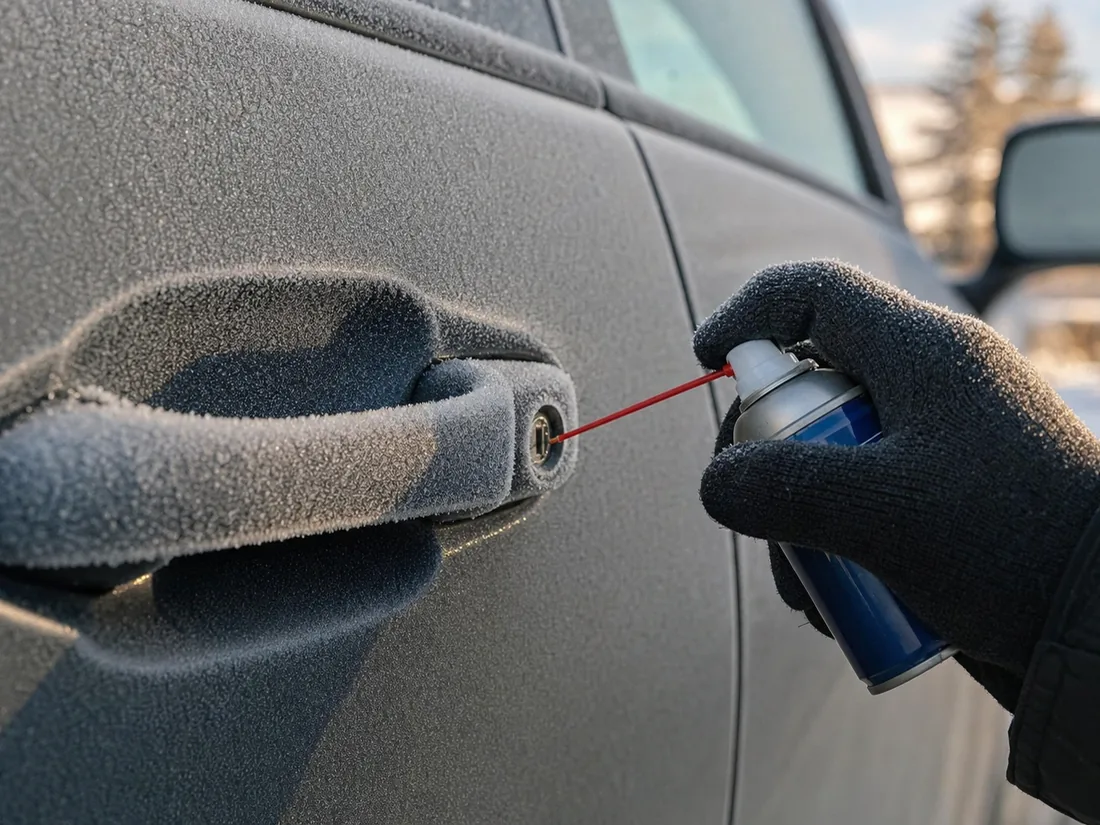
Alcohol melts ice by lowering the freezing point of the water it mixes with, and it evaporates instead of pooling, which is why commercial lock de-icers are alcohol. Work down this list and stop when the key turns.
Three families of lubricant get recommended for locks, and the makers do not fully agree.
| Lubricant | What it leaves behind | What the makers say | Best use on a car |
|---|---|---|---|
| Graphite | A dry, black, slippery powder | AGS says its Lock-Ease leaves a graphited film that shields against rust. Master Lock's care guide says never use dry graphite, because people over-apply it and the excess jams the mechanism. | Older cars' cylinders, in tiny amounts, never on top of oil. |
| Silicone | A thin, clear, water-repellent film | WD-40 Specialist Silicone is rated from -100°F to 500°F and safe on rubber, plastic, and vinyl, and the maker lists door seals and vehicle locks as uses. Master Lock rules it out for its padlocks. | The clear winner for weatherstrips and door seals. Acceptable in a cylinder if it is a dry-film silicone. |
| PTFE and other dry-film lock lubes | A thin solid film once the solvent carrier flashes off | 3-IN-ONE's Lock Dry Lube is sold as a graphite-free, quick-dry formula that will not build up in the lock. Master Lock specifies its own PTFE lock lubricant for all of its locks. Tri-Flow, the PTFE product most people know, is built on petroleum oils with PTFE added, so it stays wet. | The safest single choice for the key cylinder. Use an oil-carried PTFE such as Tri-Flow only as a one-time flush, then follow with a dry film. |
Two rules matter more than the brand. First, quantity: Master Lock's instruction is a very light spray or a few drops, and one short burst with the straw in the keyway is a full application. Second, work it in. Master Lock's method is to put the key in and work the lock several times to spread the lubricant. Turn the key both ways, wipe the blade, and repeat until it comes out clean; black or gritty means you have just cleaned the cylinder.
Master Lock's interval is every 3 to 6 months. One GM owner's manual, for the 2010 GMC TopKick, puts key lock cylinders on the annual list: lubricate the key lock cylinders at least once a year. Fall before the first freeze and spring after the salt suits a car that lives outside. Never layer graphite over oil or oil over graphite; the mix is a paste. If a lock's history is unknown, the same can does the cleaning: 3-IN-ONE's is sold as an aerosol that penetrates to dissolve build-up, so cycle the key until the blade comes out clean.
Once the key turns or the fob chirps and the door still will not budge, stop working on the keyway.
The seal is frozen to the body. This is the common one. AAA describes it exactly: door seals trap moisture, which freezes and glues the door shut. The fix is pressure, not pulling. AAA's method is to push firmly on the door, then pull, a few times, to crack the ice along the seal. De-icer along the gap between door and frame helps.
The latch is frozen. The latch is the steel claw at the rear edge of the door that grabs the striker on the body. Water gets in through the drain holes and handle-cable openings and freezes in the mechanism. Frozen open, the door bounces back off the striker. Frozen closed, the handle moves but nothing releases. Ford recalled 2015-2017 F-150s and 2017 Super Duty trucks after finding that water in the latch could freeze, and a door that looked closed could open while driving; the fix was a water shield over the latch. If a door will not click fully shut, do not drive it. Warm the latch with de-icer or a hair dryer, work the handle until it moves freely, then spray a dry lubricant into the mechanism.
Preventing both is the same job. The same GM manual says a coat of silicone grease keeps weatherstrips sealing and stops them sticking, and cold, damp weather calls for more frequent application. Wipe the seals dry and wipe on a thin coat of silicone, trunk and fuel door included.
On a car with power locks, four things can fail: the fob, the actuator inside the door, the latch, and the key cylinder. Each has a symptom that points at it.
The two jobs a shop is most likely to quote, from RepairPal's national estimates as of September 2026:
| Repair | Parts | Labor | Total |
|---|---|---|---|
| Door lock actuator replacement | $236 to $271 | $145 to $213 | $381 to $484 |
| Door lock cylinder replacement | about $190 | $90 to $132 | $281 to $323 |
Both exclude taxes and fees and vary by model. RepairPal notes that a locksmith can rekey the new cylinder to match your existing key; ask whether that is in the quote. The comparison is the point: a frozen or dirty cylinder costs a can of lubricant, one destroyed by forcing it costs roughly $300, and an actuator costs more and cannot be fixed with spray, so if the symptom is electrical, stop spraying.
Do this once before the first hard freeze.
Through the winter, two habits. If you wash the car in freezing weather, dry the seals and keyways before you park; Firestone lists a cold-weather car wash as one of the two usual causes of a frozen lock. And use the key, not just the fob, in each door once a month, so you find a stiff cylinder in daylight rather than at 6 a.m. AAA's low-tech trick for a car parked nose to the weather is a magnet over the keyhole.
A buyer will try every door, and a driver's door that needs the key jiggled, a fob that only works from three feet away, or a rear door that ignores the lock button reads as neglect, fair or not. It is a cheap impression to fix: a can of lock lubricant and a coin cell cover most of it, and a dead actuator is a priced job you can do or disclose.
The latch matters more. A door that does not fully latch is a safety defect, and it ends a test drive. If a door has ever popped open or refused to click shut in the cold, have the latch looked at before you list the car, and check for an open recall, since that work is free. Doors that all lock, unlock, open, and close as they should make every other claim about the car easier to believe.
As a one-time rescue, yes: WD-40 Multi-Use is a water displacer by name and design, and forcing moisture out of a frozen keyway is exactly what it does. As the lubricant you leave in the cylinder, no. It stays wet, and a wet film collects the grit that makes a lock stick in dry weather. Follow it with a short shot of a dry-film lock lubricant and cycle the key until the blade comes out clean.
A dry-film lock lubricant, usually PTFE, is the safest choice for the cylinder itself: the solvent carrier cleans and then flashes off, leaving a film that does not hold dust, and Master Lock specifies PTFE for all of its locks. Read the can, though. Some PTFE products, Tri-Flow among them, are oil-based and stay wet, so use those only to flush a gummed cylinder. Silicone is the right product for rubber door seals. Graphite works but is easy to over-apply and turns to paste on top of old oil.
Three usual reasons. The cylinder has run dry and the wafers drag instead of sliding. Old oil-based spray has collected dust and hardened into paste. Or the key itself is worn, so the cuts no longer lift the wafers cleanly. Test with a spare key first: if the spare turns smoothly, cut a new key from it. Otherwise flush the cylinder with a lock dry lube and work the key until it comes out clean.
Probably not. If no door responds to the fob but the inside switch works, it is the fob battery; use the mechanical key blade hidden in the fob to get in, and replace the coin cell. If every door responds except one, the actuator in that door has failed. If the fob works and the key will not turn, the cylinder is frozen or dirty. Sort the electrical from the mechanical before paying for anything.
A frozen or dirty cylinder costs a can of lock lubricant and ten minutes. When a part is actually dead, RepairPal's national estimates as of September 2026 put a door lock actuator replacement at $381 to $484 and a door lock cylinder replacement at $281 to $323, before taxes and fees and depending on the model. RepairPal notes a locksmith can rekey the new cylinder to match your existing key; ask whether that is in the quote.