The only document in the Vermont set that lets somebody else sign the assignment block for you, and the only one that needs both a witness and a notary. It is a single-vehicle appointment - the car is described at the top by make, model, plate and identification number - and the authority it grants is written out in the form's own sentence: to sign any documents for the vehicle described above, including but not limited to vehicle purchase, vehicle sale, application for title and/or registration, and transfer of ownership. Vermont will not take a power of attorney drawn on somebody else's paper for a vehicle transaction, and it will not take this one signed at the kitchen table with nobody watching.
Written against VN-101 (06/2023), issued under 14 V.S.A. s. 3505(c), which bars the agent from witnessing or notarising the appointment, affirmed under penalty of perjury per 23 V.S.A. s. 202, s. 203, s. 2082 and s. 2083. Book the notary and the witness for the same fifteen minutes. Every route people try to shortcut this form - signing at home and getting it notarised on the way past the bank, asking the person being appointed to sign as witness - fails on a sentence printed on the form itself.
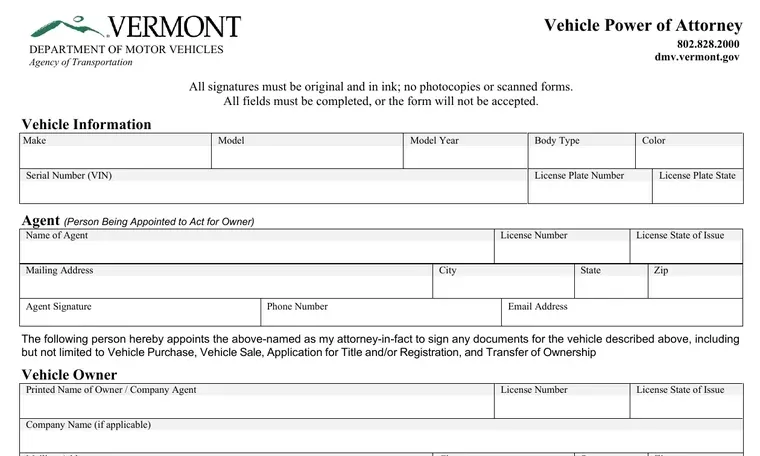
Two documents, and they are not the same thing. Take the blank VN-101 from the dmv.vermont.gov copy so you get the revision that is current today, then print our VN-101 guide and keep it beside you while you fill theirs in.
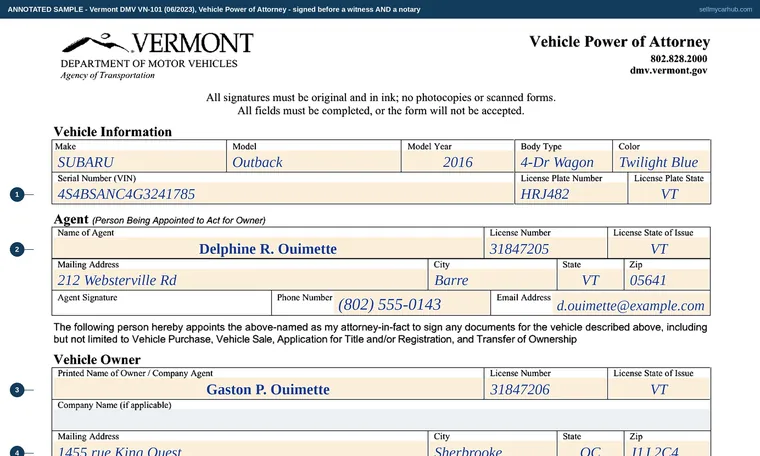
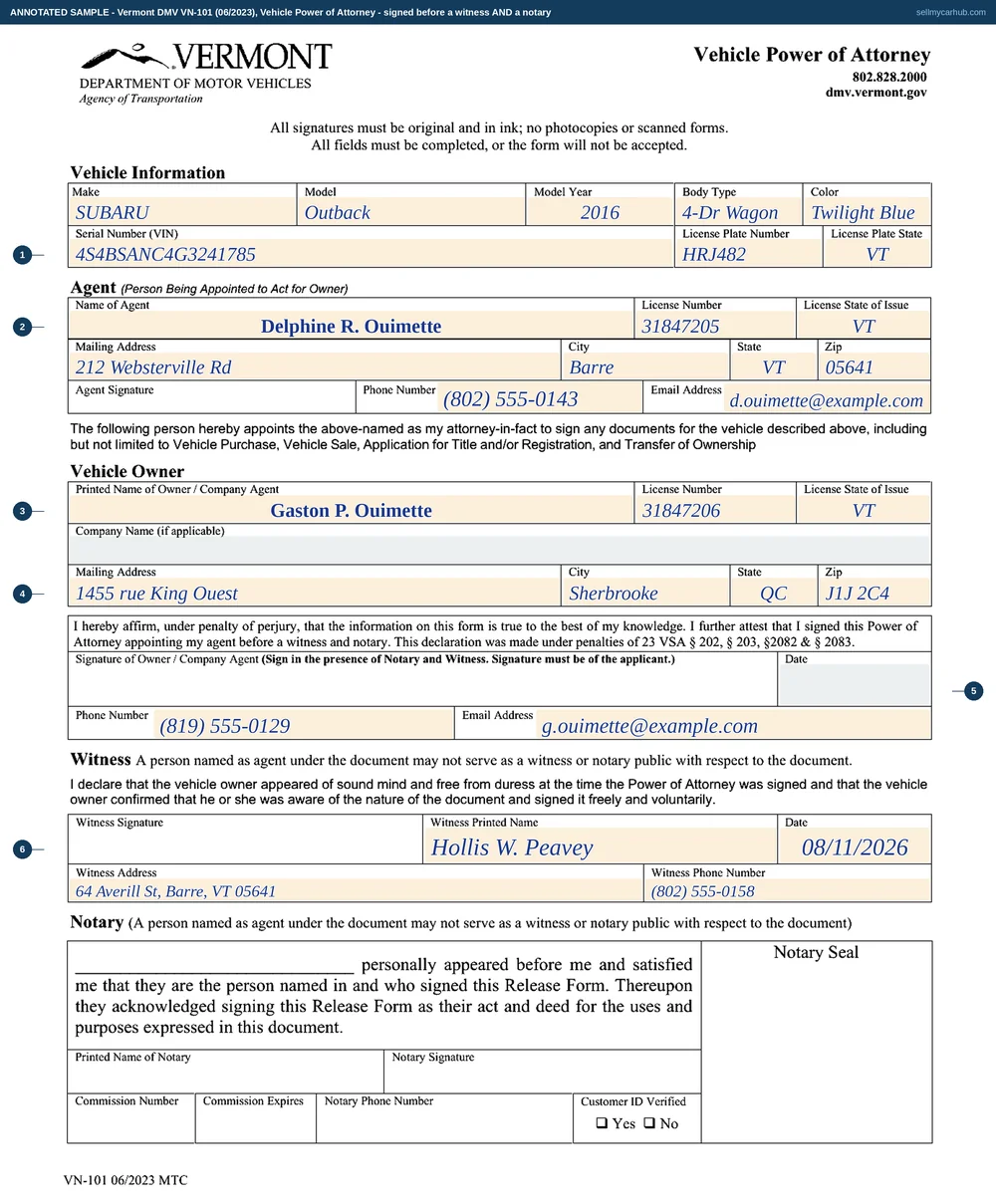
This is the actual VN-101, rendered from the PDF the Vermont Department of Motor Vehicles, Agency of Transportation publishes and completed end to end: letterhead, every field, and the blocks at the foot.
The one vehicle this appointment covers, copied off the certificate.
Watch out: If two cars are being sold, that is two forms. There is no box on this sheet for a second vehicle and no version of it that covers a fleet.
Seventeen characters and the plate the car is wearing now.
Watch out: Write the plate state even when it is obviously Vermont. An empty box is an incomplete form, and this form says incomplete forms are not accepted.
The person you are appointing, with a driving credential the department can look up.
Watch out: Choose somebody who will be reachable for a fortnight, not somebody who is doing you a favour on their way to the airport.
Four boxes for the agent's own address.
Watch out: It does not have to be a Vermont address. Nothing in this form requires the agent to live in the state, and plenty of them do not.
The agent's own signature and two ways of reaching them.
Watch out: They can sign this afterwards. What they cannot do is walk into a DMV office with it unsigned and expect to use it.
Your name in print, and your own credential.
Watch out: Print the name exactly as it appears on the certificate. A married name on the licence and a maiden name on the title is a query the notary cannot fix for you.
Your address, including a foreign one if that is where you are.
Watch out: An owner temporarily in Quebec or Alberta writes that address here. It is a reason for the form, not an obstacle to it.
Signed in front of the witness and the notary, both watching, on the date written beside it.
Watch out: Take photographic identification. The notary ticks a box on this form to say your identification was verified, and they will not tick it on your word.
Five boxes completed by somebody who is neither you nor the agent nor the notary.
Watch out: A neighbour, a colleague, the person at the next desk in the bank. What they are declaring is that you looked well and were not being leaned on.
Printed name, signature, commission number, expiry, phone number and the identification tick.
Watch out: This is the notary's block and none of it is yours to prepare. A form arriving with the commission number already typed in is the fastest way to have the whole appointment refused.
| On the form | What to put in it |
|---|---|
| Make, Model, Model Year, Body Type, Color | The vehicle this appointment covers, and it covers no other. One car, one form. |
| Serial Number (VIN), License Plate Number, License Plate State | Copied from the certificate rather than from memory. The plate state box exists because the department sees plenty of vehicles still wearing another jurisdiction's plate. |
| Name of Agent, License Number, License State of Issue | Who is being appointed, with a credential the department can check. The agent is a named individual, not a firm. |
| Agent Mailing Address, City, State, Zip | Where the agent lives. It is not required to be a Vermont address, and it does not have to match yours. |
| Agent Signature, Phone Number, Email Address | The agent signs too. The instruction sheet on the second page sets out when: the agent does not have to sign at the same time as the principal, but must sign before using the power of attorney for the first time. |
| Printed Name of Owner / Company Agent, License Number, License State of Issue | You, printed rather than signed, with your own credential beside it. |
| Company Name (if applicable) | One wide box for a business owner. A person selling their own car leaves it alone. |
| Owner Mailing Address, City, State, Zip | Your address as the department holds it. |
| Signature of Owner / Company Agent (Sign in the presence of Notary and Witness. Signature must be of the applicant.), and Date | The operative signature, under an affirmation that you signed before a witness and a notary. Both have to be watching at the same time as each other and as you. |
| Owner Phone Number, Email Address | Two contact boxes under your signature, because this is the form the department rings about if the agent turns up with a question. |
| Witness Signature, Witness Printed Name, Date | Under a declaration that you appeared of sound mind and free from duress and confirmed that you knew what you were signing. |
| Witness Address, Witness Phone Number | The witness has to be findable afterwards. This is not a box to fill in with the name of somebody who has already left. |
| Notary block: Printed Name of Notary, Notary Signature, Commission Number, Commission Expires, Notary Phone Number, Customer ID Verified Yes/No | A full acknowledgement with a seal panel beside it. The notary completes every line of it, including the tick that says your identification was checked. |
| Page 2 - Agent duties | Vermont law imposes a fiduciary duty on the agent: act in good faith, refrain from doing things that benefit yourself rather than the principal, avoid conflicts of interest, stop acting immediately if the power is revoked, and exercise the care of a reasonably prudent person. |
| Page 2 - Revocation | You may revoke at any time, in writing, by telling your agent, by tearing the document up or crossing it out, or by any other act that shows you want it revoked. Tell the agent you have done it. |
Every line here was read off VN-101 (06/2023) itself — the PDF is here — and off the Vermont Department of Motor Vehicles, Agency of Transportation pages. This is plain-language help with a form, not legal advice, and where our wording and the agency's differ, theirs governs.
Back to all Vermont seller paperwork, or what selling a car in Vermont involves.