Sell My Car Hub

How to fill out Tennessee RV-F1310501

One page that moves a car out of an estate without going near a court, and it fits a much narrower case than people expect. The purpose paragraph sets both conditions: the deceased left no will, and there is no surviving spouse. Everybody who would inherit signs the same sheet to relinquish their claim in favour of one named person, who then applies for the title.
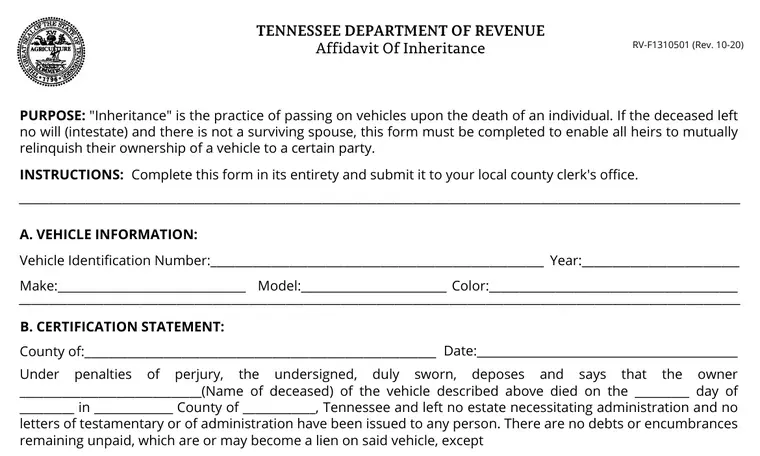
Written against RV-F1310501 (Rev 10-20), issued under Rule 1340-5-13-.02(2)(b) and Tenn. Code Ann. 55-4-101. Read the two conditions in the purpose paragraph before anything else. Most estates fail one of them, and an affidavit completed for an estate that has a will or a surviving spouse is a wasted trip for however many relatives you gathered to sign it.

Two documents, and they are not the same thing. Take the blank RV-F1310501 from the tn.gov copy so you get the revision that is current today.

Filled in

What a completed one looks like

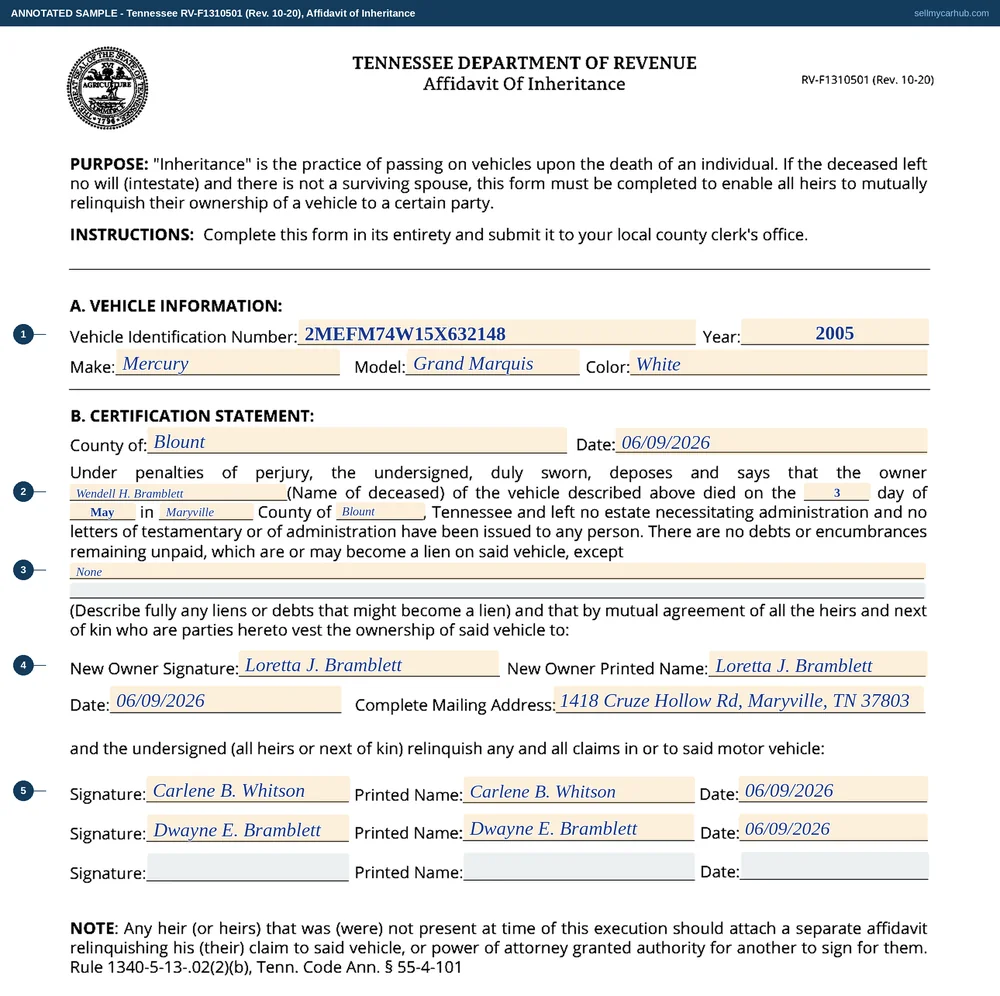
This is the actual RV-F1310501, rendered from the PDF the Tennessee Department of Revenue publishes and completed end to end: letterhead, every field, and the blocks at the foot.

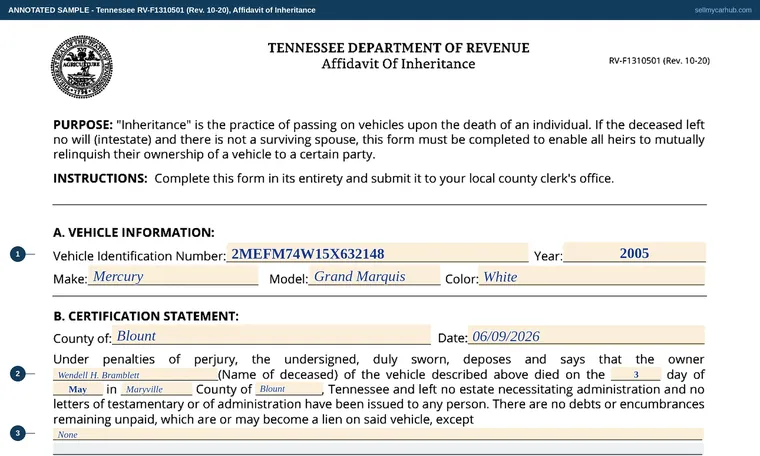
Tennessee form RV-F1310501 filled in: a 2005 Mercury Grand Marquis, vehicle identification number 2MEFM74W15X632148, white, sworn in Blount County on 9 June 2026, stating that Wendell H. Bramblett died on the third day of May in Maryville, county of Blount, Tennessee, leaving no liens, with ownership vested in Loretta J. Bramblett of Maryville and two heirs, Carlene B. Whitson and Dwayne E. Bramblett, signing to relinquish their claims.
Two heirs signing, and the third row deliberately left empty rather than filled in on somebody's behalf. The note under the block is the reason: an absent heir attaches their own affidavit or grants a power of attorney, and nobody signs for them.
Field by field

Every line, in the order you meet it

  1. 1
    You fill this in

    Check both conditions first

    No will, and no surviving spouse. Those two facts are what this form is for.

    Watch out: If either fails, stop. A will means letters testamentary, and a surviving spouse means the surviving-spouse route - both are different transactions at the same counter.

  2. 2
    You fill this in

    Block A, the vehicle

    Vehicle identification number, year, make, model and colour, copied from the certificate of title.

    Watch out: The certificate itself has to go in with this. The affidavit explains who may sign; it does not replace the document being signed.

  3. 3
    You fill this in

    The sworn sentence

    The county, the date, the deceased's name, the day and month of death, and the city and county in Tennessee where they died.

    Watch out: It is one running sentence with four blanks in it - day, month, place and county - and it is easy to lose your place halfway along. It also swears that no letters of testamentary or of administration have been issued to any person, so an estate with an administrator already appointed is on the wrong form.

  4. 4
    You fill this in

    Liens and debts

    Two lines to describe fully any liens or debts that might become a lien on the vehicle. Write None if there are none.

    Watch out: A car loan that was still running is exactly what this line is for. The clerk needs to know before a clean title is issued, not afterwards.

  5. 5
    You fill this in

    Who the vehicle is going to

    The new owner's signature, printed name, date and complete mailing address.

    Watch out: One person. The whole mechanism is that the heirs agree among themselves and then relinquish in favour of a single named party.

  6. 6
    You fill this in

    Every heir signs

    Signature, printed name and date on the relinquishment rows, for all heirs and next of kin.

    Watch out: Get them in one room if you can. Collecting separate affidavits from scattered relatives is the part of this that takes months rather than minutes.

At a glance

What goes where

On the formWhat to put in it
A. Vehicle informationFive boxes describing the car: vehicle identification number, year, make, model and colour.
B. Certification statementA county and a date, then a single sworn sentence: that the named owner died on a stated day and month in a stated city and county of Tennessee, left no estate necessitating administration, and that no letters of testamentary or of administration have been issued to any person.
Liens and debtsTwo lines under the printed words: there are no debts or encumbrances remaining unpaid, which are or may become a lien on said vehicle, except - and then a full description of any there are.
The new ownerBy mutual agreement of all the heirs and next of kin who are parties hereto, vesting ownership in a named person, with their signature, printed name, date and complete mailing address.
The heirs' relinquishmentThree rows of signature, printed name and date, under the words: and the undersigned, all heirs or next of kin, relinquish any and all claims in or to said motor vehicle.
The noteAny heir not present at the time of execution should attach a separate affidavit relinquishing their claim, or grant a power of attorney for another to sign for them.

What gets this one rejected

Rules that decide whether it is accepted

Every line here was read off RV-F1310501 (Rev 10-20) itself — the PDF is here — and off the Tennessee Department of Revenue pages. This is plain-language help with a form, not legal advice, and where our wording and the agency's differ, theirs governs.

Back to all Tennessee seller paperwork, or what selling a car in Tennessee involves.

Want the paperwork handled instead?

Get My Instant Offer → Online · about 2 minutes · free

Or send the details — we'll come to you

Sorting out a car after a death is slow and often not worth the trouble. Tell us what it is and we will make it simple.

or call/text (877) 405-1808