Sell My Car Hub

How to fill out South Dakota Form 1020

Hail is a South Dakota industry, and this is the form that decides whether a hail-written car can be sold at all. The instruction at the head sets out the duty that catches owners rather than insurers: if the owner retains possession of the vehicle, the owner shall prior to sale or transfer of the title obtain a salvage title, and failure to do so is a Class 1 misdemeanor. That applies where an insurer or self-insurer declared the vehicle a total loss but the owner kept it - the common outcome when a payout is taken and the car stays in the yard. The statement itself is short: two yes-or-no questions and a declaration.
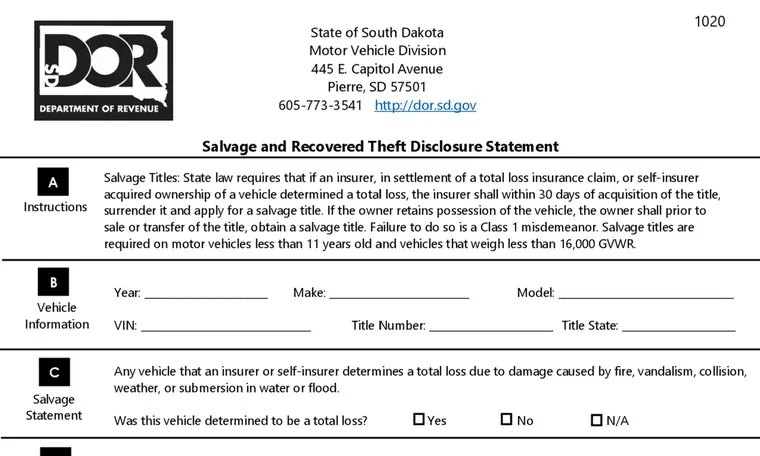
Written against Form 1020 (no revision printed), issued under South Dakota Department of Revenue, Motor Vehicle Division, under SDCL 32-3-51.19 to 32-3-51.22. The trap is the payout you kept. A South Dakota owner who takes an insurance settlement on a hail-damaged or flooded car and keeps the vehicle has acquired a duty, not just a cheque - the salvage title has to be obtained before the car is sold or the title transferred, and the offence is complete at the sale. It is also worth knowing what the branding does to the car afterwards: once a South Dakota title carries a salvage brand, getting back to a road-legal title runs through the rebuilt-vehicle inspection on Form 1016, and a vehicle more than ten model years old cannot be salvage-titled at all, which changes the conversation rather than ending it.

Two documents, and they are not the same thing. Take the blank Form 1020 from the sddor.seamlessdocs.com copy so you get the revision that is current today, then print our Form 1020 guide and keep it beside you while you fill theirs in.

Filled in

What a completed one looks like

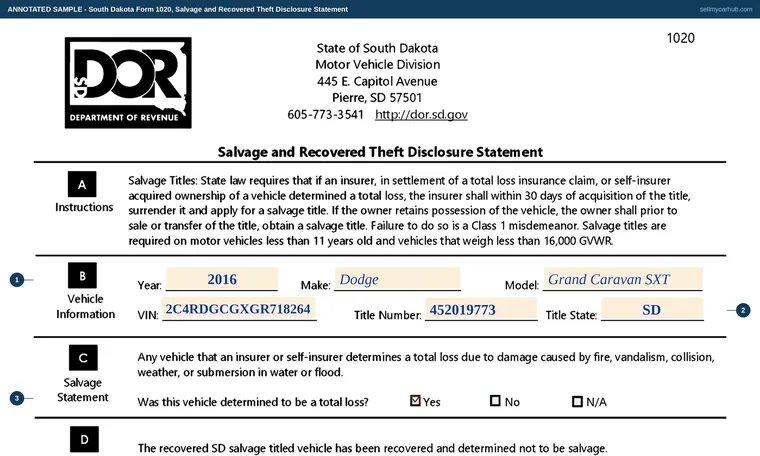
This is the actual Form 1020, rendered from the PDF the South Dakota Department of Revenue, Motor Vehicle Division publishes and completed end to end: letterhead, every field, and the blocks at the foot.

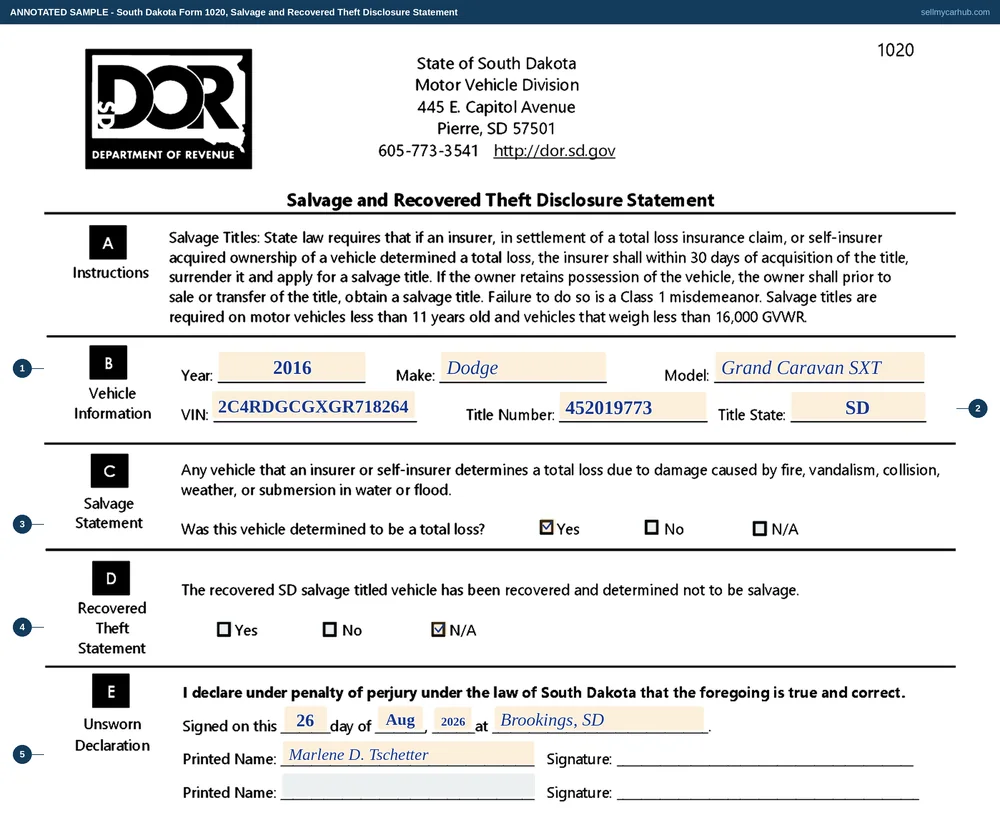
A completed South Dakota Salvage and Recovered Theft Disclosure Statement, Form 1020. The vehicle block identifies a 2016 Dodge Grand Caravan by year, make, model and vehicle identification number, with a South Dakota title number and title state. The salvage statement is answered Yes, that the vehicle was determined to be a total loss. The recovered theft statement is answered N/A. The unsworn declaration is dated at Brookings, South Dakota, with the first printed-name line completed and both signature lines left blank.
Completed for the situation the form exists for - a hail total loss where the insurer paid out and the owner kept the vehicle. The recovered-theft question is answered N/A rather than left blank, because it is a separate statement about a salvage-titled car being restored to an unbranded record, and a blank there is read as an omission.
Field by field

Every line, in the order you meet it

  1. 1
    You fill this in

    The vehicle, and where its title came from

    Year, make, model, VIN, title number and the state that issued the title.

    Watch out: The title state is not decoration. A brand carried on another state's certificate is transferred onto the South Dakota one in the previous state field.

  2. 2
    You fill this in

    Was it determined to be a total loss?

    Yes, No or N/A, against the printed definition covering fire, vandalism, collision, weather and submersion in water or flood.

    Watch out: The question is about what the insurer determined, not about what you think of the damage. A settlement letter calling it a total loss answers it.

  3. 3
    You fill this in

    The recovered theft question

    Whether a South Dakota salvage-titled vehicle has been recovered and determined not to be salvage.

    Watch out: For most sellers this is N/A. It exists for the narrow case where a stolen car came back undamaged and the salvage brand has to come off the record.

  4. 4
    You fill this in

    The declaration, date and place

    Day, month, place of signing, then printed names and signatures. Two pairs, for a jointly titled vehicle.

    Watch out: No notary is needed. What is needed is that this reaches the county treasurer before the car does, because the salvage title has to exist before the sale.

At a glance

What goes where

On the formWhat to put in it
Year, Make, ModelThe vehicle block at the head of the statement.
VIN, Title Number, Title StateThe identification number, the title number and the state that issued it - the last one matters because a branded out-of-state title produces a branded South Dakota one.
Salvage Statement - Was this vehicle determined to be a total loss?Yes, No or N/A, under the printed definition: any vehicle that an insurer or self-insurer determines a total loss due to damage caused by fire, vandalism, collision, weather, or submersion in water or flood.
Recovered Theft StatementYes, No or N/A, under the sentence that the recovered South Dakota salvage-titled vehicle has been recovered and determined not to be salvage.
Unsworn DeclarationSigned on a stated day at a named place, with two printed-name and signature pairs, under the declaration that the foregoing is true and correct under penalty of perjury.

What gets this one rejected

Rules that decide whether it is accepted

Every line here was read off Form 1020 (no revision printed) itself — the PDF is here — and off the South Dakota Department of Revenue, Motor Vehicle Division pages. This is plain-language help with a form, not legal advice, and where our wording and the agency's differ, theirs governs.

Back to all South Dakota seller paperwork, or what selling a car in South Dakota involves.

Want the paperwork handled instead?

Get My Instant Offer → Online · about 2 minutes · free

Or send the details — we'll come to you

A hail car, a flood car or a total loss you kept is squarely the kind of vehicle we buy - tell us what the insurer called it and we will price it as it is rather than as it was.

or call/text (877) 405-1808