Sell My Car Hub

How to fill out South Dakota Form 1016

The only inspection in the whole South Dakota titling system, and the third of three motor-vehicle forms that has to be notarised. It is how a salvage-branded car, a kit car or a vehicle built up out of parts becomes something that can be titled and driven, and it is priced accordingly: all information on this form must be complete and submitted to the county treasurer with a $25 inspection fee. Two pages. The first is a component inventory - thirteen named parts, each wanting the origin and the part number - and the second is the sworn affidavit and the notary block. A Department of Revenue employee then certifies that they have personally examined the vehicle, its major component parts and the ownership documents.
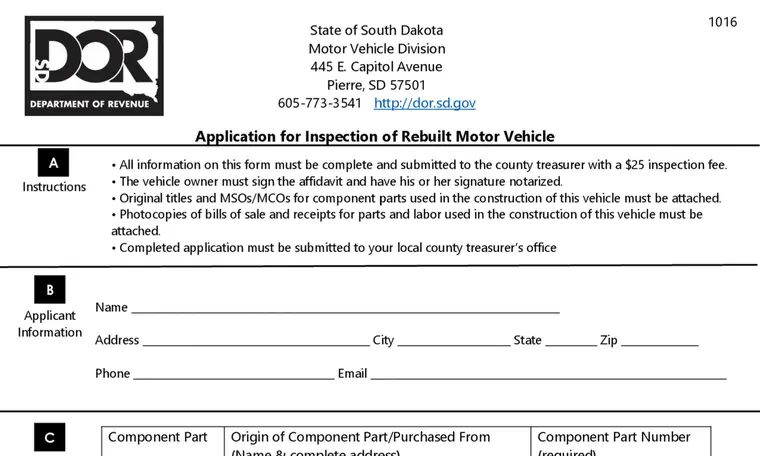
Written against Form 1016 (no revision printed), issued under South Dakota Department of Revenue, Motor Vehicle Division, inspection under SDCL 32-3-53 and 32-3-53.2. Do not start the rebuild by throwing away the paperwork. This form is an audit of provenance as much as of workmanship: thirteen component rows wanting an origin with a complete address, original titles or certificates of origin for major components, and photocopied receipts for parts and labour. A car rebuilt over two winters from parts bought at auctions and from a neighbour is exactly what the form is for, and exactly the case where the documents were never kept. Collect them as you go, keep the salvage title itself, and remember that the affidavit is sworn before a notary or a county treasurer and carries an indemnity to the state.

Two documents, and they are not the same thing. Take the blank Form 1016 from the sddor.seamlessdocs.com copy so you get the revision that is current today, then print our Form 1016 guide and keep it beside you while you fill theirs in.

Filled in

What a completed one looks like

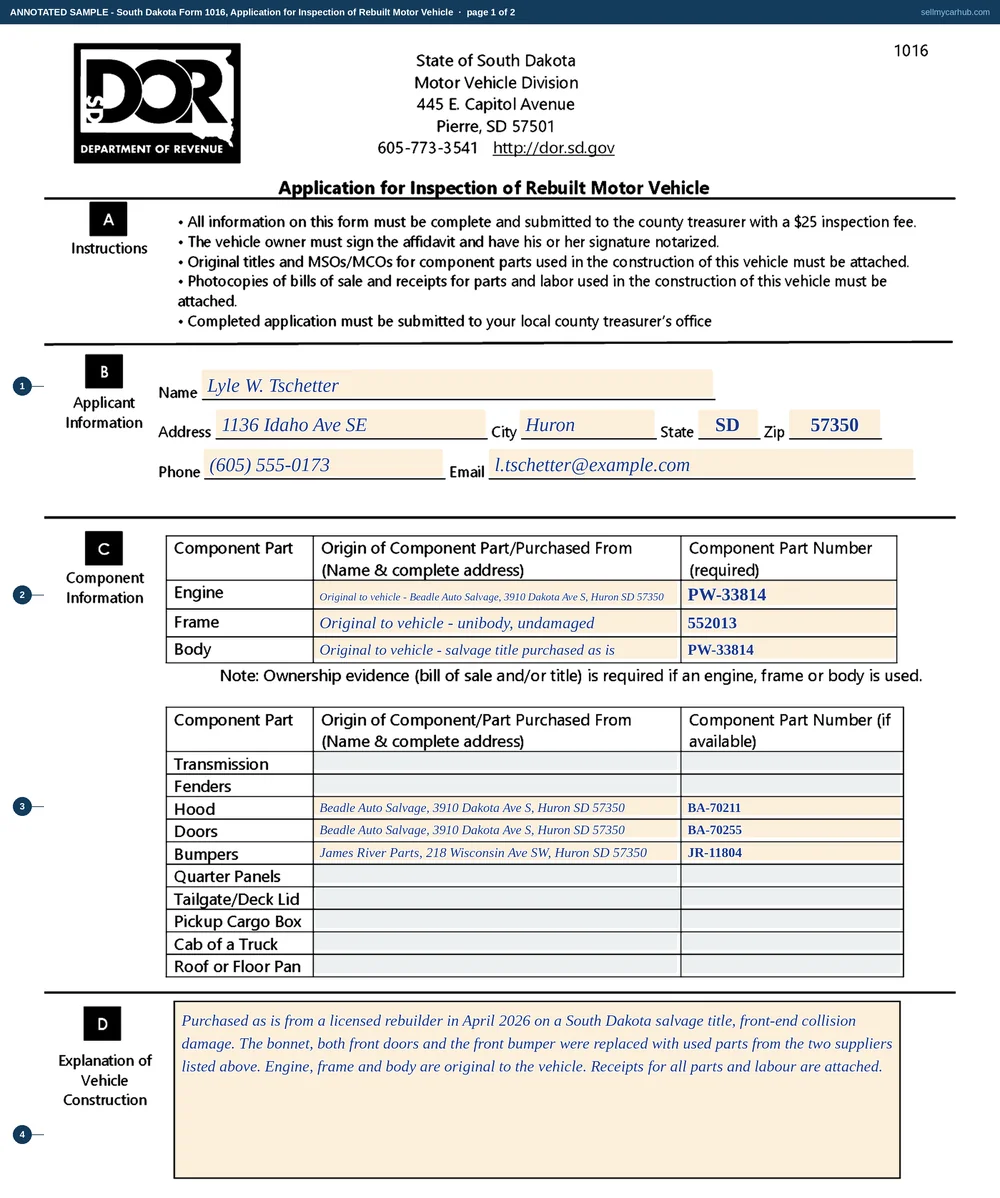
This is all 2 pages of the actual Form 1016, rendered from the PDF the South Dakota Department of Revenue, Motor Vehicle Division publishes and completed end to end: letterhead, every field, and the blocks at the foot.

A completed South Dakota Application for Inspection of Rebuilt Motor Vehicle, Form 1016. Page one names Lyle W. Tschetter of Huron, South Dakota as applicant and lists the origin and part number for the engine, frame and body, with an explanation of the vehicle construction beneath. Page two has the box for a vehicle purchased as is from a rebuilder ticked, a 2014 Jeep Cherokee identified by year, make, model, type and weight, the affiant's full legal name in separate first, middle and last boxes, a driver's licence number and telephone number, and both a physical and a mailing address in Huron. The signature line, the notary block and the Department of Revenue certification block are shaded grey.
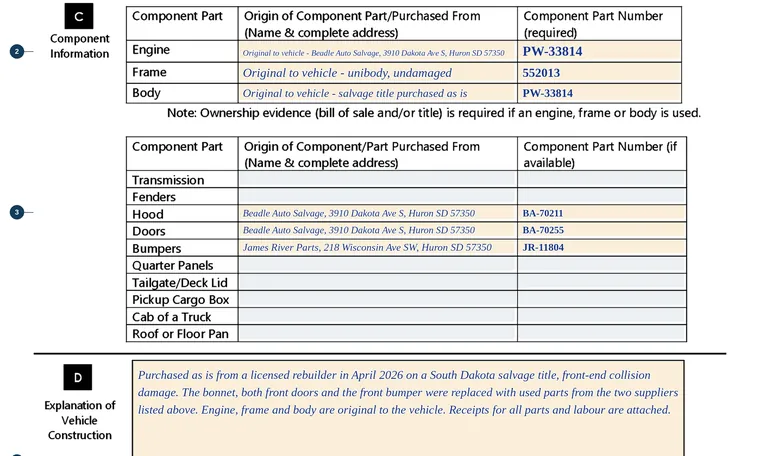
Page 1 of 2. Page one: the applicant and the component inventory. Engine, frame and body are completed with an origin and a part number because the form marks those three required; the ten optional rows below are filled where they were replaced and washed grey where they were not.
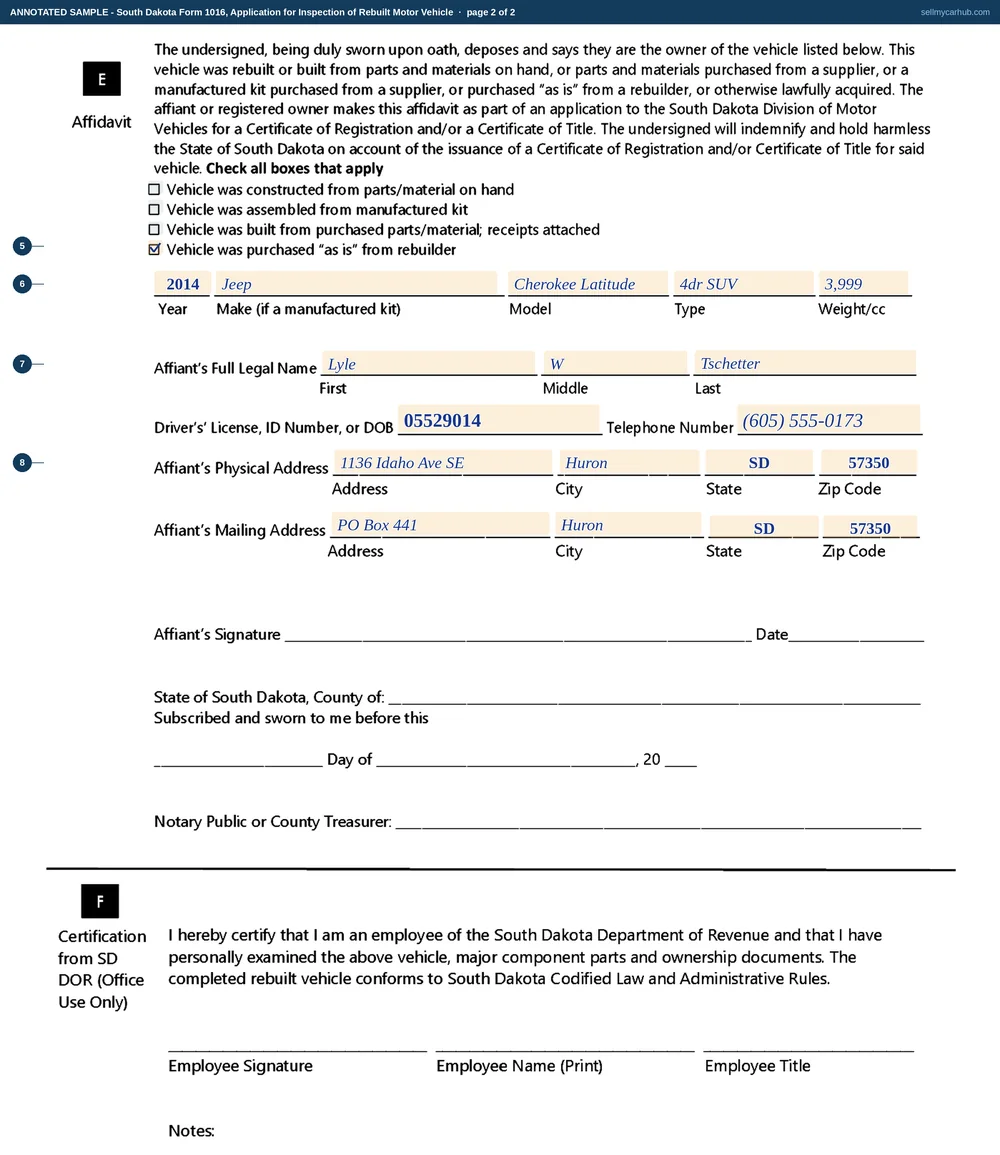
A completed South Dakota Application for Inspection of Rebuilt Motor Vehicle, Form 1016. Page one names Lyle W. Tschetter of Huron, South Dakota as applicant and lists the origin and part number for the engine, frame and body, with an explanation of the vehicle construction beneath. Page two has the box for a vehicle purchased as is from a rebuilder ticked, a 2014 Jeep Cherokee identified by year, make, model, type and weight, the affiant's full legal name in separate first, middle and last boxes, a driver's licence number and telephone number, and both a physical and a mailing address in Huron. The signature line, the notary block and the Department of Revenue certification block are shaded grey.
Page 2 of 2. Page two: the sworn affidavit with one of the four construction boxes ticked, the affiant's legal name and both addresses. The signature line, the notary block and the Department of Revenue certification are washed grey - none of the three is the applicant's to complete.
Field by field

Every line, in the order you meet it

  1. 1
    You fill this in

    Applicant details

    Name, address, phone and email for the vehicle's owner, at the head of page one.

    Watch out: Use a phone number that is answered. The inspection is a physical appointment with a division employee, arranged through the county treasurer.

  2. 2
    You fill this in

    Engine, frame and body - origin and part number

    For each of the three, where the component came from with a complete address, and its part number, which the form marks required.

    Watch out: These three are the ones that need paper behind them. Ownership evidence - a bill of sale, a title, or a manufacturer's certificate of origin - is required if an engine, frame or body is used.

  3. 3
    You fill this in

    The other ten component rows

    Transmission, fenders, hood, doors, bumpers, quarter panels, tailgate or deck lid, cargo box, cab and roof or floor pan, with origins and part numbers where available.

    Watch out: Leave a row blank only where the original part is still on the car. A replaced part with no origin recorded is what turns an inspection into a second visit.

  4. 4
    You fill this in

    Explanation of vehicle construction

    The free-text block: what the vehicle started as, what was replaced and in what order.

    Watch out: Write it for someone who has never seen the car. The inspector reads this before examining the vehicle, and a clear account is what makes the examination short.

  5. 5
    You fill this in

    One or more of the four construction boxes

    Parts or material on hand; a manufactured kit; purchased parts with receipts attached; or purchased as is from a rebuilder.

    Watch out: Ticking purchased parts commits you to the receipts. The affidavit says receipts attached in the box label itself, so an unsupported tick is a failed application.

  6. 6
    You fill this in

    The vehicle row and the affiant's identity

    Year, make, model, type and weight, then the affiant's full legal name split across first, middle and last, with a licence number or date of birth and a phone number.

    Watch out: The make box reads make if a manufactured kit. A vehicle built from scratch may genuinely have no make, and inventing one creates a record nothing else will match.

  7. 7
    You fill this in

    Physical address and mailing address

    Two full rows. The physical address is where the vehicle actually is.

    Watch out: They are not the same question. A rural route mailing address will not tell an inspector which yard the car is standing in.

  8. 8
    Somebody else fills this in

    The notary block and the department's certification

    Subscribed and sworn before a notary public or county treasurer, then a Department of Revenue employee certifies the personal examination of the vehicle, the components and the ownership documents.

    Watch out: Sign in front of whoever takes the acknowledgement, not before. And leave the certification block entirely alone - it is the department's, and a pre-filled one is the fastest way to have the file returned.

At a glance

What goes where

On the formWhat to put in it
Applicant InformationName, address, city, state, zip, phone and email.
Component Information - engine, frame, bodyThree rows, each wanting the origin of the component or where it was purchased from, with a name and complete address, and the component part number, which the form marks required. A note beneath: ownership evidence, a bill of sale or title, is required if an engine, frame or body is used.
Component Information - the other tenTransmission, fenders, hood, doors, bumpers, quarter panels, tailgate or deck lid, pickup cargo box, cab of a truck, and roof or floor pan. Origin and part number where available.
Explanation of Vehicle ConstructionA large free-text block for the account of how the vehicle was put together.
The affidavit, page twoThe undersigned, being duly sworn upon oath, deposes and says they are the owner of the vehicle listed below - rebuilt or built from parts and materials on hand, or parts and materials purchased from a supplier, or a manufactured kit purchased from a supplier, or purchased as is from a rebuilder, or otherwise lawfully acquired - and will indemnify and hold harmless the State of South Dakota.
Check all boxes that applyFour ticks: constructed from parts or material on hand; assembled from a manufactured kit; built from purchased parts or material, receipts attached; purchased as is from a rebuilder.
Vehicle rowYear, make - the form adds if a manufactured kit - model, type and weight or engine capacity.
Affiant's Full Legal Name, Driver's License or ID or DOB, Telephone NumberThe owner, identified. First, middle and last are separate boxes.
Affiant's Physical Address and Mailing AddressTwo full address rows, because a rebuilt vehicle is inspected where it is rather than where the post goes.
Affiant's Signature, Date, and the notary blockState of South Dakota, County of ___, subscribed and sworn to before me, then Notary Public or County Treasurer.
Certification from SD DOR, office use onlyAn employee signature, printed name and title, certifying that they have personally examined the above vehicle, major component parts and ownership documents, and that the completed rebuilt vehicle conforms to South Dakota Codified Law and Administrative Rules.

What gets this one rejected

Rules that decide whether it is accepted

Every line here was read off Form 1016 (no revision printed) itself — the PDF is here — and off the South Dakota Department of Revenue, Motor Vehicle Division pages. This is plain-language help with a form, not legal advice, and where our wording and the agency's differ, theirs governs.

Back to all South Dakota seller paperwork, or what selling a car in South Dakota involves.

Want the paperwork handled instead?

Get My Instant Offer → Online · about 2 minutes · free

Or send the details — we'll come to you

If a rebuild has stalled and the inspection is the thing standing between you and a title, tell us where it got to - we buy projects as well as running cars.

or call/text (877) 405-1808