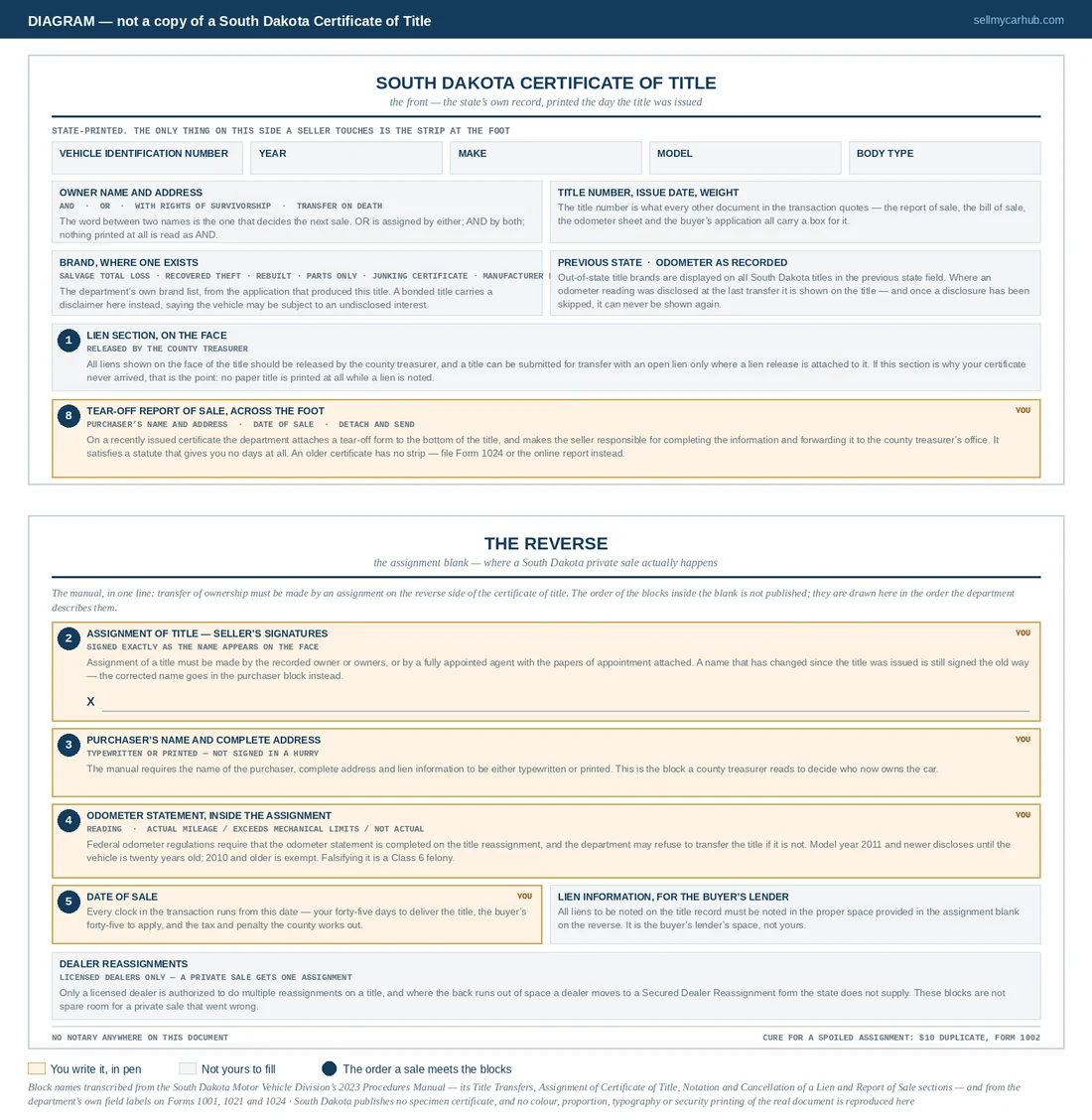
South Dakota puts the sale on the back. The face of the certificate is what the state printed the day it was issued - vehicle, owners, brands, liens - and the assignment blank on the reverse is where a private sale happens: seller's signatures, the buyer's name and complete address, the date of sale, the odometer statement, and a space for the buyer's new lender. A recently issued title carries one more thing: a tear-off report of sale at its foot, which is yours to complete and send back.
Last updated .
Your 9 boxes
As a private seller you complete these and nothing else:
There is no blank South Dakota certificate to download, and no specimen of one anywhere in the department's library - the counties issue it on secure stock. The diagram below is drawn from the Motor Vehicle Division's own descriptions of its document; beside this paragraph is our printable checklist of the entries in the assignment blank that are yours.
The division will not accept an incomplete application form or an application form that it considers inaccurate or appears to be altered - and South Dakota publishes no correction affidavit for a certificate, so a spoiled assignment means a $10 duplicate before the sale can move.
The manual walks the same order this page does: assignment of a title must be made by the recorded owner or owners, transfer of ownership must be made by an assignment on the reverse side of the certificate of title, the purchaser's name and complete address must be typewritten or printed, and federal odometer regulations require that the odometer statement is completed on the title reassignment.
The certificate itself
A South Dakota certificate, front and back, and the blank on the reverse where the sale happens
One sheet, two sides, and a private seller writes on one of them. The face is the state's record of the vehicle and its owners; the reverse carries the assignment blank, the odometer statement inside it and the dealer reassignment space that is not yours. At the foot of a recently issued certificate sits the tear-off report of sale - the strip that satisfies a statute with no grace period in it.
Amber — you write it, in pen
Grey — not yours to fill
Numbered — the order a sale meets the blocks
Click or tap the picture to open it full size.
Drawn, and labelled as a drawing on the image itself, because South Dakota publishes no specimen of its certificate. Four sources were searched before this was built: the Motor Vehicle Division's 2023 Procedures Manual (282 pages; its 149 embedded images enumerated with pdfimages and found to be fee schedules, form artwork, a prorate map, website screenshots and the plate catalogue), the ELT Guide (22 pages, three images, none a title), the department's title and registration pages, and its county-treasurer training material. Every block name here is transcribed instead from the manual's Title Transfers, Assignment of Certificate of Title, Notation and Cancellation of a Lien and Report of Sale sections, and from the department's own field labels on Forms 1001, 1021 and 1024. No colour, proportion, typography or security printing of the real certificate is reproduced.
A real one, filled in
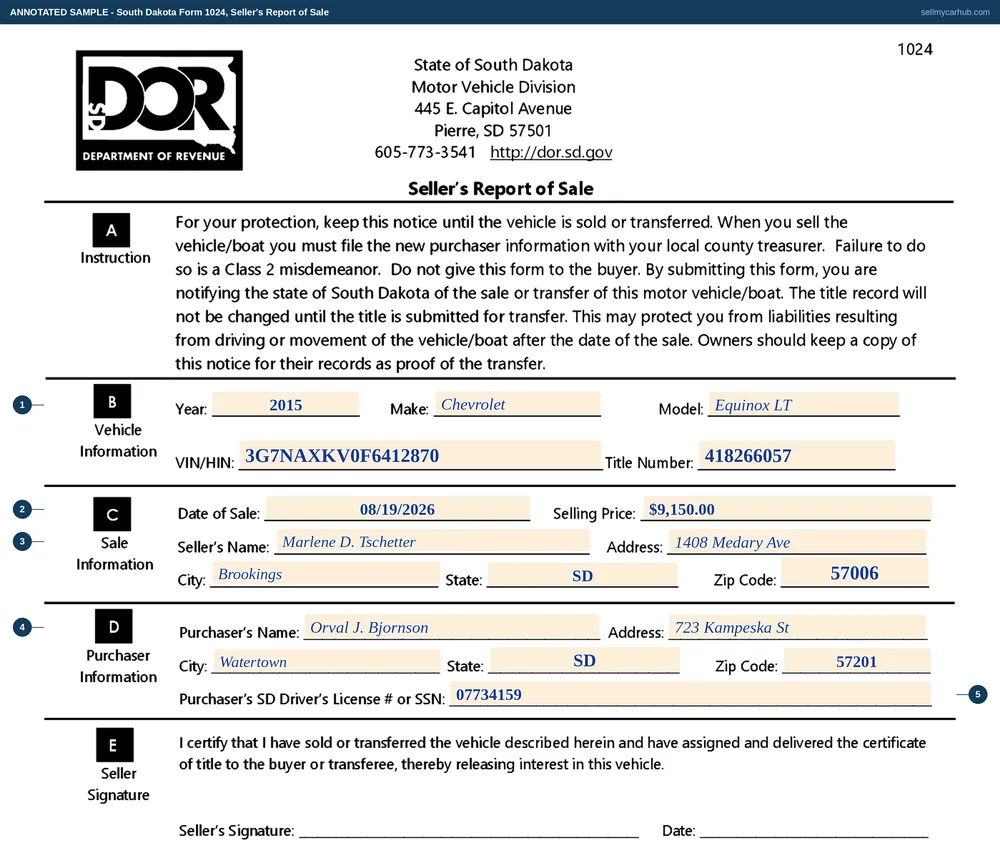
The Seller's Report of Sale, completed for the same sale
South Dakota publishes no picture of its certificate, but the document that mirrors the assignment is downloadable and here it is finished: Form 1024 for a 2015 Chevrolet Equinox sold in Brookings for $9,150. It records the same four facts the assignment blank records - who sold, who bought, when, and which vehicle - and its own instruction carries a warning that belongs on this page.
Click or tap the picture to open it full size.
Read its first instruction before you file it. For your protection, keep this notice until the vehicle is sold or transferred; when you sell the vehicle you must file the new purchaser information with your local county treasurer; failure to do so is a Class 2 misdemeanor - and then, in the department's own words, do not give this form to the buyer. It is your notice, not theirs. The signature line at the foot carries no field in the department's own form, so it is left for pen here rather than filled with a guess.
Step by step
Every box, in the order you meet it
0
You fill this in
Before any ink: read the face, then turn it over
Check the connector printed between the owner names, check whether a lien is shown on the face, and find the assignment blank on the reverse. Note whether the foot of the front carries a tear-off report of sale.
Watch out: South Dakota has no correction affidavit for a certificate. The division refuses an application that appears to be altered, and the only route back from a spoiled assignment is a $10 duplicate - which only the recorded owner can apply for.
1
The lienholder fills this in
The lien on the face, if there is one
All liens shown on the face of the title should be released by the county treasurer, and a title can be accepted for transfer with an open lien only where a lien release is attached to it.
Watch out: If your title never arrived, this is why: no paper title is printed while a lien is noted. The lender clears it electronically through its provider, or on Form 1503 if it does not use one, and the department then prints and mails the certificate.
2
You fill this in
Assignment blank, reverse: every owner signs as printed
Assignment must be made by the recorded owner or owners, signing exactly as the name appears on the face. One signature carries an OR title; an AND title, or one with nothing printed between the names, needs them all.
Watch out: A name that has changed since the title was issued does not get signed the new way. Sign as the face reads and print the current name in the purchaser block instead - that is the manual's own instruction for a marriage or a name change.
3
You fill this in
The purchaser's name and complete address, printed
The manual requires the name of the purchaser, complete address and lien information to be either typewritten or printed in the assignment blank on the reverse.
Watch out: Printed, not signed off in a hurry. This is the block a county treasurer reads to decide who now owns the car, and an assignment carrying a first name and a town is not a complete address.
4
You fill this in
The odometer statement, inside the assignment
Federal odometer regulations require the odometer statement to be completed on the title reassignment. Whole miles for any 2011-or-newer vehicle under twenty years old, with one of the printed statements ticked.
Watch out: Falsifying it is a Class 6 felony under SDCL 32-3-30.1, and the department may refuse to transfer the title if it is left incomplete. A 2010-or-older car is exempt - but if a previous owner skipped the disclosure, the manual says the odometer can never be shown on that title again.
5
You fill this in
Record the date of sale
The date the assignment is dated is the date every clock in the transaction runs from - your forty-five days to deliver, the buyer's forty-five days to apply, and the tax the county calculates.
Watch out: Do not change it later to buy anybody time. If the sale date is changed on the title the applicant has to prove the correct purchase date with a bill of sale or sales contract, and the manual notes that the penalty keeps running while they do.
6
You fill this in
Take the plates off, before the car leaves
The transferor shall remove the number plates from the vehicle. They go with you, and the unexpired months become a credit when they are attached to your next vehicle.
Watch out: Leaving them on is a Class 2 misdemeanor and it forfeits the credit outright - the plates are no longer valid the moment they stay behind. A $5 reassignment fee applies when you put them on the next car.
7
You fill this in
Hand over the free 45-day seller's permit
The seller shall provide the purchaser with a seller's permit that allows movement of the vehicle until it is registered, and no later than forty-five days from the date of purchase. It costs nothing, from the state portal or a county treasurer's kiosk.
Watch out: This one is yours to supply, not the buyer's, and it is a Class 2 misdemeanor to skip. Print it before your buyer arrives, not after - the car is not legally moving without it.
8
You fill this in
File the report of sale the same day
At the time of sale, the seller files a report of sale naming the purchaser and their address - on the tear-off strip at the foot of a recent certificate, online through the state portal, or on Form 1024.
Watch out: There is no grace period written into the statute at all. And read what it does and does not do: the report serves only as notification of a sale and does not cause any action to be taken against the title or registration record.
9
You fill this in
Give the buyer the bill of sale, then the title
A bill of sale cannot replace the assignment, but the buyer needs it at the counter. Deliver the assigned certificate inside forty-five days of the sale.
Watch out: Without a bill of sale the treasurer assesses the 4% excise tax on the retail value in a dealers' guide rather than on what your buyer paid. On an older car that gap is usually larger than the tax itself.
10
The buyer fills this in
The buyer's forty-five days
Title application, the 4% excise tax, the $10 title fee and the $2 technology fee, at the county treasurer in the county where they live - within forty-five days of the purchase date.
Watch out: Past forty-five days the county adds a $1 late fee for each week to twenty-five weeks and $50 thereafter, plus interest and a 10% penalty on the tax after sixty days. Past ninety days it is a Class 2 misdemeanor - and at day forty-six you can make it one by filing a written complaint.
Before the pen
Six rules for the pen, on a document the state will not let you correct
Six habits for a certificate that has no correction form standing behind it.
Work on the reverse, never the face
Transfer of ownership must be made by an assignment on the reverse side of the certificate of title. The face is the state's printing; the only thing on that side you ever detach is the tear-off report of sale at its foot.
Sign the name the face prints, not the name you use
The manual's marriage-and-name-change rule generalises: the seller signs using the exact name shown on the face of the title. The corrected name belongs in the purchaser block, or on a supporting affidavit, never over the top of the old one.
Print the buyer's details, do not scribble them
The name of the purchaser, complete address and lien information must be either typewritten or printed. A county treasurer who cannot read the address cannot issue the title.
Never leave the odometer statement half-done
The department may refuse to transfer the title or issue a new title if the owner, seller or auctioneer does not complete the odometer disclosure information on the vehicle title - and falsifying it is a Class 6 felony.
Stay out of the reassignment blocks
They are reserved for licensed dealers, and only a licensed dealer is authorised to do multiple reassignments on a title. A private sale gets one assignment.
Photograph the reverse before it leaves your hand
South Dakota's record does not change until your buyer reaches a counter, and the report of sale explicitly takes no action against the title record. Your photograph and your filed report are the whole of your evidence for up to forty-five days.
The ink rule is the Motor Vehicle Division in Pierre's own: “The division will not accept an incomplete application form or an application form that the Division considers inaccurate or appears to be altered.”
— Motor Vehicle Division, 2023 Procedures Manual.
Check your source
Three things South Dakota sellers get told that the state's own sources contradict
Three things South Dakota sellers repeat that the state's own sources contradict, one of which will cost you money and one of which is a misdemeanor.
"You have to get the title notarised before the buyer can use it."
Not for anything an ordinary sale touches. The word notary does not appear once in the Motor Vehicle Division's 282-page Procedures Manual, and nothing in SDCL chapter 32-3 requires it. What the department uses instead is an Unsworn Declaration printed at the foot of its forms - "I declare under penalty of perjury under the law of South Dakota that the foregoing is true and correct" - which appears on the title application, the duplicate application, the bill of sale, the salvage statement, the lien release and the bonded-title forms alike. Three forms at the edges of a sale genuinely do need a notary: the Succession Affidavit, the rebuilt-vehicle application and the power of attorney. Two of those three accept a county treasurer's signature instead, which is why the courthouse is usually the shortest route.
"Leave the plates on so the buyer can drive it home, then they'll mail them back."
That is a Class 2 misdemeanor and it costs you the credit. SDCL 32-5-2.7 puts the duty on the transferor to remove the number plates, and closes both doors behind it: no refund may be issued if the plate is detached and not reattached, and if the transferor fails to remove the plates, the transferor loses any credit and the plates are no longer valid. The buyer's legal drive home was never going to come from your plates anyway - South Dakota makes you supply a free forty-five-day seller's permit for exactly that, and failing to provide it is a second Class 2 misdemeanor.
"Write a dollar on the bill of sale and your buyer saves the tax."
It does the opposite, and the exemption people are reaching for already exists. SDCL 32-5B-4 tells the treasurer what to do with a price that is no or nominal consideration: tax the retail value stated in a nationally recognised dealers' guide. The Bill of Sale form prints that rule on its own face and gives you a box to explain a genuinely low price - condition of vehicle at time of sale - which is the honest route to the same place. And the real relief is in s. 32-5B-2: a vehicle eleven or more model years old sold for $2,500 or less before trade-in is exempt from the excise tax outright, at whatever the true price was.
Seven signature rules from the department's manual, and the first three are decided by a single word printed between two names:
Every owner printed on the face, exactly as printed
Assignment of a title must be made by the recorded owner or owners. The manual's rule for a name that has since changed is to sign as seller using the exact name shown on the face, and print the new name as purchaser instead.
Either owner, where the names are joined by OR
John Doe or Mary Doe must be assigned by either. That is the only connector that lets one signature carry the sale.
Both owners, where the names are joined by AND - or by nothing
John Doe and Mary Doe must be assigned by both, and a title with no connector printed between the names is interpreted as "and", requiring the signatures of all owners.
The survivor alone, on a WROS title after a death
John Doe and Mary Doe, with rights of survivorship may be assigned by the survivor on the death of one, when a certified copy of the death certificate is attached to the certificate of title.
A fully appointed agent, with the appointment attached
Papers of appointment - a power of attorney - must be attached to the title document when the assignment is made by an appointed agent. South Dakota's own Form 1023 is notarised, and the manual notes that a non-secure power of attorney is the one commonly used in private transactions.
A trustee, where the title is in a trust's name
If a title is issued in the name of a trust without a trustee indicated, a copy of the trust papers must be submitted; where the trust names multiple trustees joined by "and", all their signatures are required.
Not a licensed dealer, and not you in a dealer's block
Only a licensed dealer is authorised to do multiple reassignments on a title. The reassignment blocks on the back are not spare room for a private sale that went wrong.
Once it is signed
The assignment ends your ownership and starts four errands. The plates come off, the permit goes to the buyer, the report of sale is due the same day, and the forty-five days begins.