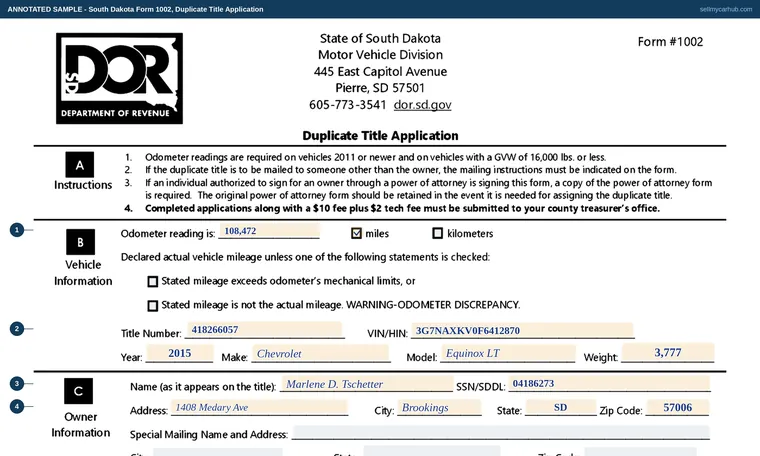
One form covers six different disasters, and its declaration lists them: the original title has been either lost, stolen, destroyed, mutilated, illegible or was never received. That last one matters more in South Dakota than elsewhere, because a title that was printed and posted can go missing between Pierre and a rural mailbox - and the department waives the fee if you notice quickly enough. It is also the only repair South Dakota publishes for a spoiled assignment: there is no correction affidavit for a certificate, so a title signed in the wrong place is a duplicate application, $10 plus the $2 technology fee, filed by the recorded owner.
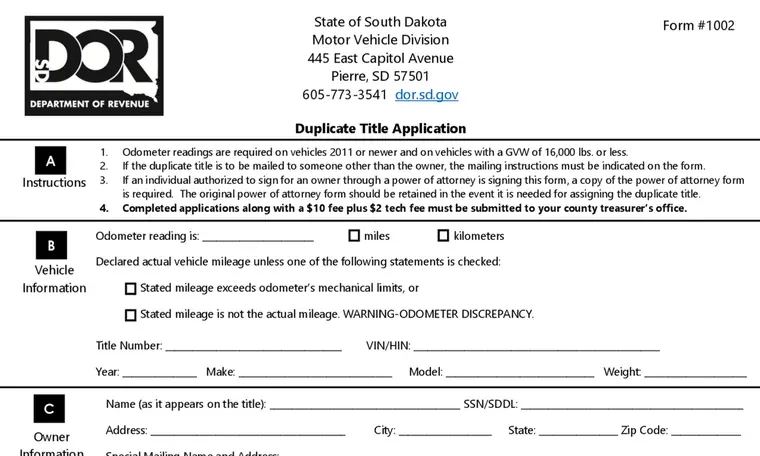
Written against Form 1002 (no revision printed), issued under South Dakota Department of Revenue, Motor Vehicle Division, applied for under SDCL 32-3-29. The declaration at the foot is the part people sign without reading, and it is the part that matters if a sale is already under way. You are declaring that you have not transferred the vehicle to another owner - or, if you have, that you are applying for the duplicate on behalf of the new owner. A seller who has already handed over an assigned certificate and then applies for a duplicate in their own name is making a false declaration under penalty of perjury on a document that will produce a second negotiable title for the same car. If the assignment was spoiled, get the spoiled certificate back and attach it.
Two documents, and they are not the same thing. Take the blank Form 1002 from the sddor.seamlessdocs.com copy so you get the revision that is current today, then print our Form 1002 guide and keep it beside you while you fill theirs in.
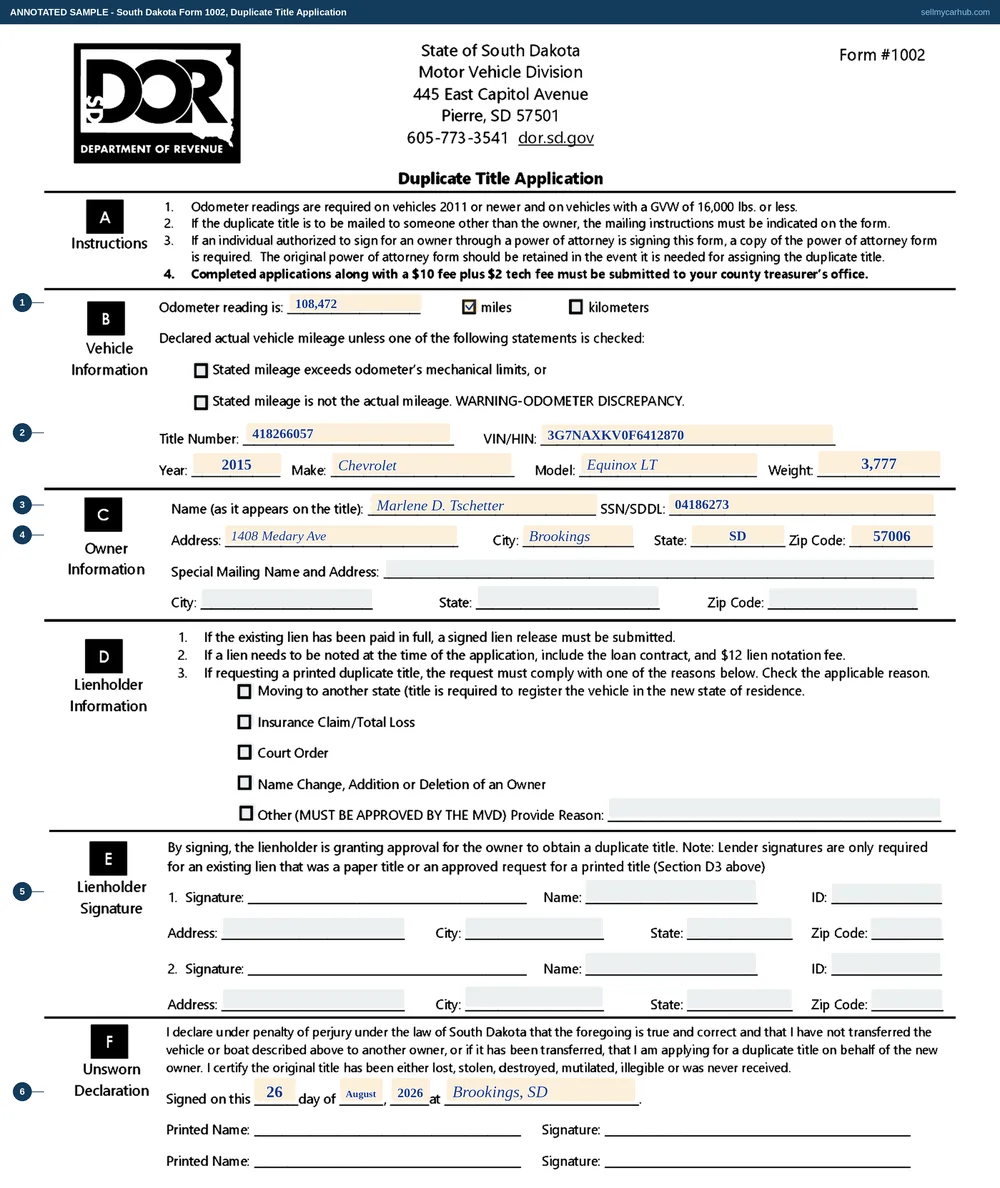
This is the actual Form 1002, rendered from the PDF the South Dakota Department of Revenue, Motor Vehicle Division publishes and completed end to end: letterhead, every field, and the blocks at the foot.
The current reading in whole units, with miles or kilometres ticked, and one of the two exception boxes only if it applies.
Watch out: Required for a 2011-or-newer vehicle or anything at or under 16,000 lb gross weight - so on most cars, not just the recent ones.
The title number, VIN or HIN, year, make, model and weight, identifying the record being replaced.
Watch out: If the title number is gone with the title, an old registration renewal notice usually carries it. So does the county treasurer's record, which is why any county can take this.
The name as it appears on the title, with a South Dakota driver's licence or social security number beside it.
Watch out: A name that has changed since the title was issued is signed the old way. The duplicate will be issued as the record reads, and the new name goes on at the next transaction.
Where the duplicate goes. The second block exists for a duplicate that has to be sent to someone other than the owner.
Watch out: The fee waiver for a title lost in the post depends on the replacement being sent to the same address the original went to - so changing it here can cost you the $10.
A reason for a printed title, then the lienholder's signature, name, identification and address.
Watch out: Lender signatures are only required for an existing lien that was a paper title or an approved printed-title request. A paid-off lien needs a release attached, not a signature here.
Day, place, printed name and signature - and on an AND title, every owner signs.
Watch out: Read the sentence you are signing. It declares that the vehicle has not been transferred to another owner, which is a live question if a sale is already half-done.
| On the form | What to put in it |
|---|---|
| Odometer reading is ___, miles or kilometers | The current reading, with a unit tick. The instruction at the head of the form sets the test: odometer readings are required on vehicles 2011 or newer and on vehicles with a GVW of 16,000 lbs. or less. |
| Declared actual mileage unless one of the following is checked | Two ticks beneath it - stated mileage exceeds the odometer's mechanical limits, or stated mileage is not the actual mileage, with the printed warning of an odometer discrepancy. |
| Title Number, VIN/HIN, Year, Make, Model, Weight | The vehicle block. The title number is what the department searches on, so it is worth digging out of an old registration if the certificate is gone. |
| Name (as it appears on the title), SSN/SDDL | The recorded owner, in the name the record holds. The manual is specific: where the name has changed, the applicant should sign using the name that was used on the original title. |
| Owner Address, City, State, Zip Code | The address the duplicate goes to unless the special mailing block below is used. |
| Special Mailing Name and Address | For a duplicate that must go somewhere other than the owner. The department's own instruction: if the duplicate title is to be mailed to someone other than the owner, the mailing instructions must be indicated on the form. |
| Lienholder Information, and one of five reasons | A block that only bites where a lien exists: moving to another state, an insurance claim or total loss, a court order, a name change or an owner being added or deleted, or Other, which must be approved by the Motor Vehicle Division. |
| Lienholder Signature, Name, ID, Address | Two lender blocks. The note above them limits when they are needed - lender signatures are only required for an existing lien that was a paper title, or an approved request for a printed title. |
| Unsworn Declaration | Signed on a stated day at a named place, printed name and signature, under the declaration that you have not transferred the vehicle to another owner - or, if it has been transferred, that you are applying on behalf of the new owner. |
Every line here was read off Form 1002 (no revision printed) itself — the PDF is here — and off the South Dakota Department of Revenue, Motor Vehicle Division pages. This is plain-language help with a form, not legal advice, and where our wording and the agency's differ, theirs governs.
Back to all South Dakota seller paperwork, or what selling a car in South Dakota involves.