Pennsylvania splits the job across a document you own and a form you cannot get. You assign the Certificate of Title in Section A on its reverse, in front of a notary or a dealer-licensed agent; that agent then prepares Form MV-4ST, which is issued to authorised agents only and is never published for download. Every block described below is transcribed from PennDOT's own fact sheets and bulletins, named beside each one.
Last updated .
Your 6 boxes
As a private seller you complete these and nothing else:
There is no blank Pennsylvania title to download and no blank MV-4ST either - PennDOT states that the form is only available from authorized agents of PennDOT. What the department does publish is a full field-by-field instruction sheet for it and a completed specimen inside the Agent Services Handbook, and this walkthrough is built out of both.
When Sections A and D are signed and notarized, the title has been transferred. Until then it has not been, whatever has changed hands.
PennDOT's sequence is fixed: the seller lists the purchaser's name and address, signs and prints, and discloses the odometer reading, in the presence of an authorized agent - and only then does the purchaser sign and print in the spaces provided.
The certificate itself
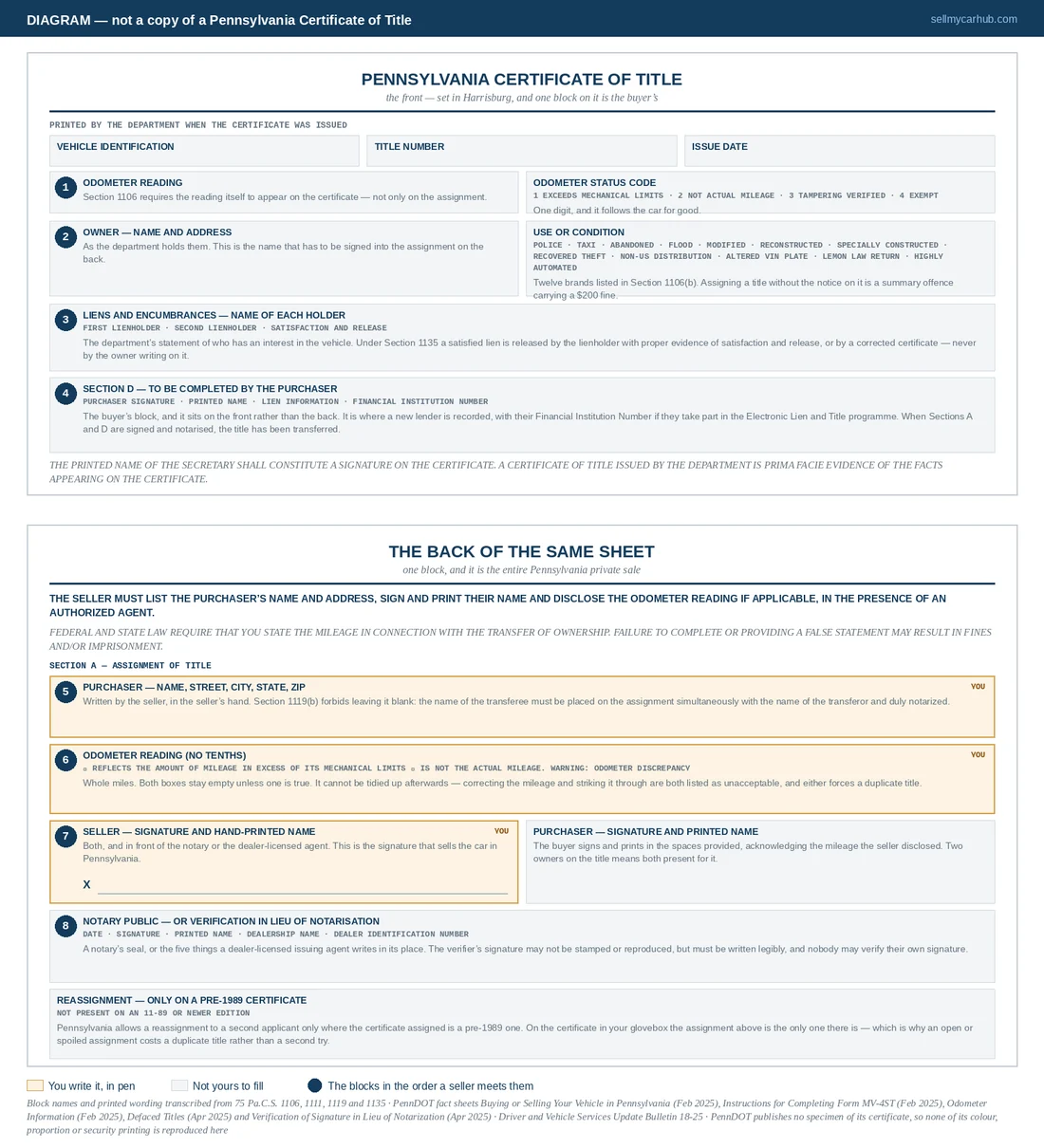
What sits where on a Pennsylvania certificate, front and back
Pennsylvania prints its certificate on one sheet, both sides. The front is the department's: the vehicle, the owner, the brands, the lien statement and the purchaser's Section D. The back carries Section A, the assignment, and that single block is the entire private sale. The eight markers below number the certificate’s own blocks in the order a seller meets them, front then back — a different set from the numbered steps further down this page, which run through the whole appointment rather than through the document.
Amber — you write it, in pen
Grey — not yours to fill
Numbered — the blocks in the order a seller meets them
Click or tap the picture to open it full size.
Drawn, and labelled as a drawing across the top. PennDOT publishes no specimen of its own certificate: the pa.gov search index was filtered to the whole dvspubsforms tree and the Driver and Vehicle Services bulletin folder and queried for specimen, conforming, exhibit, security features, title stock and 11-89; every BMV manual was downloaded and scanned for a full-page raster; and the Adobe asset host that serves PennDOT's sample registration card returns nothing for any title-shaped name. Block names and printed wording here are transcribed from 75 Pa.C.S. 1106, the Buying or Selling fact sheet, the Odometer Information fact sheet and Bulletin 18-25. None of the certificate's colour, proportion or security printing is reproduced.
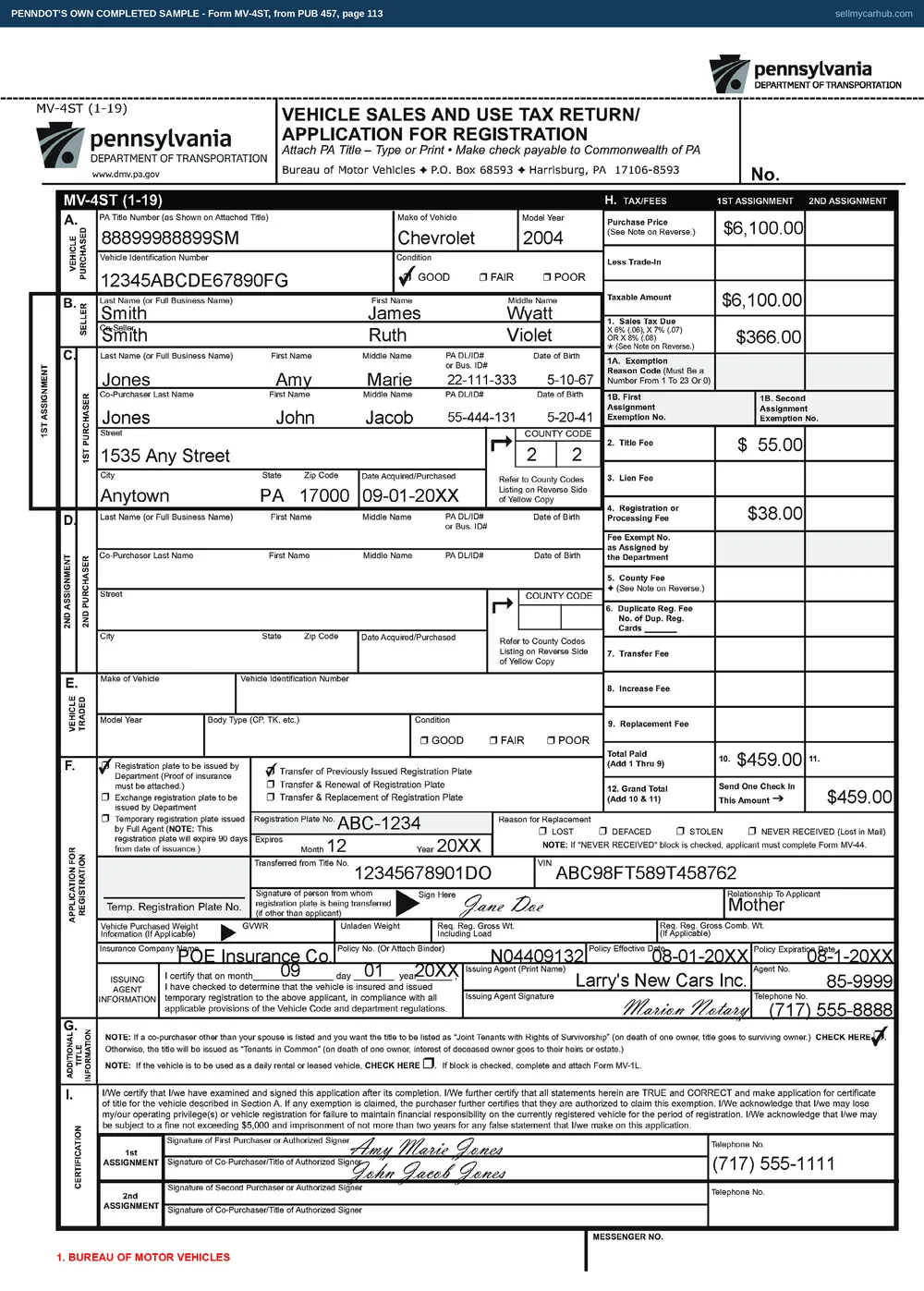
The form you cannot download, filled in
PennDOT's own completed MV-4ST, reproduced from the Agent Services Handbook
Because Form MV-4ST is issued to authorised agents only, there is no blank copy to annotate. There is something better: PennDOT prints a completed specimen of it on page 113 of PUB 457, the Agent Services Handbook, revision 5-25. Every name on it is the department's own invention - Smith, Jones, 1535 Any Street, Anytown PA 17000, dates written 20XX - so nothing here belongs to anybody.
Click or tap the picture to open it full size.
Look at Section H. The fee column runs purchase price, less trade-in, taxable amount, sales tax, title fee, lien fee, registration fee - and the agent adds them for the buyer at the appointment. And note Section G: if a co-purchaser other than a spouse wants right of survivorship, somebody has to tick that box, because the default PennDOT applies is tenants in common.
Step by step
Every box, in the order you meet it
0
You fill this in
Before any box: book the appointment
PennDOT's first instruction to a Pennsylvania seller is not a form. The buyer and seller should meet at a notary, tag service, or motor vehicle dealer to ensure the title application is completed correctly.
Watch out: Turn up with a blank assignment. A seller who has helpfully filled in Section A at home has produced a signature nobody witnessed, and the agent will send them for a duplicate title rather than accept it.
1
You fill this in
Section A, reverse - the purchaser's name and address
You write the buyer's name and address into the assignment block yourself. It is your handwriting, not theirs.
Watch out: Leaving it blank makes an open title, and Section 1119(b) forbids it outright: the name of the transferee must be placed on the assignment simultaneously with the name of the transferor and duly notarized.
2
You fill this in
Section A - the odometer disclosure
Whole miles, no tenths, plus two boxes: mileage in excess of mechanical limits, and not the actual mileage with an odometer discrepancy warning.
Watch out: Once written it cannot be tidied. PennDOT's defaced-titles guidance treats correcting the mileage as unacceptable and sends the parties for a duplicate title instead.
3
You fill this in
Section A - sign and hand-print
Your signature and your printed name, both, in front of the notary or the dealer-licensed agent doing the verification.
Watch out: Hand-print means hand-print. PennDOT's sentence is that the seller must sign and handprint their name on the proof of ownership document.
4
The buyer fills this in
Section A - the buyer signs too
The purchaser must sign and print their name in the spaces provided, acknowledging the mileage figure you just disclosed.
Watch out: Two owners on the title means two signatures, and PennDOT requires both people physically present for the notarisation.
5
The buyer fills this in
Section D, front - the purchaser's block
Section D on the front of the title is completed by the purchaser, and any new lien goes there, with the lender's Financial Institution Number if they are in the Electronic Lien and Title programme.
Watch out: This is the block that finishes the job: when Sections A and D are signed and notarized, the title has been transferred.
6
The buyer fills this in
The MV-4ST the agent prepares
Sections A to I, filled in by the agent from your certificate: vehicle, seller, purchaser, county code, registration, tax and fees, and the buyer's certification.
Watch out: Watch the county code. It is a two-digit number from PennDOT's own list - 02 for Allegheny, 51 for Philadelphia - and it is what decides whether the tax rate is 6, 7 or 8 per cent.
7
The buyer fills this in
The three copies
White to PennDOT, yellow retained by the agent for at least three years, pink kept by whoever the title is being issued to.
Watch out: The buyer should leave with the pink copy in hand. It is their only evidence that an application exists until the certificate arrives from Harrisburg.
8
You fill this in
Take the plate off the car
Remove the registration plate before the buyer drives away. The agent issues them a temporary plate valid for 90 days.
Watch out: The registration plate should never be given to the purchaser - PennDOT's own emphasis. It is yours to transfer or to surrender, and it is never theirs.
9
You fill this in
Surrender the plate, then cancel the insurance
Form MV-141 with the plate attached, reason block 2, Vehicle Sold. The agent dates it and gives you a copy.
Watch out: In that order. Section 1786(g)(2) protects you only if the plate and card were already surrendered when the coverage terminated.
Before the pen
Before you book the tag service
Six habits, and the first of them is about where you are standing rather than what you write.
Do not sign it at home
The whole Pennsylvania transfer turns on a witnessed signature. Signing early does not save a step, it wastes the title.
Sign and hand-print, both
PennDOT asks the seller to sign and handprint their name. A signature on its own is half the requirement.
No erasures, no white-out, no correction tape
The defaced-titles guidance names all three, plus folds, creases, tears and staple holes that make the assignment unreadable.
Whole miles, and only once
Mileage cannot be struck through and altered. If it goes down wrong, the fix is a duplicate title.
A bill of sale proves nothing here
Pennsylvania will not accept one as proof of ownership. The certificate is the document; a receipt is just a receipt.
Read the declaration above your signature
Most of these forms carry an unsworn declaration under 18 Pa.C.S. 4904 - a fine of at least $1,000 and up to two years.
Pennsylvania notary myths, and what the statute actually requires
Three things repeated confidently about selling a car in Pennsylvania. Each one has a source below it, and each one costs a seller either a second trip to the notary or a three-month suspension.
"Leave the plate on the car so the buyer can drive it home."
The opposite of the Pennsylvania rule, and PennDOT emphasises the sentence: the registration plate should never be given to the purchaser. The buyer gets a temporary registration plate from the authorised agent instead, valid for 90 days. Leave your plate on and it is still registered to you, still expected to be insured by you, and still returnable by you within five days under Section 1334.
"Download the MV-4ST and fill it in before you go."
You cannot. PennDOT states that Form MV-4ST is only available from authorized agents of PennDOT, and there is no copy of it on the forms site - the file simply does not exist, while every neighbouring MV number downloads. The same is true of Form MV-1. What is published is a field-by-field instruction sheet for each and a completed specimen of both inside PUB 457, the Agent Services Handbook.
"A notary is optional if you both sign in front of each other."
Not in Pennsylvania. Section 1111(a) requires the assignment to be sworn before a notary public or other officer empowered to administer oaths, or verified by a licensed wholesale auction or a dealer-licensed issuing agent, and Bulletin 18-25 states flatly that for a Pennsylvania certificate of title assigned to an individual, notarization IS required. Doing it any other way is a summary offence: $100 for a first offence, $300 to $1,000 for a later one.
Six signature rules, and only two of the signatures are yours:
The seller, in Section A on the reverse
Purchaser's name and address in your handwriting, the odometer reading, then your signature and your printed name - all of it witnessed.
The buyer, in Section A as well
The purchaser signs and prints in the spaces provided, acknowledging the mileage you disclosed.
The buyer again, in Section D on the front
Section D on the front of the title must be completed by the purchaser, and it is where a new lender goes if the car is being financed.
The notary, or a dealer-licensed agent
Either notarises or verifies. A verifier must be an issuing agent licensed as a dealer and authorised to issue temporary plates, and must write the date, their signature, their printed name, the dealership name and its DIN.
Two owners on the title
Both have to be present for signature and notarization or verification of signature - PennDOT's MV-1 instructions say it in those words.
Nobody, by stamp
The verifier's signature may not be stamped or reproduced, but must be written legibly. Falsely verifying one is a summary offence with a $300 fine.
Once it is signed
Signing is the middle of the job. In Pennsylvania what happens next is not a form you post - it is the plate coming off the car, and the order in which you surrender it and cancel the insurance.