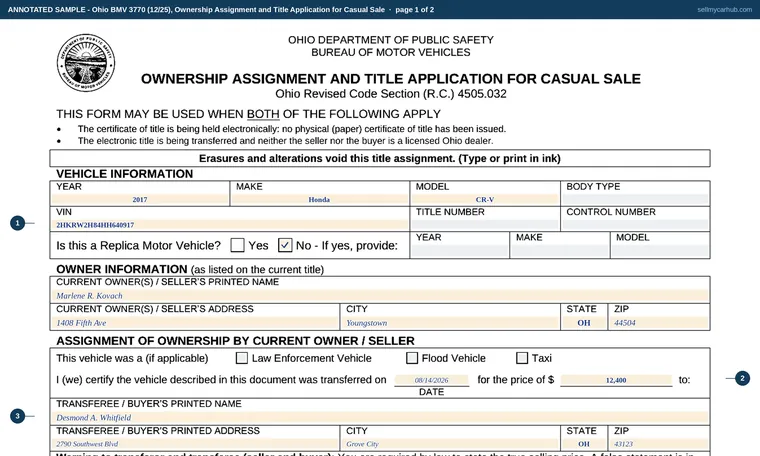
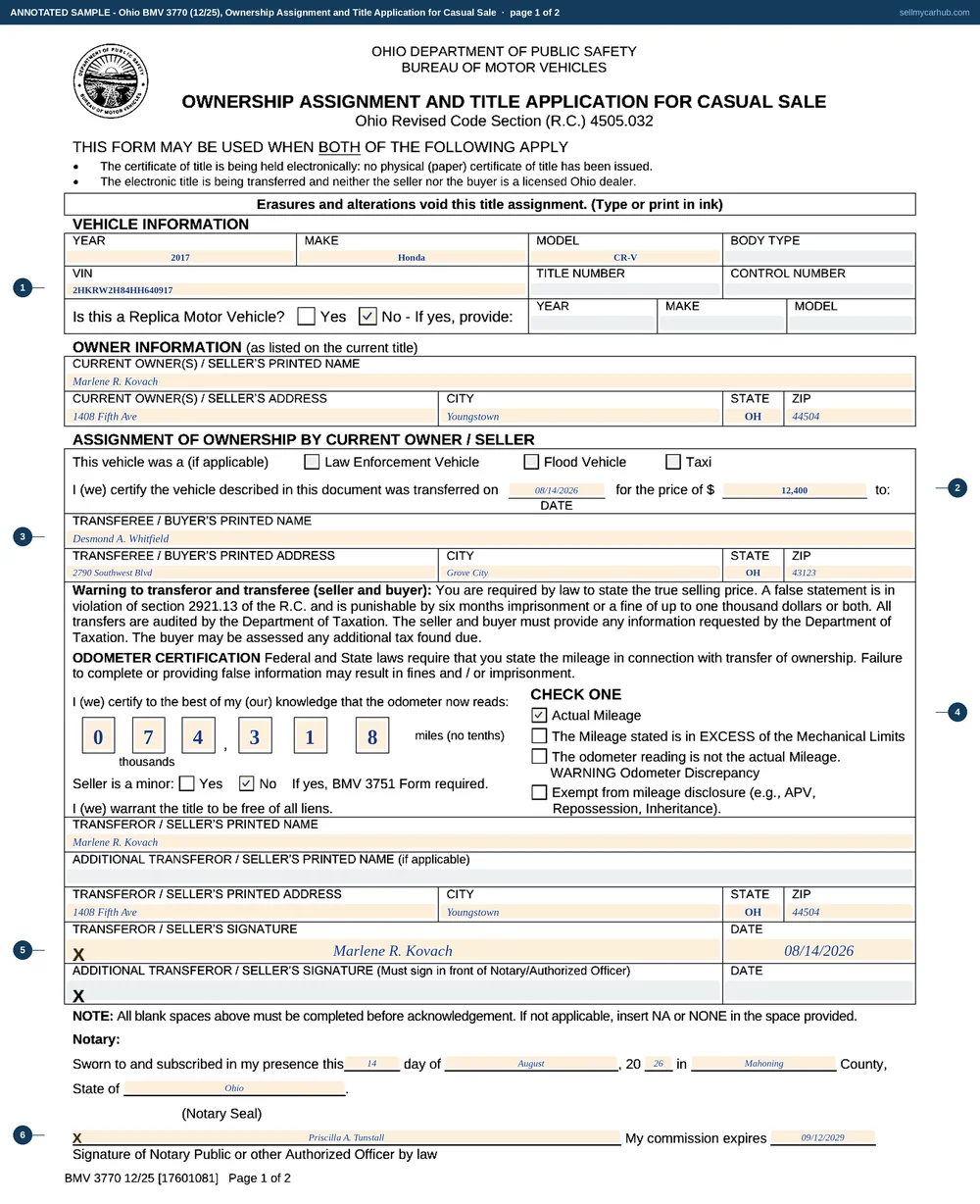
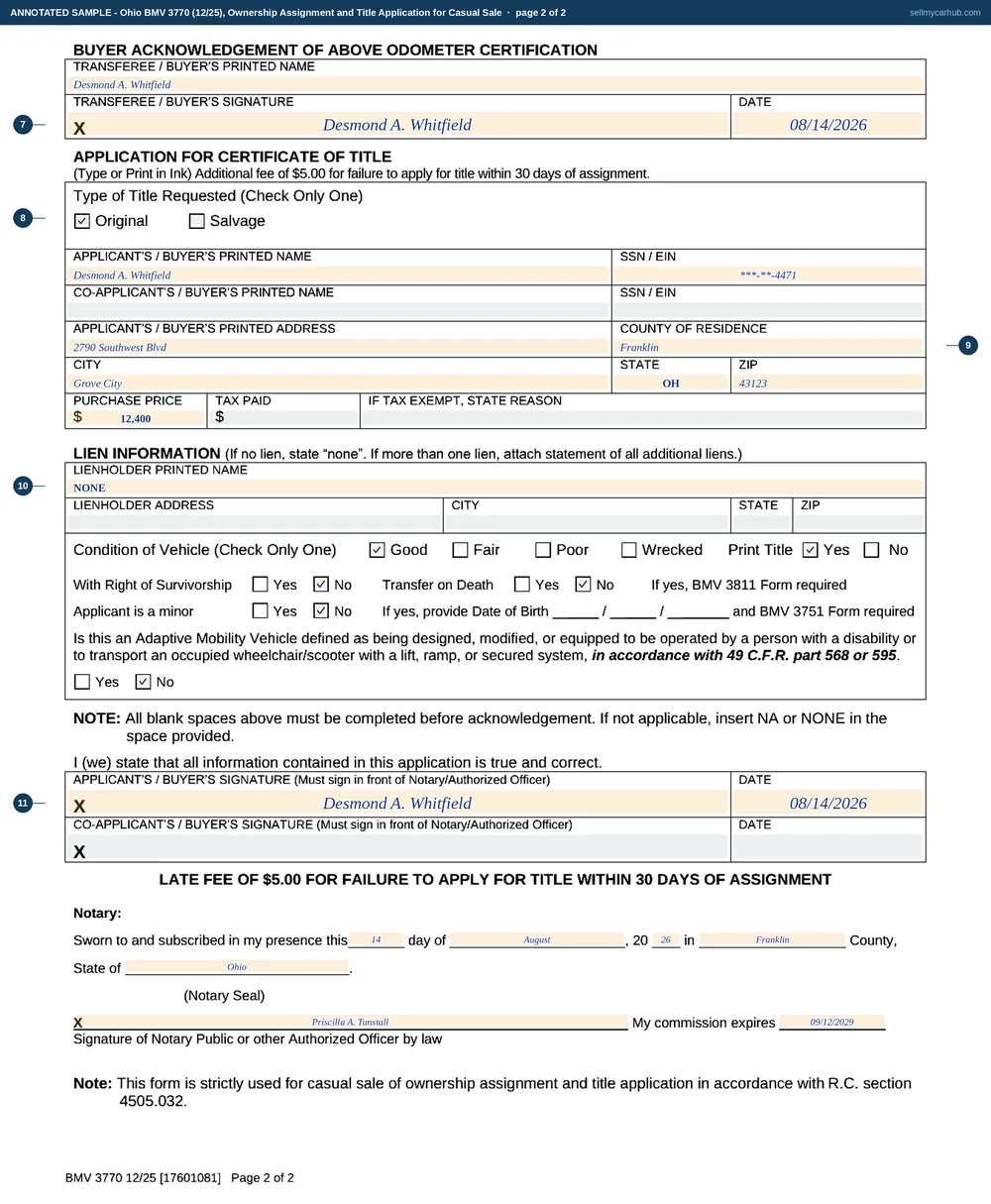
The back of an Ohio title, printed on a sheet of paper. When the certificate is held electronically there is no reverse to write on, so this stands in for it: your assignment of ownership on page one, the buyer's acknowledgement and application on page two, and a notary block on each. Two conditions have to hold, and the form states both across the top - no physical certificate has been issued, and neither party is a licensed Ohio dealer.
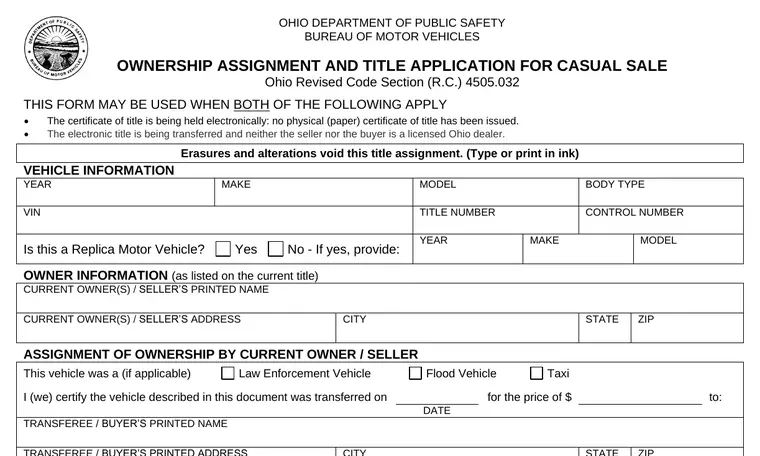
Written against BMV 3770 (12/25), issued under Ohio Revised Code 4505.032. This is the form the whole electronic-title route runs on, and it is revised often - check the code in the footer against the copy on the BMV's forms page before you write anything on it.
Two documents, and they are not the same thing. Take the blank BMV 3770 from the dam.assets.ohio.gov copy so you get the revision that is current today.
This is all 2 pages of the actual BMV 3770, rendered from the PDF the Ohio Bureau of Motor Vehicles publishes and completed end to end: letterhead, every field, and the blocks at the foot.
Year, make, model, body type, VIN, title number and control number, copied off the electronic title record rather than off the car.
Watch out: Body type is the clerk's abbreviation, not a word you choose. Take it from the record; guessing at it is one of the easier ways to have the form handed back.
The printed sentence gives you two blanks: the date the vehicle was transferred, and the price it was transferred for.
Watch out: The warning printed immediately below is not decoration. It says all transfers are audited by the Department of Taxation and that a false statement of the price violates section 2921.13 of the Revised Code.
Full legal name and a complete address, printed, in the block headed transferee.
Watch out: Get the spelling from their identification before you start writing. This is the block corrections happen in, and a correction voids the assignment.
Six boxes, one digit each, no tenths - then one tick from four in the CHECK ONE column beside them.
Watch out: Actual Mileage is a statement, not a default: leaving all four empty is an incomplete certification and the notary should not take the acknowledgement. Exempt is for an all-purpose vehicle, a repossession or an inheritance, not for an old car.
Printed name, address, signature and date. A second row waits for an additional transferor if two names are on the title.
Watch out: The additional signature line spells out what applies to both of them - must sign in front of Notary/Authorized Officer. A clerk of courts title office keeps notaries at the counter, which is why most Ohio sales are signed there.
Sworn to and subscribed in my presence this ___ day of ______, 20 ___ in ______ County, with the seal, the officer's signature and the date the commission expires.
Watch out: Everything above it has to be finished first. The note directly over this block says all blank spaces above must be completed before acknowledgement, and to insert NA or NONE where a line does not apply.
Page two opens with the buyer's printed name, signature and date against the odometer certification you made on page one.
Watch out: This is a federal requirement rather than an Ohio flourish, and it is why the two of you usually end up at the counter together.
Two boxes under Type of Title Requested. An ordinary roadworthy car is Original.
Watch out: Salvage is not a way of saving money on an old car. It changes what the vehicle legally is, and it cannot be undone by ticking the other box next time.
Printed name, Social Security or employer identification number, address, city, state, ZIP and county of residence.
Watch out: The county line is the buyer's own, and it is what sets the combined sales tax rate the clerk collects. It is not your county and not where the paperwork is filed.
The lienholder's printed name and address, under a heading that says if no lien, state none.
Watch out: Write the word. A blank reads as a question nobody answered, and the same instruction turns up on every Ohio title form.
Under the line stating that all information contained in this application is true and correct, with a second acknowledgement block for the notary underneath.
Watch out: Printed in bold across the foot of the page: a late fee for failure to apply for title within 30 days of assignment. The clock starts the day you sign, not the day they get round to it.
| On the form | What to put in it |
|---|---|
| Vehicle information | Year, make, model, body type, the vehicle identification number, and the title and control numbers off the electronic record. A replica question sits under them with its own year, make and model boxes for a Yes. |
| Owner information | Your printed name and address exactly as the current title holds them - the heading says as listed on the current title. |
| Assignment of ownership | Three ticks for a former law enforcement vehicle, flood vehicle or taxi, then the printed certification: the vehicle described in this document was transferred on ______ for the price of $______ to - and the buyer's printed name and address. |
| Odometer certification | Six printed boxes for the reading, one digit each, with a comma after the third and the word thousands under the second. Beside them a CHECK ONE column of four: Actual Mileage; the mileage stated is in EXCESS of the mechanical limits; the odometer reading is not the actual mileage; exempt from mileage disclosure. |
| Seller is a minor | A Yes or No that most people skip. Yes needs a notarised BMV 3751 with it. |
| The transferor block | Printed name, an additional transferor line for a second owner, address, then the signature and date rows - the second of which says in its own label that it must be signed in front of a notary or authorised officer. |
| The notary block, page one | Sworn to and subscribed in my presence this ___ day of ______, 20 ___ in ______ County, State of ______, with a space for the seal and the commission expiry. |
| Buyer acknowledgement, page two | The buyer prints, signs and dates to acknowledge the odometer certification you just made. |
| Application for certificate of title | Original or Salvage, the applicant's printed name, Social Security or employer number, address and county of residence, the purchase price and tax, the lien information, the condition of the vehicle, and whether a paper title is to be printed. |
| The notary block, page two | A second acknowledgement, this one for the buyer. Two notarisations on one document is normal in Ohio. |
Every line here was read off BMV 3770 (12/25) itself — the PDF is here — and off the Ohio Bureau of Motor Vehicles pages. This is plain-language help with a form, not legal advice, and where our wording and the agency's differ, theirs governs.
Back to all Ohio seller paperwork, or what selling a car in Ohio involves.