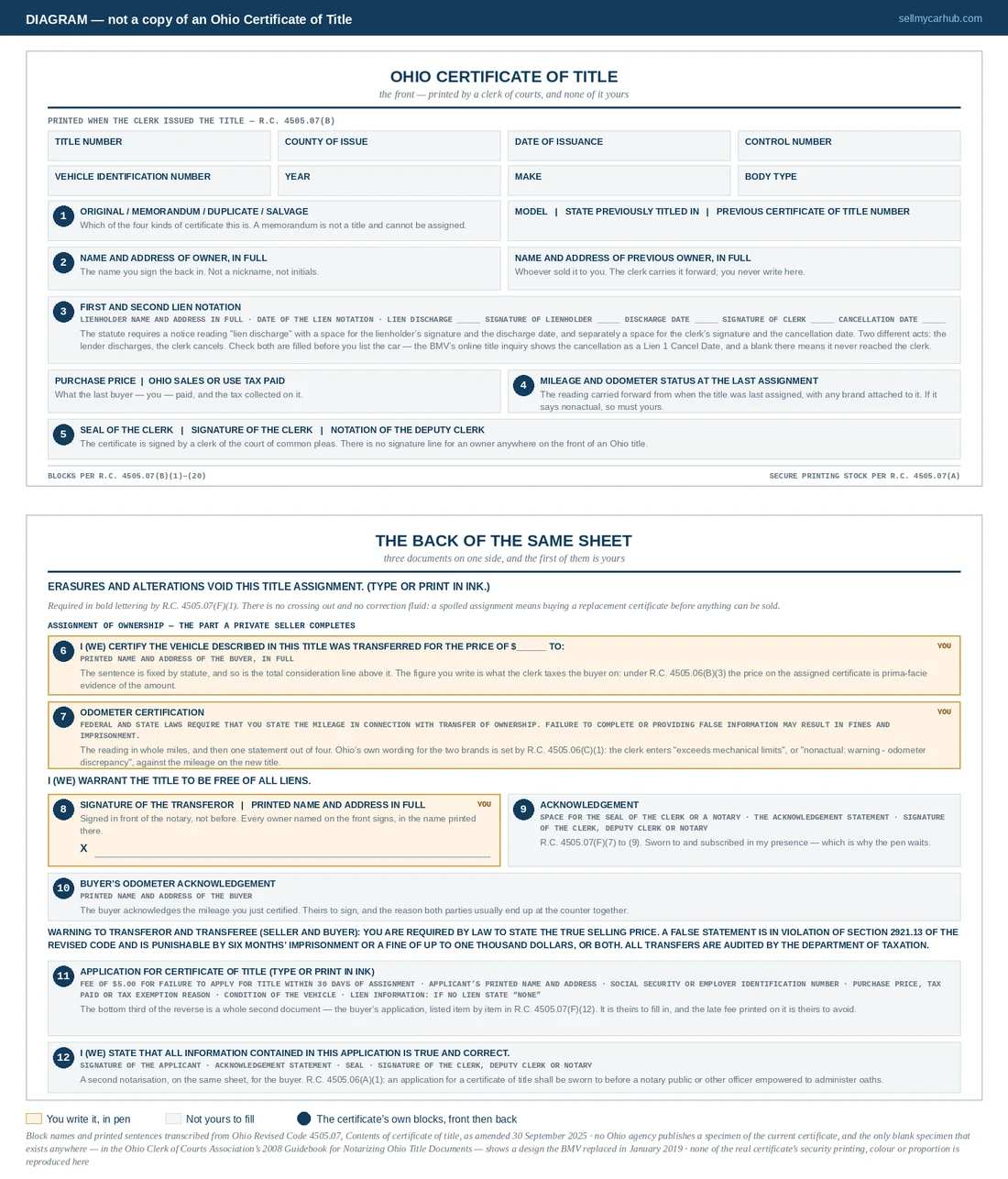
An Ohio certificate carries the whole transfer on its reverse: your assignment at the top, the buyer's odometer acknowledgement in the middle, and the buyer's application for a new title at the foot. Every block below is transcribed from R.C. 4505.07, which specifies the front and the back of the certificate item by item and quotes the printed sentences word for word.
Last updated .
Your 8 boxes
As a private seller you complete these and nothing else:
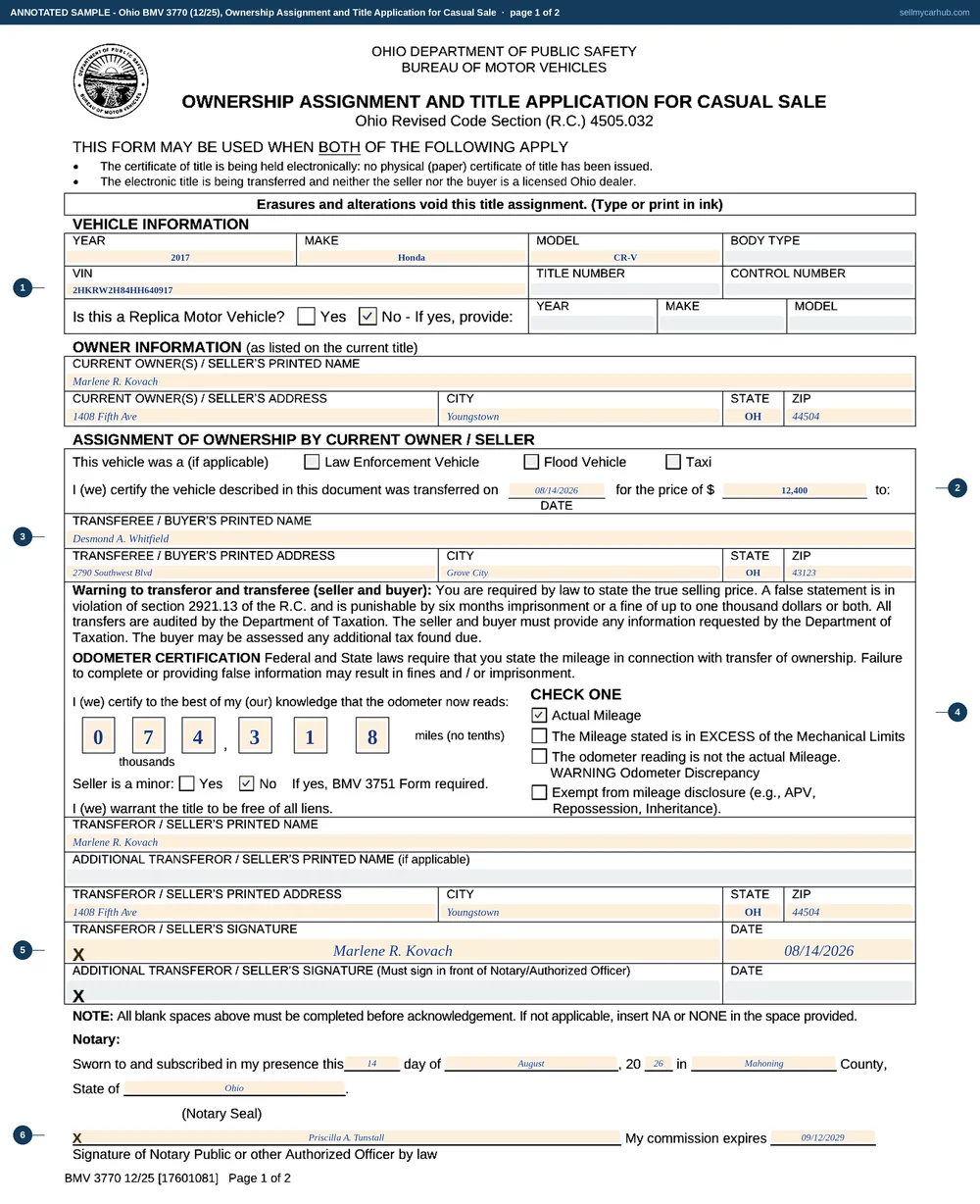
There is no blank Ohio title to download and no sample to practise on - the certificate is printed on secure stock by the clerk of courts and the only copy in existence is the one in your drawer. What you can download is BMV 3770, which R.C. 4505.032 makes the exact equivalent for an electronic title, and that is the document shown filled in below.
One line governs the whole side: ERASURES AND ALTERATIONS VOID THIS TITLE ASSIGNMENT. (Type or print in ink.)
The statute is the specification the printer works to. Where it says the reverse shall carry a notice in bold lettering, that notice is on your title in bold lettering.
The certificate itself
What is on an Ohio certificate, front and back, by statute
Ohio prints the transfer on the reverse of the certificate and nothing a private seller writes belongs on the front. The markers below number the blocks in the order R.C. 4505.07 lists them, front then back — a different set from the numbered steps further down this page, which follow the order you fill them in.
Amber — you write it, in pen
Grey — not yours to fill
Numbered — the certificate’s own blocks, front then back
Click or tap the picture to open it full size.
Drawn, not photographed, and it says so across the top. No Ohio agency publishes a specimen of the current certificate: the BMV's titling pages, its fee and forms pages, all 21 of its title forms and its own Lien Release and Title visual aid contain no picture of one, and the only blank specimen that exists anywhere is in the Ohio Clerk of Courts Association's Guidebook for Notarizing Ohio Title Documents, which dates from 2008 and shows a certificate two designs out of date - the BMV replaced it in January 2019. Every block name and every quoted sentence here is transcribed instead from R.C. 4505.07, the statute the certificate is printed to.
The same transfer, on a form you can download
BMV 3770, page one, completed for one private sale
When the title is electronic there is no reverse to write on, and R.C. 4505.032 puts the identical assignment on BMV 3770 instead - the BMV's own words are that it serves the same purpose as the back of a physical title. Page one is yours, top to bottom. Amber is what gets written; the grey blocks belong to somebody else or do not apply to an ordinary cash sale.
Click or tap the picture to open it full size.
Look at the mileage row. Six printed boxes, a comma between the third and the fourth, and the word thousands under the second - Ohio wants the reading digit by digit with no tenths, and then a separate tick in the CHECK ONE column. Actual Mileage is a positive statement, not a default: leaving all four boxes empty is an incomplete certification, and the notary is not supposed to take the acknowledgement.
Step by step
Every box, in the order you meet it
1
You fill this in
Before the pen: do not sign it yet
The assignment is a sworn statement. It is signed in front of a notary public or a deputy clerk of courts, who is certifying that they watched you sign it.
Watch out: A clerk of courts title office keeps notaries at the counter, so the usual answer is to meet the buyer there and do the whole thing in one visit. Signing at the kerb and finding a notary afterwards does not work - the acknowledgement says sworn to and subscribed in my presence.
2
You fill this in
The price, and the date of delivery
The printed sentence is fixed by statute: I (we) certify the vehicle described in this title was transferred for the price of $______ to: - followed by the buyer's printed name and address in full.
Watch out: The number you write is what the clerk taxes the buyer on. R.C. 4505.06(B)(3) makes the price on the assigned certificate prima-facie evidence of the amount, and every Ohio title form warns that all transfers are audited by the Department of Taxation.
3
You fill this in
The buyer's name and address
Full legal name, spelled the way the buyer's identification spells it, and a complete address.
Watch out: Get it before you start writing, not while the buyer is looking over your shoulder. This is the block where corrections happen, and a correction here voids the assignment.
4
You fill this in
The odometer certification
The reading in whole miles, no tenths, and then one tick from four: Actual Mileage; the mileage stated is in excess of the mechanical limits; the odometer reading is not the actual mileage; or exempt from mileage disclosure.
Watch out: Exempt is not an age box. Its printed examples are an all-purpose vehicle, a repossession and an inheritance. Getting this wrong is not a clerical slip - R.C. 4549.46 makes an odometer disclosure violation a felony of the fourth degree.
5
You fill this in
I (we) warrant the title to be free of all liens
A printed certification that sits immediately above your signature. You are not ticking it; you are signing under it.
Watch out: If a lender was ever on this title, check the front for a discharge date before you sign. The BMV's own title inquiry shows a Lien 1 Cancel Date - a blank there means the release never reached the clerk, whatever the lender told you on the phone.
6
You fill this in
Your signature and printed name
Signed and printed exactly as your name appears on the face of the title, with your address. Every owner shown on the front signs.
Watch out: Legal names only. The Clerk of Courts Association's guidance to notaries is explicit about it - Clifton J. Smith, not CJ Smith - and a company or a trust signs in the entity's name followed by the person's name and their position.
7
You fill this in
The notary acknowledgement
Sworn to and subscribed in my presence this ___ day of ______, 20__ in ______ County, State of ______, with the notary's signature, seal and commission expiry.
Watch out: A notary is not supposed to take an acknowledgement on a document with blanks left to be filled in later. Where something does not apply, the form's own instruction is to insert NA or NONE rather than leaving the space empty.
8
The buyer fills this in
The buyer acknowledges the mileage
A second block, in the middle of the reverse, where the buyer prints their name and signs to acknowledge the odometer certification you just made.
Watch out: This is a federal requirement, not an Ohio flourish, and it is the reason both parties usually end up at the counter together.
9
The buyer fills this in
The application for a certificate of title
The bottom third of the reverse. Type of title requested, the buyer's printed name, address, county of residence and Social Security number, the purchase price and tax paid, and the lien information.
Watch out: Where there is no lender the printed instruction is to state none - a blank reads as a question nobody answered. And the county on this line is the buyer's own, because it decides the combined sales tax rate.
10
The buyer fills this in
The buyer signs, and is notarised too
Under the line I (we) state that all information contained in this application is true and correct, followed by a second acknowledgement block for the notary or deputy clerk.
Watch out: R.C. 4505.06(A)(1) is the reason: an application shall be sworn to before a notary public or other officer empowered to administer oaths. Two notarisations on one piece of paper is normal in Ohio.
11
The buyer fills this in
Thirty days, then five dollars
The application has to reach a county Clerk of Courts title office within thirty days of the assignment or delivery.
Watch out: The penalty is printed on the document itself - fee of $5.00 for failure to apply for title within 30 days of assignment. It is small, but a buyer who has drifted past thirty days has usually also let the temporary tag expire.
12
You fill this in
And your plates come off
Not a block on the title at all, but the step that ends your registration. R.C. 4503.12(A) says the original owner immediately shall remove the license plates from the motor vehicle.
Watch out: There is no Ohio notice of sale to file instead. The plates in your hand are the whole mechanism, and leaving them on the car is a fourth-degree misdemeanour under the same section.
Before the pen
Before you sit down with the clerk
Six habits, and the first two are the ones that void an Ohio assignment outright.
Ink, and no second attempt
The instruction printed across the top of BMV 3770 is type or print in ink, and the sentence beside it is that erasures and alterations void the assignment. There is no correcting a slip on this document.
Nothing signed before the notary sees it
Both the assignment and the application are sworn statements. The acknowledgement block certifies that the signing happened in the notary's presence.
NA or NONE, never a gap
The form's own note: all blank spaces above must be completed before acknowledgement. If not applicable, insert NA or NONE in the space provided.
The name the title carries
Sign and print the name shown on the face of the certificate. An entity signs in the entity's name, then the person, then their position.
Whole miles
The mileage boxes are labelled miles (no tenths), and there is one printed box per digit.
Read the warning above the price
You are required by law to state the true selling price. It appears on BMV 3770, BMV 3772, BMV 3774 and BMV 3754 in identical words.
What Ohio sellers are told about the BMV that is wrong
Three things said confidently about selling a car in Ohio that will each cost you a trip. Every correction below links the Ohio source it comes from.
“Take the title to the BMV and they will transfer it.”
They will not, because they cannot. The BMV puts the correction at the top of every one of its titling pages: Ohio titles are issued by Clerk of Courts title offices, the BMV does not issue titles. A deputy registrar licence agency does plates, registration and driver licences. The certificate of title is a county Clerk of Courts matter, and the two are usually not in the same building.
R.C. 4503.12(A) says the registration expires on transfer and the original owner immediately shall remove the license plates from the motor vehicle, and division (D) makes a violation a misdemeanor of the fourth degree. The buyer's legal way home is a forty-five-day temporary tag from a deputy registrar, which the BMV says has to be obtained before the title is transferred into their name.
“You cannot sell it until the paper title turns up.”
In Ohio you very often can. Most titles are now held electronically, and R.C. 4505.032 lets a private seller assign one to an Ohio buyer on BMV 3770, which the BMV describes as serving the same purpose as the back of a physical title. The department's own visual aid puts it in one sentence: you do not need a paper title to sell or transfer your vehicle.
Ohio wants more signatures on a private sale than most states, and every one of them is witnessed:
Every owner on the face of the title
All of them sign the assignment, in the names printed on the front, and all of them sign in front of the notary.
The notary or the deputy clerk
Signs, dates and seals the acknowledgement. A clerk of courts title office has notaries at the counter, which is why most Ohio assignments are signed there rather than at a bank.
The buyer, twice
Once to acknowledge your odometer certification, and once on the application for the new title - and that second signature is notarised too.
An attorney-in-fact
Only on an original, notarised BMV 3771, which is surrendered with the title and becomes part of the permanent record.
A parent or guardian, where either party is under 18
On a notarised BMV 3751, which the BMV requires whenever the seller or the buyer is a minor.
Nobody, on behalf of a dead owner
A surviving spouse uses BMV 3773 and a named beneficiary uses the transfer-on-death route. Neither one signs the decedent's name.
Once it is signed
The assignment is the whole of your job. In Ohio there is no notice of sale to post afterwards - the plates coming off is what ends the registration, and the thirty-day clock that follows is the buyer's, not yours.