Sell My Car Hub

How to fill out Ohio BMV 3754

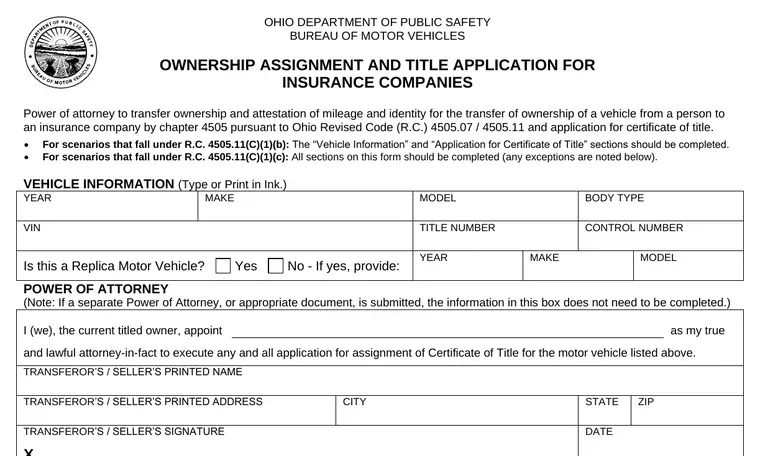
The insurer's form, and the one an owner signs when a total loss is bought out. Like the dealer version it is three documents stacked on one sheet: a power of attorney appointing the insurance company, the assignment of ownership with its price and mileage, and the company's own application - for a salvage certificate, not an ordinary title. Two paragraphs at the top tell the insurer which sections to complete for which scenario.
Written against BMV 3754 (12/25), issued under Ohio Revised Code 4505.07 and 4505.11. Signing this is the moment the car stops being yours, and the price on it is the settlement figure. Read the mileage row and the condition tick as carefully as the number, because both follow the vehicle into its next title.

Two documents, and they are not the same thing. Take the blank BMV 3754 from the dam.assets.ohio.gov copy so you get the revision that is current today.

Filled in

What a completed one looks like

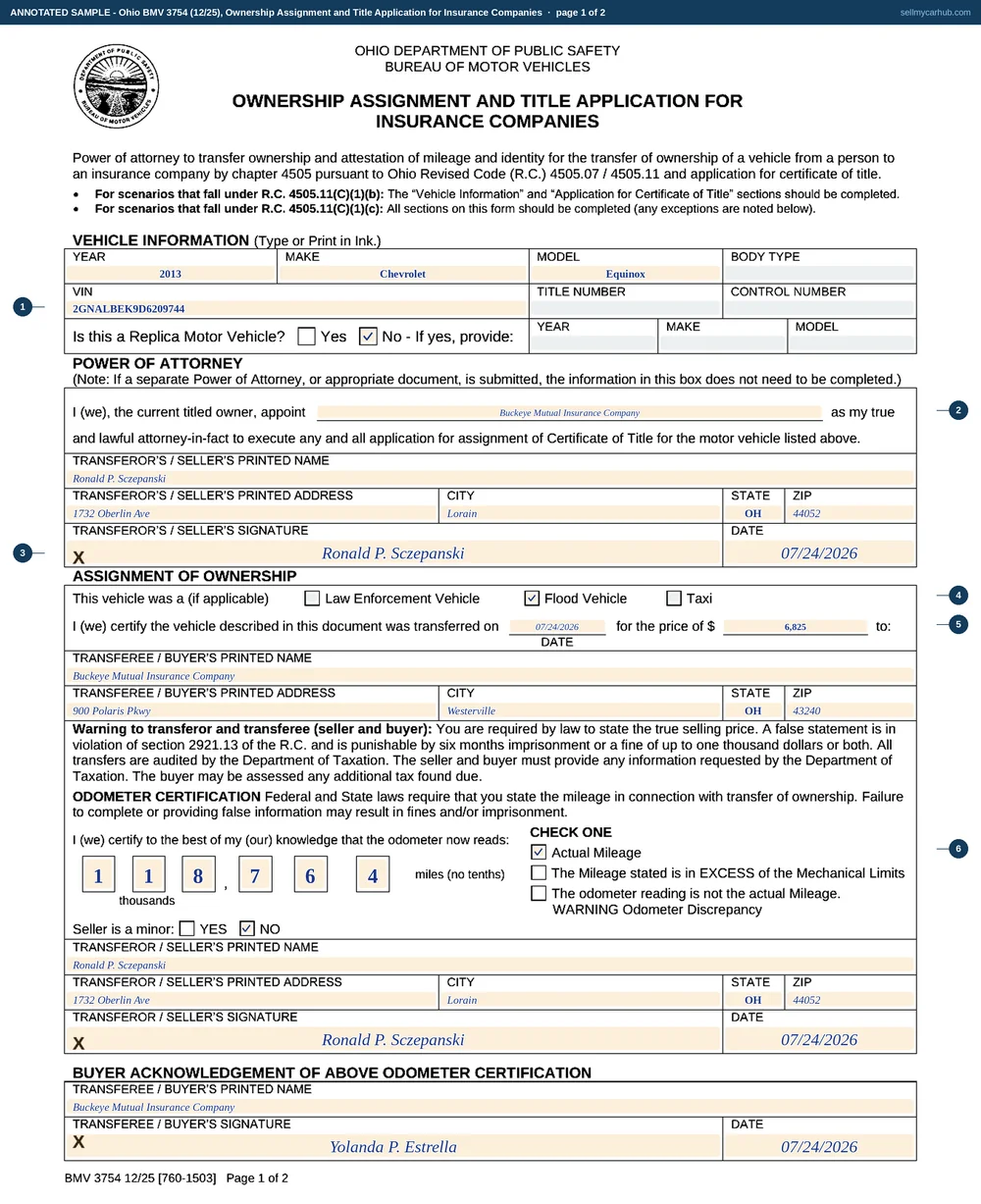
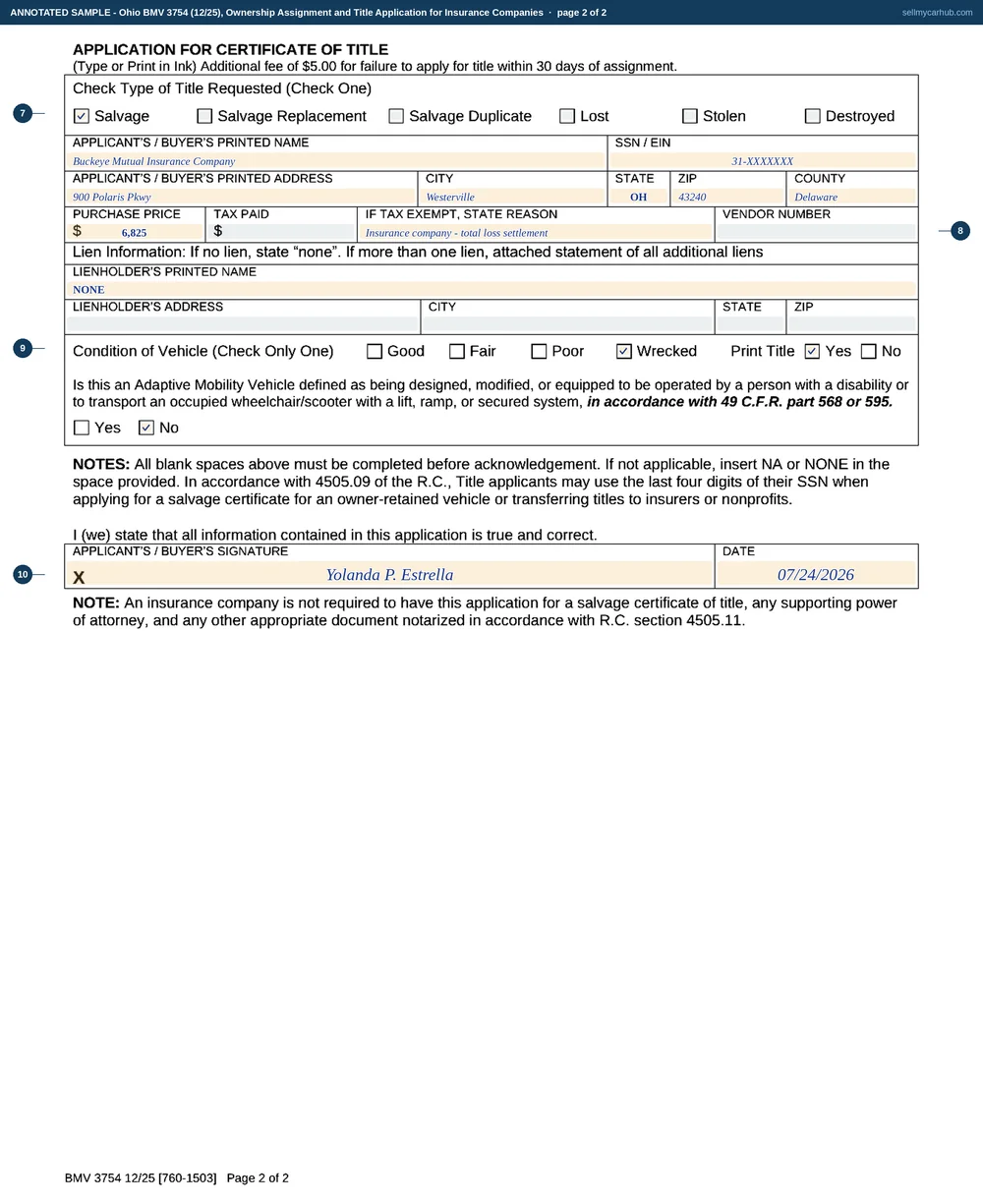
This is all 2 pages of the actual BMV 3754, rendered from the PDF the Ohio Bureau of Motor Vehicles publishes and completed end to end: letterhead, every field, and the blocks at the foot.

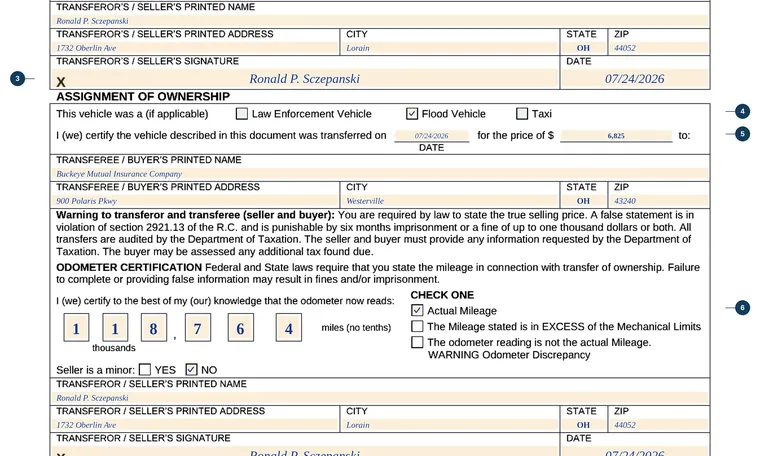
Ohio form BMV 3754 filled in: a 2013 Chevrolet Equinox, VIN 2GNALBEK9D6209744, with Buckeye Mutual Insurance Company appointed attorney-in-fact by owner Ronald P. Sczepanski of Lorain, the Flood Vehicle box ticked, the vehicle transferred on 24 July 2026 for 6,825 dollars, an odometer reading of 118764 with Actual Mileage ticked, and on page two a salvage certificate applied for with the condition ticked Wrecked and the lienholder line reading NONE.
Page 1 of 2. The owner's half. Note that the price on the assignment is the settlement figure, and the condition tick on page two is what turns the title into a salvage certificate.
Ohio form BMV 3754 filled in: a 2013 Chevrolet Equinox, VIN 2GNALBEK9D6209744, with Buckeye Mutual Insurance Company appointed attorney-in-fact by owner Ronald P. Sczepanski of Lorain, the Flood Vehicle box ticked, the vehicle transferred on 24 July 2026 for 6,825 dollars, an odometer reading of 118764 with Actual Mileage ticked, and on page two a salvage certificate applied for with the condition ticked Wrecked and the lienholder line reading NONE.
Page 2 of 2. The insurer's application. Salvage, not an ordinary certificate - and the tax exemption line carries the reason.
Field by field

Every line, in the order you meet it

  1. 1
    You fill this in

    Vehicle information

    Year, make, model, body type, VIN, title number and control number, copied from the certificate.

    Watch out: This block is completed for both of the scenarios the form describes at the top, which is why it sits above everything else.

  2. 2
    You fill this in

    The power of attorney

    The insurance company's name written into the appointment sentence, then your printed name, address, signature and date.

    Watch out: Check the company name is the underwriter rather than the adjusting firm. The authority is to execute an assignment of your certificate of title, and it should not be held by a contractor.

  3. 3
    You fill this in

    The first transferor signature

    Signed and dated under the power of attorney block.

    Watch out: If a separate power of attorney has already been signed, this box does not need completing - the note above it says so. Doing both is not belt and braces, it is two authorities.

  4. 4
    You fill this in

    This vehicle was a

    Law Enforcement Vehicle, Flood Vehicle or Taxi.

    Watch out: Flood is the tick that changes what the car is for the rest of its life, and it is the reason a lot of these forms exist. If water was the cause, it belongs here whether or not anybody asks.

  5. 5
    You fill this in

    The date and the price

    The date the vehicle was transferred and the price it was transferred for - the settlement figure.

    Watch out: The warning underneath is the same one Ohio prints on every assignment: you are required by law to state the true selling price, and all transfers are audited by the Department of Taxation.

  6. 6
    You fill this in

    The odometer row

    Six boxes for the reading, then one tick from the CHECK ONE column, then the seller-is-a-minor question.

    Watch out: A wrecked car still has a mileage. Read it off the dash if the dash still reads, and use the not-actual statement if it does not.

  7. 7
    The buyer fills this in

    Salvage, salvage replacement or salvage duplicate

    The three choices at the head of page two, with lost, stolen and destroyed as sub-options.

    Watch out: There is no ordinary certificate on this form. What comes out the other end is a salvage certificate, and that is the point of it.

  8. 8
    The buyer fills this in

    Purchase price and tax exemption

    The price and tax paid, or a reason the transaction is exempt.

    Watch out: The insurer completes this half. It is worth reading before you sign, because the price on it should be the figure you agreed.

  9. 9
    The buyer fills this in

    Condition of vehicle

    Good, Fair, Poor or Wrecked, check only one, beside a Print Title question.

    Watch out: Wrecked on a total loss is the honest answer and the expected one. A vehicle recorded as Good on a salvage application invites a question neither party wants.

  10. 10
    The buyer fills this in

    The applicant's signature

    The insurer signs under the certification that all information contained in the application is true and correct.

    Watch out: No notary here: the note at the foot exempts an insurance company from having this application, its supporting power of attorney and other appropriate documents notarised.

At a glance

What goes where

On the formWhat to put in it
Vehicle informationYear, make, model, body type, VIN, title number and control number, with the replica question underneath.
Power of attorneyI (we), the current titled owner, appoint ______ as my true and lawful attorney-in-fact to execute any and all application for assignment of Certificate of Title for the motor vehicle listed above - followed by the transferor's printed name, address, signature and date. A note says this box need not be completed if a separate power of attorney is submitted.
Assignment of ownershipThe three condition ticks - law enforcement vehicle, flood vehicle, taxi - then the date of transfer, the price, and the insurance company's printed name and address as transferee.
Odometer certificationSix boxes for the reading with a CHECK ONE column beside them, and a seller-is-a-minor question.
Transferor block, againPrinted name, address, signature and date - a second set, because the first set belonged to the power of attorney rather than to the assignment.
Buyer acknowledgementThe insurer's printed name, signature and date against the odometer certification.
Application for certificate of titleSalvage, Salvage Replacement or Salvage Duplicate, with lost, stolen and destroyed as sub-options; the applicant's details and county; purchase price, tax paid, tax exemption reason and vendor number; lien information; condition of the vehicle; and whether a title is printed.

What gets this one rejected

Rules that decide whether it is accepted

Every line here was read off BMV 3754 (12/25) itself — the PDF is here — and off the Ohio Bureau of Motor Vehicles pages. This is plain-language help with a form, not legal advice, and where our wording and the agency's differ, theirs governs.

Back to all Ohio seller paperwork, or what selling a car in Ohio involves.

Want the paperwork handled instead?

Get My Instant Offer → Online · about 2 minutes · free

Or send the details — we'll come to you

A settled total loss you decided to keep, or a car the insurer walked away from - tell us what happened and we will tell you what it is worth.

or call/text (877) 405-1808