The next-of-kin version, for the estate that has no surviving spouse and no surviving minor children. It is the same $25,000 ceiling and the same notary, but a much longer set of questions - because without a spouse the DMV has to satisfy itself that no court is going to be involved either.
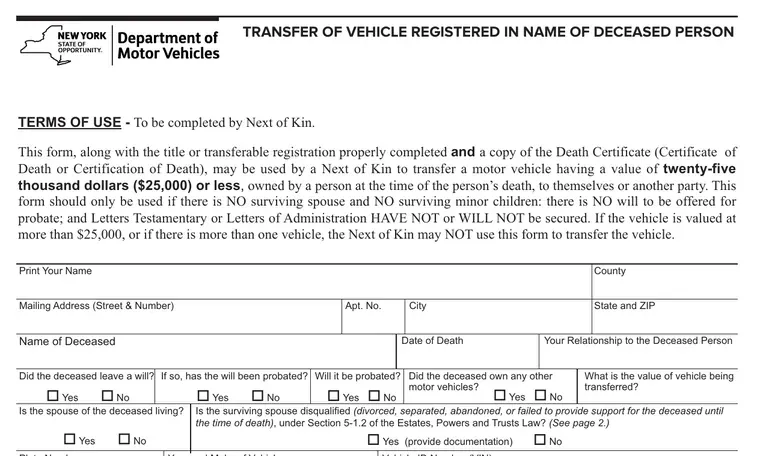
Written against MV-349 (8/21), issued under New York Estates, Powers and Trusts Law, with the surviving-spouse disqualification test at section 5-1.2. Read the terms of use before anything else on the page. Four conditions have to hold at once, and the form has no mechanism for a case where three of them do - a next of kin who fills it in optimistically has sworn to something they cannot support.
Two documents, and they are not the same thing. Take the blank MV-349 from the dmv.ny.gov copy so you get the revision that is current today, then print our MV-349 guide and keep it beside you while you fill theirs in.
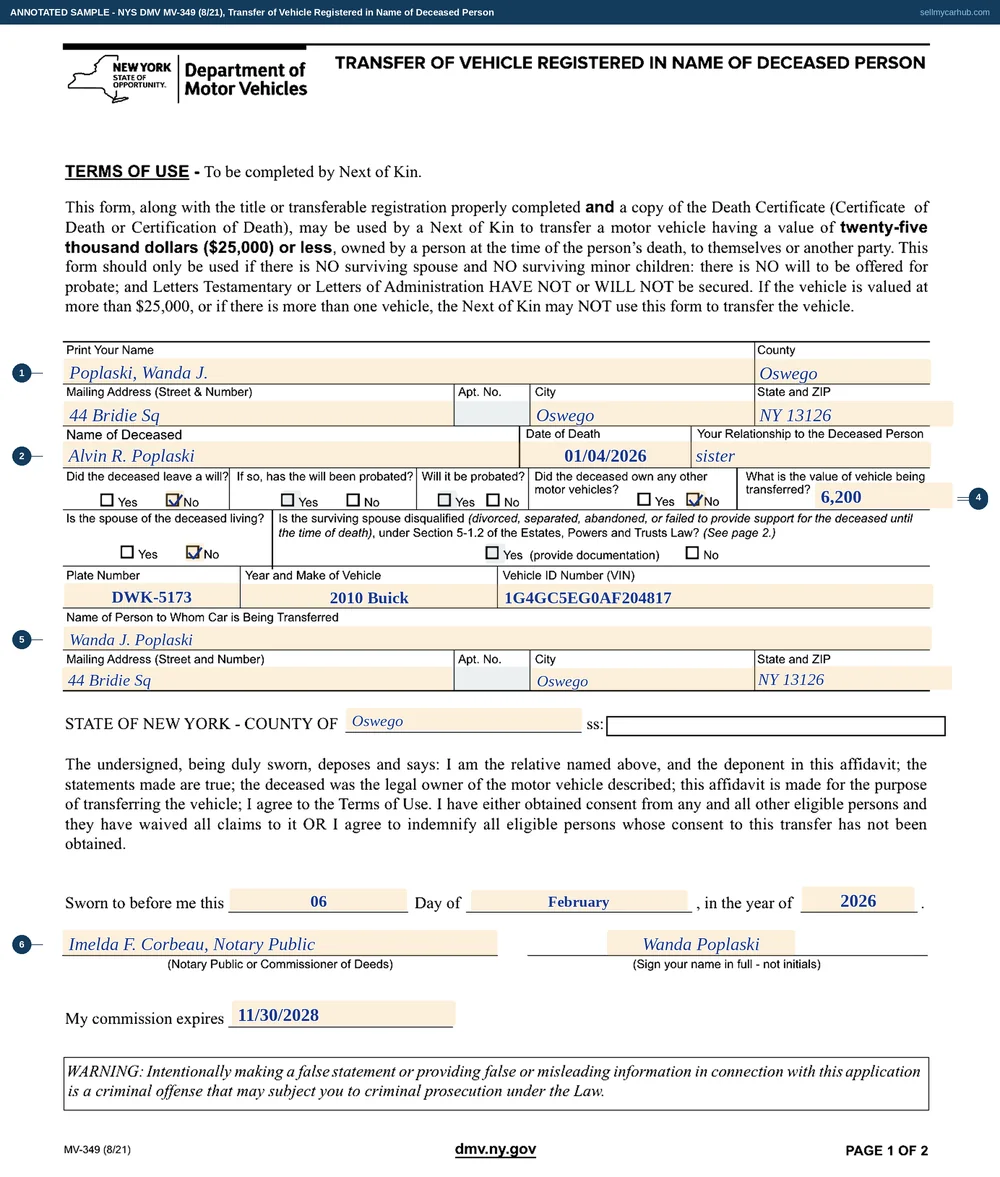
This is the actual MV-349, rendered from the PDF the New York State Department of Motor Vehicles publishes and completed end to end: letterhead, every field, and the blocks at the foot.
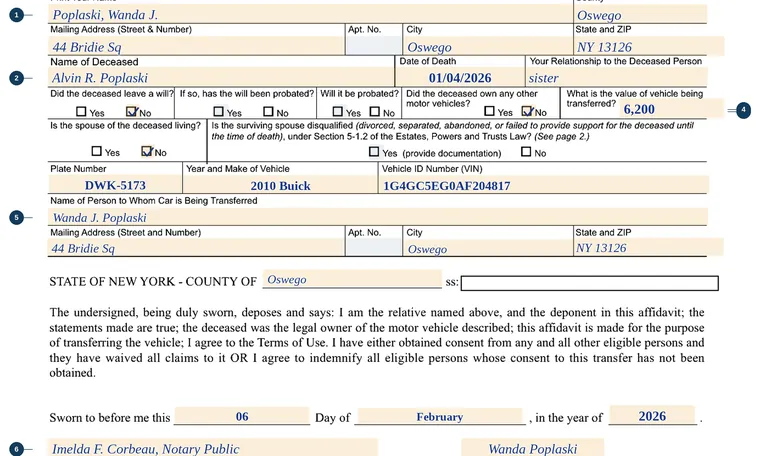
The next of kin, with the county, then the mailing address on the row beneath.
Watch out: Only one person can be the deponent. If two siblings are sorting the car out between them, decide which of you is signing before either of you writes anything.
Three cells: who died, when, and how you are related.
Watch out: Relationship in plain words - sister, nephew, cousin. It is what the department reads to decide whether you are next of kin at all.
Whether there was a will, whether it has been or will be probated, and whether the deceased owned any other motor vehicles.
Watch out: A yes to any of these takes you out of this form. That is not a setback to be worked around; it is the form telling you the transfer belongs in the Surrogate's Court.
What the vehicle being transferred is worth, in the cell at the end of the question row.
Watch out: The ceiling is twenty-five thousand dollars and it is a value at the date of death. Write the number you can defend rather than the number that keeps the form usable.
The name and full address of the person receiving the vehicle.
Watch out: It can be you, and it can be a buyer. Either way the name here has to match the certificate assignment, because the two documents travel to the counter together.
Sign in full before a notary public or commissioner of deeds, who completes the jurat and the commission expiry.
Watch out: Read the sentence you are swearing to. It contains an indemnity of every eligible person whose consent you have not obtained, and that is a real undertaking rather than a formula.
| On the form | What to put in it |
|---|---|
| Terms of use | The block at the head that decides whether you may use the form at all: one vehicle worth twenty-five thousand dollars or less; no surviving spouse and no surviving minor children; no will to be offered for probate; and Letters Testamentary or Letters of Administration have not been and will not be secured. |
| Print your name, and your county | The next of kin, and the county they are in. |
| Mailing address | Street and number, apartment, city, state and ZIP. |
| Name of deceased, date of death, and your relationship | Three cells across one row. |
| The five questions | Did the deceased leave a will? If so, has it been probated? Will it be probated? Did the deceased own any other motor vehicles? And what is the value of the vehicle being transferred? |
| The spouse questions | Is the spouse of the deceased living? And is the surviving spouse disqualified - divorced, separated, abandoned, or failed to provide support for the deceased until the time of death - under section 5-1.2 of the Estates, Powers and Trusts Law, which the form reprints in full on page 2. |
| The vehicle | Plate number, year and make, and the vehicle identification number. |
| Transferred to | Name and full address of the person the car is going to. |
| The affidavit and jurat | The undersigned, being duly sworn, deposes and says that they are the relative named above, that the statements are true, that the deceased was the legal owner, and either that they have obtained consent from all other eligible persons who have waived their claims, or that they agree to indemnify every eligible person whose consent has not been obtained. |
Every line here was read off MV-349 (8/21) itself — the PDF is here — and off the New York State Department of Motor Vehicles pages. This is plain-language help with a form, not legal advice, and where our wording and the agency's differ, theirs governs.
Back to all New York seller paperwork, or what selling a car in New York involves.