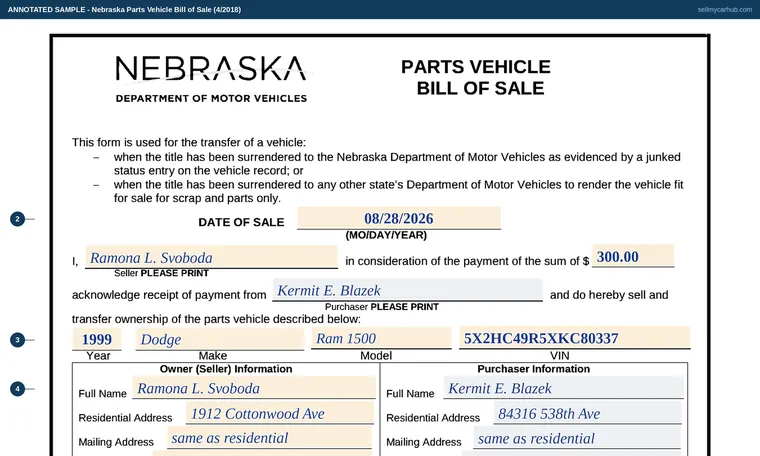
The document for selling a car that is no longer a car. Its header states its two lawful uses: transfer of a vehicle when the title has been surrendered to the Nebraska DMV as evidenced by a junked status entry on the vehicle record, or surrendered to any other state's DMV to render the vehicle fit for sale for scrap and parts only. A junked Nebraska vehicle has no certificate to assign - the title died with the surrender - so this bill of sale is the whole conveyance: date, price, both parties, the vehicle, an odometer certification, and a seller's signature the form itself says must be notarized. The closing warning names the price of stretching it: using this form for a vehicle that does not meet the parts-vehicle definition can mean a fine or imprisonment or both, and s. 60-142 makes it a Class III misdemeanor.
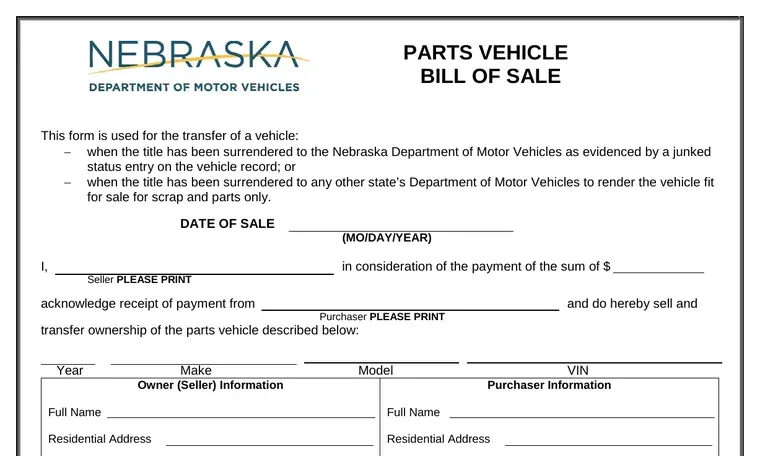
Written against Parts Bill of Sale (4/2018), issued under Neb. Rev. Stat. s. 60-142; the sole transfer document for a vehicle with a junked status entry on the record. The gap this form leaves is what happens to the hulk between signature and crusher. The buyer's name and both addresses are your only trail if the shell turns up dumped on a county road with the VIN still readable and traceable to the junked record you once held. Photograph the completed form, keep your copy with the refund paperwork, and prefer buyers with a business name and a yard over a phone number and a trailer.
Two documents, and they are not the same thing. Take the blank Parts Bill of Sale from the dmv.nebraska.gov copy so you get the revision that is current today, then print our Parts Bill of Sale guide and keep it beside you while you fill theirs in.
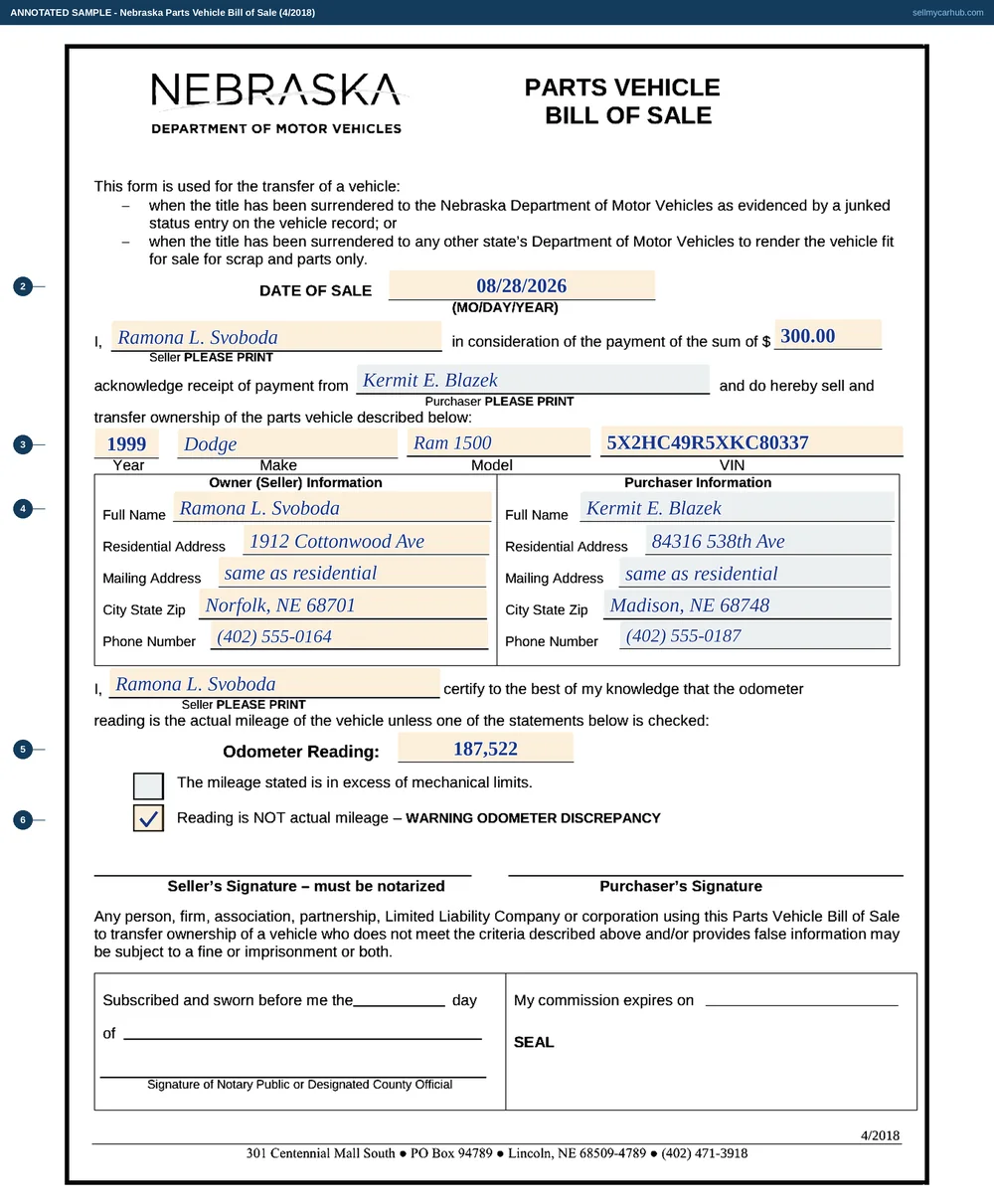
This is the actual Parts Bill of Sale, rendered from the PDF the Nebraska Department of Motor Vehicles, Driver and Vehicle Records Division publishes and completed end to end: letterhead, every field, and the blocks at the foot.
The form's authority is a junked status entry on the vehicle record - the state of the record, not your recollection of surrendering the title.
Watch out: If you are not certain the surrender was ever processed, ask a county counter before selling. The form used on a vehicle that still has a live title is the misuse its penalty clause describes.
The date of sale in its box, then your printed name, the price and the purchaser's printed name in the operative sentence.
Watch out: Scrap prices move with the metal market, but the figure still gets written - an acknowledged receipt for three hundred dollars beats a handshake for roughly whatever it weighs.
Year, make, model and the full VIN.
Watch out: Read the VIN off the dash or door plate since there is no title to copy from - it is the number that connects this sale to the junked record.
Your full name, residential address, mailing address, city-state-zip and phone; the purchaser's same five entries in their column.
Watch out: The purchaser's column is your trace on the hulk. A buyer reluctant to give a residential address is telling you something worth hearing before the winch starts.
Your printed name, the reading as the dead dial shows it, and an exception box where one is true.
Watch out: Not actual is the routine answer on a parts vehicle with a broken cluster, and checking it costs nothing here - this record is not going back on a title.
The seller's line carries the printed requirement - must be notarized - and any notary or designated county official serves.
Watch out: Do the notary stop before the buyer arrives with the trailer, or meet at a bank. The stamp is the step this form will not run without.
Plates, decals and the registration certificate go to the county treasurer with the Application for Refund within sixty days of the junking.
Watch out: Dismantlement and junking sit in the refund statute's own list of qualifying events - the money does not care that the car left on a trailer.
| On the form | What to put in it |
|---|---|
| Date of Sale | Month, day and year in the box at the top, before the operative sentence. |
| I, (Seller) ... the sum of $ | Your printed name and the price, in the sentence that acknowledges receipt of payment and transfers ownership of the parts vehicle. |
| (Purchaser) | The buyer's printed name, completing the sentence - typically a salvage yard, a rebuilder buying a donor, or a scrapper. |
| Year, Make, Model, VIN | The vehicle information row. The VIN still matters on a dead car - it ties the sale to the junked record. |
| Owner (Seller) Information and Purchaser Information | Two columns: full name, residential address, mailing address, city-state-zip and phone number for each side - a fuller identity block than the ordinary bill of sale carries. |
| The odometer certification | Your printed name again, the odometer reading, and the two exception boxes - the mileage stated is in excess of mechanical limits, and reading is NOT actual mileage, WARNING ODOMETER DISCREPANCY. |
| Seller's Signature - must be notarized | The form prints the requirement in the signature line's own label. The purchaser's signature line beside it carries no such demand. |
Every line here was read off Parts Bill of Sale (4/2018) itself — the PDF is here — and off the Nebraska Department of Motor Vehicles, Driver and Vehicle Records Division pages. This is plain-language help with a form, not legal advice, and where our wording and the agency's differ, theirs governs.
Back to all Nebraska seller paperwork, or what selling a car in Nebraska involves.