Montana's all-purpose affidavit, and the form that decides whether a small mistake costs you a replacement title or nothing. The manual lists nine jobs for it, from explaining a crossed-out entry to consenting to a name being added to a title, and one that is purely a seller's: relinquishing a classic-car or personalized plate so it can follow the car to the buyer. What it cannot do is rescue an erasure - the manual is explicit that an error statement may only be used when the previous information can still be read, and that a complete erasure means the title is void and a replacement must be obtained.
Written against MV100 (6/26), issued under prescribed by the Motor Vehicle Division; signed under MCA 45-7-203. The statement block is the whole form, so write it as a fact rather than as a request. The manual's tests are about content - does it explain the error, does it carry a complete vehicle description, is it signed by the right person - and a sentence that says please fix this satisfies none of them.
Two documents, and they are not the same thing. Take the blank MV100 from the mvdmt.gov copy so you get the revision that is current today, then print our MV100 guide and keep it beside you while you fill theirs in.
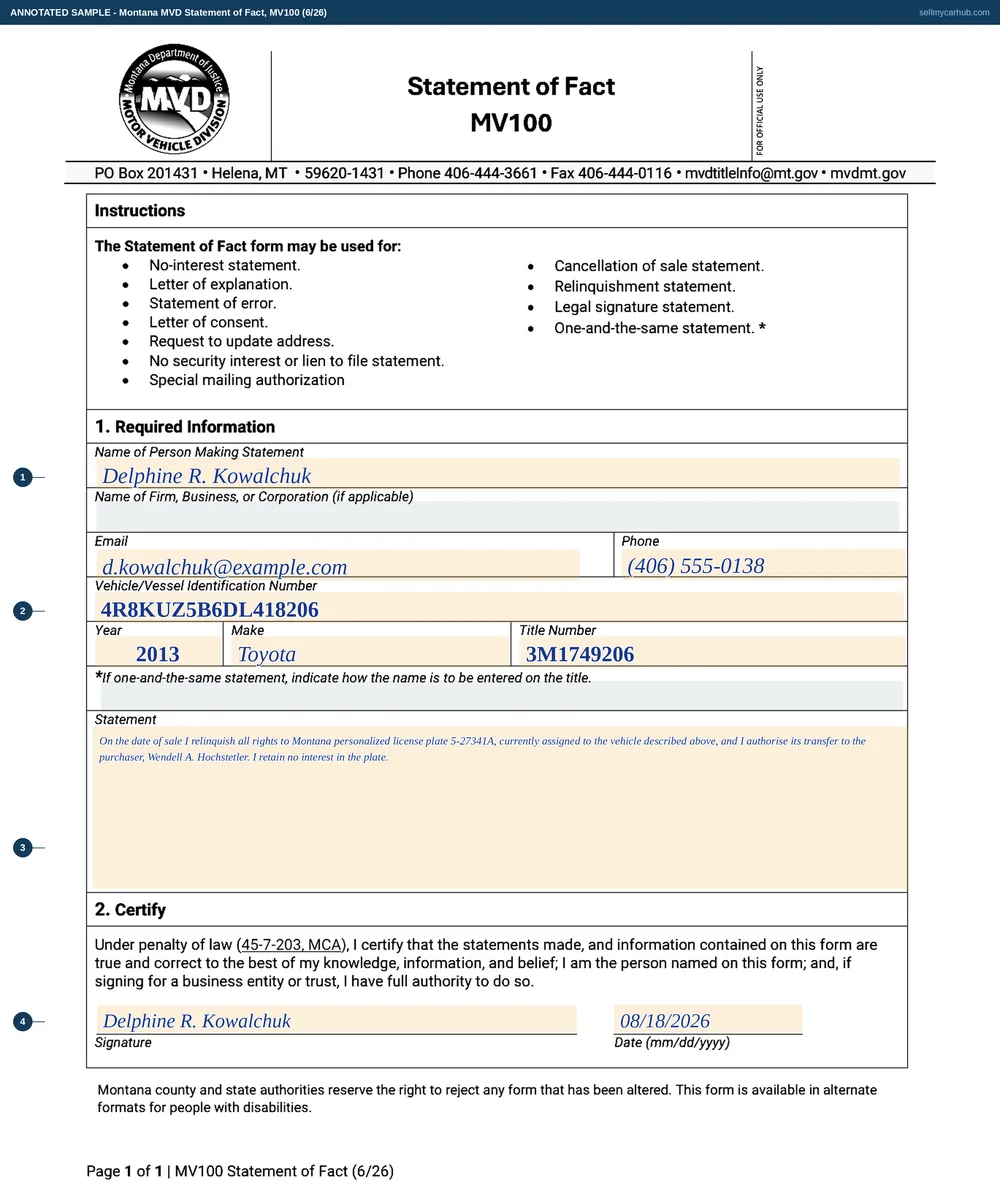
This is the actual MV100, rendered from the PDF the Montana Department of Justice, Motor Vehicle Division, Vehicle Services Bureau publishes and completed end to end: letterhead, every field, and the blocks at the foot.
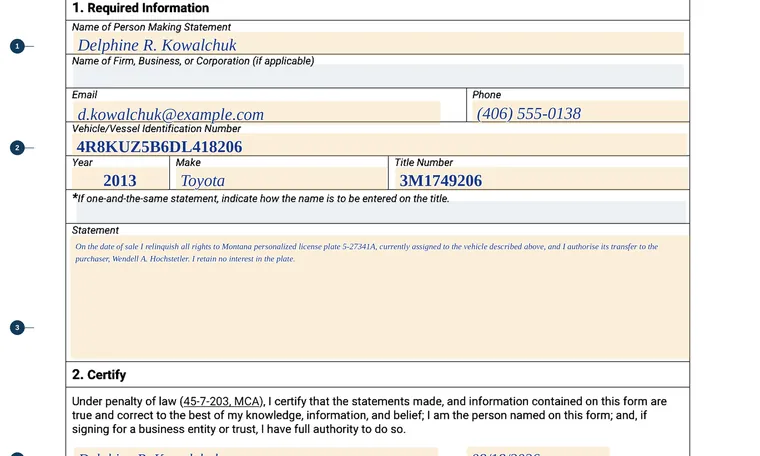
Your name, and the business name only if a company owns the vehicle.
Watch out: For an error statement this must be the person who actually made the error. Somebody else explaining it is a letter, not a statement of error.
VIN or hull number, year, make and the title number.
Watch out: A complete vehicle description is one of the manual's explicit requirements for an error statement. Leaving the title number blank is how a statement ends up attached to no record at all.
One block of free text carrying the whole substance of the form.
Watch out: Say what happened and what should be true, in plain sentences. If it is a relinquishment of plates, name the plate and the person it is going to; if it is an error, say what was written, what it should say, and why.
One signature under MCA 45-7-203, unsworn falsification to authorities.
Watch out: No notary. Montana removed the acknowledgement requirement from title transfers in October 2025, and this form has never carried one - the criminal certification is what stands behind it.
| On the form | What to put in it |
|---|---|
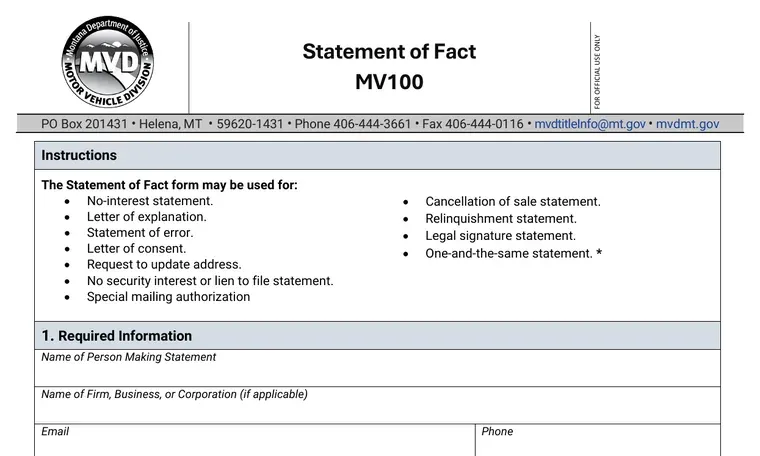
| The instruction list | The nine uses the division prints on the form itself: a no-interest statement, a letter of explanation, a statement of error, a letter of consent, a request to update address, a no security interest or lien to file statement, a special mailing authorization, a cancellation of sale statement, a relinquishment statement, a legal signature statement and a one-and-the-same statement. |
| Section 1, Required Information | Name of person making the statement, name of firm, business or corporation where relevant, email, phone, the vehicle or vessel identification number, year, make, title number, and a line for the name as it is to be entered on the title where this is a one-and-the-same statement. |
| Statement | One large free-text block. Everything the form does happens here, and the manual's requirements for each kind of statement are requirements about what this box says. |
| Section 2, Certify | The signature and date, under MCA 45-7-203, certifying the statements are true, that the signer is the person named on the form, and that a business or trust signer has full authority. |
Every line here was read off MV100 (6/26) itself — the PDF is here — and off the Montana Department of Justice, Motor Vehicle Division, Vehicle Services Bureau pages. This is plain-language help with a form, not legal advice, and where our wording and the agency's differ, theirs governs.
Back to all Montana seller paperwork, or what selling a car in Montana involves.