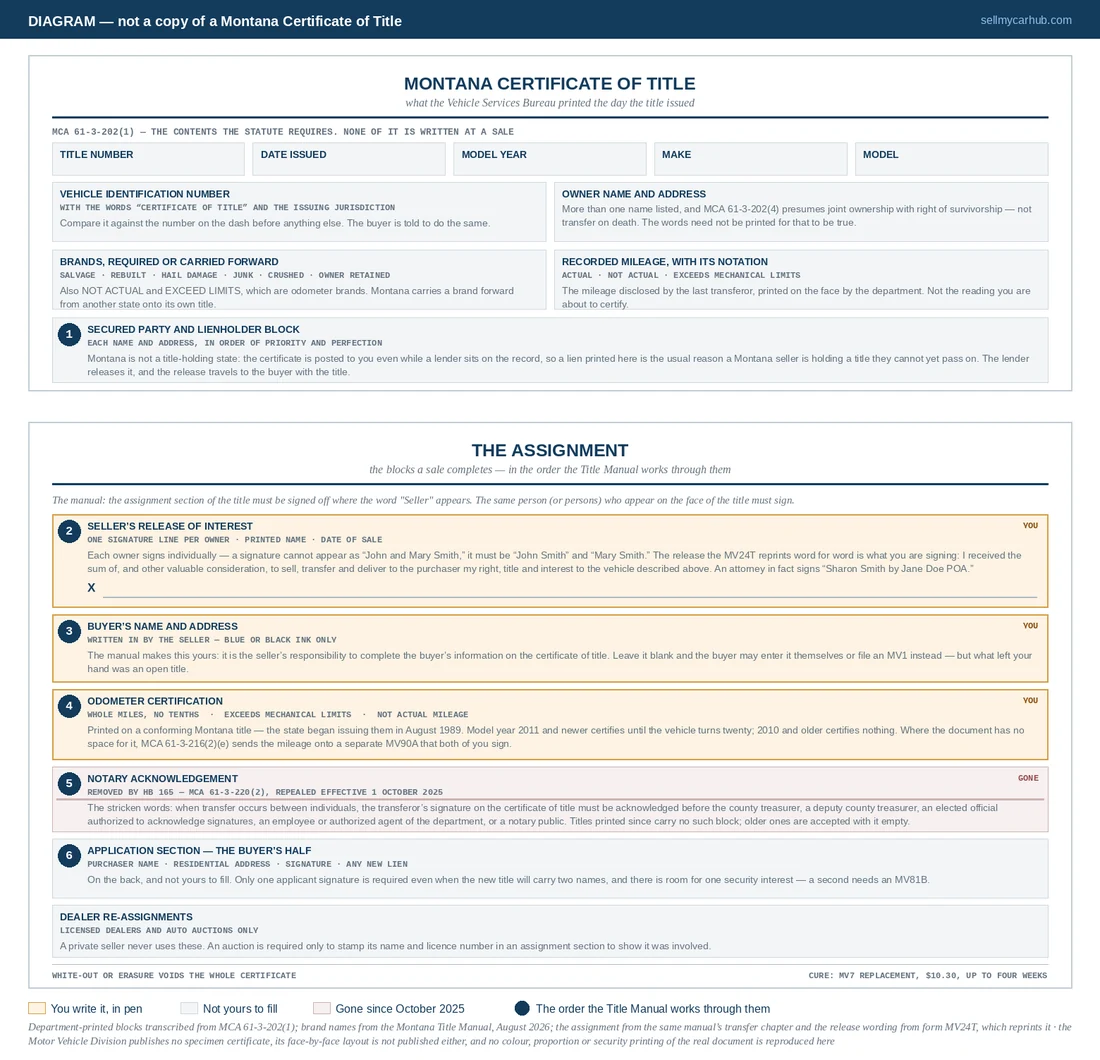
A Montana sale happens in the assignment section of the certificate: the word Seller, the buyer's details that you write in, the odometer line where the document carries one, and - until October 2025 - a notary block underneath. That block is gone from titles printed since, and blank is now the correct state of it on older ones. Here is the document, block by block, in the order a sale meets them.
Last updated .
Your 7 boxes
As a private seller you complete these and nothing else:
There is no blank Montana certificate to download - the counties issue it on secure stock from the Vehicle Services Bureau's record - and no specimen of one in the division's library. The diagram above is drawn from the statute's own list of contents and the manual's transfer chapters, and beside this paragraph is our printable checklist of the entries that are yours to make.
White-out and erasure void the whole certificate, not just the entry. A clean single line through a mistake, everything still legible, with an MV100 explaining it, is what the counter will usually take instead.
The manual's own order is the one below: release the security interest, sign off where the word Seller appears with every owner signing individually, complete the buyer's information because that is the seller's responsibility, record the mileage where the title provides for it, and hand over the certificate with a lien release if the face shows one.
The certificate itself
A Montana Certificate of Title, and the assignment block where the sale happens
One sheet. The department-printed half carries what the record held on the day the title issued - title number, vehicle, owner, brands, any security interest - and the assignment half carries the transfer: the seller's release, the buyer's details and application, the odometer certification, and the notary block that stopped being required in October 2025.
Amber — you write it, in pen
Grey — not yours to fill
Numbered — the order the Title Manual works through them
Click or tap the picture to open it full size.
Drawn, and labelled as a drawing on the image itself, because Montana publishes no specimen of its certificate. We checked the places one would live: the Title Manual dated August 2026, whose 185 embedded images are the department seal repeated on every page and a cover picture; the MV32 Licensed Dealer Guidelines, which carries no image at all; the June 2026 Buying & Selling guide; and the division's Vehicle Title Information and Tips for Selling pages. Every block name here is transcribed instead from MCA 61-3-202, which lists what a Montana certificate must contain, from the Title Manual's transfer chapters, and from the MV24T, which reprints the title's own interest-release wording.
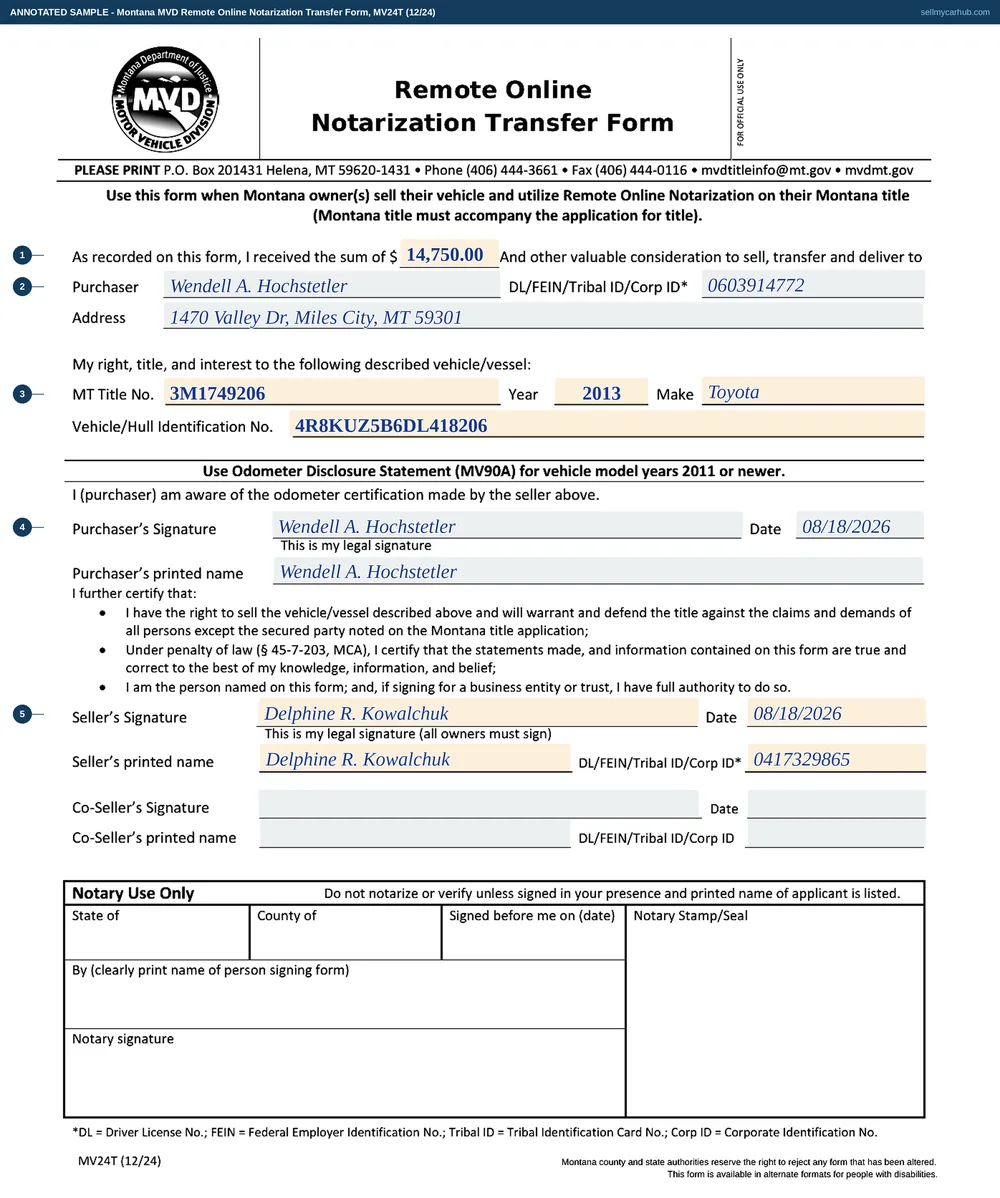
A real one, filled in
The MV24T, which reprints the title's own release wording
There is no picture of a Montana certificate to show, but there is a form that quotes the certificate at length. The MV24T stands in for the title's interest-release section when an owner signs remotely, so its body is the release sentence itself - here completed for a 2013 Toyota 4Runner sold in Lewistown for $14,750.
Click or tap the picture to open it full size.
Read the release sentence, because it is the title's. I received the sum of, and other valuable consideration, to sell, transfer and deliver to the purchaser my right, title and interest to the following described vehicle - that is what you are signing on the certificate itself. The notary block is shaded here because this is the one Montana transfer document that still needs one: MV24T exists only for remote online notarisation, which the manual authorises on any document except a title.
Step by step
Every box, in the order you meet it
0
You fill this in
Before any ink: read the face and find out which title you have
Check whether a security interest is printed on it, whether a brand is carried forward, and whether the document has a notary section at the foot - anything printed since 1 October 2025 does not.
Watch out: If yours has a notary box, leave it empty. The division accepts titles produced before October 2025 with that section uncompleted, and filling it in now buys you nothing.
1
The lienholder fills this in
Clear the security interest, if the face shows one
A lien release from the lender named on the title has to reach the buyer with the certificate. The division's line is that you must provide the purchaser with it, and only the lending institution named on the title can produce it.
Watch out: A release does not automatically produce a clean title. If you want the lien off the printed document before you sell, that is an MV7 and $10.30 to the Vehicle Services Bureau, or the release taken to your county treasurer.
2
You fill this in
Sign the assignment where the word Seller appears
Every owner named on the face signs, each on their own line, exactly as the face prints them. Record the date of sale in the same section.
Watch out: A signature that reads John and Mary Smith is the classic Montana rejection. Two names on the face means two signatures, even when the two people share a surname and a chequebook.
3
You fill this in
Write the buyer's name and address on the title yourself
Montana makes this the seller's job: it is the seller's responsibility to complete the buyer's information on the certificate of title. Blue or black ink, and the person who signs as buyer must be the person written there.
Watch out: If you leave it blank the buyer is allowed to fill it in or to file an MV1 instead - but you have handed over an open title in the meantime, and your only proof of who took the car is whatever you wrote down.
4
You fill this in
Complete the odometer certification, or an MV90A instead
Whole miles, no tenths, with one of the three notations where the reading is not straightforward. Model year 2011 and newer discloses until the car is twenty; 2010 and older discloses nothing.
Watch out: A conforming Montana title has the certification printed in the assignment. If yours does not, the mileage goes on an MV90A and both of you sign it - the buyer's signature acknowledging the reading is part of the disclosure, not a formality.
5
You fill this in
Fill in an MV24 and keep a copy of everything
The bill of sale carries the price, both parties, the vehicle and the date. Photocopy the assigned title before it leaves your hand.
Watch out: This is the whole of your after-sale protection. Montana files nothing on your behalf, and the division's own warning is that without proof of sale you can be held liable for the buyer's tickets and fines.
6
You fill this in
Take the plates off the car before the keys change hands
MCA 61-3-334 requires it immediately on transfer. Ask your county treasurer about moving them to another vehicle you own.
Watch out: The buyer does not need them and cannot lawfully use them. Their legal drive home is a $19.50 temporary registration permit taped where the plate goes, good for forty days.
7
You fill this in
Cancel the insurance - and file nothing
The division tells sellers to cancel the policy once the car is sold, to ignore any renewal notice that still arrives, and that no notification to the county treasurer's office is needed.
Watch out: Montana genuinely has no seller's notice of sale. If somebody tells you there is a deadline for reporting the sale, they are describing another state's form.
8
The buyer fills this in
The buyer's forty days
Title application and registration at the county treasurer in their own county, within forty days of the date of sale, with the title fee and the county's registration fees and option tax.
Watch out: The $10 late penalty in MCA 61-3-220(3) lands on them, not you. But a buyer who stalls is a buyer whose name is not yet on the record - which is exactly why the copy you kept matters.
Before the pen
Six rules for a certificate that correction fluid destroys
Six habits for a certificate that white-out destroys and a replacement takes four weeks to undo.
Blue or black ink, nothing else
The division's instruction for filling out a Montana title is exactly that narrow - all fields must be completed in blue or black ink only. Pencil, gel colours and a red pen are all reasons for the counter to hand it back.
Never reach for the correction fluid
Whiteout is treated as an erasure, and an erasure voids the title rather than the entry. The cure is an MV7 replacement at $10.30, which the division says can take up to four weeks to arrive.
One clean line, everything still readable
The manual will take a deletion where the original is still legible and something explains it. That is what the MV100 Statement of Fact exists for, and the manual's own condition is that if the deletions make the application questionable, the title is void.
One signature per owner, on its own line
Each owner must sign individually. This is the single most common Montana rejection, and it is unfixable on the document - a wrongly combined signature means a replacement title.
Leave the notary box empty on an older title
Since 1 October 2025 the acknowledgement is not required and the section is not printed on new stock. On a title that still has one, the division accepts it uncompleted.
Write the buyer in before the car leaves
Montana puts completing the buyer's information on you. Do it while both of you are standing there, and photograph the finished assignment - it is the only copy you will ever have.
The ink rule is Montana MVD's own: “White-out or attempts to erase or scratch out entries void the title.”
— Montana Title Manual, August 2026.
Check your source
Three things Montana sellers still repeat
Three things Montana sellers still say, two of which were true until quite recently:
"You have to get the title notarized or the sale isn't valid."
True until 1 October 2025, and false since. HB 165 struck MCA 61-3-220(2) - the subsection that required a transferor's signature to be acknowledged before a county treasurer, a deputy county treasurer, an elected official, a department agent or a notary public - and the Secretary of State's notary office published the stricken text and the date. Titles printed since carry no notary section at all, and older ones are accepted with the box empty. The stamp survives at the edges: a signature made with a mark, a power of attorney, a bill of sale used with a break/bond application, and a second seller signing on a later day than the first.
"Leave the plates on him - he can bring them back after he registers it."
That is not a favour, it is a violation of MCA 61-3-334, which requires the transferor to remove the plates immediately on transfer. The division adds the practical consequence: if you do not remove them you may be liable for any parking or traffic violations that happen after the sale, and you should not accept a promise to return them. The buyer's lawful drive home is a temporary registration permit under MCA 61-3-224 - $19.50, forty days, displayed where the plate would be. Only a classic-car or personalized plate can follow the car, and only on an MV100 that relinquishes all rights to it.
"A bill of sale is enough - I'll just write one out and hand him the keys."
Not for a car already titled in Montana. The manual's rule has no softness in it: a BOS cannot be used to transfer ownership of a Montana title, all registered owners must sign off on the title itself, and a bill of sale is not acceptable to transfer a Montana resident's interest to a buyer. The MV24 is your record of the sale and the buyer's proof of ownership on the drive home, not the transfer. The narrow exception runs the other way: where the title is genuinely missing, the car is currently registered in Montana and the buyer is a Montana resident, the division lets you hand over an MV1, an MV24 and an MV7 and the transfer moves on the electronic record instead - and that bill of sale does need a notary.
Six signature rules from the division's own manual - and note that the last one puts the notary back:
Every owner named on the face, individually
The manual: the same person (or persons) who appear on the face of the title must sign. Each owner signs their own name - John Smith and Mary Smith, never John and Mary Smith on one line.
Nobody before a notary, since 1 October 2025
HB 165 struck the acknowledgement subsection out of MCA 61-3-220. Titles printed after that date have no notary section; a pre-October title is accepted with its notary section empty.
A business, through a person with authority
On titles issued from 4 September 1984 the seller's certification statement already carries the authorisation; on anything older the official capacity of the person signing for the business must be written in.
An attorney in fact, naming the owner first
The format the manual prescribes and the MV65 reprints: Sharon Smith by Jane Doe POA. A business holding the power writes the owner, then the business, then the signer, then POA.
A personal representative, after the court appoints them
John Doe by Jane Smith, PR, with the appointment papers attached - and the manual bars the representative from handing that authority on to anyone else by power of attorney.
Two owners on different days - and here the notary comes back
A separate notary acknowledgement is required for each signature acknowledged after the first seller's. Witnesses in lieu of a notary acknowledgement is not acceptable.
Once it is signed
The signed title ends your ownership. The plates come off the same minute, there is nothing to file afterwards, and the only paper you keep is the copy you made.