A Missouri certificate carries the transfer on its reverse, in a block headed ASSIGNMENT that runs across the top of the page. Fourteen fields, numbered here exactly as the Department of Revenue numbers them on its own example page, and the great majority are yours. Read the five printed paragraphs above the block before you write in it: the one headed ALL is a completion order rather than a warning, and it says the owners sign and hand print their names after the purchaser's name, lienholder, sale price, trade-in, net price, date of sale and mileage spaces are completed. Signing first and filling in afterwards is how a title ends up assigned in blank.
Last updated .
Your 11 boxes
As a private seller you complete these and nothing else:
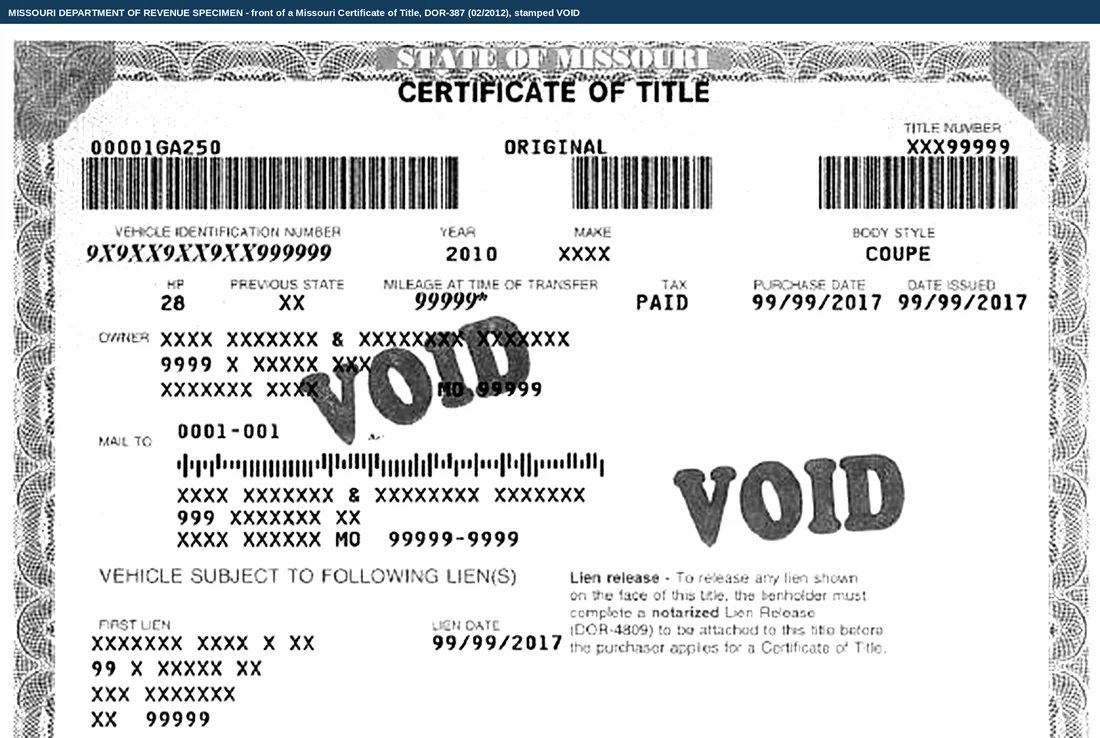
There is no blank Missouri title to download and nothing to practise on - the certificate is printed on secure stock and the only one in existence is the one in your drawer. What the Department does publish is a voided example of both sides, and that is the document reproduced below.
WARNING: Alterations, erasures or mistreatment will void this title/certificate.
The instruction band across the top of the assignment side is the specification. It is printed on every Missouri certificate, and it is where the sentence about alterations comes from.
The Department's own picture
A blank Missouri certificate, front and back
This is not a drawing and it is not somebody's title photographed. It is the specimen the Department of Revenue publishes in its Certificate of Title example, form DOR-387 (02/2012): the front stamped VOID twice with the Department's placeholder data on it, and the back completely blank. The amber blocks below are the ones a private seller completes; grey belongs to a dealer, a lender or the buyer.
Amber — you write it, in pen
Grey — not yours to fill
Numbered — matches the steps below
Click or tap the picture to open it full size.
The front, as the Department publishes it at dor.mo.gov. A private seller writes nothing on this side. Two things on it matter to you anyway: the DATE ISSUED, because your sale cannot be dated before it, and the lien block, because anything printed there has to be released on a notarised Form 4809 before the buyer can title the car.
Filled in
The assignment, completed for one private sale
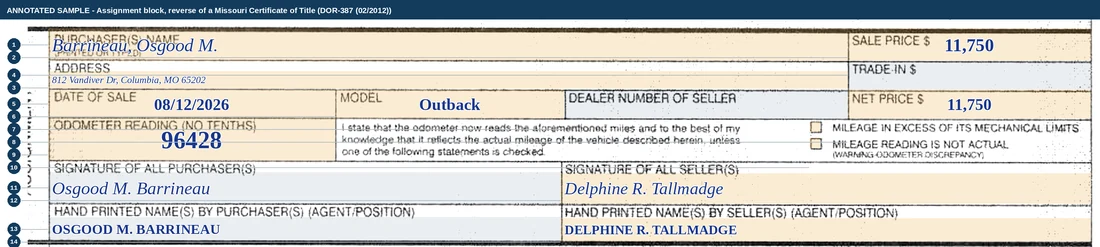
A 2016 Subaru Outback sold in Kansas City on 12 August 2026 for $11,750 with 96,428 miles showing. Amber is what the seller writes, grey is the buyer's half. Note the two mileage boxes: neither is ticked, because the reading is true and the printed sentence beside them already certifies it unless one of them is.
Click or tap the picture to open it full size.
Fourteen fields, numbered as the Department numbers them in its own example. Every rectangle here was found by reading the printed table rules off the Department's image - the horizontal rules that divide the rows and the vertical rules that divide the columns - rather than measured by eye.
Click or tap the picture to open it full size.
Everything printed above the first box you write in. Five paragraphs, and the one headed ALL is the reason a Missouri assignment comes back most often: it lists the spaces that have to be completed before the owners sign - purchaser's name, lienholder, sale price, trade-in if applicable, net price, date of sale and mileage.
Step by step
Every box, in the order you meet it
1
You fill this in
Purchaser's name, printed or typed
The buyer's full legal name, printed. The Department's instruction adds that the name on the application for title must match the name shown in the title assignment.
Watch out: Take the spelling off their licence before you start writing. This is the field corrections happen in, and a correction on a Missouri title needs a signed statement of correction to travel with it.
2
You fill this in
Sale price
The price without deducting any trade-in, in dollars, in the money column down the right-hand edge.
Watch out: On a gift the word GIFT goes here instead, and the Department's own bracket says do not use a sale price of $1. A dollar is a sale, and a sale is taxed on what the license office thinks the car is worth.
3
You fill this in
Address
The buyer's physical address - the Department asks for the physical address of the purchaser rather than a post office box.
Watch out: It is not decoration. The buyer's address sets the local sales tax rate the license office charges them, and a mismatch between this line and their Form 108 is a query.
4
Dealers only
Trade-in
The amount allowed on a vehicle taken in part exchange, or on a rebate. Empty on an ordinary cash sale between two people.
Watch out: Only a dealer can allow a trade-in against a car they are buying, so on a private sale this block stays blank and the next two figures are the same number.
5
You fill this in
Date of sale
Month, day and year. The Department's note beside it is short and worth reading twice: this determines if a title penalty is due.
Watch out: It also cannot be earlier than the DATE ISSUED printed on the front of the certificate. RSMo 301.210 transfers ownership at the moment of assignment, so an earlier date describes a sale that legally had not happened - and unpicking it means Form 4205 signed by both of you.
6
You fill this in
Model
The model line, which the front of the certificate does not carry - the face shows year, make and body style only.
Watch out: Copy it off the car's own badging or its registration, not from memory. Outback, not Legacy Outback; the license office keys what you write.
7
Dealers only
Dealer number of seller
A licensed Missouri dealer's number. On a private sale this stays empty.
Watch out: If someone selling you a car fills this in from a piece of paper rather than from a licence, you are looking at curbstoning - the Department runs a page about it under buying a vehicle.
8
You fill this in
Net price
The sale price minus the trade-in, allowance or rebate. The Department's instruction for this block is that the net price must be recorded.
Watch out: In an ordinary cash sale it is the same figure as the sale price, so write it rather than leaving the space empty. A blank net price is one of the commonest reasons a Missouri assignment is handed back.
9
You fill this in
Odometer reading, no tenths
The mileage at the moment of transfer, in whole miles, written above your signature.
Watch out: RSMo 407.536 puts it there deliberately - the signature of the transferor below the mileage shall constitute an odometer mileage statement. Falsifying it is a class E felony under the same section.
10
You fill this in
The two mileage boxes
MILEAGE IN EXCESS OF ITS MECHANICAL LIMITS for a five-digit odometer that has rolled past 99,999, and MILEAGE READING IS NOT ACTUAL for a reading you know to be wrong or cannot vouch for.
Watch out: Ticking the second one brands the next title WARNING - ODOMETER DISCREPANCY for good, and the Department also wants a statement of the facts - Form 1545 is the one built for it. Ticking neither is the right answer on an honest reading.
11
The buyer fills this in
Signature of all purchaser(s)
The left-hand half of the signature row. The Department's instruction is that the signature of at least one purchaser must be recorded.
Watch out: One is enough however many people are buying, which is the opposite of your side of the same row. The buyer signing is also their acknowledgement of the mileage you have just certified.
12
You fill this in
Signature of all seller(s)
Every owner named on the face of the title signs, in the name the face carries.
Watch out: Two owners joined by AND on the front means two signatures here. A business signs in the business name followed by the agent and the agent's position.
13
The buyer fills this in
Hand printed name(s) by purchaser(s)
The buyer's name in block capitals under their signature, with an agent's position added where the buyer is a business.
Watch out: Again only one purchaser has to do it. Where a business is buying, the Department's worked example is the whole business name, then the person, then what they are - John Smith's Auto Sales, Gary Brown, Salesman.
14
You fill this in
Hand printed name(s) by seller(s)
A separate line, and a separate requirement: all sellers listed on the face of the title must print their name on the title assignment.
Watch out: This is the block Missouri sellers most often leave half done. A signature is not a printed name, and one person cannot print two owners' names in one hand.
15
The buyer fills this in
Lienholder name and address
A block at the foot of the reverse, below the dealer reassignments, for the buyer's lender rather than yours.
Watch out: Your own lender does not go here. A lien already printed on the front is cleared with a notarised Form 4809 attached to the title, and the buyer will not get a clear title without it.
16
You fill this in
Then the plates, then the notice
Not on the title at all, and the two steps that end your connection to the car. Take the plates off before the buyer takes possession, and file the Notice of Sale within thirty days.
Watch out: The tear-off Notice of Sale is attached to the bottom of the title itself. If it is still there, use it - it is the same form as the 5049 and it saves you finding a printer.
Before the pen
Before you write on it
Six habits, and the second one is the difference between a corrected Missouri title and a replaced one.
No correction fluid, ever
The Department's selling page says it in five words - you may not use correction fluid (white-out) or erase marks from the title - and the certificate itself warns that alterations and erasures void it.
One thin line, and a statement
A genuine slip is survivable, which is not true everywhere. The Department will accept an ownership document where the error is obvious and there is no indication of an attempt to defraud, if one thin line is drawn through the wrong entry and the right one written above, and the person who made the error writes a signed statement of correction.
Fill it in before anybody signs
The band at the top of the assignment gives the order: the owners sign and hand print after the purchaser's name, lienholder, sale price, trade-in, net price, date of sale and mileage are completed.
Print the name as well as signing it
Two lines, two requirements, and both of them say all sellers listed on the face of the title.
Whole miles
The mileage field is labelled ODOMETER READING (NO TENTHS). A decimal point in it is not the reading the license office will key.
Never hand it over with the buyer's name blank
That is an open title. The Department's titling manual calls possession of one unlawful, for a private seller as much as for a dealer.
Three things Missouri sellers are told confidently that are not so. Each correction links the Missouri source it came from.
“You have to get the title notarised.”
Not in Missouri, and not for a long time. The Department of Revenue's page for sellers ends its assignment instructions with the sentence: these signatures do not need to be notarized. What Missouri does notarise is the lien release, the duplicate-title application and a power of attorney - three documents a seller can easily meet on the way to a sale, which is probably where the belief comes from. A license office will notarise one for you for two dollars.
“Once the buyer has driven off, it is their problem.”
For thirty days it is still yours. RSMo 301.196 requires the transferor to notify the department of revenue within thirty days of the date of transfer, and 301.198 makes failing to do so an infraction - up to $200, and up to $300 as a class C misdemeanor if it was done to help the buyer avoid titling. The Department's own words for why you would bother: prompt notification will help protect you from possible liability.
In Missouri it is on the seller's list, not the buyer's. The Department's selling page tells you what you must provide to the vehicle buyer and puts a safety inspection certificate less than 60 days old second on it, with an emissions certificate as well for sellers in St. Louis City and Jefferson, St. Charles and St. Louis counties. A car within ten years of its model year with under 150,000 miles on it is exempt from the safety inspection.
Fewer signatures than most states, because none of them is witnessed - but Missouri wants a printed name beside every one:
Every owner shown on the face of the title
All of them sign the assignment, and all of them hand print their names as well. The Department's wording is that the signature must be exactly the same as the names appear on the face of the title.
One purchaser, and only one
The buyer's half asks for the signature of at least one purchaser and the hand printed name of at least one purchaser. Where two people are buying, the second name goes on the title application instead.
Nobody in front of a notary
There is no acknowledgement block on the assignment side of a Missouri title, because none is required. Take the pen, not an appointment.
An attorney-in-fact, on a notarised Form 4054
Or, where the title is not available at the time of sale, on the Department's secure Form 5086 - which is not a document you can print at home.
An agent, where the owner is a business
The full business name first, then the agent's printed name and their position with the business.
The lienholder, separately
Not on the assignment at all. A lien shown on the face of the title is released on a notarised Form 4809, which is attached to the title rather than written on it.
Once it is signed
Two things follow a signed Missouri assignment and neither is optional. The plates come off before the buyer takes possession, and the Notice of Sale reaches the Department within thirty days.