A lienholder's sworn statement that it took a car back lawfully, and the document that lets ownership move without the previous owner ever signing anything. A seller meets it from the wrong end: this is what happens if the loan is not paid, and it is also the form to ask about if a car you are trying to sell turns out to have been repossessed and returned years ago.
Written against TTL105 (TTL105_1119, November 2019), issued under M.G.L. c.90D s.17. Section 17 also says something a seller should know: if the lienholder succeeds to the owner's interest and holds the vehicle for resale, it need not take out a new certificate of title in its own name - it passes the old certificate, the affidavit and the supporting documents straight on. That is why a car can arrive with a certificate in a stranger's name and a notarised affidavit attached, and why that stack has to stay together.
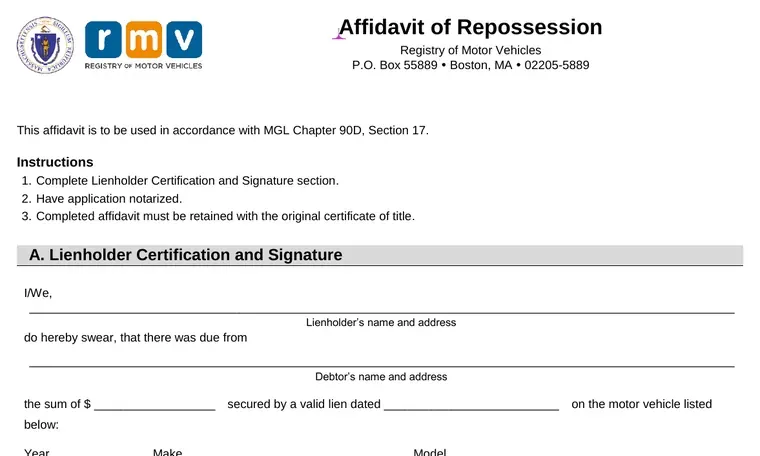
Two documents, and they are not the same thing. Take the blank TTL105 from the mass.gov copy so you get the revision that is current today.
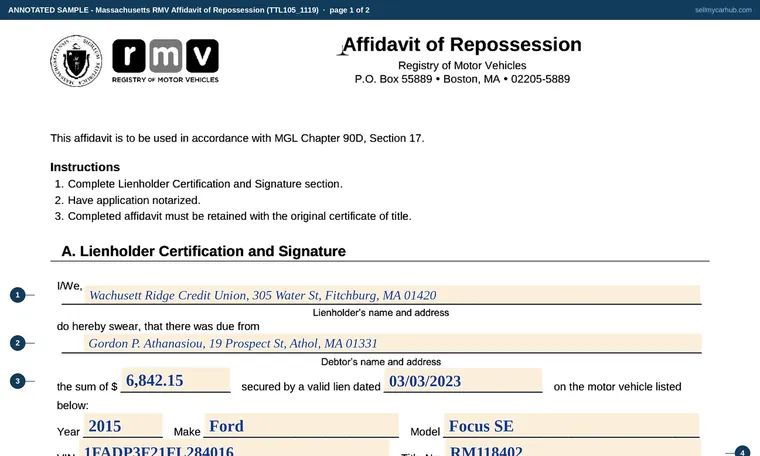
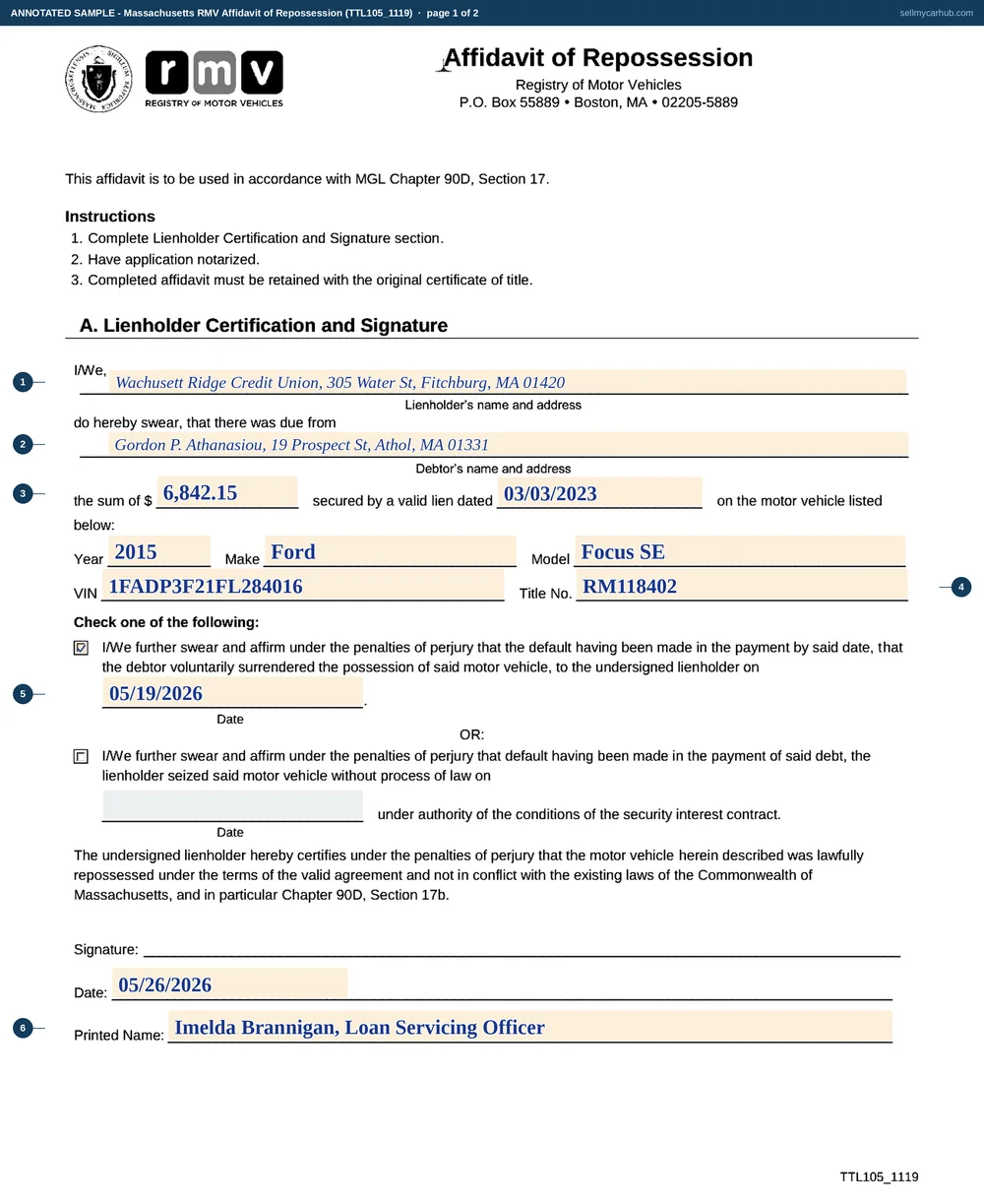
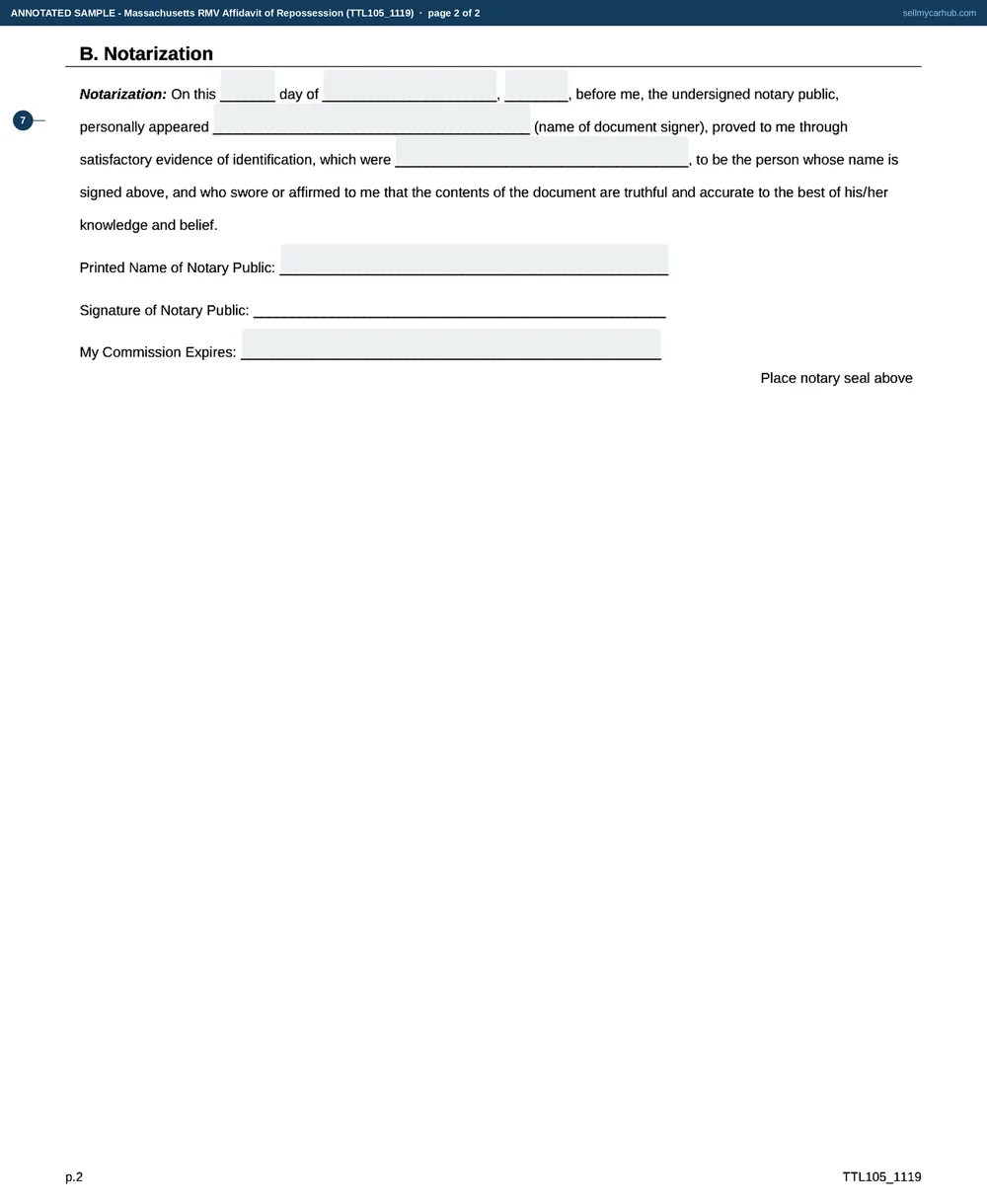
This is all 2 pages of the actual TTL105, rendered from the PDF the Massachusetts Registry of Motor Vehicles publishes and completed end to end: letterhead, every field, and the blocks at the foot.
The lienholder named on the certificate of title, and nobody else.
Watch out: A private seller never completes it. If a car you own is repossessed, this is the document the lender uses to move it on without your signature.
Lienholder name and address, debtor name and address, the sum due and the date of the valid lien.
Watch out: The lien date matters as much as the amount - it is what establishes that the security interest existed before the default.
The year, the make, the model, the identification number and the title number of the car being taken back.
Watch out: The title number ties the affidavit to the certificate it has to be retained with.
Voluntary surrender on a date, or seizure without process of law on a date.
Watch out: Sworn under the penalties of perjury either way, and certified as not in conflict with chapter 90D section 17b.
Signature, date and printed name in section A; the notary completes section B on page two.
Watch out: Signed in front of the notary, not before. What the notary certifies is that the person who signed stood in front of them and swore to what the affidavit says.
The completed affidavit is retained with the original certificate of title.
Watch out: If you are ever offered a car whose certificate is in a name that is not the seller's, this affidavit is the document that should be stapled to it.
| On the form | What to put in it |
|---|---|
| A, Lienholder Certification and Signature | The lienholder's name and address, the debtor's name and address, the sum due, the date of the valid lien, and the vehicle's year, make, model, vehicle identification number and title number. |
| The two boxes | One says the debtor voluntarily surrendered possession on a stated date. The other says the lienholder seized the motor vehicle without process of law on a stated date under the authority of the conditions of the security interest contract. One or the other, never both. |
| The certification | That the vehicle was lawfully repossessed under the terms of the valid agreement and not in conflict with the laws of the Commonwealth, and in particular chapter 90D section 17b. |
| B, Notarization | The notary records the date, the name of the document signer, the identification produced, their own signature and commission expiry, and applies the seal. |
Every line here was read off TTL105 (TTL105_1119, November 2019) itself — the PDF is here — and off the Massachusetts Registry of Motor Vehicles pages. This is plain-language help with a form, not legal advice, and where our wording and the agency's differ, theirs governs.
Back to all Massachusetts seller paperwork, or what selling a car in Massachusetts involves.