Sell My Car Hub

How to fill out Maine MVT-6

For a vehicle whose identification number no longer exists. Maine assigns a fresh one, stamped with an M and an E, and a Bureau of Motor Vehicles detective attaches it to the vehicle in person. Two situations reach this form: a number destroyed or obliterated, which on a New England vehicle usually means forty winters of road salt, and a homemade vehicle that never had one. The reverse of the sheet is where it gets serious - a table listing every part taken from another vehicle, with that vehicle's own identification number beside it.
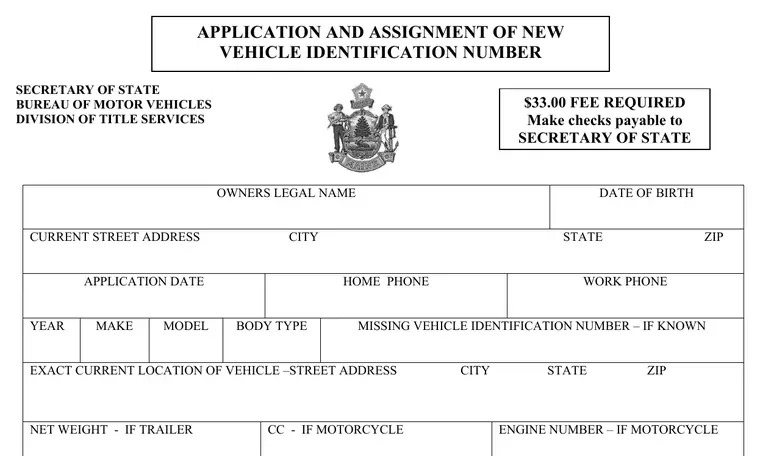
Written against MVT-6 (Rev 08-2024), issued under 29-A M.R.S. section 657. Do not clean up a corroded identification plate before the detective sees it. An obliterated number is the fact this application rests on, and a helpfully wire-brushed one is indistinguishable at a glance from a tampered one - which is the finding the Bureau's other inspection form exists to record.

Two documents, and they are not the same thing. Take the blank MVT-6 from the maine.gov copy so you get the revision that is current today, then print our MVT-6 guide and keep it beside you while you fill theirs in.

Filled in

What a completed one looks like

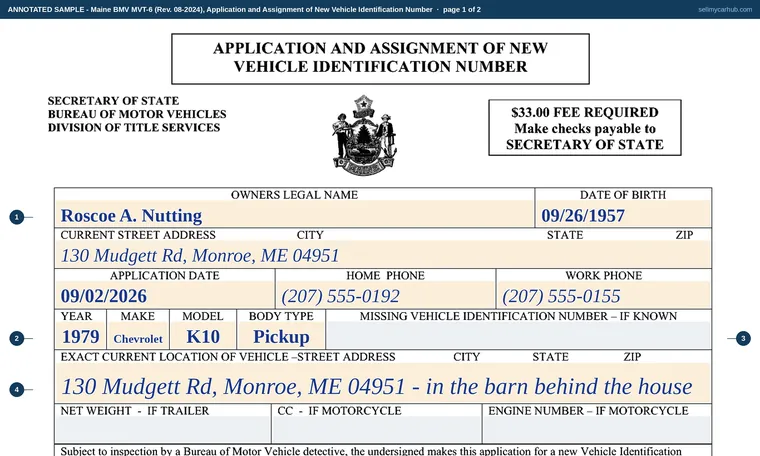
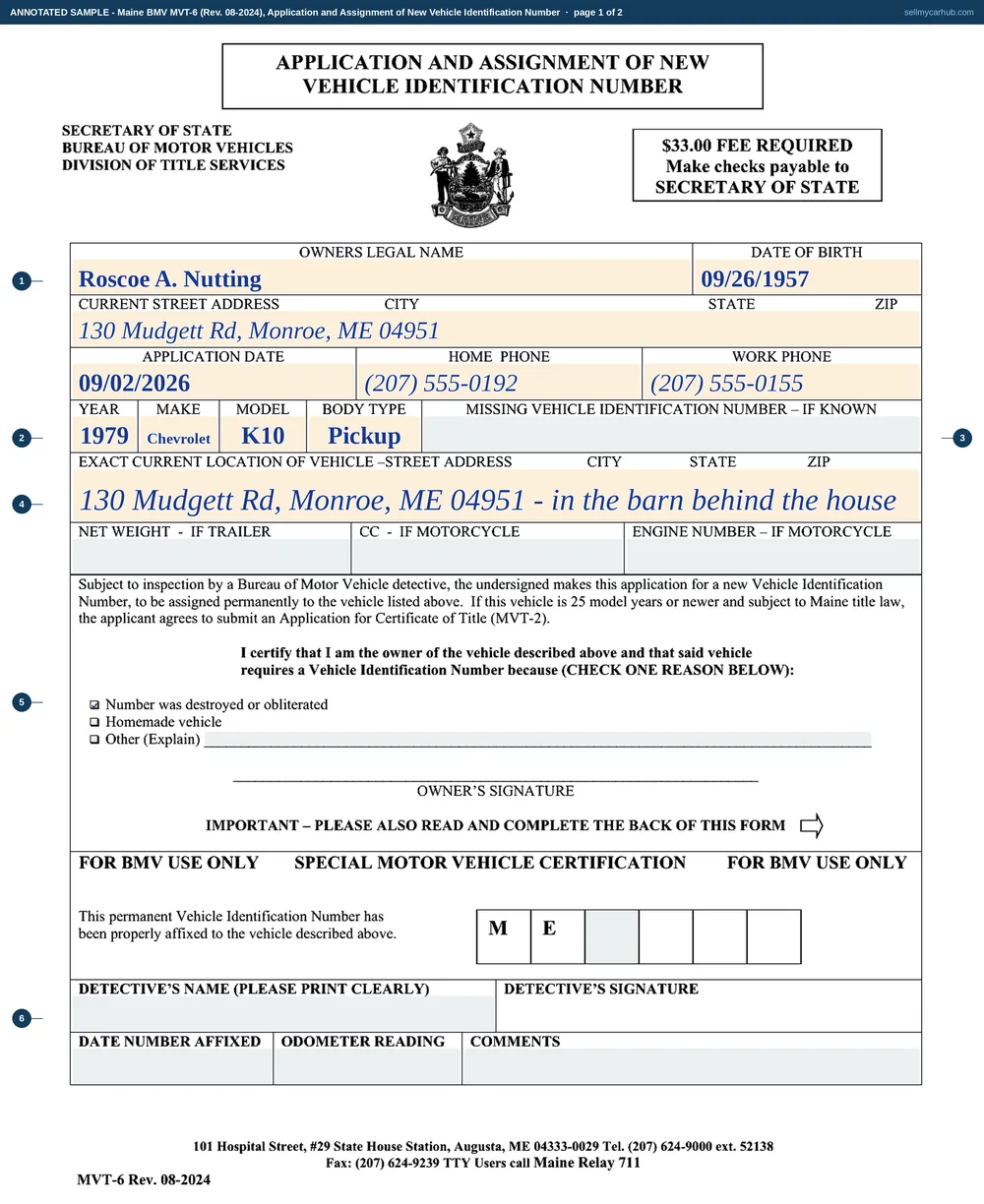
This is all 2 pages of the actual MVT-6, rendered from the PDF the Maine Bureau of Motor Vehicles publishes and completed end to end: letterhead, every field, and the blocks at the foot.

The Maine MVT-6 application and assignment of a new vehicle identification number filled in as an annotated sample. Roscoe A. Nutting of Monroe applies for a 1979 Chevrolet K10 pickup with the missing identification number box left empty, the exact current location given as a street address, and the number was destroyed or obliterated box ticked. The second page lists three parts taken from other vehicles with each donor's identification number, and the Bureau use block at the foot of the first page is greyed out as one the detective completes after the inspection.
Page 1 of 2. The application itself. Note the missing identification number box, which is left empty here because the number is genuinely unknown, and the exact current location box, which carries a full street address because a detective is going to drive to it.
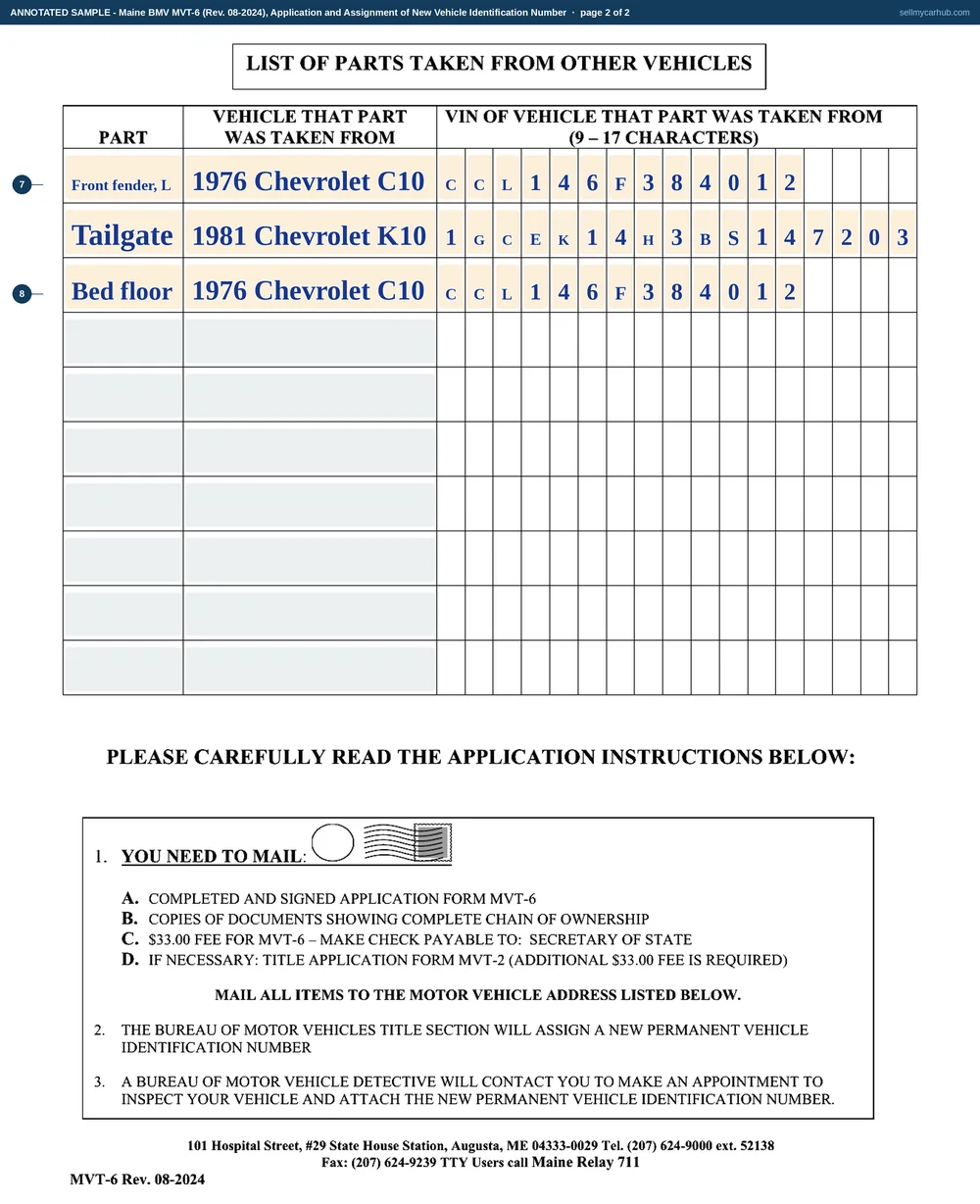
The Maine MVT-6 application and assignment of a new vehicle identification number filled in as an annotated sample. Roscoe A. Nutting of Monroe applies for a 1979 Chevrolet K10 pickup with the missing identification number box left empty, the exact current location given as a street address, and the number was destroyed or obliterated box ticked. The second page lists three parts taken from other vehicles with each donor's identification number, and the Bureau use block at the foot of the first page is greyed out as one the detective completes after the inspection.
Page 2 of 2. The reverse, where a rebuilt vehicle has to account for itself. Three rows are used and the rest are greyed, and each row names the part, the vehicle it came from and that vehicle's own identification number.
Field by field

Every line, in the order you meet it

  1. 1
    You fill this in

    Owner details

    Legal name, date of birth, street address and two telephone numbers.

    Watch out: Both phone lanes are worth completing. The next step in this process is a detective trying to reach you to arrange a visit.

  2. 2
    You fill this in

    Describe the vehicle

    Year, make, model and body type.

    Watch out: For a homemade vehicle the make is what you built it as, and the Bureau would rather have a plain description than a blank.

  3. 3
    You fill this in

    The missing number, if known

    The old identification number if any record of it survives.

    Watch out: An old registration certificate or an insurance document often carries it. Leaving it empty is honest, but finding it shortens everything that follows.

  4. 4
    You fill this in

    Exact current location

    The street address where the vehicle physically is.

    Watch out: If it is in a field behind the house, say so on the line. The appointment is made against this address and the detective needs to reach the vehicle.

  5. 5
    You fill this in

    Tick why

    Destroyed or obliterated, homemade, or Other with an explanation.

    Watch out: Other is for anything that is neither corrosion nor construction - a replacement body shell, for instance. Explain it in one line rather than leaving the assessor to guess.

  6. 6
    You fill this in

    Sign the undertaking

    The signature under the printed paragraph about inspection and about applying for a title where the vehicle is inside the title window.

    Watch out: That paragraph is a commitment, not a preamble. Signing it while intending to skip the title application is the wrong start to a process that ends with a detective at your gate.

  7. 7
    You fill this in

    Complete the parts table

    Every part taken from another vehicle, the vehicle it came from, and that vehicle's identification number.

    Watch out: Donor numbers can be nine to seventeen characters, so an older part with a shorter number is expected rather than a problem. An unlisted part found during the inspection is the problem.

  8. 8
    You fill this in

    Post the package

    The signed application, copies of the ownership chain, and the fee to Secretary of State.

    Watch out: Copies, not originals. The chain of ownership documents are the ones you will want back and the instruction asks for copies for exactly that reason.

At a glance

What goes where

On the formWhat to put in it
OwnerLegal name, date of birth, current street address, and home and work telephone numbers.
Application dateIts own box beside the telephone numbers.
The vehicleYear, make, model and body type, then a box headed missing vehicle identification number - if known, which is often and legitimately empty.
Exact current location of vehicleA full street address. The detective is coming to it, so a town name is not an answer.
Three conditional boxesNet weight if trailer, engine capacity if motorcycle, engine number if motorcycle.
The undertakingPrinted above the signature: the application is made subject to inspection by a Bureau of Motor Vehicle detective, and if the vehicle is 25 model years or newer and subject to Maine title law, the applicant agrees to submit an application for certificate of title.
WhyThree boxes, one of which is ticked: number was destroyed or obliterated, homemade vehicle, or Other with a line to explain.
List of parts taken from other vehiclesThe whole reverse. Each row takes the part, the vehicle it came from, and that vehicle's identification number, which the heading allows to be nine to seventeen characters.
Special motor vehicle certificationA Bureau block at the foot of the front, completed after the visit: the detective's printed name and signature, the date the number was affixed, the odometer reading and any comments, with M and E preprinted beside the space for the new number.

What gets this one rejected

Rules that decide whether it is accepted

Every line here was read off MVT-6 (Rev 08-2024) itself — the PDF is here — and off the Maine Bureau of Motor Vehicles pages. This is plain-language help with a form, not legal advice, and where our wording and the agency's differ, theirs governs.

Back to all Maine seller paperwork, or what selling a car in Maine involves.

Want the paperwork handled instead?

Get My Instant Offer → Online · about 2 minutes · free

Or send the details — we'll come to you

A project vehicle with no readable number is months of correspondence before it can even be advertised. Ask us what it is worth as it sits.

or call/text (877) 405-1808