Sell My Car Hub

How to fill out Maine MVT-22

One notarised page, and the whole of Maine's answer to a vehicle whose owner has died. Which box gets ticked in Section A decides everything that follows, and the four-page instruction sheet stapled behind it is the clearest thing the Bureau publishes about joint ownership, common ownership and what happens when neither applies. A surviving spouse who is selling the car rather than keeping it does not skip this form - the instructions tell them to hand the buyer the transferred title, a release of any lien, and this affidavit completed.
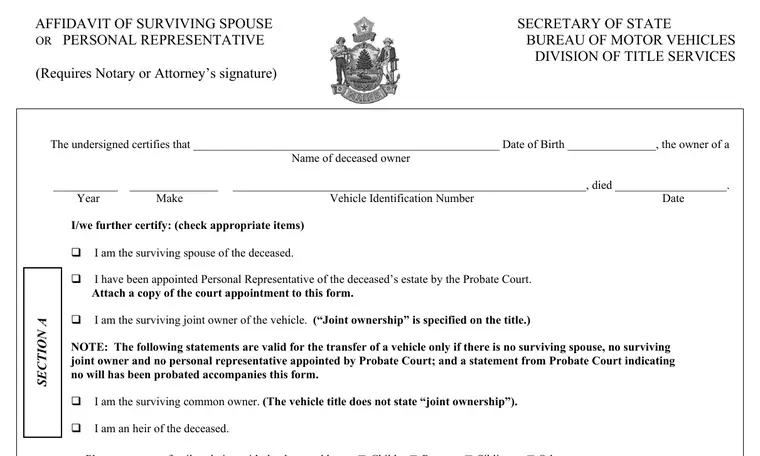
Written against MVT-22 (Rev 09-2021), issued under 29-A M.R.S. chapter 7 and Chapter 102 of the Rules of the Secretary of State. Read the front of the certificate before you tick anything. Whether it prints the words joint ownership is the single fact that decides which of the six boxes applies, and getting it wrong sends the form back with the estate no further forward and the vehicle still uninsurable.

Two documents, and they are not the same thing. Take the blank MVT-22 from the maine.gov copy so you get the revision that is current today, then print our MVT-22 guide and keep it beside you while you fill theirs in.

Filled in

What a completed one looks like

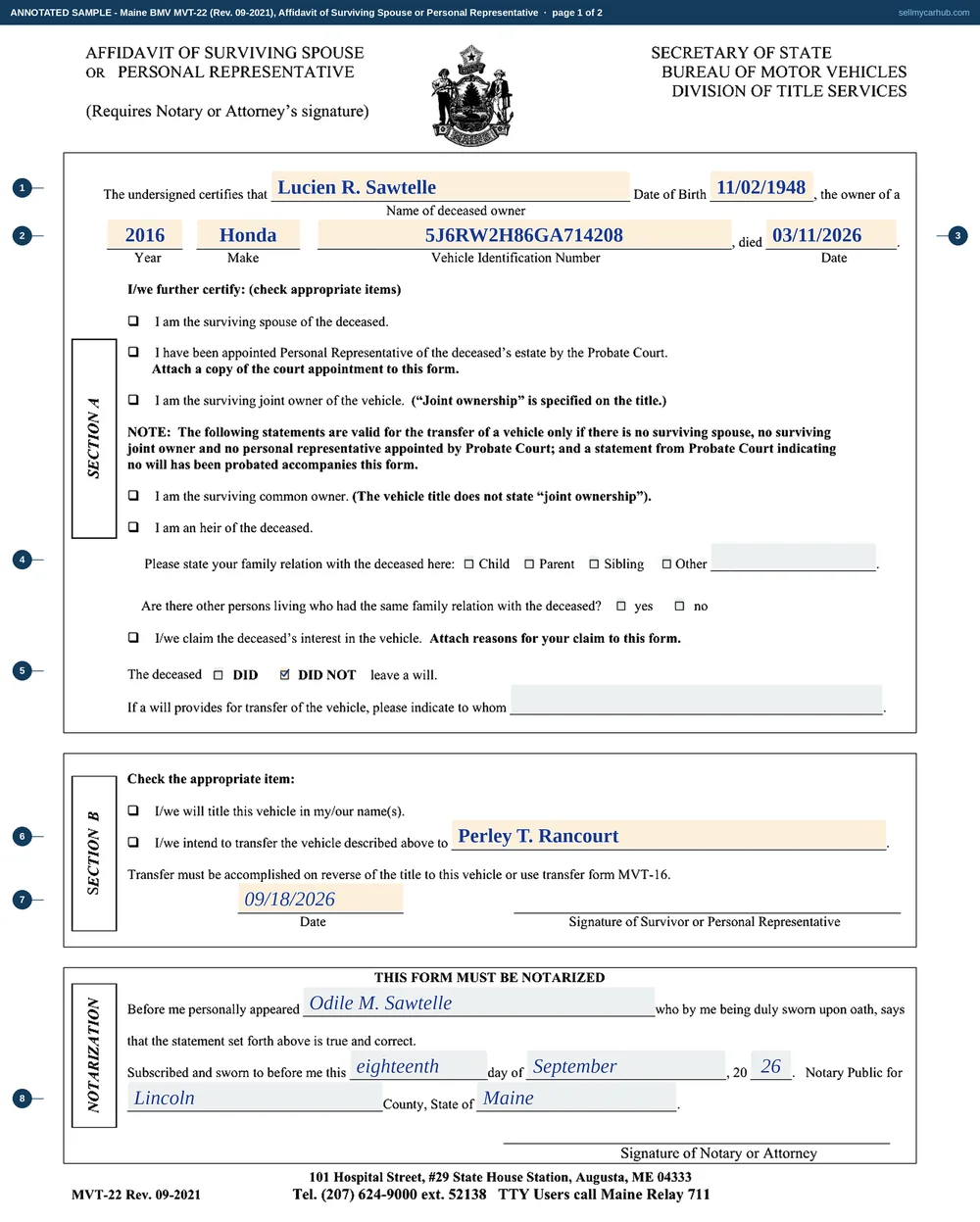
This is all 2 pages of the actual MVT-22, rendered from the PDF the Maine Bureau of Motor Vehicles publishes and completed end to end: letterhead, every field, and the blocks at the foot.

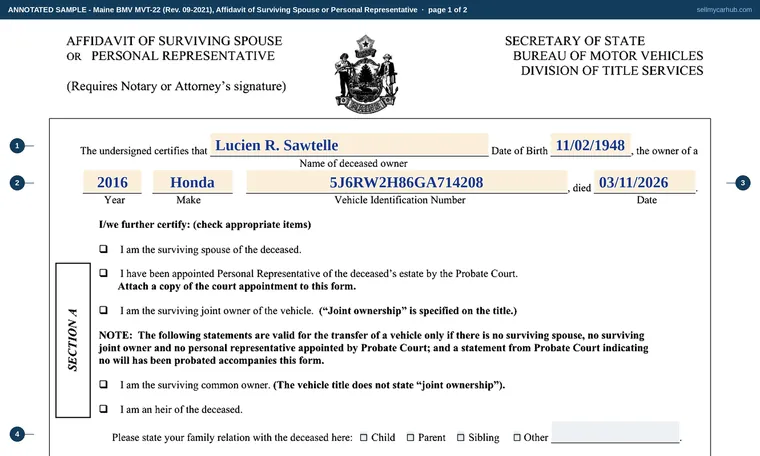
The Maine MVT-22 affidavit of surviving spouse or personal representative filled in as an annotated sample. Lucien R. Sawtelle is named as the deceased owner of a 2016 Honda CR-V with his date of birth and date of death, the DID NOT box is ticked against the question of whether he left a will, the family-relation lanes below the heir box are greyed out as ones a surviving spouse never reaches, Section B names Perley T. Rancourt as the person the vehicle is being transferred to and carries the date, and the notarisation block is completed with Odile M. Sawtelle as the appearer and Lincoln County, Maine.
Page 1 of 2. The deceased, the vehicle and the date of death across the top, the will question answered, Section B naming who the vehicle goes to, and the notarisation completed at the foot. The six squares in Section A are for ink.
The Maine MVT-22 affidavit of surviving spouse or personal representative filled in as an annotated sample. Lucien R. Sawtelle is named as the deceased owner of a 2016 Honda CR-V with his date of birth and date of death, the DID NOT box is ticked against the question of whether he left a will, the family-relation lanes below the heir box are greyed out as ones a surviving spouse never reaches, Section B names Perley T. Rancourt as the person the vehicle is being transferred to and carries the date, and the notarisation block is completed with Odile M. Sawtelle as the appearer and Lincoln County, Maine.
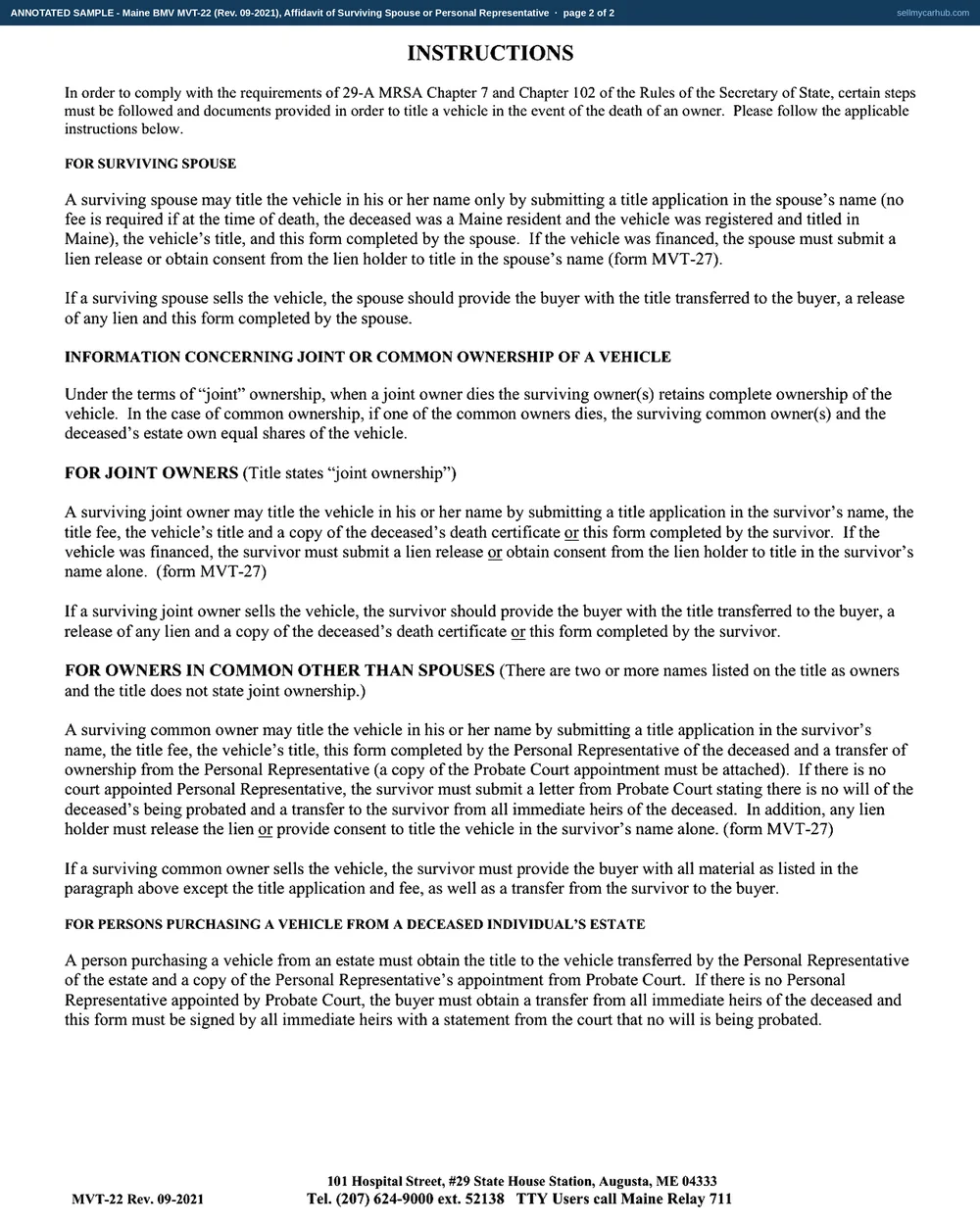
Page 2 of 2. The instruction sheet the Bureau staples behind it. Nothing on this page is filled in - it is here because it is the clearest published statement of what joint ownership and common ownership mean in Maine, and which documents each one needs.
Field by field

Every line, in the order you meet it

  1. 1
    You fill this in

    Name the deceased and the vehicle

    Name, date of birth, date of death, and the year, make and identification number of the vehicle.

    Watch out: Use the name as the certificate prints it. Where it differs from the death certificate, expect to be asked, and bring both.

  2. 2
    You fill this in

    Read the front of the title first

    Whether it says joint ownership decides between two of the six boxes.

    Watch out: This is the fact everything else hangs on, and it is printed on the certificate rather than something anyone needs to remember.

  3. 3
    You fill this in

    Tick one box in Section A

    Surviving spouse, personal representative, surviving joint owner, surviving common owner, heir, or a claim on the deceased's interest.

    Watch out: The last three sit under a printed condition. If a spouse, a joint owner or a court-appointed representative exists, those three are not available at all.

  4. 4
    You fill this in

    Attach what your box requires

    A copy of the Probate Court appointment, or the court's statement that no will is being probated, or written reasons for a claim.

    Watch out: The attachment is named in the box you ticked. An affidavit arriving without it is the commonest delay in an estate transfer.

  5. 5
    You fill this in

    Answer the will questions

    Did or did not leave a will, and who the will provides the vehicle to if it says.

    Watch out: Answer both even where the answer is no will. A blank there reads as unfinished rather than as none.

  6. 6
    You fill this in

    Section B, title it or transfer it

    Either you will title the vehicle in your own name, or you name the person you are transferring it to.

    Watch out: A survivor who is selling the car ticks the second and writes the buyer in. The transfer itself still happens on the reverse of the certificate or on the Bureau's separate transfer sheet.

  7. 7
    You fill this in

    Sign in front of a notary

    Date, signature, then the notary or attorney completes the block beneath.

    Watch out: Where the transfer runs through heirs rather than a spouse or representative, all immediate heirs sign - and all of them sign in front of the notary.

At a glance

What goes where

On the formWhat to put in it
The deceasedName, date of birth, and the date of death, wrapped around a vehicle row of year, make and vehicle identification number.
Section A, who you areSix tick boxes. The first three stand alone: surviving spouse, personal representative appointed by the Probate Court with a copy of the appointment attached, or surviving joint owner where joint ownership is specified on the title.
Section A, the other threeSurviving common owner where the title does not state joint ownership, heir of the deceased, or a claim on the deceased's interest with reasons attached. The Bureau prints a warning above them: these are valid only where there is no surviving spouse, no surviving joint owner and no personal representative, and a statement from the Probate Court that no will is being probated accompanies the form.
Family relationWhere the heir box is used: child, parent, sibling or other, plus a yes or no answer to whether other persons living had the same family relation with the deceased.
The willDid or did not leave a will, and if a will provides for transfer of the vehicle, to whom.
Section B, what happens nextTwo boxes. Either I or we will title this vehicle in my or our names, or I or we intend to transfer the vehicle to a named person. Underneath, the Bureau's own note that the transfer must be accomplished on the reverse of the title or on the separate transfer sheet.
SignatureDate and the signature of the survivor or personal representative.
NotarizationA full block under the words THIS FORM MUST BE NOTARIZED, taking the appearer's name, the day, month and year, a county and a state, and the signature of a notary or attorney.

What gets this one rejected

Rules that decide whether it is accepted

Every line here was read off MVT-22 (Rev 09-2021) itself — the PDF is here — and off the Maine Bureau of Motor Vehicles pages. This is plain-language help with a form, not legal advice, and where our wording and the agency's differ, theirs governs.

Back to all Maine seller paperwork, or what selling a car in Maine involves.

Want the paperwork handled instead?

Get My Instant Offer → Online · about 2 minutes · free

Or send the details — we'll come to you

Settling an estate is not the moment to be learning about title law. Tell us what the certificate says and we will take it from there.

or call/text (877) 405-1808