Sell My Car Hub

How to fill out Kentucky TC 96-159

A garage's or a wrecker company's affidavit for selling a vehicle it has never owned, to recover a bill the owner has not paid. Kentucky lets a repairer do this after the reasonable agreed charge for repair has gone unpaid for at least 30 days, and a towing and storage operator after 45. For a seller the reason to read it is defensive: this is the document that ends your ownership of a car sitting in somebody else's yard, and every step on it is a deadline you could still interrupt.
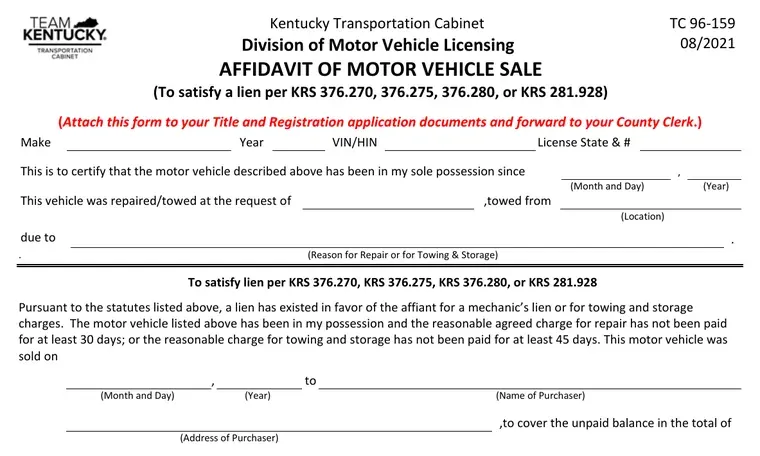
Written against TC 96-159 (08/2021), issued under KRS 376.270, KRS 376.275, KRS 376.280 and KRS 281.928. If your car is in a yard and the bill is disputed, the dates on this affidavit are the ones that matter - possession, the mailed notice, the ten-day notice and the three weeks of advertising. Every one of them is a point at which the sale can still be stopped by paying, and every one of them passes quietly.

Two documents, and they are not the same thing. Take the blank TC 96-159 from the transportation.ky.gov copy so you get the revision that is current today.

Filled in

What a completed one looks like

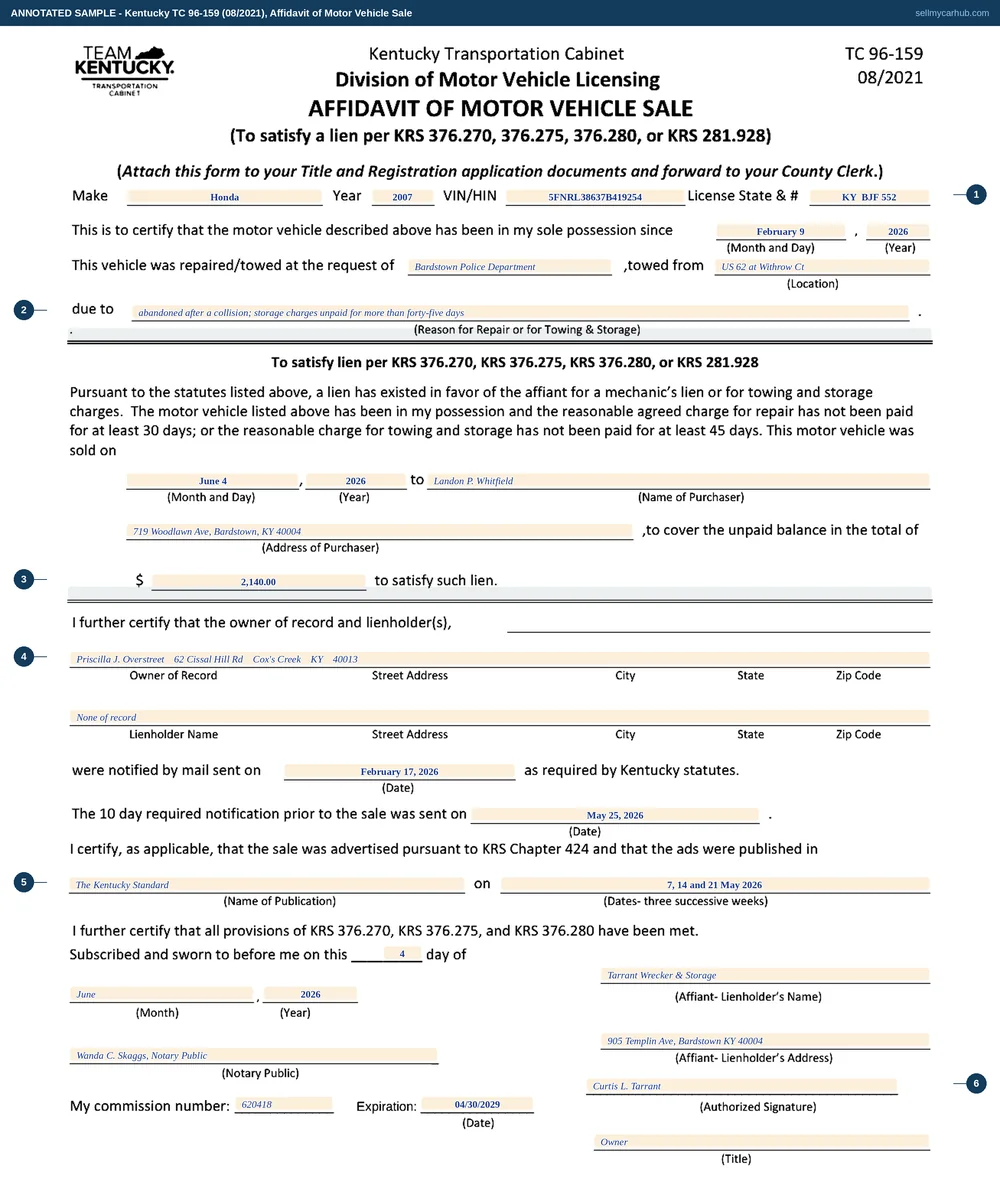
This is the actual TC 96-159, rendered from the PDF the Kentucky Transportation Cabinet, Division of Motor Vehicle Licensing publishes and completed end to end: letterhead, every field, and the blocks at the foot.

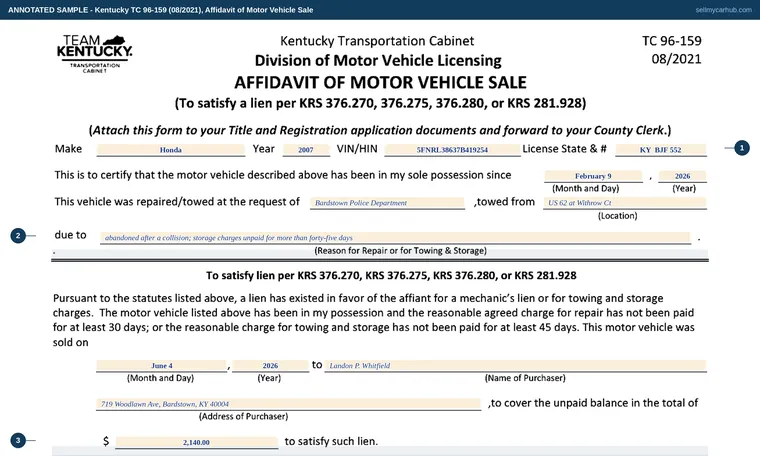
Kentucky form TC 96-159 filled in by a wrecker company: Tarrant Wrecker and Storage certifies sole possession of a 2007 Honda Odyssey, vehicle identification number 5FNRL38637B419254, since 9 February 2026 after a police-requested tow, sold on 4 June 2026 to Landon P. Whitfield for 2,140 dollars to cover unpaid storage, with notice mailed to owner of record Priscilla J. Overstreet and advertisements run in The Kentucky Standard for three successive weeks.
Read it as a timeline rather than as a form. Possession in February, notice by post a week later, a ten-day warning at the end of May, three weeks of advertising, and a sale in June - each of those dates a moment the owner could have stopped it.
Field by field

Every line, in the order you meet it

  1. 1
    Dealers only

    The vehicle and the date possession began

    Make, year, identification number, plate, and the month, day and year the vehicle came into the affiant's sole possession.

    Watch out: For an owner: this date is the anchor. Everything else on the sheet counts forward from it, so it is the first thing to check.

  2. 2
    Dealers only

    Why it is there

    Who requested the repair or the tow, where it was towed from, and the reason on the wide line.

    Watch out: A police-requested tow and a customer-requested repair are different situations with different statutes behind them, and the form asks you to say which.

  3. 3
    Dealers only

    The sale and the unpaid balance

    The date sold, the purchaser's name and address, and the total the sale is covering.

    Watch out: The total is what the lien is being satisfied for, not what the vehicle was worth. Those are two different numbers and the difference belongs to the owner.

  4. 4
    Dealers only

    Owner of record and lienholder

    Full name and address rows for both, exactly as the state's record has them.

    Watch out: A lienholder row filled in with none of record is a claim that the clerk will check against the title.

  5. 5
    Dealers only

    The two notification dates

    The date notice was mailed as Kentucky statutes require, and the separate date of the ten-day notification prior to the sale.

    Watch out: Two different letters, two different dates. A single mailing does not satisfy both lines.

  6. 6
    Dealers only

    Advertising, then swear it

    The publication and the dates it ran for three successive weeks, then the authorised signature, title and the notary's block.

    Watch out: The advertisement is the public part of this process, and it is where an owner who has lost track of a car occasionally finds it again.

At a glance

What goes where

On the formWhat to put in it
The vehicleMake, year, vehicle identification or hull number, and the licence state and number, across the top.
Sole possession sinceA month and day, then a year - the date the affiant's possession began, which is the date every subsequent deadline counts from.
Repaired or towed at the request ofWho asked for the work or the tow, where it was towed from, and a wide line for the reason for repair or for towing and storage.
The statutory recitalA printed paragraph that a lien has existed in favour of the affiant for a mechanic's lien or for towing and storage charges, and that the charge has gone unpaid for the periods the statutes set.
The saleThe month, day and year the vehicle was sold, the name and address of the purchaser, and the dollar total the sale was to cover.
Owner of record and lienholderTwo full address rows - name, street, city, state and ZIP - for the registered owner and for any lienholder.
NotificationThe date notice was sent by mail as required by Kentucky statutes, and a separate line for the ten-day required notification prior to the sale.
AdvertisingThe name of the publication and the dates the advertisement ran, described on the form as three successive weeks.
Affiant and juratThe lienholder's name, address, authorised signature and title, sworn before a notary with a commission number and expiration.

What gets this one rejected

Rules that decide whether it is accepted

Every line here was read off TC 96-159 (08/2021) itself — the PDF is here — and off the Kentucky Transportation Cabinet, Division of Motor Vehicle Licensing pages. This is plain-language help with a form, not legal advice, and where our wording and the agency's differ, theirs governs.

Back to all Kentucky seller paperwork, or what selling a car in Kentucky involves.

Want the paperwork handled instead?

Get My Instant Offer → Online · about 2 minutes · free

Or send the details — we'll come to you

Car sitting in a garage or a tow yard with a bill you cannot cover? Talk to us before it gets sold out from under you.

or call/text (877) 405-1808