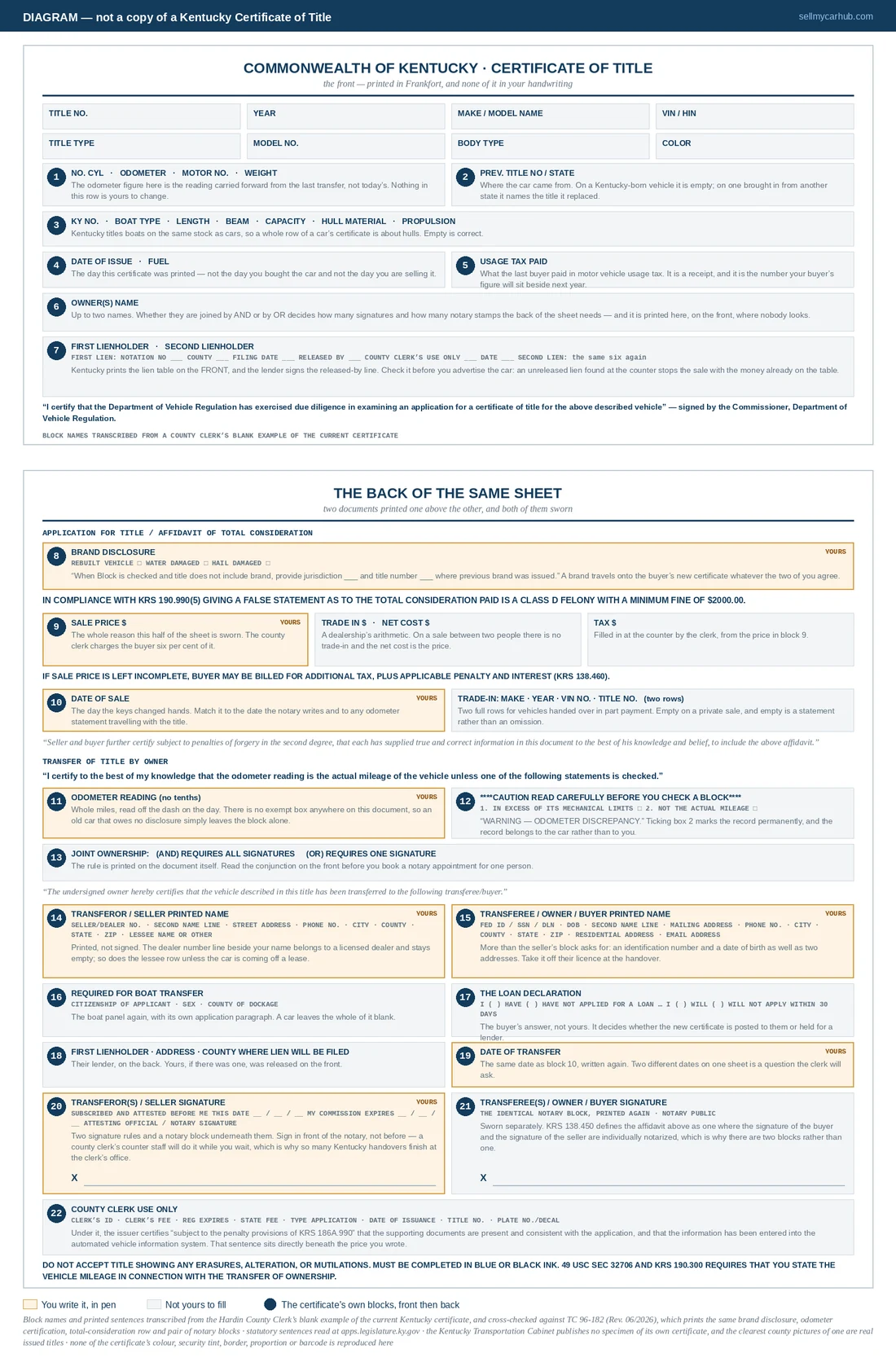
Almost all of a Kentucky sale happens on the reverse of one sheet. The front is the Cabinet's - vehicle, owner, lien table, commissioner's certification - and none of it is yours to write on. The back carries two documents printed one above the other: an application for title that doubles as a sworn affidavit of what was paid, and the transfer of title by owner where the mileage and the signatures go.
Last updated .
Your 12 boxes
As a private seller you complete these and nothing else:
You cannot download a blank Kentucky title, and the Cabinet publishes no picture of one. The certificate is printed on multi-tone secure stock at Frankfort and posted to the owner. What follows is a diagram of it, drawn from a county clerk's own blank example and from the Cabinet's TC 96-182, with a seller's blocks picked out.
DO NOT ACCEPT TITLE SHOWING ANY ERASURES, ALTERATION, OR MUTILATIONS. MUST BE COMPLETED IN BLUE OR BLACK INK. - printed across the foot of the reverse.
Every block name and every sentence in quotation marks below was transcribed from a Kentucky county clerk's published blank example of the current certificate and cross-checked against TC 96-182, which the Cabinet does publish and which prints the same odometer certification, the same total-consideration arithmetic and the same pair of notary blocks in type you can read.
The certificate itself
What is printed on a Kentucky certificate, front and back
The markers below run in the order the blocks appear on the document, front then back — which is not the order you fill them in, and the numbered steps further down this page follow that instead. Amber is yours: the affidavit, the mileage, the buyer's details and two signature blocks.
Amber — you write it, in pen
Grey — not yours to fill
Numbered — in the order the certificate prints them
Click or tap the picture to open it full size.
Drawn rather than photographed, and it says so across the top. The Kentucky Transportation Cabinet publishes no specimen of its own certificate: not on any page of drive.ky.gov, not in any of the 66 PDFs in its TC 96 forms library, and not in the KAVIS manuals it publishes for county clerks, whose pictures are all screenshots of the software. County clerks do publish pictures of the document, and the two clearest are real issued titles with real vehicle identification numbers and control numbers on them. Every block name here was transcribed instead from the Hardin County Clerk's blank example and from TC 96-182, which prints the same blocks in legible type. None of the certificate's colour, security tint or proportion is reproduced.
The half you can download
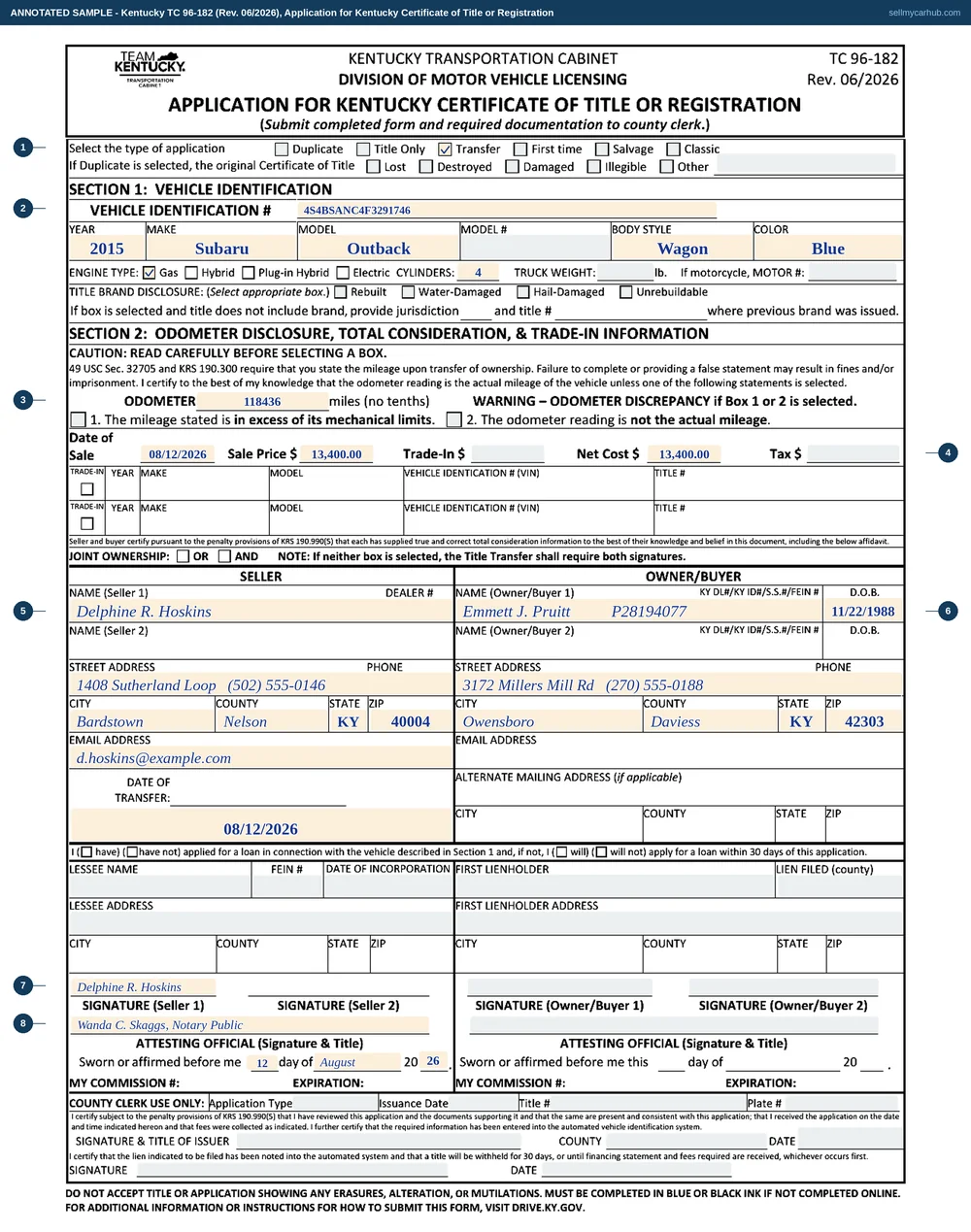
TC 96-182 carries the same two documents, on paper you can practise on
There is no blank Kentucky title to rehearse on - the certificate is secure stock and the only copy is the one in your drawer. What the Cabinet does publish is TC 96-182, which prints the identical odometer certification, the identical sale price, trade-in, net cost and tax row, and the identical pair of notary blocks. On a certificate issued before February 2000 it is not a rehearsal at all: it is required alongside the title. Amber is what a seller writes; grey is the buyer's side and the clerk's.
Click or tap the picture to open it full size.
Look at the two odometer boxes, both empty. The sentence above them certifies the reading as actual mileage unless one of them is ticked, so leaving both alone is the certification rather than an omission - and it is why there is no exempt box to reach for.
Step by step
Every box, in the order you meet it
1
You fill this in
Turn the certificate over before you agree a price
Check the lien table on the front, check whether the owner names are joined by AND or by OR, and check that the back carries an affidavit of total consideration at all.
Watch out: A certificate printed before February 2000 has only the assignment on its back, and a transfer on one of those needs a completed TC 96-182 with it. Finding that out at the clerk's counter with a buyer beside you is the expensive way.
2
You fill this in
BRAND DISCLOSURE
Four printed boxes at the head of the back: rebuilt vehicle, water damaged, hail damaged, unrebuildable. Tick what applies, and if the front of the certificate does not already carry the brand, write in the jurisdiction and title number where it was issued.
Watch out: It follows the car onto the buyer's new certificate whatever the two of you agree, so declaring it is not a concession you are making - it is the only version of the sale that survives contact with the clerk.
3
You fill this in
Sale Price $ / Trade in $ / Net Cost $ / Tax $
The money row of the affidavit of total consideration. On a private sale with no trade-in you fill the sale price and leave the rest to the counter.
Watch out: This is the single most consequential thing you write. The clerk taxes the buyer at six per cent of it, and the printed line underneath warns that if sale price is left incomplete, buyer may be billed for additional tax, plus applicable penalty and interest.
4
You fill this in
Date of Sale
The day the keys actually changed hands, in the small box beside the trade-in bracket.
Watch out: Make it the same date the notary writes, and the same date on any TC 96-5 that goes with it. Three documents about one handover carrying two different dates is the sort of thing that gets an application set aside.
5
You fill this in
Odometer Reading (no tenths)
The whole miles off the dash, on the day of the handover, under the heading TRANSFER OF TITLE BY OWNER.
Watch out: Read it on the day, not off a service invoice. If it will not fit, has been corrected, or the block is already used, the mileage moves onto a TC 96-5 and travels with the title.
6
You fill this in
The two caution boxes - normally neither
Statement 1, the mileage stated is in excess of its mechanical limits. Statement 2, the odometer reading is not the actual mileage.
Watch out: The certificate shouts CAUTION READ CAREFULLY BEFORE YOU CHECK A BLOCK at you for a reason. Statement 2 puts an odometer discrepancy on the record permanently, and there is no box for an old vehicle that simply does not need disclosing.
7
You fill this in
Transferor / Seller Printed Name, address, city, county, zip
Your details printed - not signed - in the left-hand column, with a second name line if the front of the certificate names two owners.
Watch out: Print it exactly as the front prints it. If the front says one thing and your licence says another, the Cabinet wants an affidavit showing they are the same person, and a marriage licence or a divorce decree is what it names as a good example.
8
You fill this in
Transferee / Owner / Buyer Printed Name, identification number, date of birth
The right-hand column: their name, their Kentucky licence number or Social Security number, their date of birth, and both a mailing and a residential address.
Watch out: Read it off the identification they hand you, before they put it back in their wallet. The county in that address is the clerk's office the transfer will be filed at, and it adds no local rate at all - because Kentucky's usage tax is a flat six per cent - so the address matters for where, not for how much.
9
You fill this in
Transferor(s) / Seller Signature - in front of the notary
One signature line per owner. Do not sign it until you are standing in front of a notary with identification in your hand.
Watch out: A county clerk's office will notarise it while you wait, which is the whole reason Kentucky handovers tend to end at the clerk's counter. Signing at home and asking a notary to stamp it afterwards is not something a notary can do.
10
You fill this in
Subscribed and attested before me this date - the seller's notary block
The notary's own lines directly under your signature: the date, the commission number, the expiry date and the attesting official's signature and title.
Watch out: Check the commission expiry before you leave. An expired commission is not a technicality here - it is the difference between a transfer and a car still in your name.
11
The buyer fills this in
Transferee(s) / Owner / Buyer Signature, and their notary block
The buyer's signature, then a second, separate notary block with its own date, commission number and expiry.
Watch out: Theirs, separately, and they will normally do it at their own clerk's counter when they file. Yours does not cover theirs, which is why the certificate prints the block twice.
12
The buyer fills this in
First Lienholder, address, county where lien will be filed
The buyer's lender, if they are financing it, plus the two loan tick boxes above it - have or have not applied, will or will not apply within 30 days.
Watch out: Not your lender and none of your business, but worth knowing: where a lien is noted the new certificate is held rather than posted, and the buyer walks out with a registration receipt instead.
13
Leave this blank
COUNTY CLERK USE ONLY
Clerk's ID, clerk's fee, registration expiry, state fee, type of application, date of issuance, title number and plate number - the band across the foot of the reverse.
Watch out: None of it is yours, but the clerk's certification above it cites KRS 186A.990, which makes knowingly giving false information on a title application forgery in the second degree. That sentence sits directly under the price you wrote.
14
You fill this in
Take the plate off before they drive away
Nothing to do with the certificate and everything to do with the next twelve months. The plate is registered to you and stays with you.
Watch out: If the registration had already expired, it goes back to the county clerk instead - and if the buyer drove off with it on the car, the affidavit for that is TC 96-167.
15
You fill this in
Count to fifteen days
The buyer's deadline to file at their county clerk. On day sixteen the lever in KRS 186A.215(4) becomes yours to pull.
Watch out: That lever is TC 96-3, sworn in front of a notary and handed to the clerk in your own county. It freezes the record so nothing can be registered on the vehicle until the transfer is completed.
Before the pen
Before the pen goes anywhere near it
Six habits, and the first one costs you a second trip if you get it wrong.
Blue or black ink, and nothing else
The foot of the reverse says it in capitals: it must be completed in blue or black ink if not completed online. Pencil, gel colours and a biro that skips are all reasons to start again with a duplicate.
Fill it in first, sign it last, and sign it in front of the notary
Everything except the two signature lines can be written at the kitchen table. The signatures cannot, and a notary cannot stamp a signature that was already there when you arrived.
An error is not corrected, it is replaced
The Cabinet's instruction is to provide an affidavit with new information signed and notarized rather than to scratch anything out. Where the certificate itself is the problem, you are buying a duplicate.
Read the conjunction on the front before you book the notary
AND means every owner signs and every owner is notarised. OR means one will do. Turning up with one of two owners on an AND title wastes the appointment.
Whole miles, no tenths
The box says so. Round down, write digits, and do not write a word like exempt into a block that has no exempt option.
Photograph both sides before it leaves your hand
It is the only record you will have of what was written, what the notary stamped and on what date. Kentucky gives a private seller nothing else to keep.
The ink rule is the Division of Motor Vehicle Licensing's own: “Do not use liquid paper/white-out on your title. Do not scratch through or mark out information on the title. Do not erase or mutilate.”
— Kentucky Transportation Cabinet, Vehicle Titling.
Check your source
Three things Kentucky sellers are told that will cost them
Three things Kentucky sellers repeat to each other that stopped being true, or never were. Each correction links the source it comes from.
“Leave the plate on so they can get the car home.”
That was right until January 2024 and has been wrong ever since. The Cabinet's own line is that Kentuckians will now keep their license plates when transferring vehicle ownership, and the statute forbids the plate remaining on the car. It moves onto your next vehicle for a one-time fee of $11 to transfer the registration. Leaving it on means your registration number is driving around on somebody else's insurance until they get to a clerk.
It helps nobody. The band printed above that box calls a false statement as to the total consideration paid a Class D felony with a minimum fine of $2,000, and it is the buyer the Department of Revenue bills when the number does not hold - with penalty and interest on top. The honest version costs the buyer six per cent of a real price; the helpful version costs them six per cent of book value plus a letter.
“Once it is signed and notarised the car is theirs and I am done.”
Notarising the certificate transfers nothing on its own - the record only changes when somebody walks the document into a county clerk's office, and that somebody is the buyer. Until they do, the vehicle is registered in your name, the insurance system is watching for a policy against your VIN, and the January property tax bill has your address on it. Kentucky gives the buyer fifteen days and gives you an affidavit to file when they miss it.
Who signs, how many of them, and how many notary stamps that adds up to:
Every owner the front names, if the conjunction is AND
Kentucky prints the test on the back itself: JOINT OWNERSHIP: (AND) REQUIRES ALL SIGNATURES (OR) REQUIRES ONE SIGNATURE. Read the front before you book the notary.
One owner, if it is OR
Either name transfers the car on their own. A certificate with no conjunction printed at all is treated like AND, and both owners sign.
A notary, twice
Once under the seller's signatures and once under the buyer's, each with a commission number and an expiry date. One notarisation covering both halves is not what the document asks for.
The buyer, in their own block
Printed name, address, identification number and date of birth, then a signature of their own under their own notary line. They are applying for the title as well as acknowledging your mileage.
An attorney-in-fact, on TC 96-336 and not on the title
Kentucky's limited power of attorney is a separate notarised sheet that travels with the certificate. The absent owner signs the form, not the title.
Nobody, on a decedent's line
A dead owner's car moves on a death certificate, or on court documents where the surviving owner is not the spouse - never on a signature written in the deceased owner's name.
Once it is signed
Once the notary has stamped it and the keys have gone, the only thing left on your list is the sixteenth day - and the plate, which is already in your boot.