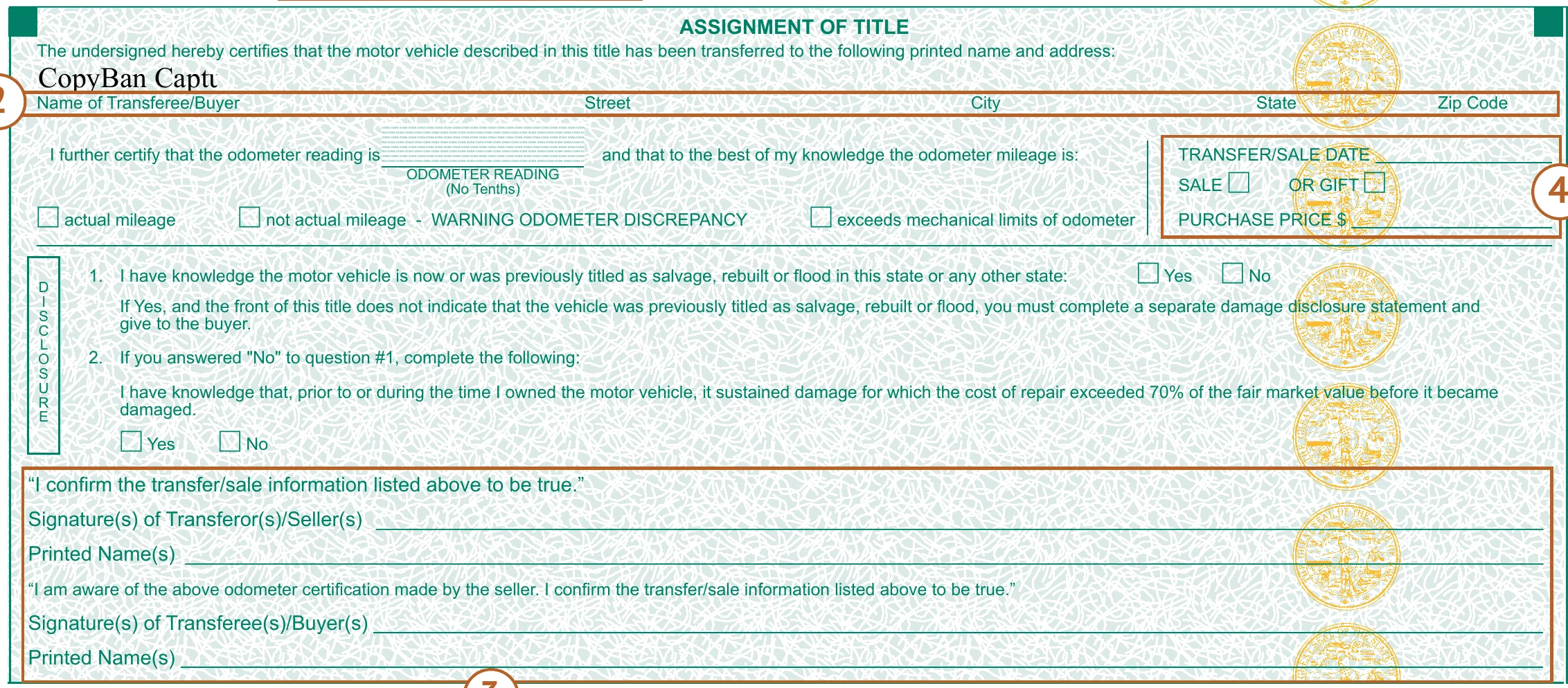
Iowa gives a seller one block and asks for everything in it. The picture below is the department's own - the assignment area of the certificate stock that has been going out to counties since early 2024, published blank in Iowa DOT's explainer of what changed. Eight entries in that block are yours to complete and two of them did not exist on the certificate before September 2023.
Last updated .
Your 9 boxes
As a private seller you complete these and nothing else:
There is no blank Iowa certificate to download and there never will be - it is security stock with a CopyBan pantograph in it, distributed to counties rather than printed on demand. What the department does publish is the picture above. Beside this paragraph is our printable checklist: the eight entries in that block that are yours, in the order the block asks for them.
Any alteration or erasure on an Iowa title is not a crossing-out, it is a notarised Affidavit of Correction attached to the document, or a replacement title.
The order the block itself runs in: the buyer's name and address across the top, the odometer reading and its notation, the transfer or sale date, the SALE or GIFT tick, the purchase price, the two damage questions, then your signature and printed name - and the buyer's signature and printed name underneath yours.
Iowa DOT's own published block
The assignment area of the current Iowa certificate, blank, as the department publishes it
This is not a drawing and it is nobody's document. It is the picture Iowa DOT prints in MM1431, its own explainer of what changed on the title certificate, dated 14 August 2025 - the security pantograph is showing, the words CopyBan Capture pantograph are printed across the buyer's name line where the artwork demonstrates itself, and every box is empty. It is the half of the title a seller actually writes on.
Amber — you write it, in pen
Grey — not yours to fill
Numbered — matches the steps below
Click or tap the picture to open it full size.
Reproduced from Changes to the Vehicle Title Certificate, Iowa DOT publication MM1431, 08/14/2025. The department published it to show counties what was new: the clarifying prompts on the buyer's line, the confirmation statements for both parties, and the bill-of-sale area at the right with its sale-or-gift ticks and its purchase price box.
The half of the block that is new
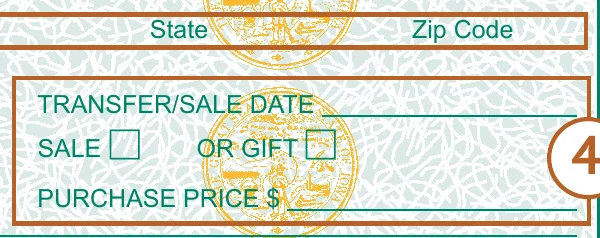
The bill-of-sale area, which did not exist before September 2023
Iowa used to record what a car sold for on a separate piece of paper. It now has three entries in the top right corner of the assignment area, and the first of them is required on every transfer there is - including the ones where no money changes hands.
Click or tap the picture to open it full size.
"The transfer/sale date is the only field in the new area that is required for every transfer." The department's own frequently asked questions go on to say that decimals are accepted in the price, that the figure written here outranks the one on the buyer's application unless the buyer can prove otherwise, and that fixing a wrong figure means a replacement title rather than a correction.
Click or tap the picture to open it full size.
Callout three on the department's page, and the change an Iowa seller is most likely to be caught out by. Both parties now sign the assignment block and both print their names in it. Iowa DOT's own answer, twice over in its frequently asked questions: the signatures of both parties are to acknowledge the transfer in its entirety, regardless of whether there is an odometer or damage disclosure or whether the transfer was by gift or retail sale.
Step by step
Every box, in the order you meet it
0
You fill this in
Before any box: read the connector on the front
Two owners joined by "or" means either of you can sign the assignment alone. Any other wording means both signatures.
Watch out: The exception catches people out: a replacement title or a junking certificate needs every owner regardless of the connector, so an "or" title does not save you if what you actually need is a duplicate.
1
You fill this in
Name and address of the transferee
Printed on the top line of the assignment area, with street, city, state and zip in their own columns.
Watch out: The 2023 redesign added prompts along this line for one reason, and the department states it plainly: to ensure only transferee/buyer info is noted on this line. Sellers were writing themselves in.
2
You fill this in
The odometer reading
Whole miles, no tenths, on any vehicle of model year 2011 or newer, with one of the three notations ticked beside it.
Watch out: "Exceeds mechanical limits" means the dial has rolled past what it can count, not that the mileage is high. Ticking it because a number looks big is a false odometer statement, and s. 321.71(12) makes that a fraudulent practice.
3
You fill this in
The transfer or sale date
In the boxed area at the top right of the block. It is the one entry in that area required on every transfer, whatever kind.
Watch out: It sets the buyer's thirty days and your six months for the registration refund, so it is the date everything else in this sale is measured from. Get it wrong and undoing it is Form 411219 or a replacement title.
4
You fill this in
SALE or GIFT, and the purchase price
One tick and one figure. Cents are accepted; the department's own answer is that a price submitted with cents is processed with cents.
Watch out: This is the figure the buyer's fee for new registration is worked out from, at ten dollars plus five per cent. If it disagrees with the buyer's application, Iowa treats yours as the official one because you attested to it.
5
You fill this in
The two damage questions
Whether the vehicle has ever been titled salvage, rebuilt or flood; and if not, whether repairs during your ownership cost more than seventy per cent of what it was worth beforehand.
Watch out: Required on any vehicle seven model years old or newer. If the answer to the first is yes and the front of the title does not show it, you owe the buyer a separate Form 411108 as well.
6
You fill this in
Your signature and your printed name
On the transferor lines, under the sentence beginning I confirm the transfer/sale information listed above to be true.
Watch out: The printed name line is new too. Before the redesign Iowa took a signature and left it at that, which is exactly why the department added a place to write the name legibly.
7
The buyer fills this in
The buyer signs the same block
Signature and printed name, under a statement that they are aware of the odometer certification you made.
Watch out: It is not optional and it is not only about mileage. Iowa DOT's own answer is that both parties sign regardless of whether there is an odometer or damage disclosure and regardless of whether the transfer was a gift or a retail sale.
8
You fill this in
Tell them the county and the expiry date
Which county the vehicle was last registered in, and when the plates expire. It goes to the buyer verbally or on the bill of sale, not into a box.
Watch out: s. 321.45(3) makes this the owner's duty in the same sentence that requires the assignment itself. Iowa registration runs on the owner's birth month, so the buyer has no way to work it out.
9
You fill this in
Take the plates off before it leaves
Both of them, in the driveway. They are assigned to you under s. 321.34, not to the vehicle.
Watch out: Then choose: onto a replacement vehicle within thirty days, carrying your unused registration across as a credit, or in to any county treasurer with a claim for the balance in cash.
Before the pen
Six rules for the pen on a certificate that now records the money as well as the car
Six habits for a document that now records the price as well as the ownership, and cannot be corrected without a notary.
Black or blue, and the department says why
It is a recommendation rather than a rule - Iowa DOT's own answer is that there is no law requiring blue or black ink and another colour may be accepted if it is legible. The reason to follow it anyway is in the same answer: the title is scanned, and the writing has to still be visible afterwards.
Write the price you were actually paid
The purchase price has its own box now and it is the number the buyer's fee for new registration is calculated on. Rounding it down as a favour is the thing the department's investigators list as tax fraud, in those words.
Never write in the buyer's half of the block
The prompts along the top line were added because sellers kept putting themselves there. A name in the transferee line that is not the transferee is a notarised affidavit to undo.
Fill in the date before you hand it over
It is required on every transfer, it starts the buyer's thirty days and your six months, and it is the entry Form 411219 has a dedicated tick box for - which tells you how often it goes wrong.
Leave the odometer boxes alone on a 2010 or older
Exempt means empty. Writing a reading into a box the rule does not ask for creates a disclosure you did not have to make and gives a counter clerk a reason to read the rest of the block harder.
Photograph the completed block
Iowa's own suggestion for proof of sale is to retain a copy of the back of the title showing assignment to the buyer. That copy, or a receipt from the buyer, is what you will want if the car keeps getting tickets.
Three things Iowa sellers repeat that are not true
Three things Iowa sellers tell each other. The first one is the one that costs money, and the department's own checklist is why it is wrong.
"Leave the plates on the car - in Iowa they go with the vehicle."
They do not, and the section that says so is headed with the answer: 321.34 Plates or validation sticker furnished - retained by owner. The plates are assigned to the owner, and when the owner transfers the vehicle the owner shall remove the registration plates from the vehicle. The department's Seller's Checklist starts with the same instruction before it gets anywhere near the title. Leaving them on is not a favour to the buyer either: they cannot register the car on your plate, and you throw away the unused registration, which Iowa will otherwise give you back in cash or credit.
"You have thirty days to notify the state that you sold it."
There is no such deadline, because there is no such duty. Iowa's seller's notice is Form 411107 and s. 321.46(5) says the seller MAY file it. The thirty days people are thinking of belong to the buyer - s. 321.46(1) gives the transferee thirty calendar days to apply for the new title, and Form 411007 prints the warning on its own face. What filing the notice actually buys you is a presumption: from the day the treasurer notes it, the record says you assigned and delivered the certificate. That is useful. It is not compulsory, and it is not what protects you.
"The buyer will owe sales tax, so keep the price off the title."
Two errors in one sentence. Iowa charges no sales tax on a vehicle at all - s. 321.105A imposes a fee for new registration of ten dollars plus five per cent of the purchase price, paid by the buyer to the county treasurer when the application goes in. And the price is not optional to record: it has its own box in the assignment area, Iowa Administrative Rule 701.250 requires a seller-signed bill of sale or equivalent to establish it, and the figure you attest to on the title is the one the county treats as official. Getting it wrong is not a correction, it is a replacement title.
Six signature rules, and the third one is new enough that plenty of Iowa buyers have never been asked for it:
You, as the transferor
On the Signature(s) of Transferor(s)/Seller(s) line, with your name printed underneath it. No notary, no witness, no appointment - Iowa asks for the signature and the printed name and nothing else.
Every owner, if the front says "and"
761 IAC 400.13(1): names joined by "or" mean any one signature transfers the vehicle; in all other cases the signature of each named owner is required.
The buyer, on the line below yours
New since the 2023 redesign and easy to miss. Iowa DOT's own answer is that both parties sign whether or not there is an odometer or damage disclosure and whether the transfer was a gift or a sale.
Nobody, over the top of a mistake
A wrong sale date, a name in the wrong box, a misspelling - each is a tick box on Form 411219, and the affidavit that carries it has to be notarised and attached to the document with the error in it.
Your lender, if a security interest is printed on the front
Either on the face of the certificate over their own signature, or on a separate notarised release, Form 411168. Iowa allows both and the choice is theirs.
An attorney in fact, if you cannot be there
Form 411021 names the vehicle and lists what the agent may do; a general power of attorney needs Form 411020 alongside it, one affidavit per vehicle.
Once it is signed
Signing the block is the middle of an Iowa sale, not the end of it. The plates still have to come off, and the unused registration on them is money you can have back.