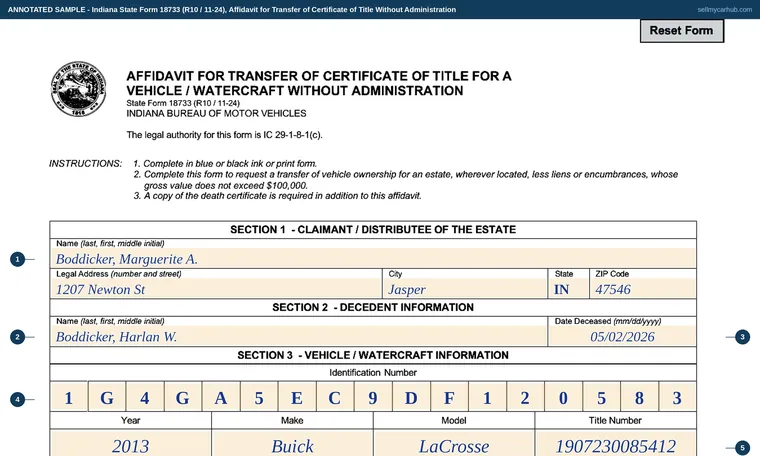
One page that moves a car out of a small estate without opening probate. The claimant swears to five things - the size of the estate, that five days have passed, that no personal representative has been appointed, that they are entitled to the vehicle, and that it carries no lien that is theirs - attaches a death certificate, and the BMV transfers the title. Four sections and sixteen boxes, which is a remarkably small amount of paper for what it does.
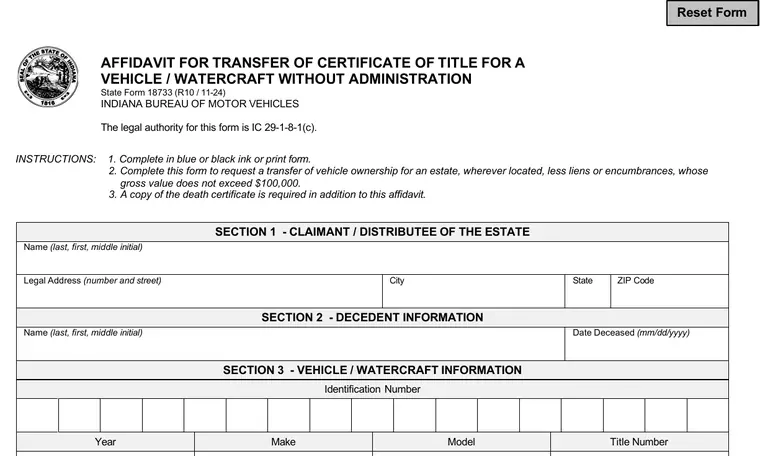
Written against State Form 18733 (R10 / 11-24), issued under IC 29-1-8-1(c). Read the five bullets as a set before writing anything. They are conditions rather than boxes - if one of them is not true on the day you sign, the affidavit is not merely incomplete, it is a false statement about a probate estate.
Two documents, and they are not the same thing. Take the blank State Form 18733 from the forms.in.gov copy so you get the revision that is current today.
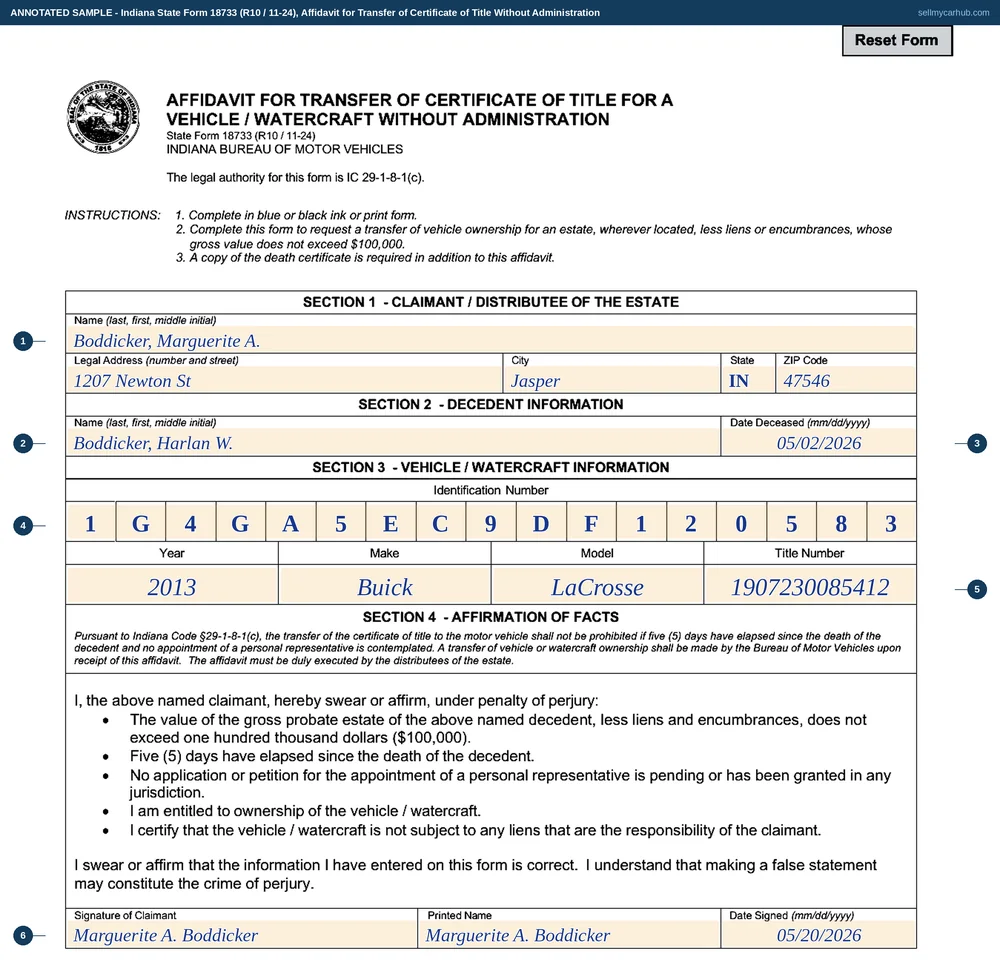
This is the actual State Form 18733, rendered from the PDF the Indiana Bureau of Motor Vehicles publishes and completed end to end: letterhead, every field, and the blocks at the foot.
The second bullet and the statute quoted above it both require that five days have elapsed since the death of the decedent.
Watch out: It is the shortest wait in Indiana's title system and there is no way round it. Signing on day four makes the affidavit untrue on its face.
The third bullet reaches any jurisdiction, not just Indiana.
Watch out: Ask the family before you sign, not afterwards. A personal representative appointed in another state is exactly the situation this bullet is written to catch.
Your name in the order last, first, middle initial, and your legal address.
Watch out: The claimant is the distributee - the person entitled to the vehicle. If that is more than one person, the form's preamble expects it to be executed by the distributees, and a branch will want to see how that was decided.
The deceased owner's name as the certificate carries it, and the date of death.
Watch out: As the certificate carries it. A married name on the death certificate and a maiden name on the title is a one-and-the-same problem on top of a probate one.
Identification number, Year, Make, Model and the Title Number.
Watch out: The title number is not marked optional on this form. If the certificate cannot be found, that is a separate problem to solve before this one.
Nothing to tick - they are certifications, and signing below adopts all five.
Watch out: The first one is about the whole gross probate estate, not about the car. A modest vehicle in a large estate does not qualify, however small the vehicle.
A copy, required by instruction 3 in addition to the affidavit.
Watch out: A copy is enough here, which is unusual - but it has to be a death certificate rather than an obituary, a funeral notice or a letter.
Signature of Claimant, printed name and date.
Watch out: Under penalty of perjury and with nobody watching. Every one of the five statements above the line is one you are personally swearing to about somebody else's estate.
| On the form | What to put in it |
|---|---|
| SECTION 1 - CLAIMANT / DISTRIBUTEE OF THE ESTATE | The claimant's name in the order last, first, middle initial, then a legal address with city, state and ZIP. |
| SECTION 2 - DECEDENT INFORMATION | The deceased owner's name and the Date Deceased in month, day and four-digit year. |
| SECTION 3 - VEHICLE / WATERCRAFT INFORMATION | The Identification Number in its own banded box, then Year, Make, Model and Title Number. |
| SECTION 4 - AFFIRMATION OF FACTS | A block of statute text followed by five bulleted certifications, each sworn under penalty of perjury. |
| The five bullets | That the gross probate estate less liens and encumbrances does not exceed one hundred thousand dollars ($100,000); that five (5) days have elapsed since the death; that no application or petition for the appointment of a personal representative is pending or has been granted in any jurisdiction; that the claimant is entitled to ownership; and that the vehicle is not subject to any liens that are the responsibility of the claimant. |
| Signature of Claimant | One signature row with a printed name and a date. No notary, and no space for a second claimant. |
Every line here was read off State Form 18733 (R10 / 11-24) itself — the PDF is here — and off the Indiana Bureau of Motor Vehicles pages. This is plain-language help with a form, not legal advice, and where our wording and the agency's differ, theirs governs.
Back to all Indiana seller paperwork, or what selling a car in Indiana involves.