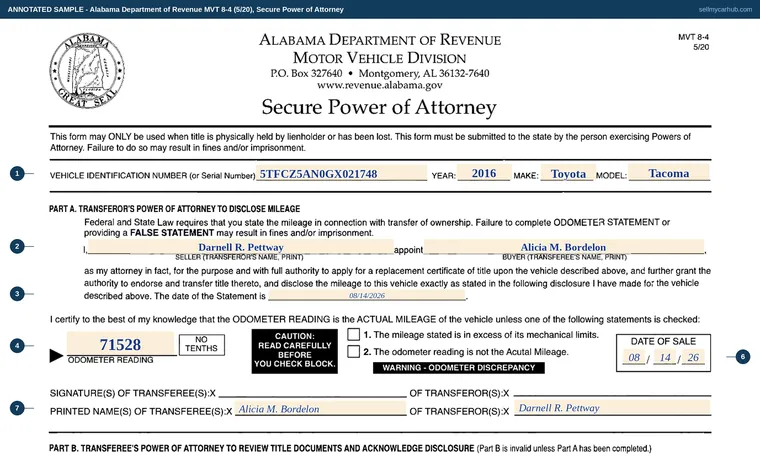
The document that lets a sale go ahead when the paper certificate is in a lender's safe or has vanished. It is not a general power of attorney: the restriction is printed in a single line under the title - this form may ONLY be used when title is physically held by lienholder or has been lost. It is in three parts, and it hands the mileage disclosure from one party to the other in a controlled way that federal law prescribes.
Written against MVT 8-4 (5/20), issued under Federal Truth in Mileage Act of 1986; 49 CFR 580.13. Alabama does hold liens electronically, but not everywhere and not by default. The Department's answer is conditional: if a designated agent (non-licensing official) is set-up for ELT, then any titles issued recording their lien will be issued as an ELT. Where the lender that financed your car is not on that system, the certificate is a physical document in somebody's file drawer and the payoff has to clear before it moves - which is the gap this form exists to cross. Where it is, there is no cost to print a physical title from an electronic one, but once an ELT is printed on physical title paper it can not be printed again, and a second copy is a replacement application at full price.
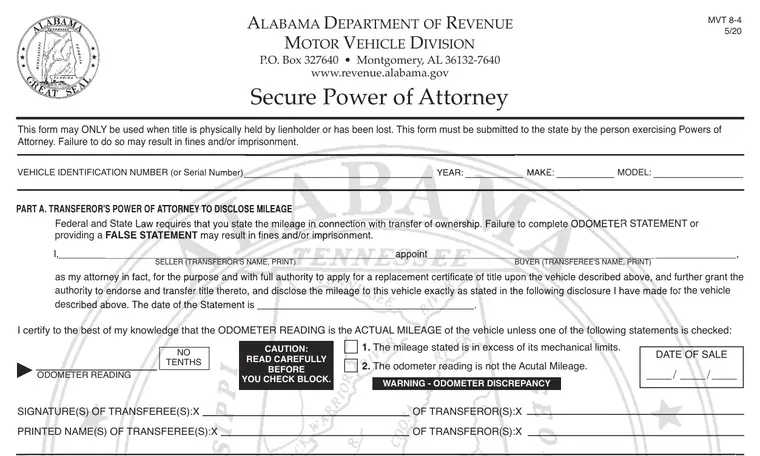
Two documents, and they are not the same thing. Take the blank MVT 8-4 from the revenue.alabama.gov copy so you get the revision that is current today.
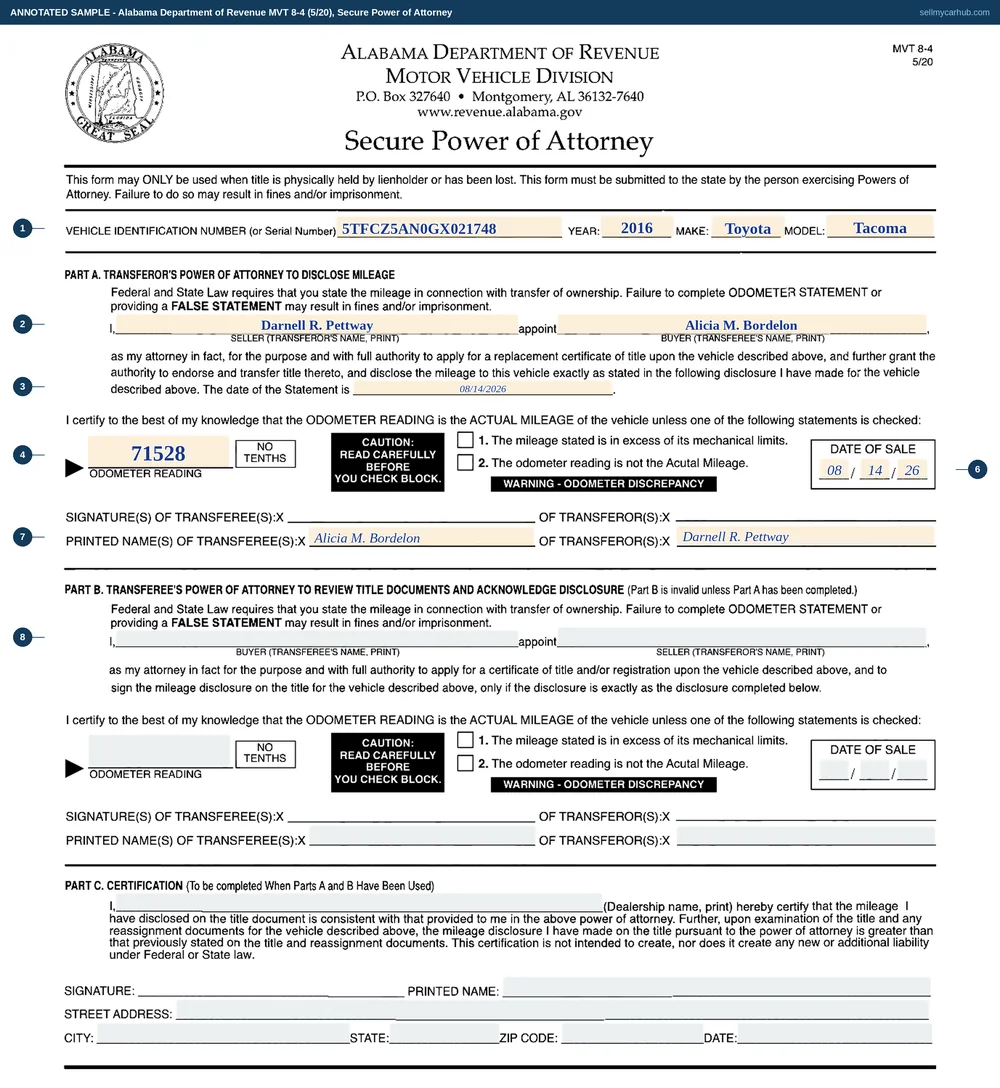
This is the actual MVT 8-4, rendered from the PDF the Alabama Department of Revenue, Motor Vehicle Division publishes and completed end to end: letterhead, every field, and the blocks at the foot.
Vehicle identification number, year, make and model across the top of the sheet.
Watch out: Take it from the certificate if you can see one, and from the dashboard plate if you cannot. On a lost title this row is what the replacement application will be built from.
Your printed name in the first gap, the buyer's printed name in the second.
Watch out: The labels under the two gaps are SELLER (TRANSFEROR'S NAME, PRINT) and BUYER (TRANSFEREE'S NAME, PRINT). Getting them the wrong way round reverses the whole instrument.
The date this disclosure is being made, written into the sentence where it says the date of the Statement is.
Watch out: It is inside the granting sentence rather than beside the signature, which is why it is the field most often left blank.
Whole miles, in the box marked with NO TENTHS.
Watch out: Whatever goes here will be copied onto the title later by somebody who is not you. If it is wrong, it is wrong under your name and under a federal statute.
Left empty unless the mileage is past the odometer's mechanical limit or is not the actual mileage.
Watch out: The caution between them is printed in three lines and means it: READ CAREFULLY BEFORE YOU CHECK BLOCK.
Month, day and year at the right-hand end of the odometer row.
Watch out: This and the date of the Statement are usually the same day. They are separate fields because they are not always.
Transferee signs on the left, transferor on the right, with printed names underneath both.
Watch out: Four lanes and all four are wanted. The buyer signs Part A too - they are accepting your disclosure, not just receiving the power.
The buyer names themselves and appoints you, repeats the same reading and the same date, and both of you sign again.
Watch out: Part B is what lets you sign the replacement certificate when it arrives. Without it you have handed over authority and kept none.
| On the form | What to put in it |
|---|---|
| Vehicle identification number, year, make, model | One row across the top, covering all three parts. |
| Part A - transferor's power of attorney to disclose mileage | You name yourself and appoint the buyer as your attorney in fact, with full authority to apply for a replacement certificate of title upon the vehicle described above, and further grant the authority to endorse and transfer title thereto, and disclose the mileage to this vehicle exactly as stated in the following disclosure I have made. A dated statement line sits inside the sentence. |
| Part A odometer block | Reading with NO TENTHS beside it, the caution READ CAREFULLY BEFORE YOU CHECK BLOCK, statement 1 for a mileage in excess of its mechanical limits, statement 2 for a reading that is not the actual mileage, and a three-part date of sale. |
| Part A signatures | Signature(s) of transferee(s) on the left and of transferor(s) on the right, then printed names of each underneath. Both of you sign Part A. |
| Part B - transferee's power of attorney to review title documents | The mirror image. The buyer names themselves and appoints you, so that you can sign the mileage disclosure on the title later - but only if the disclosure is exactly as the disclosure completed below. The heading warns that Part B is invalid unless Part A has been completed. |
| Part B odometer block and signatures | The identical block again, with its own reading, its own two statements and its own date of sale, and the same four signature lanes. |
| Part C - certification | A dealership name, a signature and printed name, street address, city, state, ZIP and date. It certifies that the mileage disclosed on the title document is consistent with that provided in the power of attorney, and is completed when Parts A and B have both been used. |
Every line here was read off MVT 8-4 (5/20) itself — the PDF is here — and off the Alabama Department of Revenue, Motor Vehicle Division pages. This is plain-language help with a form, not legal advice, and where our wording and the agency's differ, theirs governs.
Back to all Alabama seller paperwork, or what selling a car in Alabama involves.