Sell My Car Hub

How to fill out Wisconsin MV2673

A table of twenty-three major parts, each with a row asking where it came from, submitted to a Wisconsin salvage vehicle inspector when a repaired salvage car is put back on the road. It is the document behind a rebuilt salvage title, and if you are selling a car you repaired yourself, it is the paperwork that decided what your title says.
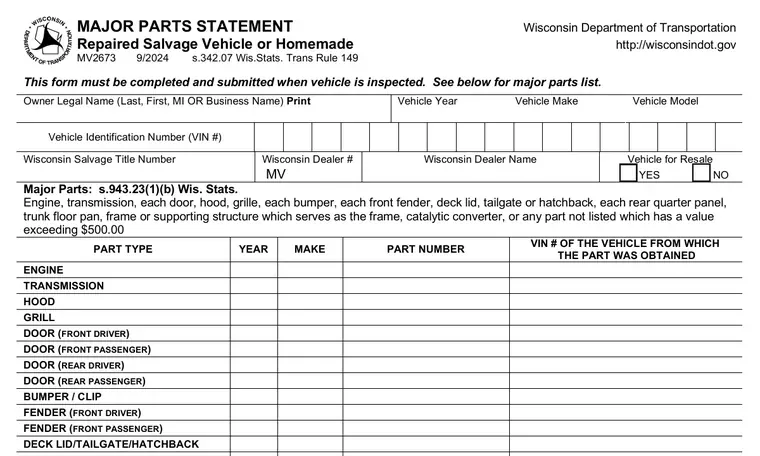
Written against MV2673 (9/2024), issued under s. 342.07, Wis. Stats., and Trans Rule 149. This form belongs to a repair and inspection process rather than to a sale. It is here because a rebuilt salvage brand on a title you are selling came from one of these, and because a buyer asking where the parts came from is asking about this document.

Two documents, and they are not the same thing. Take the blank MV2673 from the wisconsindot.gov copy so you get the revision that is current today.

Filled in

What a completed one looks like

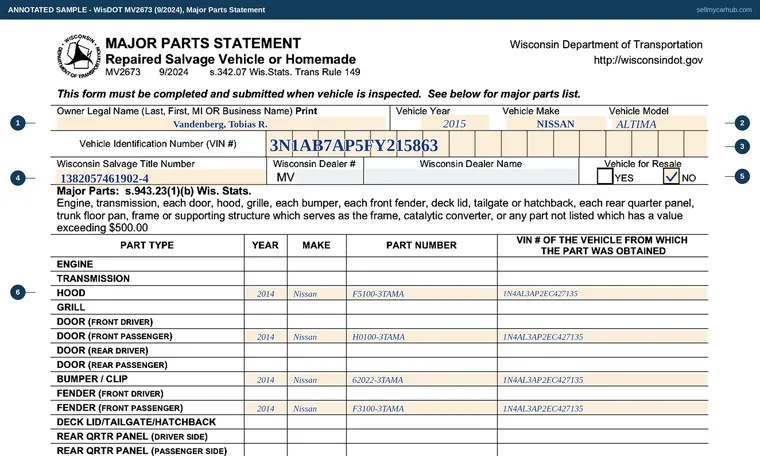
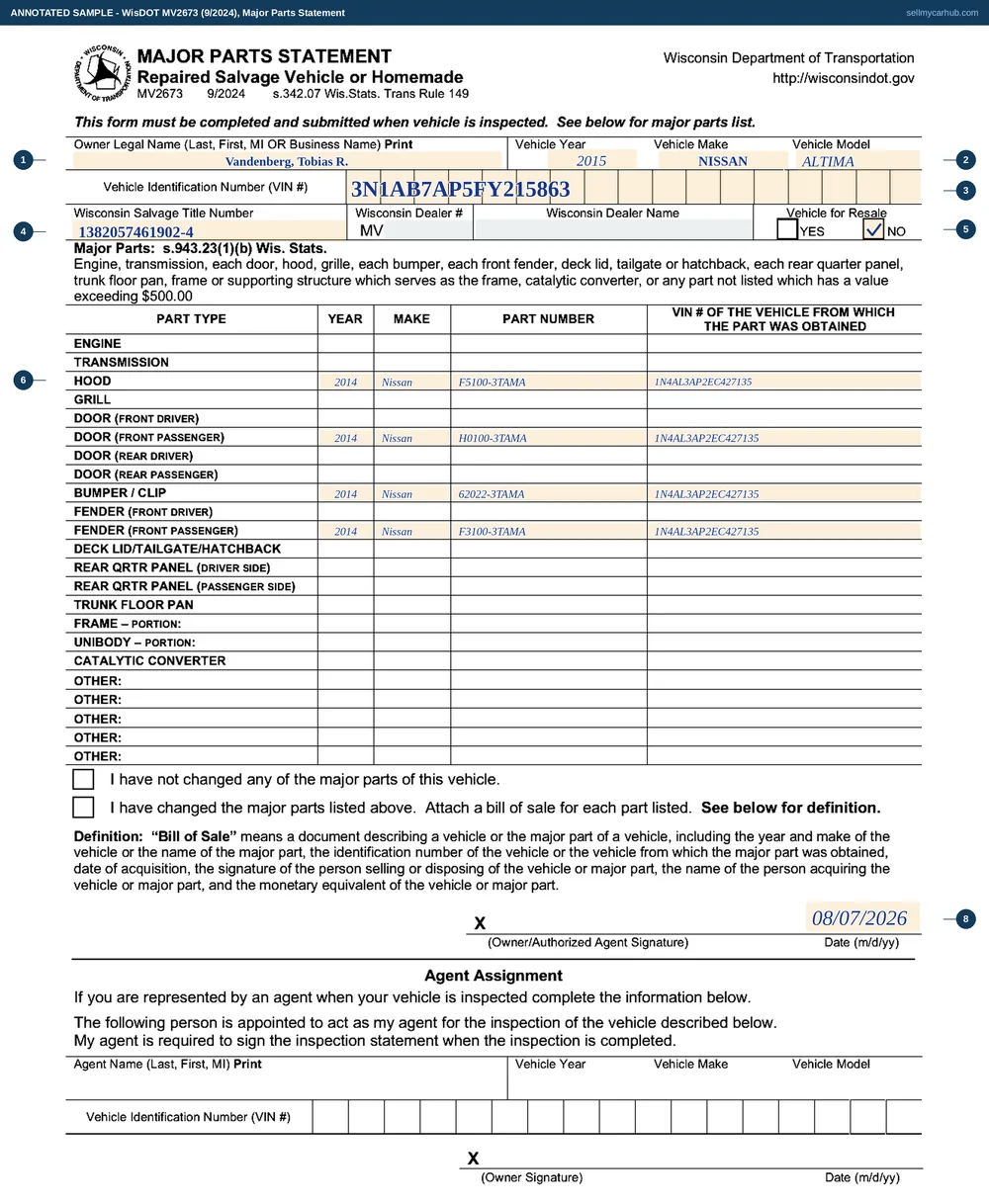
This is the actual MV2673, rendered from the PDF the Wisconsin Department of Transportation, Division of Motor Vehicles publishes and completed end to end: letterhead, every field, and the blocks at the foot.

A completed Wisconsin Major Parts Statement, form MV2673, for a repaired 2015 Nissan Altima owned in La Crosse: the owner's name, vehicle year, make and model across the top, the vehicle identification number, the Wisconsin salvage title number, the Vehicle for Resale NO box ticked, and rows filled in for the hood, the front passenger door, the front passenger fender and the front bumper, each with the year, make, part number and the identification number of the donor vehicle.
The last column is the one that matters: every replaced part has to name the vehicle it came from, and every row filled in needs a bill of sale attached. Rows for parts that were not replaced stay empty. Names, part numbers and donor identification numbers invented for the sample.
Field by field

Every line, in the order you meet it

  1. 1
    You fill this in

    Owner Legal Name

    The person who repaired or assembled the vehicle, at the top left.

    Watch out: If a dealer did the work, their number and name go in the boxes on the row below and this one still names the owner.

  2. 2
    You fill this in

    Vehicle Year, Make and Model

    Three boxes across the top row, beside the owner's name.

    Watch out: Describe the vehicle as it was titled before the damage, not as it looks now. The salvage title number below ties the two together.

  3. 3
    You fill this in

    Vehicle Identification Number

    One wide box under the header block, for the vehicle being repaired.

    Watch out: This is the surviving VIN, not a donor's. Donor numbers all belong in the last column of the table.

  4. 4
    You fill this in

    Wisconsin Salvage Title Number

    The salvage certificate the vehicle is being brought back from.

    Watch out: Without it there is nothing for the inspector to match the statement against, and the application will not proceed.

  5. 5
    You fill this in

    Vehicle for Resale - YES or NO

    Two ticks that tell the inspector whether the repaired car is going straight back on the market.

    Watch out: Answer it honestly. A resale answer that does not match what happens next is the sort of inconsistency salvage inspectors are trained on.

  6. 6
    You fill this in

    The major parts table

    Twenty-three rows. For each part replaced: year, make, part number, and the identification number of the vehicle the part came from.

    Watch out: Leave rows blank where nothing was replaced. The empty rows are information too, and filling them with dashes reads as a form completed without thought.

  7. 7
    You fill this in

    The two statements below the table

    Either no major parts were changed, or the listed parts were - and the second requires a bill of sale for each one.

    Watch out: The form defines what a bill of sale means here, and it includes the year and make of the vehicle the part came off. A receipt with a part number on it is not enough.

  8. 8
    You fill this in

    Signature and date

    Signed by the owner or authorised agent, with the vehicle described again above the second signature block.

    Watch out: It is submitted with the repaired salvage vehicle application to the Wisconsin Salvage Vehicle Inspector, not posted to Madison.

At a glance

What goes where

On the formWhat to put in it
Owner Legal NameThe person who repaired or assembled the vehicle.
Vehicle Year / Make / ModelThree boxes across the top row beside the name.
Vehicle Identification Number (VIN)A wide box under the header block.
Wisconsin Salvage Title NumberThe salvage certificate the repaired vehicle is being brought back from.
Wisconsin Dealer # and Wisconsin Dealer NameFor a dealer filing it. Blank where the owner did the work.
Vehicle for Resale - YES / NOTwo ticks. It changes who the inspection is for.
The major parts tableTwenty-three named rows - engine, transmission, four doors, hood, grille, bumper or clip, two front fenders, deck lid or tailgate or hatchback, two rear quarter panels, trunk floor pan, frame portion, unibody portion, catalytic converter and five Other rows - each with year, make, part number and the VIN of the vehicle the part came from.
I have not changed any of the major parts of this vehicleThe first of two exclusive ticks below the table.
I have changed the major parts listed aboveThe second, and it comes with a requirement: attach a bill of sale for each part listed.
Owner / authorized agent signature and date, and a second owner signature blockSignature rules at the foot, with the vehicle described again above the second one.

What gets this one rejected

Rules that decide whether it is accepted

Every line here was read off MV2673 (9/2024) itself — the PDF is here — and off the Wisconsin Department of Transportation, Division of Motor Vehicles pages. This is plain-language help with a form, not legal advice, and where our wording and the agency's differ, theirs governs.

Back to all Wisconsin seller paperwork, or what selling a car in Wisconsin involves.

Want the paperwork handled instead?

Get My Instant Offer → Online · about 2 minutes · free

Or send the details — we'll come to you

Rebuilt, repaired, inspected and still hard to sell - branded cars are most of what we buy. Tell us the history and we will tell you what it is worth.

or call/text (877) 405-1808