Sell My Car Hub

How to fill out a Wisconsin title

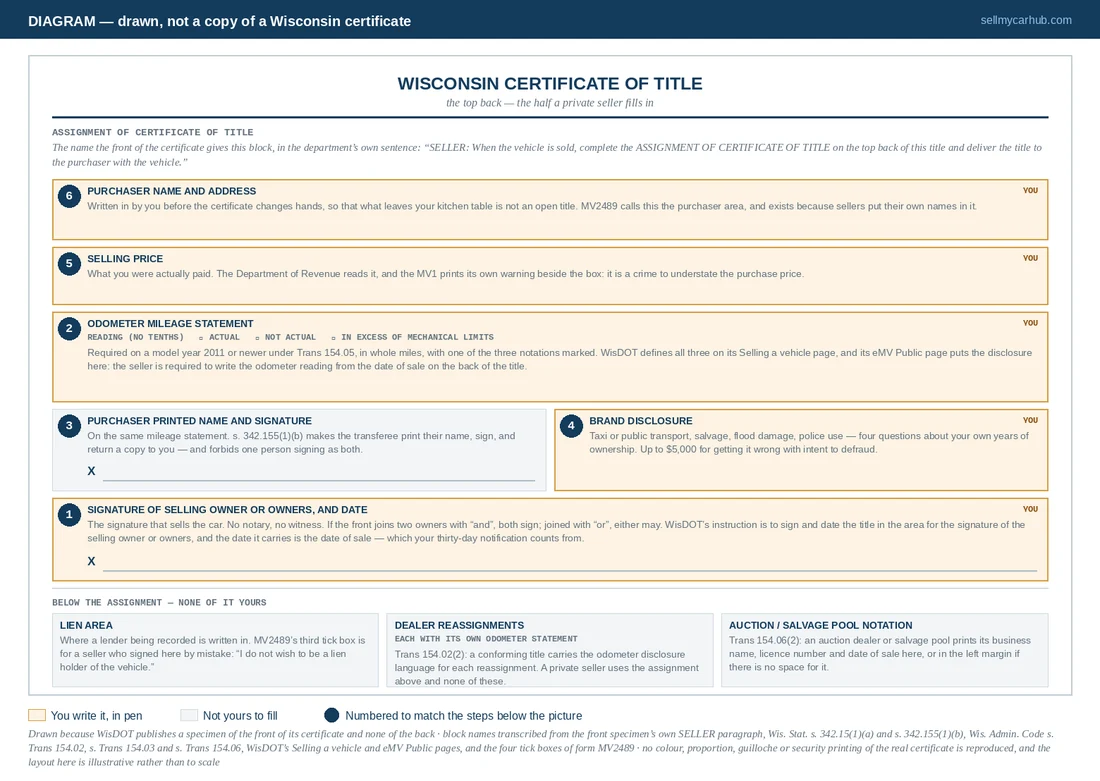
Wisconsin prints everything the department knows on the front and leaves the whole of your job to the back. The front below is the department's own specimen - void, watermarked, made out to WisDOT itself - and the instruction printed on it tells you where to go: complete the ASSIGNMENT OF CERTIFICATE OF TITLE on the top back of this title. Five entries in that block are yours, and the rest of this page is those five.

There is no blank Wisconsin certificate to download and there never will be - it is security stock, watermarked, and void without the watermark. What the department does publish is the void specimen above. Beside this paragraph is our printable checklist: the five entries that are yours, in the order the back of the title asks for them.

Any alteration, correction fluid, or erasure voids this title. It is printed down the certificate's own border, so nobody can say they were not told.

The department's order is fixed and short: sign as the selling owner, fill in the odometer statement, complete the brand disclosure if it applies, fill in the selling price, fill in the buyer's name and address, hand over a lien release if there is a lien, take the plates off, then file the seller notification.

WisDOT's own specimen

The front of a Wisconsin certificate, void and watermarked, exactly as the department publishes it

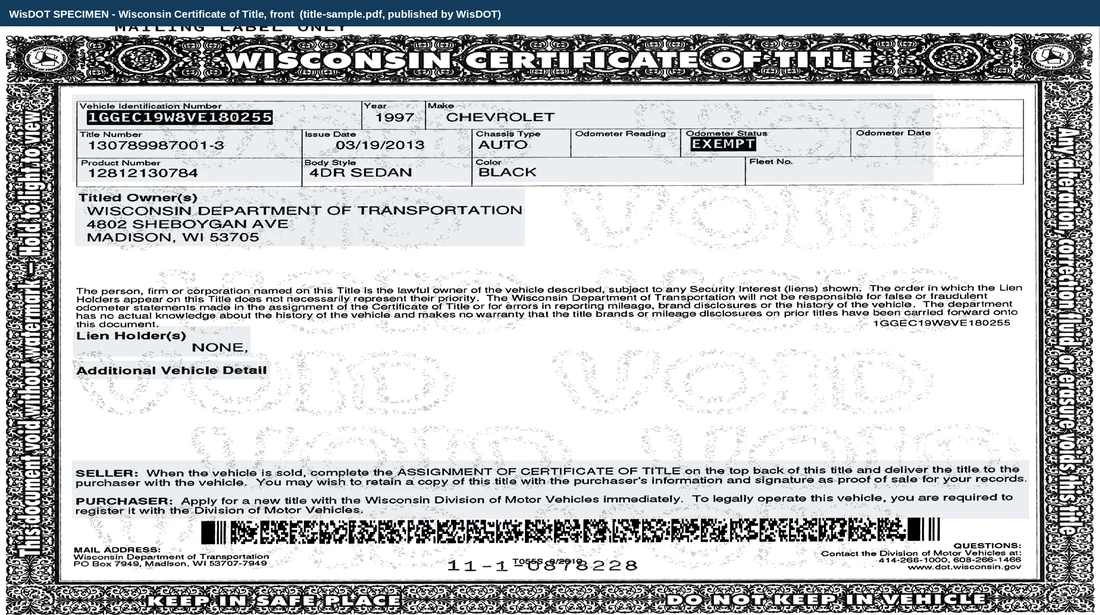
This is not a drawing and not anybody's document. It is the file WisDOT publishes as Sample of Wisconsin certificate of title for vehicle: VOID printed across the panel, and the titled owner is the department itself at 4802 Sheboygan Ave, Madison. Every box on this face is printed by the department. The two paragraphs at the foot are the only part of the front a seller has to read.

The front of a Wisconsin Certificate of Title, WisDOT's own void specimen, with VOID watermarked across the panel. The vehicle identification number, title number, product number, year, make, issue date, chassis type, body style, colour, odometer reading, odometer status and odometer date boxes across the top are shaded as department-printed, as are the titled owner block reading Wisconsin Department of Transportation, the lien holder block reading NONE and the additional vehicle detail block. The two paragraphs at the foot beginning SELLER and PURCHASER are shaded as well, because they are instructions rather than boxes. The border legends read KEEP IN SAFE PLACE, DO NOT KEEP IN VEHICLE, This document void without watermark - Hold to light to view, and Any alteration, correction fluid, or erasure voids this title.
Nothing on this side is yours to write on. The odometer status box printed EXEMPT here is the department's own record from the last transfer, not a box you tick - and on this 1997 vehicle titled in 2013 it was set under the ten-model-year rule that has since been replaced. Reproduced from WisDOT's published specimen, title-sample.pdf.
The two paragraphs that matter

The instruction the department prints for you, at reading size

At the bottom of the front, under the legal paragraph nobody reads, are two sentences addressed to the two people in the transaction. The first is the only sentence on the whole certificate that tells a Wisconsin seller what to do, and it names the block on the back by its own title.

A close crop of the foot of a Wisconsin Certificate of Title showing two paragraphs. The first begins SELLER and instructs the seller to complete the assignment of certificate of title on the top back of the title and deliver it to the purchaser with the vehicle, and to retain a copy with the purchaser's information and signature as proof of sale. The second begins PURCHASER and instructs the buyer to apply for a new title with the Wisconsin Division of Motor Vehicles immediately. Below them is the mail address block for the Wisconsin Department of Transportation, PO Box 7949, Madison.
"You may wish to retain a copy of this title with the purchaser's information and signature as proof of sale for your records." That is a suggestion on the department's part and the closest thing Wisconsin prints to a receipt - because the notification you file later is not put on the vehicle record, and the record itself does not change until the buyer applies.
A labelled drawing, marked DIAGRAM across the top, of the assignment of certificate of title block on the back of a Wisconsin certificate. Five areas are picked out in amber as the seller's: the purchaser name and address block, the selling price, the odometer mileage statement with its reading and its actual, not actual and in excess of mechanical limits notations, the brand disclosure, and the signature and date of the selling owner or owners. Four further areas are shaded grey: the purchaser's printed name and signature on the odometer statement, and below the assignment a lien area, the dealer reassignment blocks and an auction or salvage pool notation.
Drawn, not reproduced. WisDOT publishes a specimen of the front of its certificate and none of the back. Four sweeps went looking for one: twelve filename guesses in the same directory as the front specimen, a crawl of 241 department pages and the 85 manuals and newsletters they link, the redacted photograph in the Wholesale Dealer Guidebook - which is somebody's real title behind blue bars and so unusable - and the three secure-stock forms that stand in for the block, none of which is downloadable. So the block below is a diagram, labelled as one. Every name in it is transcribed from a cited source: the certificate's own SELLER paragraph, Wis. Stat. s. 342.15(1)(a), s. 342.155(1)(b), Trans 154.03 and WisDOT's own list of what a seller completes. Proportions are illustrative and no security printing is shown.

Before you watch. One line in the video's own description is looser than the law it describes: it says a privately sold vehicle “should be registered with WisDOT within 30 days of the sale”. The thirty days in s. 342.41 belong to your notification, not to registration - and registration is the buyer's job, on a two-business-day clock if they intend to drive it. Take the thirty days from this page and the statute rather than from that sentence.

Seventy-seven seconds from the department on the thirty-day notification and what a private seller has to do around it. Nothing loads from YouTube until you press play.

Step by step

Every box, in the order you meet it

  1. 0
    You fill this in

    Before any box: check who holds the title

    Wisconsin has posted titles to lenders rather than owners since 30 July 2012. If a loan was listed, what you have at home is a Confirmation of Ownership and not a certificate.

    Watch out: You cannot apply for a replacement of a title the lender holds - the MV2119 says owners are not eligible until the loan is cleared. Ring the lender before you advertise, not after somebody has agreed a price.

  2. 1
    You fill this in

    Signature of the selling owner

    In the assignment block on the top back of the certificate. If the front joins two names with "and", both of you sign; if it joins them with "or", either of you may.

    Watch out: No notary and no witness. Wisconsin asks for the signature itself, and s. 342.15(5) makes failing to execute the assignment worth a forfeiture of up to $500.

  3. 2
    You fill this in

    The odometer mileage statement

    Whole miles, on a model year 2011 or newer, with actual, not actual, or in excess of mechanical limits marked beside the number.

    Watch out: In excess of mechanical limits means the dial rolled from 99,999 to zero, not that the car has done a lot of miles. Marking it because a number looks high is a false statement on a disclosure that carries a Class H felony for intent to defraud.

  4. 3
    The buyer fills this in

    The buyer prints and signs on the same statement

    Wisconsin's mileage disclosure needs both of you. s. 342.155(1)(b) requires the transferee to print their name on the statement, sign it and return a copy to you.

    Watch out: One person may not sign as both transferor and transferee in the same transaction. If the buyer is not there in person, the disclosure is not finished, whatever else has been signed.

  5. 4
    You fill this in

    The brand disclosure

    Four questions about your own years of ownership - taxi or public transport, salvage, flood damage over 70% of value, police use - answered on the title itself.

    Watch out: This is the $5,000 one. s. 342.15(5m) sets a forfeiture of up to $1,000 for getting it wrong and a fine of up to $5,000 for doing it with intent to defraud.

  6. 5
    You fill this in

    The selling price

    What you were actually paid, written on the title, because it is the figure the buyer's 5% sales tax is worked from.

    Watch out: WisDOT's own warning is that the Department of Revenue checks titles and investigates suspiciously low sale prices. A favour to the buyer here is a crime under the MV1's own words, and the MV1 prints them beside the box.

  7. 6
    You fill this in

    The purchaser's name and address

    Filled in by you, before the certificate leaves your hand, so that what you hand over is not an open title.

    Watch out: The certificate's own instruction is to deliver the title to the purchaser with the vehicle - which means completed. An assignment with the buyer's block blank is the version that comes back to you as a parking ticket.

  8. 7
    The lienholder fills this in

    The lien release, if a lien holder is printed on the front

    A separate document from your lender. Wisconsin does not release a lien by signature on the certificate; the buyer hands the release in with the title.

    Watch out: If you cannot remember who the lender was, WisDOT runs a lien holder search on the vehicle record. Do it before the sale - a buyer at a counter with a title and no release is sent home.

  9. 8
    You fill this in

    Take the plates off the car

    Before it is driven away. On an auto or light truck the department's instruction is never to leave them on, and there is no refund for the time left on them.

    Watch out: If they went with the car anyway, the MV2514 has a box that says so, and ticking it gets the vehicle notated as sold in DMV records - which the seller notification does not.

  10. 9
    You fill this in

    File the seller notification within thirty days

    Online at sellernotify.wi.gov: the VIN, who bought it, the price and the date. Required by s. 342.41 for every individual-to-individual sale, junk vehicles included.

    Watch out: Save the confirmation, because that confirmation is all you get. WisDOT's own sentence is that it will not be noted on the vehicle record - the record changes when the buyer titles the car, not when you file.

Before the pen

Six rules for the pen, on a document that voids itself when corrected

Six habits, and four of them are about what not to put on a document that voids itself when corrected.

Blue or black, and nothing erasableCorrection fluid and erasure void a Wisconsin title outright, and it is printed on the certificate's own border. A pencil, a gel pen that lifts, a hopeful scribble - all of them turn a $214.50 transfer into a $20 replacement and a delay.
Read whether your title says AND or ORIt decides whether you need one signature or two, and it is printed on the front where the owners are named. Finding out on the day is how a completion slips a fortnight.
Write the buyer's name and address in yourselfAn open certificate is the one mistake that outlives the sale. The department's instruction on the face of the title is to deliver it to the purchaser completed.
Do not touch the odometer boxes on a 2010 or olderExempt means the line stays empty. Writing a reading into a box the rule does not ask for invents a disclosure and gives a counter a reason to look harder at the rest.
Photograph the completed back before you hand it overWisDOT's own suggestion, printed on the title: retain a copy with the purchaser's information and signature as proof of sale. Nothing else in this state gives you a receipt.
Take the plates off in the drivewayNot tomorrow, not after they have driven home. They are yours, they are worth nothing to the buyer, and they are the fastest route to somebody else's parking ticket.

The ink rule is Wisconsin DMV's own: “Never sign your title or give it to anyone until you have been paid for the vehicle.” — WisDOT, Selling a vehicle.

Check your source

Three things Wisconsin sellers tell each other that are not true

Three things Wisconsin sellers repeat to each other. The first one is the expensive one, and the department's own page is the reason it is wrong.

"Leave the plates on so they can drive it home."

The instruction is the opposite and it is phrased as a prohibition, not a preference: never leave the license plates on an auto or light truck (8,000 pounds or under) when selling or junking the vehicle. They cannot be used by someone else, WisDOT does not want them back - do not return the plates to DMV - and the department's advice is to cut them up. If the buyer needs to drive the car away, an authorised agent sells them a temporary plate for $3 that lasts ninety days. Five kinds of vehicle do keep their plates, and a car is not one of them: a truck at 10,000 pounds or more, a farm truck at 16,000 or more, a moped, a trailer and a recreational vehicle trailer.

WisDOT, I sold my vehicle

"File the seller notification and the car is off your name."

It is not, and the department says so on the same page that takes the notification: once completed, you will have the option to print, email or save confirmation of your notification. It will not be noted on the vehicle record. Wisconsin's thirty-day report under s. 342.41 tells the state who bought the car - the statute is called Identity of buyer - and the record itself changes only when the buyer applies for a title in their name. Filing is still compulsory. It is simply not the thing that clears you, which is why the plates and the completed assignment matter as much as the online form does.

WisDOT, Seller notification

"You need a bill of sale, and it has to be witnessed."

Neither half is right. WisDOT publishes the MV2928 with a bill of sale attached and describes it as being for your convenience, not a required form, and the sheet itself is printed DO NOT SUBMIT THIS TO DMV. And there is no witness or notary anywhere in a Wisconsin private sale: the department's whole vehicle set carries one notarised signature, and it belongs to the parent or guardian of an owner under eighteen. What you should keep is a copy of the completed title, which is what the certificate's own SELLER paragraph suggests.

WisDOT, Selling a vehicle
Who has to sign

Six signature rules, and the fourth surprises people who have sold a car in another state:

You, as the selling ownerIn the assignment block on the back. No notary, no witness, no appointment - Wisconsin asks for a signature and nothing more.
Every owner, if the front says "and"Two names joined by and means both signatures. Joined by or, any one of you may sign alone. Read which word is on your own certificate before you set a date.
You again, on the odometer statementOnly for a model year 2011 or newer, in whole miles, with actual, not actual, or in excess of mechanical limits marked beside it.
The buyer, on the same odometer statementWisconsin's disclosure is not one-sided: s. 342.155(1)(b) requires the transferee to print their name on the mileage disclosure statement and sign it, and no one person may sign as both transferor and transferee.
Your lender, on a separate lien releaseNot on the title. A Wisconsin lien release is a document from the lien holder that the buyer hands in alongside the certificate.
Nobody, over the top of a mistakeThere is no correcting a Wisconsin certificate. A wrong entry is a Statement of Intent or a replacement title, never a crossing-out.

Once it is signed

Signing the back is the middle of a Wisconsin sale. What comes after it is the part with your name still on it: the plates come off the car, and the notification goes in within thirty days.

The two things that follow a signed title — what happens to the plates and telling Wisconsin DMV the car is gone — are set out in full on the Wisconsin paperwork page rather than repeated here.

The forms that go with it: the MV2514, the only Wisconsin form that puts SOLD on the record, the thirty-day notification, which is an online service and not a form and the MV2489, for the day you sign in the buyer's box.

Every field description here is taken from the WisDOT, Selling a vehicle and the Wisconsin Department of Transportation, Division of Motor Vehicles title pages, current as of 2026-08-23. Plain-language help with a form, not legal advice, and where our wording and the agency's differ, theirs governs.

Back to all Wisconsin paperwork, or what selling a car in Wisconsin involves.

Or let someone else do the paperwork

Get My Instant Offer → Online · about 2 minutes · free

Or send the details — we'll come to you

A title your lender still holds, a co-owner who moved away, plates you cut up before you thought about the paperwork - tell us what you have and we will tell you what the car is worth as it stands.

or call/text (877) 405-1808