The court's version of the same idea. Where a vehicle changes hands under a court order rather than by agreement, the officer who conducted the sale - a trustee, an assignee, a clerk or another officer - swears this instead of producing an assignment, and the purchaser gets a title on the strength of it. A private seller never fills it in, and may very much need to read one.
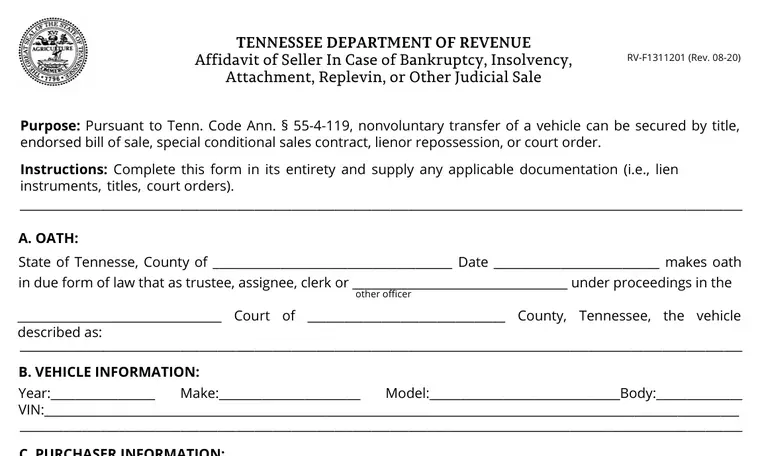
Written against RV-F1311201 (Rev 08-20), issued under Tenn. Code Ann. 55-4-119. The purpose paragraph lists five ways a nonvoluntary transfer can be secured - title, endorsed bill of sale, special conditional sales contract, lienor repossession, or court order - and this affidavit is only for the last of them.
Two documents, and they are not the same thing. Take the blank RV-F1311201 from the tn.gov copy so you get the revision that is current today.
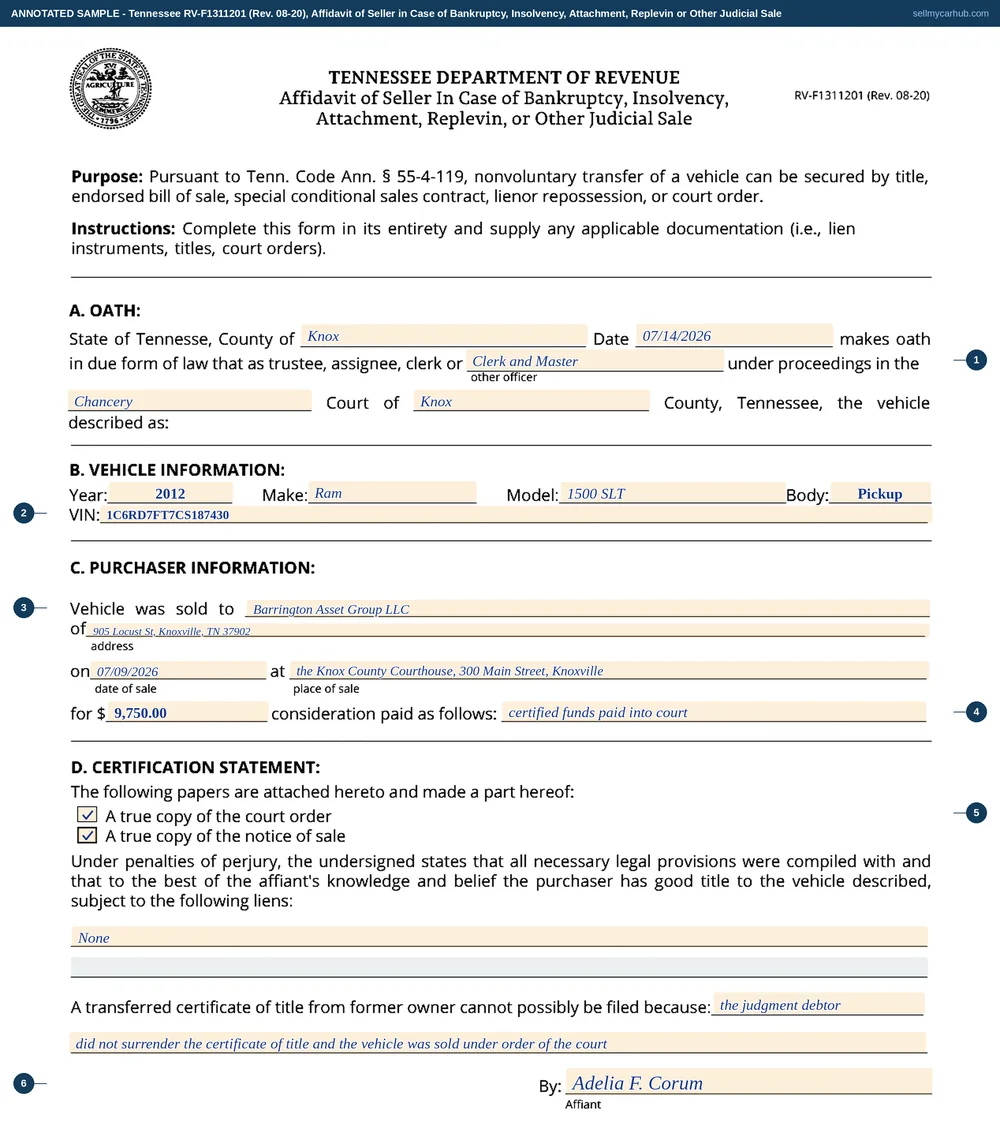
This is the actual RV-F1311201, rendered from the PDF the Tennessee Department of Revenue publishes and completed end to end: letterhead, every field, and the blocks at the foot.
The county, the date, the affiant's capacity, and the court and county the proceedings were in.
Watch out: For a former owner reading a copy, this block is the one to check first. It names the proceeding, which is what tells you where to go to ask questions.
Year, make, model, body and vehicle identification number.
Watch out: The vehicle identification number is what the Department matches to the record. Everything else on the block is description.
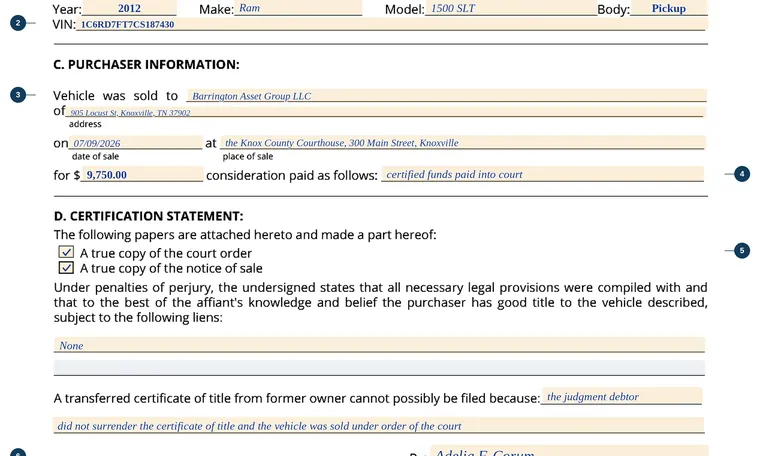
The purchaser, their address, the date and place of the sale, the price and how it was paid.
Watch out: Place of sale matters in a judicial sale in a way it does not in a private one - a courthouse step is not the same as a lot, and the notice should have named it.
A true copy of the court order and a true copy of the notice of sale, each with its own tick box.
Watch out: Both, not either. The order is the authority and the notice is the evidence that the owner had the chance to know.
Two lines listing any remaining encumbrances, under the statement that the purchaser has good title subject to them.
Watch out: A judicial sale does not automatically clear every lien. What is written here is what the new certificate will show.
One line explaining why a transferred certificate from the former owner cannot possibly be filed, then the affiant's signature.
Watch out: It is a single signature line with no date beside it, which is unusual on a Tennessee form - the date lives at the top of the oath instead.
| On the form | What to put in it |
|---|---|
| A. Oath | The county and date, the capacity of the person swearing - trustee, assignee, clerk or other officer - and the court and county the proceedings were in. |
| B. Vehicle information | Year, make, model, body and vehicle identification number. |
| C. Purchaser information | Who the vehicle was sold to, their address, the date of sale, the place of sale, the price and how the consideration was paid. |
| D. Certification statement | Two tick boxes for the papers attached - a true copy of the court order and a true copy of the notice of sale - then the statement, under penalties of perjury, that all necessary legal provisions were complied with and that the purchaser has good title subject to the liens listed. |
| Remaining liens | Two lines to set out any liens the new title has to carry. |
| Why no title is attached | A line reading: a transferred certificate of title from former owner cannot possibly be filed because. |
| Signature | One line, marked Affiant. |
Every line here was read off RV-F1311201 (Rev 08-20) itself — the PDF is here — and off the Tennessee Department of Revenue pages. This is plain-language help with a form, not legal advice, and where our wording and the agency's differ, theirs governs.
Back to all Tennessee seller paperwork, or what selling a car in Tennessee involves.