The step South Carolina would rather you took while everyone is alive. Naming a beneficiary on the certificate now means the car moves on a death certificate later instead of through the Probate Court - and the SCDMV is blunt about the alternative, saying that in general it does not interpret or accept wills for titles.
Written against TOD-1 (07/2025), issued under S.C. Code Ann. 62-6-401. The alternative route is heavier than people expect. Where nobody was named, the SCDMV's instruction is that a personal representative appointed by the Probate Court signs the back of the title as the seller with (PR) beside their name, with the court's certificate attached - and where there is no personal representative, a Small Estate Affidavit lets the vehicle be titled to one named person and does not let that person sign it over to anyone else.
Two documents, and they are not the same thing. Take the blank TOD-1 from the dmv.sc.gov copy so you get the revision that is current today.
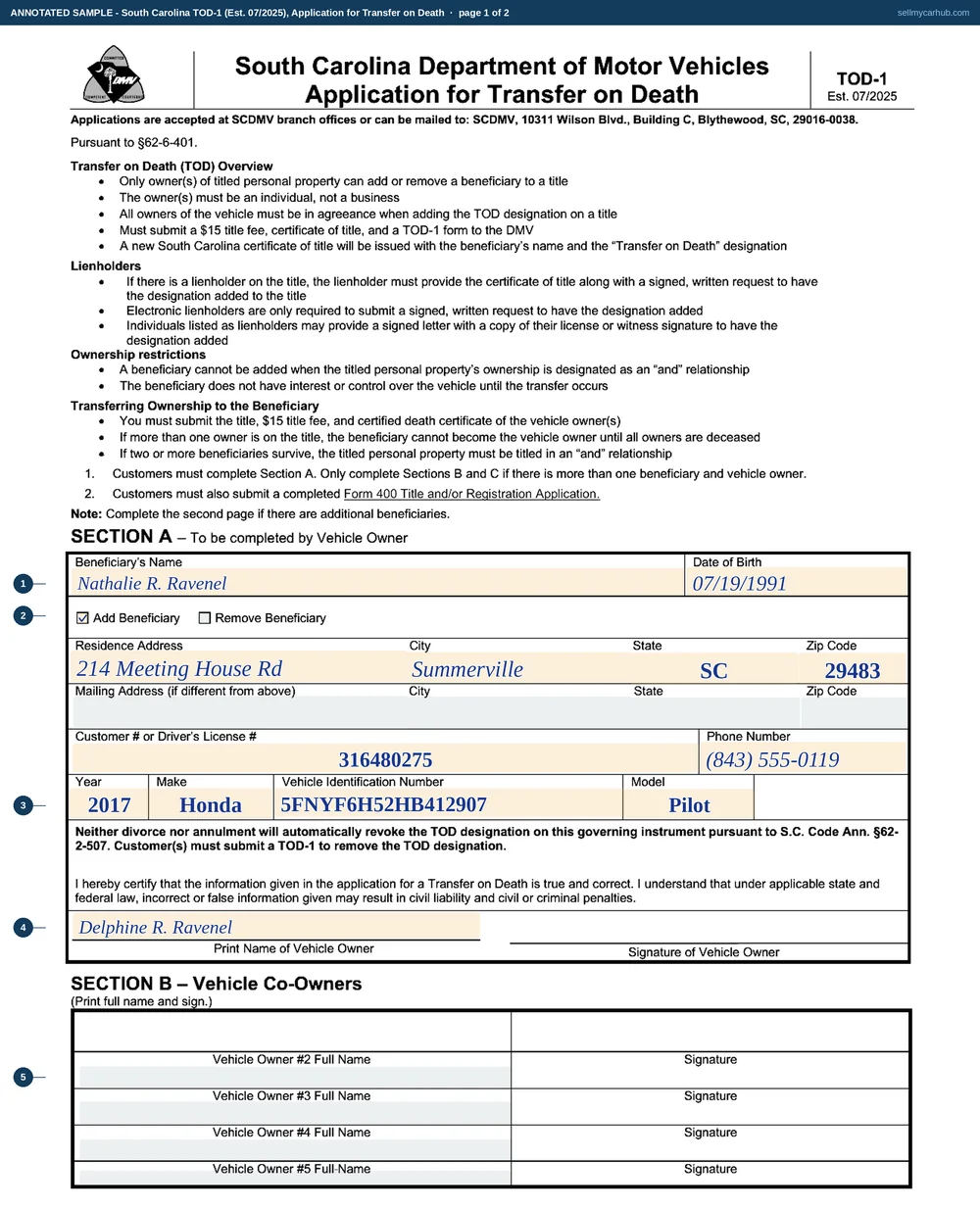
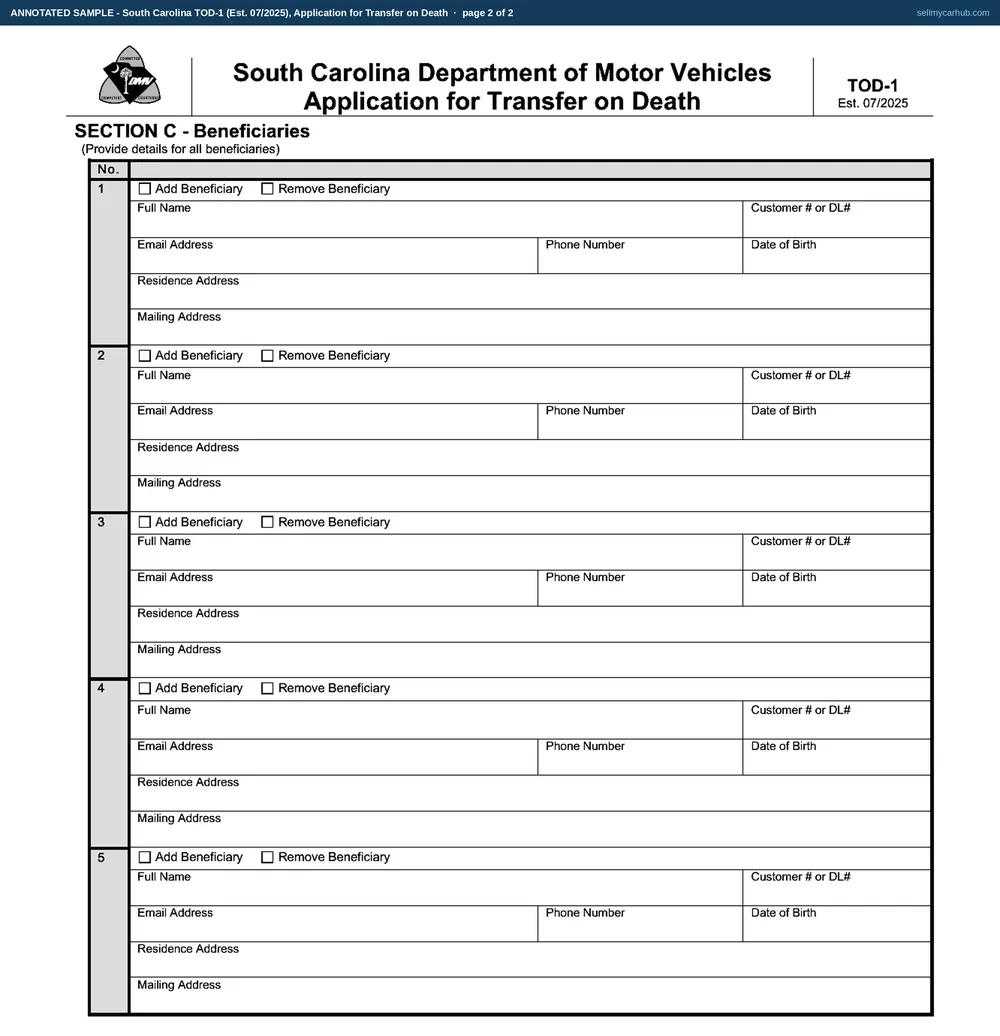
This is all 2 pages of the actual TOD-1, rendered from the PDF the South Carolina Department of Motor Vehicles publishes and completed end to end: letterhead, every field, and the blocks at the foot.
Whether the title reads AND or OR between two owner names, or names only one owner.
Watch out: An AND title cannot carry a beneficiary at all. That has to be changed before this form is any use, and changing it is itself a title transaction.
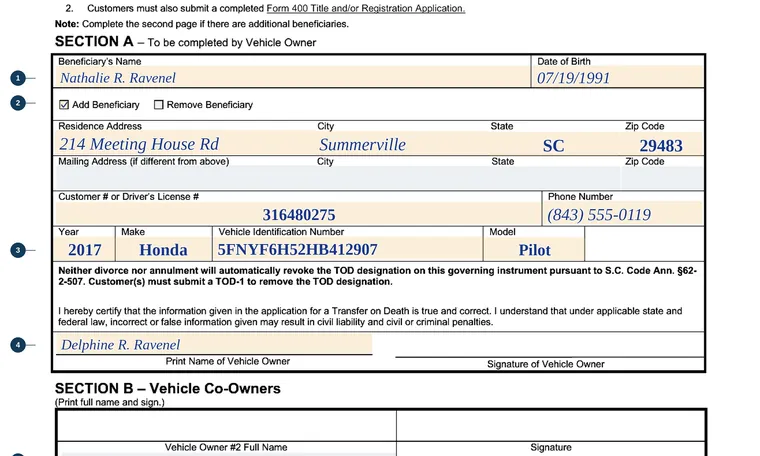
The person who will take the vehicle, with their address, customer or licence number and phone.
Watch out: Spell the name the way their identification does, because the certificate is about to be reissued carrying it and a mismatch surfaces at the worst possible moment.
One of two tick boxes. The same form does both jobs.
Watch out: Removing is the box people forget exists. A divorce does not undo a TOD designation in South Carolina, and the form says so on its own face.
Year, make, vehicle identification number and model.
Watch out: One vehicle per form. A second car with the same beneficiary needs its own TOD-1, its own certificate and its own $15.
Printed name and signature of the vehicle owner, under the declaration about civil liability and criminal penalties.
Watch out: No notary and no witness. Where there are co-owners, they print and sign in Section B and every one of them has to.
A completed Form 400, the certificate of title or the lienholder's written request, and the $15 title fee.
Watch out: A lienholder holding your certificate has to release it for this. An electronic lienholder does not send a certificate at all - only the signed request.
| On the form | What to put in it |
|---|---|
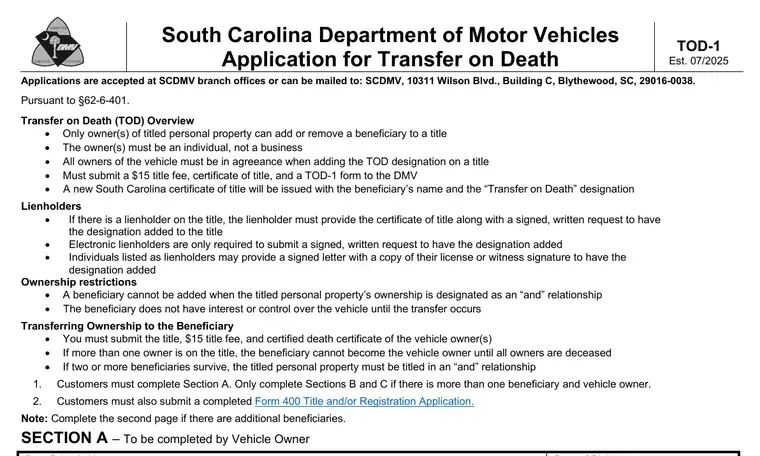
| The overview | A printed summary at the head: only owners of titled personal property can add or remove a beneficiary; the owner must be an individual, not a business; all owners must be in agreeance; and the package is a $15 title fee, the certificate of title and this form. |
| Lienholders | Three printed rules. A lienholder holding the certificate must provide it with a signed written request; an electronic lienholder need only send the signed request; and an individual listed as a lienholder may provide a signed letter with a copy of their licence or a witness signature. |
| Ownership restrictions | Two more: a beneficiary cannot be added where ownership is designated as an AND relationship, and the beneficiary has no interest or control over the vehicle until the transfer occurs. |
| Transferring to the beneficiary | What happens afterwards - the title, the $15 fee and a certified death certificate; where more than one owner is on the title the beneficiary cannot take it until all owners are deceased; and where two or more beneficiaries survive, the property must be titled in an AND relationship. |
| Section A | Beneficiary's name and date of birth, an add-beneficiary or remove-beneficiary tick, a residence address, a mailing address, a customer or driver's licence number, a phone number, then the vehicle's year, make, VIN and model. |
| The divorce note | A printed sentence: neither divorce nor annulment will automatically revoke the TOD designation on this governing instrument, and a TOD-1 must be submitted to remove it. |
| The certification | A declaration that the information is true and correct with a warning of civil liability and civil or criminal penalties, then a printed name and a signature of vehicle owner. |
| Section B, vehicle co-owners | Four rows for owners two to five, each with a full name and a signature. |
| Section C and page two | Used only where there is more than one beneficiary and more than one vehicle owner, with a continuation page for additional beneficiaries. |
Every line here was read off TOD-1 (07/2025) itself — the PDF is here — and off the South Carolina Department of Motor Vehicles pages. This is plain-language help with a form, not legal advice, and where our wording and the agency's differ, theirs governs.
Back to all South Carolina seller paperwork, or what selling a car in South Carolina involves.