Sell My Car Hub

How to fill out a South Carolina title

The face of a South Carolina certificate is the SCDMV's: vehicle, owner, brands, title number, and the lien release the lender signs. Everything a private seller does happens on the reverse, in the first of three identical blocks headed ASSIGNMENT OF A VEHICLE - and the two below yours carry a dealer licence line, because they are not for you.

ANY ALTERATIONS OR ERASURE VOIDS THE ASSIGNMENT - printed across the head of the block, and meant as written.

Section 2 of the manual sets out what a South Carolina title is and what has to happen to it before a new one can be issued, and the specimen certificate in section 5 is the picture below. Every block name on the reverse is transcribed from the SCDMV's own photograph of a completed assignment, published on page 5 of the Dealer Connection, Spring 2026.

The real thing, as the SCDMV publishes it

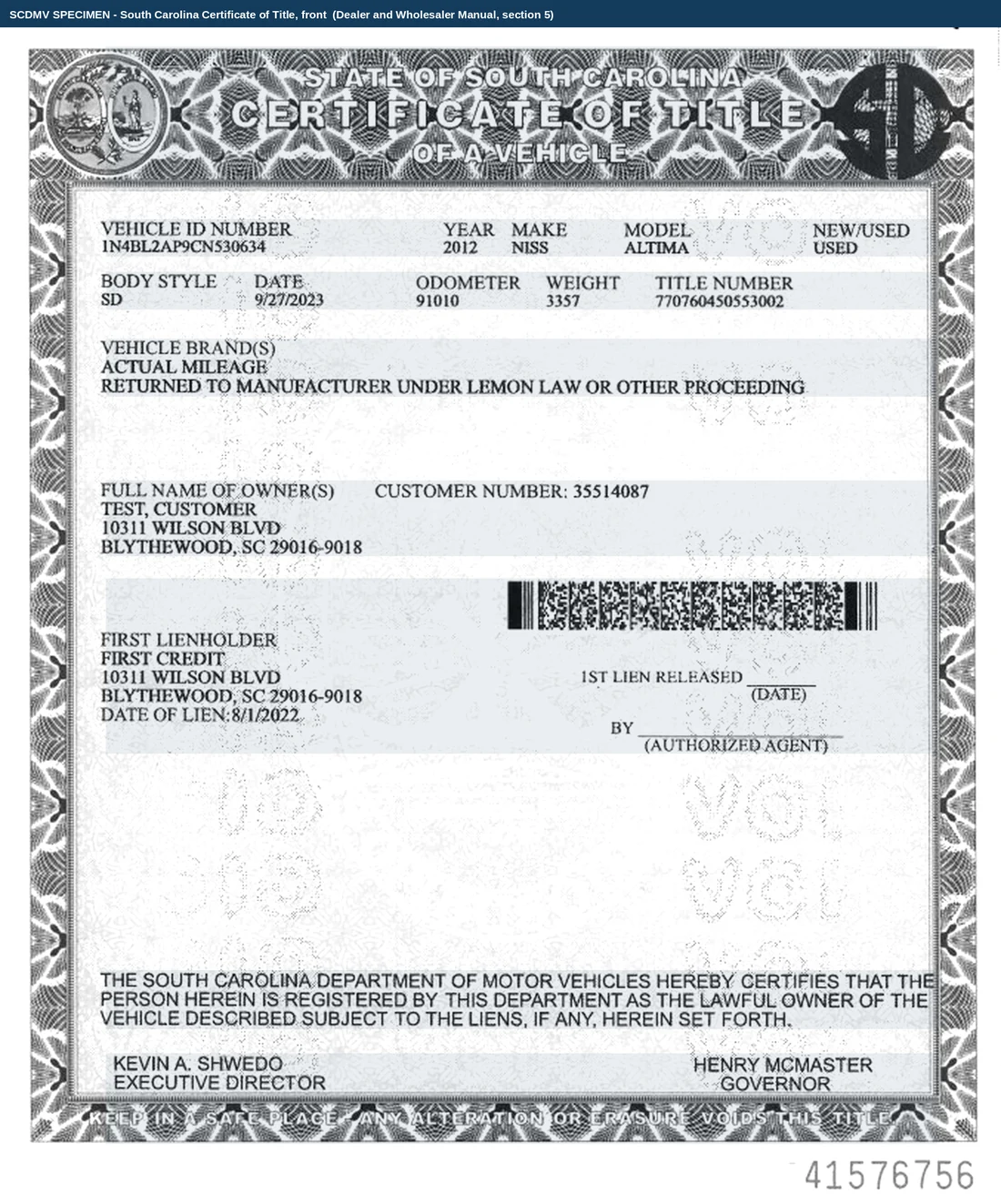
The face of a South Carolina title, from the SCDMV's own manual

This is not a drawing and it is not somebody's title. It is the specimen certificate the SCDMV prints in section 5 of its Dealer and Wholesaler Manual - stamped VOID down the face, issued to a placeholder called TEST, CUSTOMER at the Department's own Blythewood address, with a fictional lienholder called FIRST CREDIT. Every block on it is greyed and none of them is numbered, because a private seller writes on nothing at all on this side.

The specimen South Carolina Certificate of Title the SCDMV publishes in its Dealer and Wholesaler Manual, stamped VOID, showing the vehicle identification number, year, make, model, body style, issue date, odometer reading, weight and title number along the top, a vehicle brands block reading ACTUAL MILEAGE and RETURNED TO MANUFACTURER UNDER LEMON LAW OR OTHER PROCEEDING, the owner block made out to TEST, CUSTOMER at 10311 Wilson Blvd, Blythewood, a first lienholder block for FIRST CREDIT with a 1ST LIEN RELEASED signature line beside it, the Department's certification of ownership at the foot, and a warning band reading KEEP IN A SAFE PLACE - ANY ALTERATION OR ERASURE VOIDS THIS TITLE.
Published by the SCDMV, not photographed by us. Read three things off it before you advertise the car: the VEHICLE BRAND(S) block, which travels with the vehicle whatever anybody agrees; the FULL NAME OF OWNER(S) line, which is the spelling you have to sign in; and the 1ST LIEN RELEASED line beside the lienholder, which is blank on this specimen and needs to be signed and dated on yours if a lender was ever on the record.
The half you actually write on

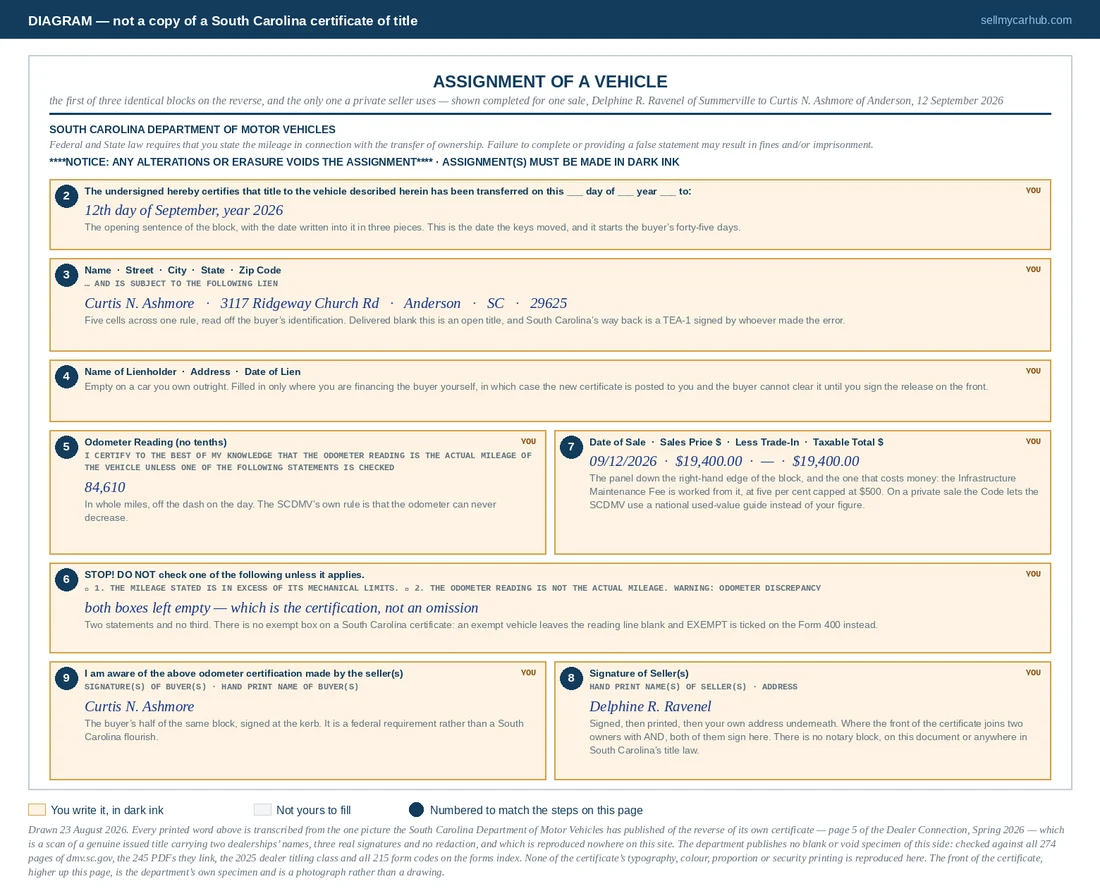
ASSIGNMENT OF A VEHICLE, filled in for one private sale

The SCDMV publishes no clean picture of the reverse - the only one it has put out is a scan of a genuine issued title with two dealerships' names and three real signatures on it, and that is not something to reproduce. So the block below is drawn, and says so across the top. Every printed word in it is transcribed from that scan; the handwriting is ours.

A diagram of the first ASSIGNMENT OF A VEHICLE block on the reverse of a South Carolina certificate of title, filled in: the transfer dated the 12th day of September 2026 to Curtis N. Ashmore of 3117 Ridgeway Church Rd, Anderson, SC 29625, no lienholder named, an odometer reading of 84,610 with neither of the two statements checked, a date of sale of 09/12/2026 and a sales price of $19,400.00 in the panel on the right, the seller's signature and hand-printed name given as Delphine R. Ravenel with a Summerville address, and the buyer's signature and hand-printed name given as Curtis N. Ashmore under the odometer acknowledgement.
Look at the two statements nobody ticked. The sentence above them certifies the reading as the actual mileage unless one of them is checked, so leaving both alone is the certification rather than an omission - and there is no third box marked exempt on this document at all. The panel on the right is the one that costs money: the sales price you write there is where the Infrastructure Maintenance Fee starts.
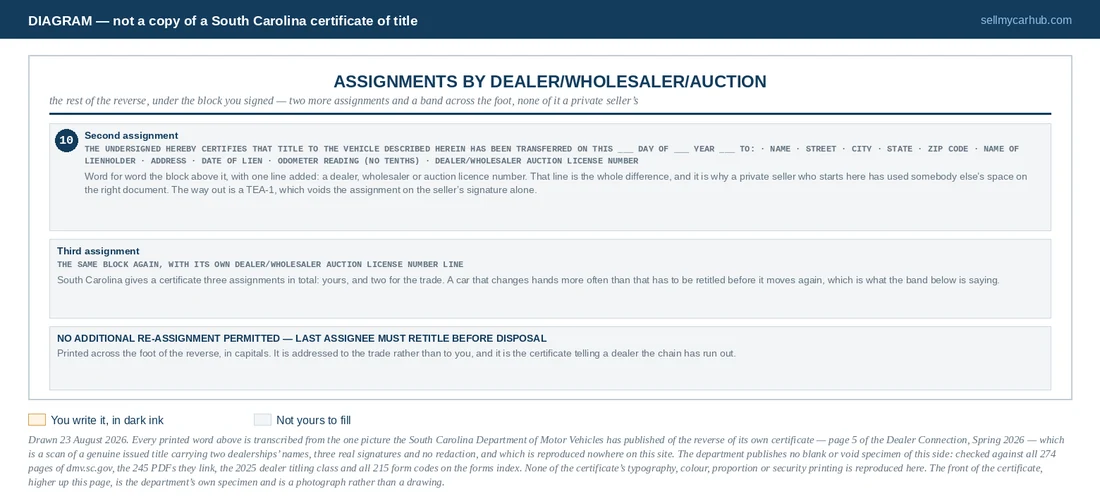
A diagram of the lower half of the reverse of a South Carolina certificate of title, entirely greyed: the heading ASSIGNMENTS BY DEALER/WHOLESALER/AUCTION over two further assignment blocks, each repeating the transfer sentence, the lienholder line, the odometer certification with its two statements and the Dealer/Wholesaler Auction License Number line, and a band across the foot reading NO ADDITIONAL RE-ASSIGNMENT PERMITTED - LAST ASSIGNEE MUST RETITLE BEFORE DISPOSAL.
The rest of the reverse, and none of it is yours. Two more assignment blocks sit under the one you signed, identical except for a Dealer/Wholesaler Auction License Number line, and the band across the foot is the certificate telling a dealer when the chain has run out. A private seller who starts in the second block has used a dealer's space, and correcting it means a TEA-1.
Step by step

Every box, in the order you meet it

  1. 1
    You fill this in

    Before the pen: read the face

    The owner names and the conjunction between them, the VEHICLE BRAND(S) block, and whether the 1ST LIEN RELEASED line is signed and dated.

    Watch out: All three can stop the sale after the money has changed hands. A lien that was paid in 2019 but never released on the face is still a lien as far as the SCDMV is concerned, and it is the lender who has to sign it off, not you.

  2. 2
    You fill this in

    The undersigned hereby certifies that title to the vehicle described herein has been transferred on this ___ day of ___ year ___

    The day, month and year of the handover, written into the printed sentence that opens the assignment block.

    Watch out: Write the date the keys moved, not the date the deposit cleared. This date and the date of sale in the panel on the right are read against each other, and against the 45-day clock the buyer is now on.

  3. 3
    You fill this in

    Name, Street, City, State, Zip Code

    The buyer's full legal name and complete address on the rules under the transfer sentence, copied off their identification rather than off a text message.

    Watch out: Never hand the certificate over with these blank. An assignment with nobody named in it is an open title, and South Carolina's way of correcting one is a TEA-1 signed by whoever made the mistake - which means finding them again.

  4. 4
    You fill this in

    and is subject to the following lien: Name of Lienholder, Address, Date of Lien

    Left empty on a car you own outright. Filled in only where the buyer is borrowing from you - South Carolina calls that seller-financing, and the SCDMV's instruction is that you complete Section 2 of the buyer's Form 400 and become the lienholder.

    Watch out: If you do finance the buyer, the new certificate is posted to you rather than to them, and the buyer cannot get a clear title until you sign the lien off. Do not fill this line in for a lender who has already been paid.

  5. 5
    You fill this in

    Odometer Reading (no tenths)

    The reading off the dash on the day of the handover, in whole miles, in the box on the left of the odometer certification.

    Watch out: The SCDMV's own training adds a rule that is not printed anywhere on the form: the odometer can never decrease. A figure lower than the one already on the record is not accepted as a correction, it is recorded as a discrepancy.

  6. 6
    You fill this in

    STOP! DO NOT check one of the following unless it applies

    Two statements and no third: the mileage stated is in excess of its mechanical limits, and the odometer reading is not the actual mileage, WARNING: ODOMETER DISCREPANCY.

    Watch out: There is no exempt box on the certificate. If the car is old enough to be exempt, the reading line stays empty and EXEMPT is ticked on the Form 400 instead - ticking statement 2 to mean exempt brands the car permanently.

  7. 7
    You fill this in

    Date of Sale, Sales Price, Less Trade-In, Taxable Total

    The small panel on the right of the block: the day it changed hands, what was paid, anything taken in part exchange, and the figure the two produce.

    Watch out: This is the number the Infrastructure Maintenance Fee is worked from, and on a private sale the SCDMV is not bound by it - the Code lets the Department use a national used-value guide instead. Writing a low figure to help the buyer can simply be overridden, and it is a false statement on a document you signed.

  8. 8
    You fill this in

    Signature of Seller(s), Hand Print Name(s) of Seller(s), Address

    Signed in dark ink in the name the face of the certificate prints, then the same name in block capitals underneath, then your own address on the line below.

    Watch out: Check the conjunction on the face before either of you touches a pen. AND between two owners means both signatures on this rule; a single signature on an AND title is a rejection, and the fix is not another signature squeezed in beside it.

  9. 9
    The buyer fills this in

    I am aware of the above odometer certification made by the seller(s)

    The buyer's signature and hand-printed name, on the left-hand rules inside the same block, acknowledging the reading you have just certified.

    Watch out: Hand them the pen at the kerb rather than posting the certificate on. Federal law entitles them to a copy of the disclosure, and photographing the completed reverse takes five seconds and is the whole of your evidence later.

  10. 10
    Dealers only

    The two blocks underneath belong to dealers

    ASSIGNMENTS BY DEALER/WHOLESALER/AUCTION, twice, each repeating the same sentence with a Dealer/Wholesaler Auction License Number line added.

    Watch out: Start in the second block by mistake and you have used a dealer's space. The band at the foot - no additional re-assignment permitted, last assignee must retitle before disposal - is the certificate saying the chain ends here.

  11. 11
    The buyer fills this in

    The buyer's Form 400 and their bill of sale

    The application that goes with the certificate, plus a signed bill of sale showing the total sale price less any trade-in. The SCDMV asks for one on all title transactions.

    Watch out: If the assignment on your certificate has no sales-price line - titles issued before 19 June 1989 do not - then the bill of sale is not optional paperwork, it is the only document carrying the price and the mileage.

  12. 12
    The buyer fills this in

    The county, before the plate

    A property tax bill generated by their county auditor and paid to their county treasurer, with the receipt in their own name.

    Watch out: This is the step that sends a South Carolina buyer home without a tag. The SCDMV can title the car without it; it cannot register the car without it, because a registration may not be issued until the ad valorem tax is paid.

  13. 13
    You fill this in

    And the tag comes off

    Nothing to do with the certificate. The plate stays with you, the registration card goes back with it, and the Code gives you thirty days to move it or return it.

    Watch out: Returning it with a Form 452 is the only step in a South Carolina sale that pays you: the county auditor orders a prorated refund of the property tax for the complete months left in the tax year.

Before the pen

Six habits that keep a South Carolina assignment out of the bin

Six habits, and the first one is the difference between a sale and a form filed to undo one.

Dark ink, and the certificate says so itselfASSIGNMENT(S) MUST BE MADE IN DARK INK is printed across the top of the block. Pencil, gel that beads on the security tint and anything pale enough to scan badly are all the same problem - the branch works from a scan.
No white-out, no correction tape, no writing overAlterations or erasure void the assignment, and the SCDMV's dealer guidance is blunter still: you can modify any field on documents exempt the VIN and the Odometer. Those two are not correctable at all.
A single line strikethrough, if it is a field you may correctThe SCDMV's own instruction to dealers is to use a single line strikethrough rather than write over or scribble. It does not apply to the VIN or the odometer, and it does not apply to a signature.
Fill in the buyer before the certificate leaves your handThe name and address go on at the kerb. An assignment signed with the transferee blank is the open title, and South Carolina's route back is a TEA-1 signed by the person who made the error.
Whole miles, no tenths, no wordsThe box is labelled no tenths. Write digits. Exempt is not a word that goes in it - there is nowhere on the certificate to write it and Form 400 has the box instead.
Scan it, do not photograph itThe SCDMV rejects paperwork on quality: you cannot take pictures of documents on your phone, your documents must be scanned with a scanner. Your own photograph is for your records; anything going to Blythewood should come off a scanner.

The ink rule is the SCDMV's own: “The SCDMV will not accept the title with alterations, erasures, or “white out” on any portion of the form.” — South Carolina Department of Motor Vehicles, Dealer and Wholesaler Manual.

Check your source

Four things South Carolina sellers hear that cost them money

Four things South Carolina sellers are told with confidence that are not true. Each correction links the SCDMV page, manual or Code section it comes from.

“Let them drive off on your tag - the registration runs to the end of the year anyway.”

The tag is registered to you, not to the car, and South Carolina says so in statute: the license plate issued for the vehicle shall remain with the prior owner, who has thirty days to transfer it or return it along with the registration card. Leaving it on means your plate driving around on somebody else's insurance, and it forfeits the property tax refund that only arrives when the plate is handed in. The buyer's legal way home is a 45-day traceable temporary plate, and there is an SCDMV form for it.

South Carolina Code of Laws, section 56-3-1260

“Write a lower price on the title and save the buyer the sales tax.”

There is no sales tax on almost any South Carolina vehicle transfer - there is an Infrastructure Maintenance Fee, five per cent capped at $500. And on a private sale the Code does not tie that fee to the figure you wrote: it is five percent, not to exceed five hundred dollars, of the fair market value of the item, where fair market value means the total purchase price less any trade-in, or the valuation shown in a national publication of used values adopted by the department. So the favour is often worth nothing at all, and it is still a false statement on a signed document.

South Carolina Code of Laws, section 56-3-627

“Find a notary before either of you signs the back.”

There is nowhere on a South Carolina certificate to put a seal. The Code asks the owner to execute an assignment and warranty of title to transferee in the space provided therefor on the certificate and nothing more, and it names a notary nowhere in a vehicle transfer. Even where somebody signs on your behalf, the SCDMV's rule asks for a witness signature rather than an acknowledgement. The notary blocks people have seen belong to a trust instrument or to an out-of-state power of attorney, both of which are different documents.

South Carolina Code of Laws, section 56-19-360

“Once I hand over the title I am finished.”

Not until the notice is in. South Carolina requires the owner of a registered and licensed vehicle to notify the SCDMV in writing, immediately upon a transfer of ownership, and the form is the 416. The SCDMV puts it first in a list of four steps that ends with cancelling the insurance, and the form itself says what it is for: it is intended for the protection of the last registered owner until the actual transfer of ownership is completed. The buyer has 45 days before a penalty starts, and the car is yours on the record for every one of them.

South Carolina Department of Motor Vehicles, selling a vehicle and the four steps that follow
Who has to sign

Fewer signatures than most states ask for, and not one of them witnessed by an official:

Every owner the face names, if it reads ANDThe relationship is printed on the certificate between the two names. AND is joint ownership and both signatures are required; OR is co-ownership and either signature moves the car.
Any one owner, if it reads ORThe SCDMV's own words are that anyone on the title can complete any transaction for that vehicle without the other person's signature.
The buyer, onceOn the buyer's rule inside the same block, under the printed line I am aware of the above odometer certification made by the seller(s). It is a federal requirement rather than a South Carolina flourish.
Nobody in front of a notaryThere is no acknowledgement block on the document and no South Carolina statute asking for one. If somebody tells you a South Carolina title needs notarising, they are describing a trust deed or an out-of-state power of attorney.
An attorney-in-fact, with paper in the envelopeThe SCDMV publishes no ordinary power of attorney form. Its rule is that the document names the individual, the attorney-in-fact and the vehicle by VIN, year, make and model, and carries the individual's signature and a witness signature.
A personal representative, signing as oneThe SCDMV's instruction where the owner has died is to sign the back of the title as the seller in your name with (PR) beside it, with the Probate Court's certificate of appointment attached.
Not a dealer, in the first blockThe second and third assignment blocks carry a Dealer/Wholesaler Auction License Number line. A private seller who uses one has filled in the wrong block on the right document.

Once it is signed

The assignment is the whole of your job on the document. What is left is physical rather than clerical: the tag comes off, one form goes to Blythewood, and a photograph of the completed reverse goes on your phone before the certificate leaves your hand.

The two things that follow a signed title — what happens to the plates and telling the SCDMV the car is gone — are set out in full on the South Carolina paperwork page rather than repeated here.

The forms that go with it: the Form 400, which the buyer completes, the 416, which you post and the TEA-1, if the pen slipped.

Every field description here is taken from the South Carolina Department of Motor Vehicles, Dealer and Wholesaler Manual and the South Carolina Department of Motor Vehicles title pages, current as of 2026-08-23. Plain-language help with a form, not legal advice, and where our wording and the agency's differ, theirs governs.

Back to all South Carolina paperwork, or what selling a car in South Carolina involves.

Or let someone else do the paperwork

Get My Instant Offer → Online · about 2 minutes · free

Or send the details — we'll come to you

Lost title, a lien that was paid off years ago, a car sitting on blocks in Florence, or a tag you never handed back - tell us what you have and we will tell you the shortest way out of it.

or call/text (877) 405-1808