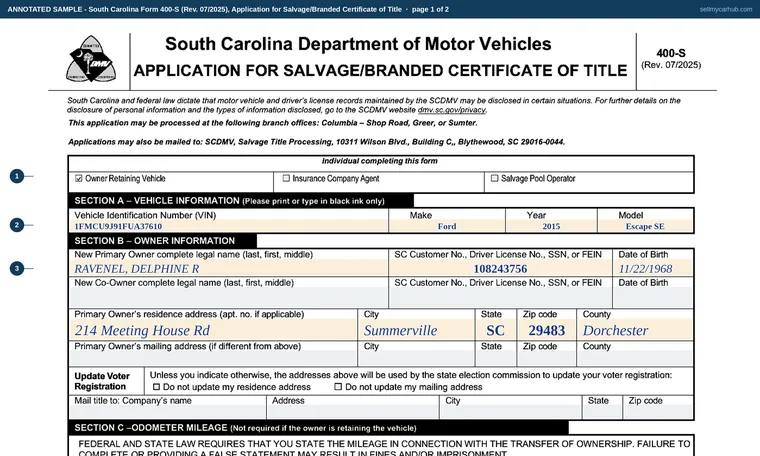
What turns a wrecked South Carolina car into a branded one. It is usually the insurer's form, but the first tick box at the top is Owner Retaining Vehicle - so a seller who keeps a totalled car rather than surrendering it fills this in themselves, and the brand it produces is permanent.
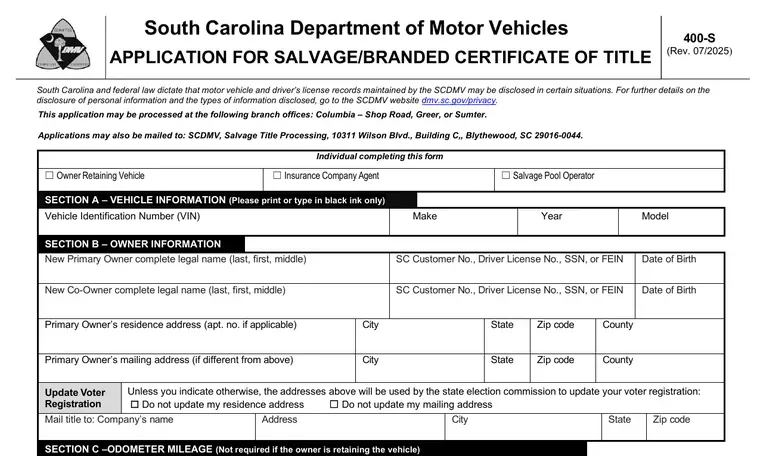
Written against 400-S (Rev 07/2025), issued under S.C. Code Ann. 56-19-480 and 56-19-485. Keeping a totalled car is a decision about the rest of its life, not about this month. The brand goes on the record, it follows the vehicle through every later sale, and the SCDMV's own advice to buyers is to check the VIN before buying precisely because of it.
Two documents, and they are not the same thing. Take the blank 400-S from the dmv.sc.gov copy so you get the revision that is current today.
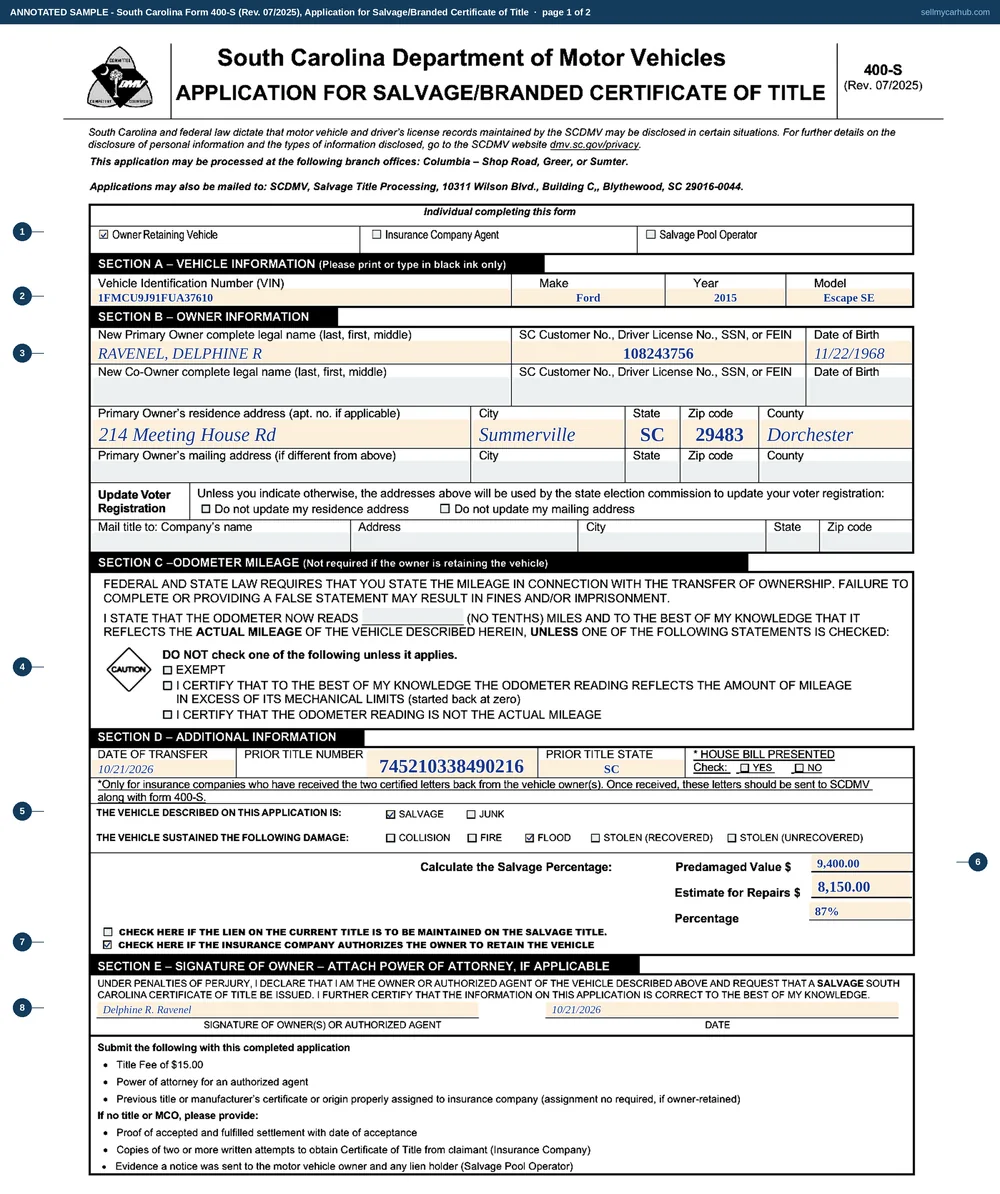
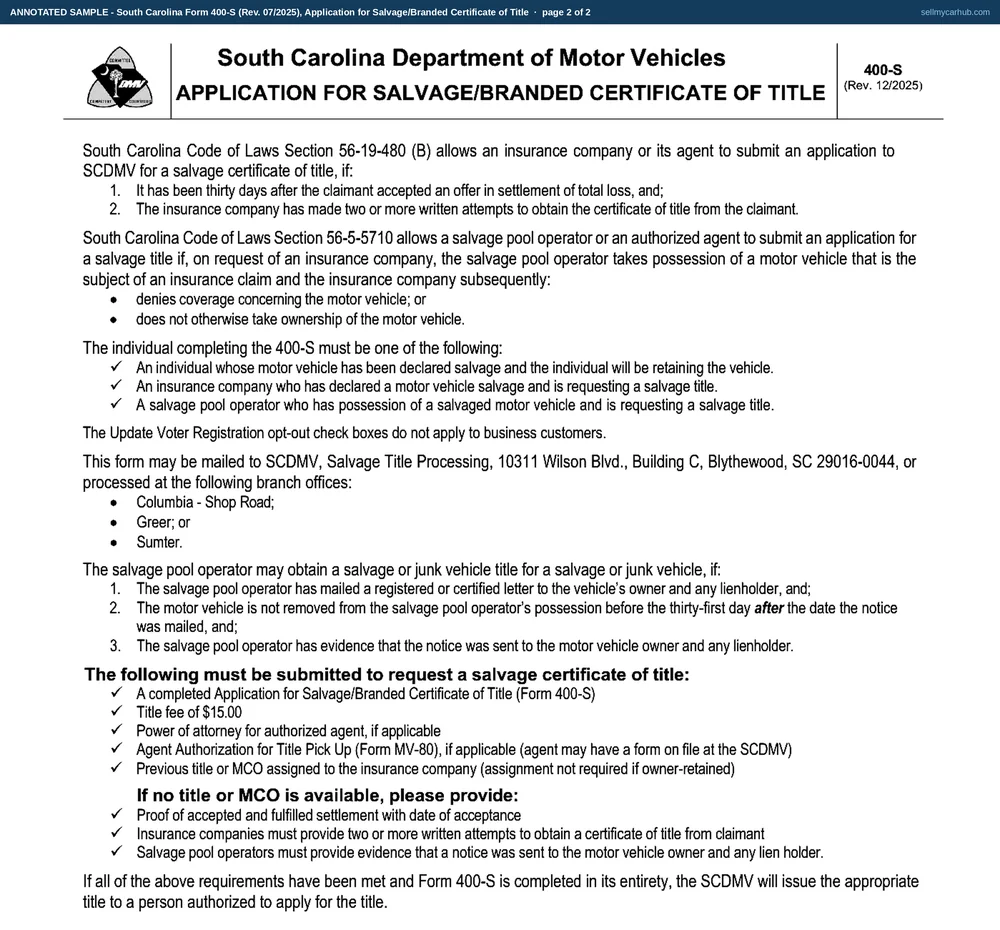
This is all 2 pages of the actual 400-S, rendered from the PDF the South Carolina Department of Motor Vehicles publishes and completed end to end: letterhead, every field, and the blocks at the foot.
Owner Retaining Vehicle, Insurance Company Agent, or Salvage Pool Operator.
Watch out: The first one is yours if the insurer settled and let you keep the wreck. Everything the form asks for afterwards depends on which of the three is ticked.
VIN, make, year and model.
Watch out: The instruction about black ink is printed in the section heading rather than at the top of the page, which is why it is missed. A salvage application is scanned and archived, and blue does not survive it well.
Your full legal name, identification number, date of birth, addresses with county, and a mail-title-to company if the certificate is going elsewhere.
Watch out: On the owner-retained route this is your own name. On the insurer route it is the insurance company's, and the difference is the whole point of the box at the head.
The odometer reading and its four options - and the note that it is not required if the owner is retaining the vehicle.
Watch out: It is not required, but it is not forbidden either. On a car you intend to rebuild and sell later, an honest reading here saves an argument about mileage on the far side of the rebuild.
Two rows of boxes: the brand being applied for, then collision, fire, flood, stolen recovered or stolen unrecovered.
Watch out: Flood and fire generate their own brands in South Carolina - salvage flood and salvage fire - and each of those has a rebuilt version. Collision produces plain salvage. The box you tick decides which words are printed on the certificate.
Predamaged value, estimate for repairs, and the percentage.
Watch out: Seventy-five per cent is the statutory line above which a vehicle must be declared a total loss. The arithmetic is the evidence for the brand, so use the insurer's own figures rather than your own estimate.
Whether the existing lien is to stay on the salvage title, and whether the insurance company authorised you to retain the vehicle.
Watch out: The second one is the box the owner-retained route lives or dies on. The SCDMV also wants a letter from the insurer saying the vehicle was declared a total loss and remained with the owner.
One signature under the perjury declaration, with the $15.00 title fee and the previous certificate.
Watch out: Salvage Title Processing has its own suffix - 29016-0044 - and its own three branches. A salvage application in the ordinary titles queue is a delay nobody will explain to you.
| On the form | What to put in it |
|---|---|
| Individual completing this form | Three tick boxes across the head: Owner Retaining Vehicle, Insurance Company Agent, Salvage Pool Operator. |
| Section A, vehicle information | Four cells - vehicle identification number, make, year and model - under a heading that asks for black ink and nothing else. |
| Section B, owner information | New primary owner's complete legal name with a customer, licence, social security or federal employer number and a date of birth; a co-owner row; residence and mailing addresses with county; the voter registration opt-outs; and a mail-title-to row for a company name and address. |
| Section C, odometer mileage | The standard reading sentence, with the note that it is not required if the owner is retaining the vehicle, and four options: EXEMPT, in excess of its mechanical limits with the parenthetical started back at zero, and not the actual mileage. |
| Section D, additional information | Date of transfer, prior title number, prior title state, and a house bill presented yes-or-no box marked with a star for insurance companies that have had two certified letters returned by the owner. |
| The vehicle's condition | Two rows of boxes. THE VEHICLE DESCRIBED ON THIS APPLICATION IS: SALVAGE or JUNK. THE VEHICLE SUSTAINED THE FOLLOWING DAMAGE: COLLISION, FIRE, FLOOD, STOLEN (RECOVERED), STOLEN (UNRECOVERED). |
| Calculate the salvage percentage | Three cells - predamaged value, estimate for repairs, and the percentage the two produce. |
| The two conditional boxes | Check here if the lien on the current title is to be maintained on the salvage title; check here if the insurance company authorizes the owner to retain the vehicle. |
| Section E, signature | The perjury declaration, then one signature rule for the owner or authorized agent with a date, and a printed note to attach a power of attorney if applicable. |
| What to submit | A list at the foot: the $15.00 title fee, a power of attorney for an authorized agent, and the previous title or manufacturer's certificate of origin properly assigned to the insurance company - with the note that the assignment is not required if the vehicle is owner-retained. |
Every line here was read off 400-S (Rev 07/2025) itself — the PDF is here — and off the South Carolina Department of Motor Vehicles pages. This is plain-language help with a form, not legal advice, and where our wording and the agency's differ, theirs governs.
Back to all South Carolina seller paperwork, or what selling a car in South Carolina involves.