Sell My Car Hub

How to fill out Oklahoma 701-6

The cover sheet the buyer files, and the one document in an Oklahoma private sale a seller does not sign. Two pages: the vehicle, the owner and any lien on the first, then a used tire recycling count, a declaration of damage or theft, a flood damage disclosure and an inspection strip on the second. A seller should still read it, because four of the answers on it are yours - the colour, the plate being transferred, the odometer reading, and whether this vehicle has ever been damaged or under water.
Written against 701-6 (Rev 07/2025), issued under 47 O.S. 1105. The two declarations on page two are the reason a seller should read a form they never sign. The damage percentage and the flood disclosure are answered by whoever applies for the title, and they will be answered using whatever you told the buyer about the vehicle. Say it plainly at the sale and it costs nothing; say nothing and it becomes a dispute after the fact.

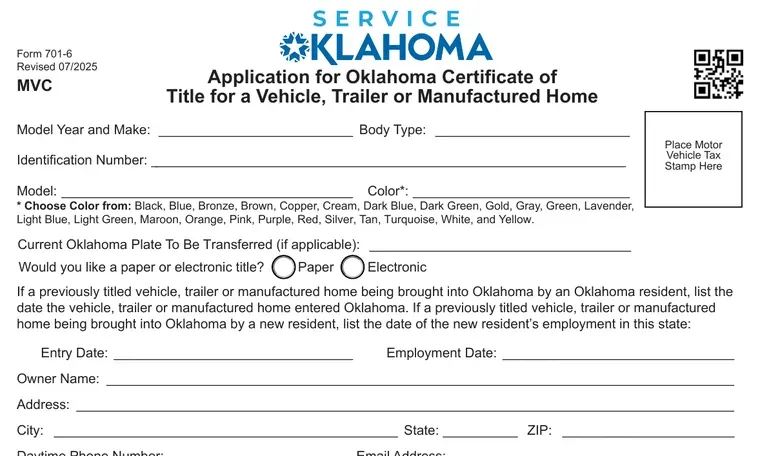
Two documents, and they are not the same thing. Take the blank 701-6 from the oklahoma.gov copy so you get the revision that is current today.

Filled in

What a completed one looks like

This is all 2 pages of the actual 701-6, rendered from the PDF the Service Oklahoma, Motor Vehicle Services publishes and completed end to end: letterhead, every field, and the blocks at the foot.

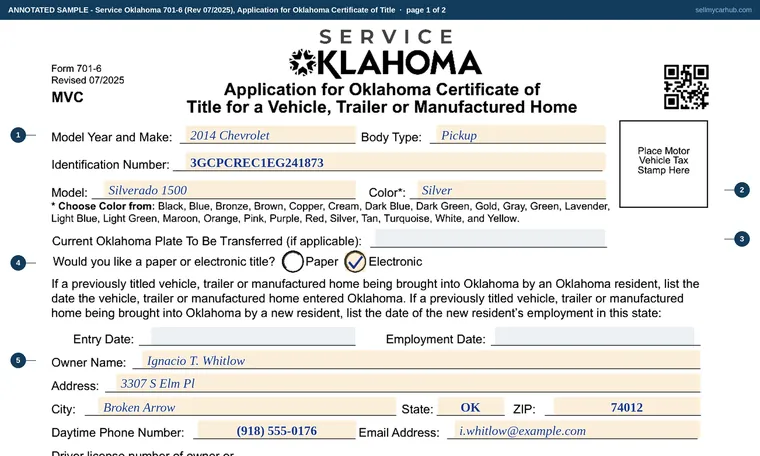
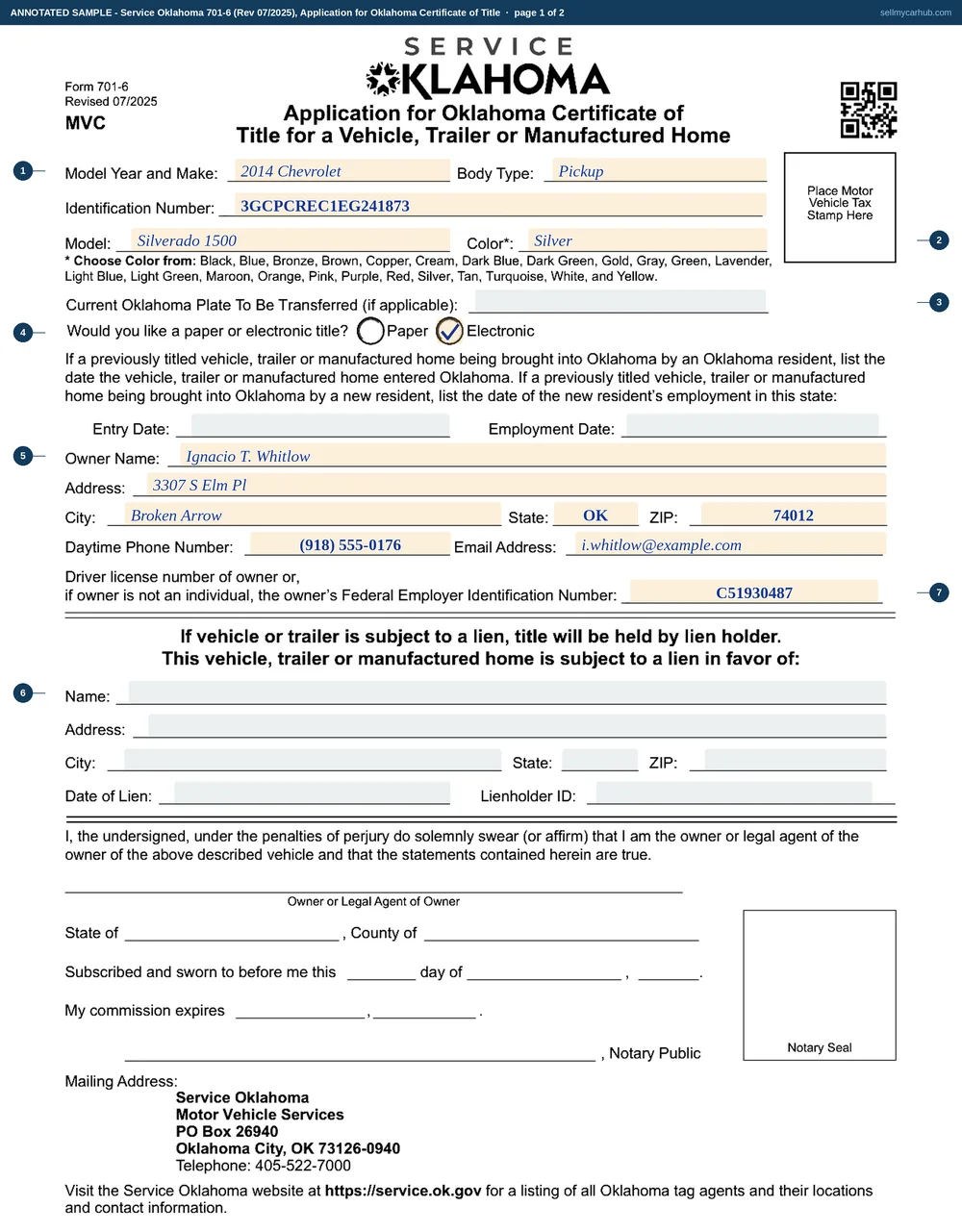
Both pages of Service Oklahoma Form 701-6 filled in by buyer Ignacio T. Whitlow for a 2014 Chevrolet Silverado 1500, vehicle identification number 3GCPCREC1EG241873, in Silver, requesting an electronic title, with no lien recorded, five tires at 19.5 inches or less, no damage or theft declared, no flood damage, and an odometer reading of 96,418 in the inspection band.
Page 1 of 2. The vehicle, the owner and the lien block, closing with a perjury certification sworn before a notary.
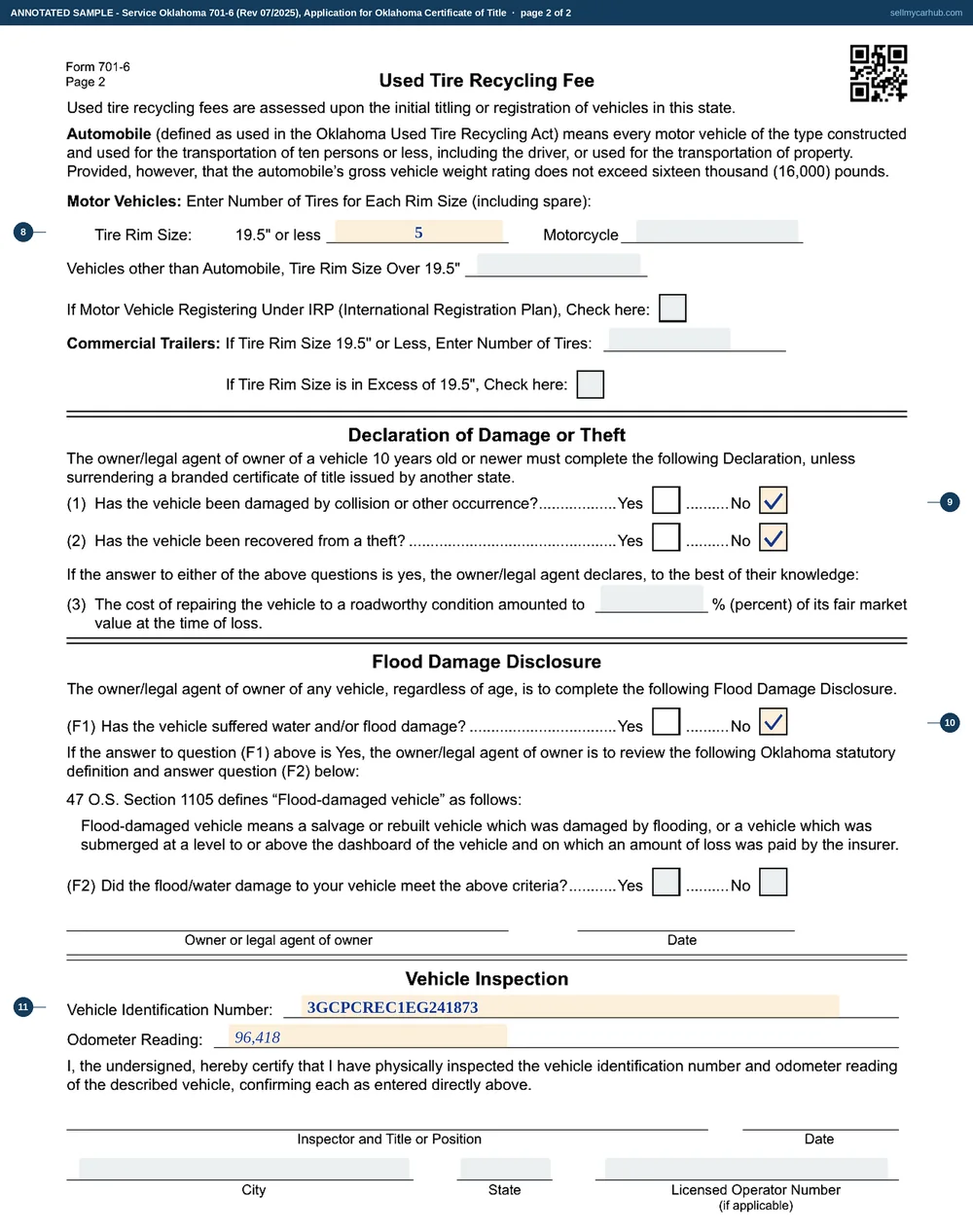
Both pages of Service Oklahoma Form 701-6 filled in by buyer Ignacio T. Whitlow for a 2014 Chevrolet Silverado 1500, vehicle identification number 3GCPCREC1EG241873, in Silver, requesting an electronic title, with no lien recorded, five tires at 19.5 inches or less, no damage or theft declared, no flood damage, and an odometer reading of 96,418 in the inspection band.
Page 2 of 2. Tires counted including the spare, both declarations answered, and an inspection band that belongs to the inspector rather than to the applicant.
Field by field

Every line, in the order you meet it

  1. 1
    The buyer fills this in

    Model Year and Make, Body Type, Identification Number

    The vehicle across the first two rules of page one.

    Watch out: Take the identification number from the notarised assignment or the 718 rather than from the vehicle, so that the application and the transfer document say exactly the same thing.

  2. 2
    The buyer fills this in

    Color

    One of the twenty-four colours printed under the box.

    Watch out: The list runs from Black to Yellow and includes Dark Blue and Light Green as separate entries. Anything else - Champagne, Graphite, whatever the manufacturer called it - is not on the list.

  3. 3
    The buyer fills this in

    Current Oklahoma Plate To Be Transferred

    The plate the buyer already holds and wants moved onto this vehicle.

    Watch out: This is where an Oklahoma buyer collects the credit for unexpired tags. Leaving it blank when they do hold a plate quietly costs them money.

  4. 4
    The buyer fills this in

    Paper or Electronic

    One tick, deciding whether a physical certificate is printed.

    Watch out: Electronic is the default now. A buyer who plans to sell out of state, or who simply wants the document in a drawer, should tick paper and expect to pay for the print.

  5. 5
    The buyer fills this in

    Owner Name, Address, and the driver licence or FEI number

    The applicant, exactly as their identification spells them, with the one box that takes either a driver licence number or a business identification number.

    Watch out: A business buying a work truck uses the Federal Employer Identification Number here, and an individual uses their licence. Mixing the two is a common reason a packet comes back.

  6. 6
    The buyer fills this in

    The lien block, and the warning above it

    The buyer's lender, its address, the date of the lien and the lienholder identifier.

    Watch out: Empty on a cash sale. Filled in, it means the certificate goes to the lender and the buyer will not see it until the loan is paid.

  7. 7
    The buyer fills this in

    The certification and the notary block

    A statement under the penalties of perjury that the applicant is the owner or legal agent of the owner, sworn before a notary public.

    Watch out: Yes, this one is notarised too. Oklahoma notarises the application as well as the transfer, so the buyer needs their own trip if they did not come along to yours.

  8. 8
    The buyer fills this in

    Used Tire Recycling Fee, on page two

    The number of tires by rim size, including the spare.

    Watch out: Five, on a normal car with a full-size spare. The count drives a real fee, which is why the form bothers to say including spare.

  9. 9
    The buyer fills this in

    Declaration of Damage or Theft

    Two yes/no questions on a vehicle ten years old or newer, and a repair-cost percentage if either is answered yes.

    Watch out: The percentage is of fair market value at the time of loss, and it is the number that decides whether a title comes back branded. It is not a guess to make casually.

  10. 10
    The buyer fills this in

    Flood Damage Disclosure

    Two more yes/no questions, with the statutory definition of a flood-damaged vehicle printed between them.

    Watch out: This one applies regardless of age. The definition turns on water at or above the dashboard and an amount of loss paid by the insurer, so a wet carpet is not automatically a yes.

  11. 11
    Somebody else fills this in

    The Vehicle Inspection band

    Identification number, odometer reading, the inspector's certification, and a licensed operator number.

    Watch out: Not the buyer's to complete. It is signed by whoever physically inspected the vehicle identification number and the odometer, which is the inspection Oklahoma requires on a vehicle arriving from another state.

At a glance

What goes where

On the formWhat to put in it
Model Year and Make, Body TypeThe opening rule, with the motor vehicle tax stamp panel to the right of it.
Identification NumberOne wide box across the sheet.
Model and ColorThe colour box carries its own printed list of twenty-four permitted colours, from Black through Turquoise to Yellow, and nothing outside it is accepted.
Current Oklahoma Plate To Be Transferred (if applicable)Where the buyer already holds a plate with time left on it, this is the box that moves it and the credit onto this vehicle.
Would you like a paper or electronic title? Paper / ElectronicTwo tick boxes. Since 1 July 2025 electronic is the default and paper is the exception.
Entry Date and Employment DateOnly for a vehicle brought into Oklahoma - the date it entered, or the date the new resident's employment in the state started.
Owner Name, Address, City, State, ZIPThe buyer, spelled as their identification spells them.
Daytime Phone Number and Email AddressContact details for the applicant.
Driver license number of owner or, if owner is not an individual, the owner's Federal Employer Identification NumberOne box serving both cases, with the alternative printed into the label.
This vehicle, trailer or manufactured home is subject to a lien in favor of: Name, Address, City, State, ZIPThe lien block, under a printed warning that if the vehicle is subject to a lien the title will be held by the lien holder.
Date of Lien and Lienholder IDThe date the security agreement was executed and the identifier Service Oklahoma assigns to the lienholder.
Owner or Legal Agent of Owner, with the notary block under itA certification under the penalties of perjury that the applicant is the owner or legal agent, sworn before a notary public with a seal.
Page two: Used Tire Recycling FeeA count of tires by rim size, including the spare, split between 19.5 inches or less, motorcycle, and over 19.5 inches, with separate lines for commercial trailers and a tick box for vehicles registering under the International Registration Plan.
Page two: Declaration of Damage or TheftTwo yes/no questions for a vehicle ten years old or newer - whether it has been damaged by collision or other occurrence, and whether it has been recovered from a theft - and, if either is yes, the cost of repair as a percentage of fair market value at the time of loss.
Page two: Flood Damage DisclosureTwo more yes/no questions, this time for a vehicle of any age, with the statutory definition of a flood-damaged vehicle printed between them.
Page two: Vehicle InspectionIdentification number, odometer reading and a certification signed by an inspector, with a city, state and licensed operator number. Not the applicant's band.

What gets this one rejected

Rules that decide whether it is accepted

Every line here was read off 701-6 (Rev 07/2025) itself — the PDF is here — and off the Service Oklahoma, Motor Vehicle Services pages. This is plain-language help with a form, not legal advice, and where our wording and the agency's differ, theirs governs.

Back to all Oklahoma seller paperwork, or what selling a car in Oklahoma involves.

Want the paperwork handled instead?

Get My Instant Offer → Online · about 2 minutes · free

Or send the details — we'll come to you

Damage history, flood history, or a story that needs telling? We buy vehicles as they are and the disclosure is our problem.

or call/text (877) 405-1808