Sell My Car Hub

How to fill out New York MV-51

For the cars New York never titled. The state issues no certificate for a motor vehicle of model year 1972 or older, and for those the ownership document is a transferable registration - or, where the current owner never registered it, this certification plus the bills of sale that show how it got to them.
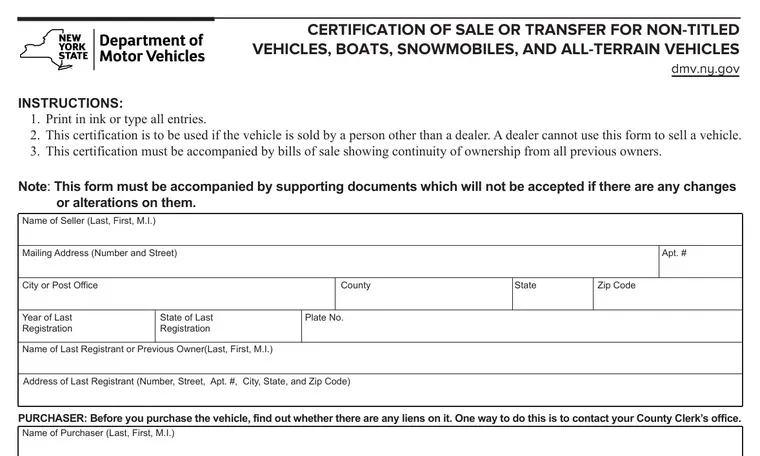
Written against MV-51 (12/25), issued under New York Penal Law section 210.45, named on the form itself. The index still lists this form under its old name, which mentions 1972 or older vehicles. The form itself was retitled at revision 12/25 and now covers non-titled vehicles, boats, snowmobiles and all-terrain vehicles - so search by the number rather than by the description.

Two documents, and they are not the same thing. Take the blank MV-51 from the dmv.ny.gov copy so you get the revision that is current today, then print our MV-51 guide and keep it beside you while you fill theirs in.

Filled in

What a completed one looks like

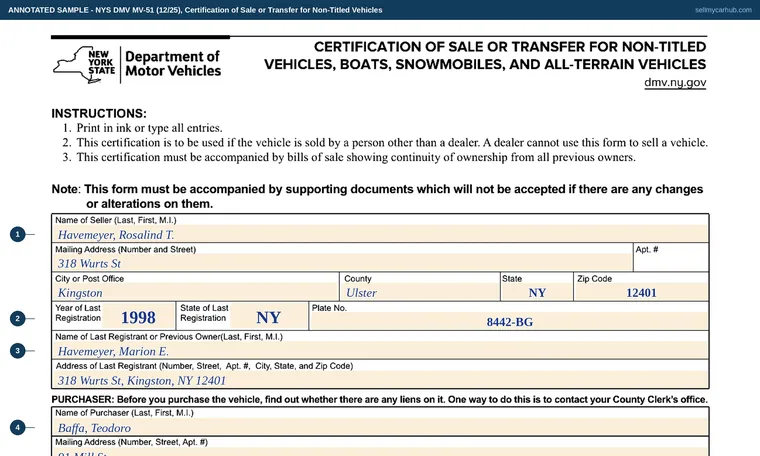
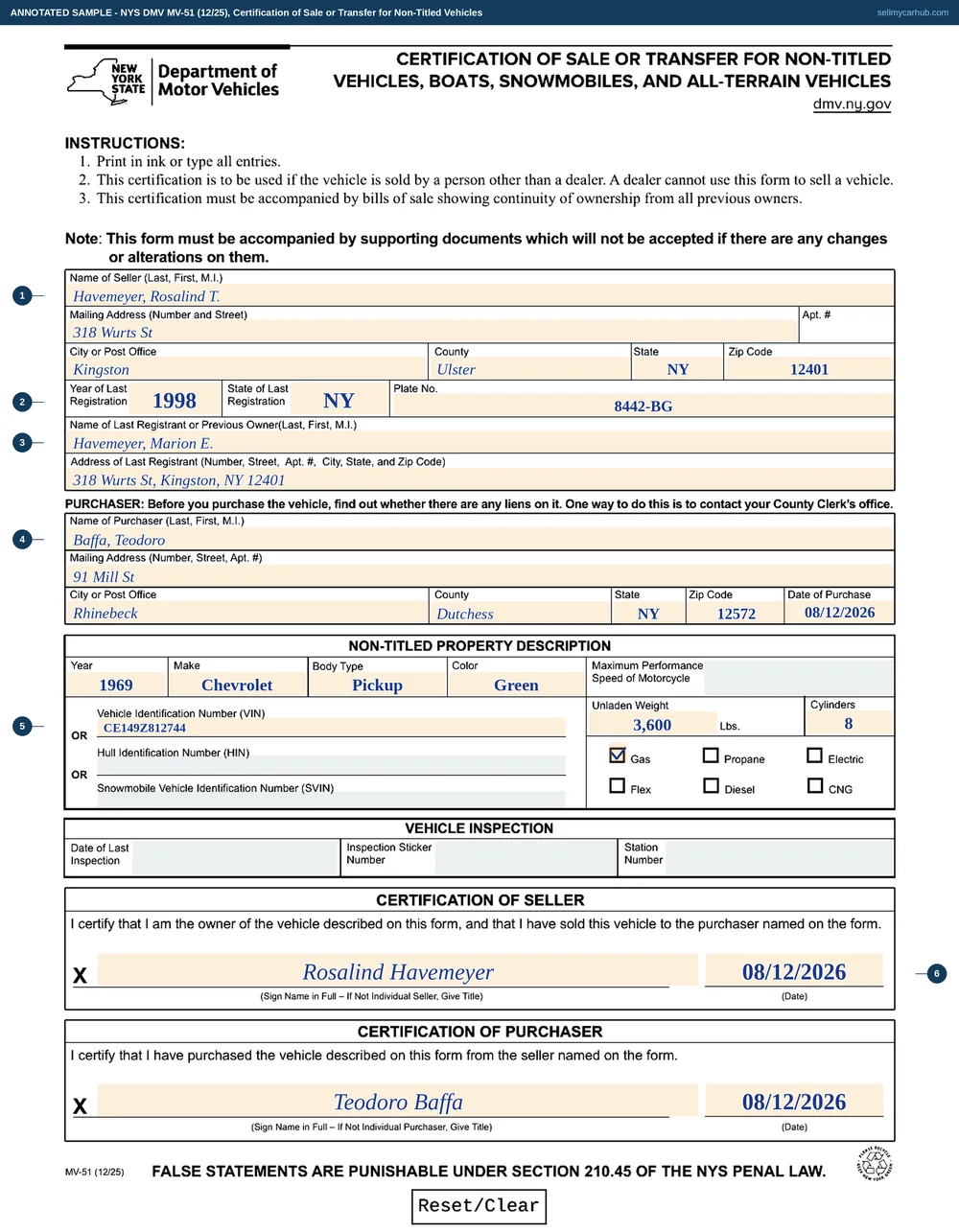
This is the actual MV-51, rendered from the PDF the New York State Department of Motor Vehicles publishes and completed end to end: letterhead, every field, and the blocks at the foot.

A New York MV-51 filled in for a 1969 Chevrolet pickup: seller Havemeyer Rosalind T. of Kingston in Ulster County, a last registration year of 1998 in New York under plate 8442-BG, the previous owner named, purchaser Baffa Teodoro of Rhinebeck in Dutchess County, a purchase date of 12 August 2026, the vehicle described as a green eight-cylinder pickup running on gas with the identification number CE149Z812744, and both certifications signed and dated.
The actual MV-51 at revision 12/25. Note the identification number: a 1969 vehicle carries nothing like the seventeen-character modern format, which is one reason these transfers are examined by hand in Albany rather than processed at a counter.
Field by field

Every line, in the order you meet it

  1. 1
    You fill this in

    Seller block

    Your name, mailing address, city or post office, county, state and ZIP.

    Watch out: County is asked for on both halves of this form. It is not a formality on a vehicle with no title record - it is part of how the DMV traces the registration history.

  2. 2
    You fill this in

    Last registration

    The year and state of the last registration, and the plate number.

    Watch out: Dig out the old registration document if you still have it. On a vehicle last plated decades ago this line is often the only thing that connects the car to any record at all.

  3. 3
    You fill this in

    Last registrant or previous owner

    The name and address of whoever held it before you.

    Watch out: This has to match the bills of sale you are attaching. The whole form is an assertion of continuity, and this is the link in the chain the DMV checks first.

  4. 4
    The buyer fills this in

    Purchaser block

    The buyer's name, address, county and the date of purchase.

    Watch out: The printed warning above this block is aimed at them, not you: before you purchase, find out whether there are any liens on it, and one way is to contact your county clerk's office.

  5. 5
    You fill this in

    Non-titled property description

    Year, make, body type, colour, weight, cylinders, fuel and the identification number on the correct one of three labelled rules.

    Watch out: Use the vehicle line for a car, the hull line for a boat and the snowmobile line for a snowmobile. Writing a car's number on the hull rule is a rejection rather than a typo.

  6. 6
    You fill this in

    Both certifications

    You certify that you own it and have sold it; the purchaser certifies that they bought it. Both sign in full and date it.

    Watch out: Sign in full - the form says so twice, once under each rule. False statements here are punishable under section 210.45 of the Penal Law.

At a glance

What goes where

On the formWhat to put in it
The three instructionsPrint in ink or type all entries; the certification is used when the vehicle is sold by somebody other than a dealer, and a dealer cannot use this form; and it must be accompanied by bills of sale showing continuity of ownership from all previous owners.
SellerName, mailing address, apartment number, city or post office, county, state and ZIP.
Last registrationYear of last registration, state of last registration and the plate number - the record that lets the DMV find the vehicle at all.
Last registrant or previous ownerName and address of whoever the record shows before you. This is the join between your bills of sale and the department's file.
PurchaserName, mailing address, city, county, state, ZIP and the date of purchase - with a warning printed above it telling the purchaser to find out whether there are liens, and suggesting the county clerk's office.
Non-titled property descriptionYear, make, body type, colour, weight, cylinders, fuel, and the identification number - vehicle, hull or snowmobile, on three separate labelled rules.
Vehicle inspectionDate of last inspection, inspection sticker number and station number.
The two certificationsThe seller certifies ownership and that the vehicle has been sold to the named purchaser; the purchaser certifies that they bought it. Both sign in full. False statements are punishable under section 210.45 of the Penal Law.

What gets this one rejected

Rules that decide whether it is accepted

Every line here was read off MV-51 (12/25) itself — the PDF is here — and off the New York State Department of Motor Vehicles pages. This is plain-language help with a form, not legal advice, and where our wording and the agency's differ, theirs governs.

Back to all New York seller paperwork, or what selling a car in New York involves.

Want the paperwork handled instead?

Get My Instant Offer → Online · about 2 minutes · free

Or send the details — we'll come to you

Pre-1973 vehicles with a paper trail rather than a certificate are exactly the sort of thing that stalls a private sale. Tell us what you have.

or call/text (877) 405-1808