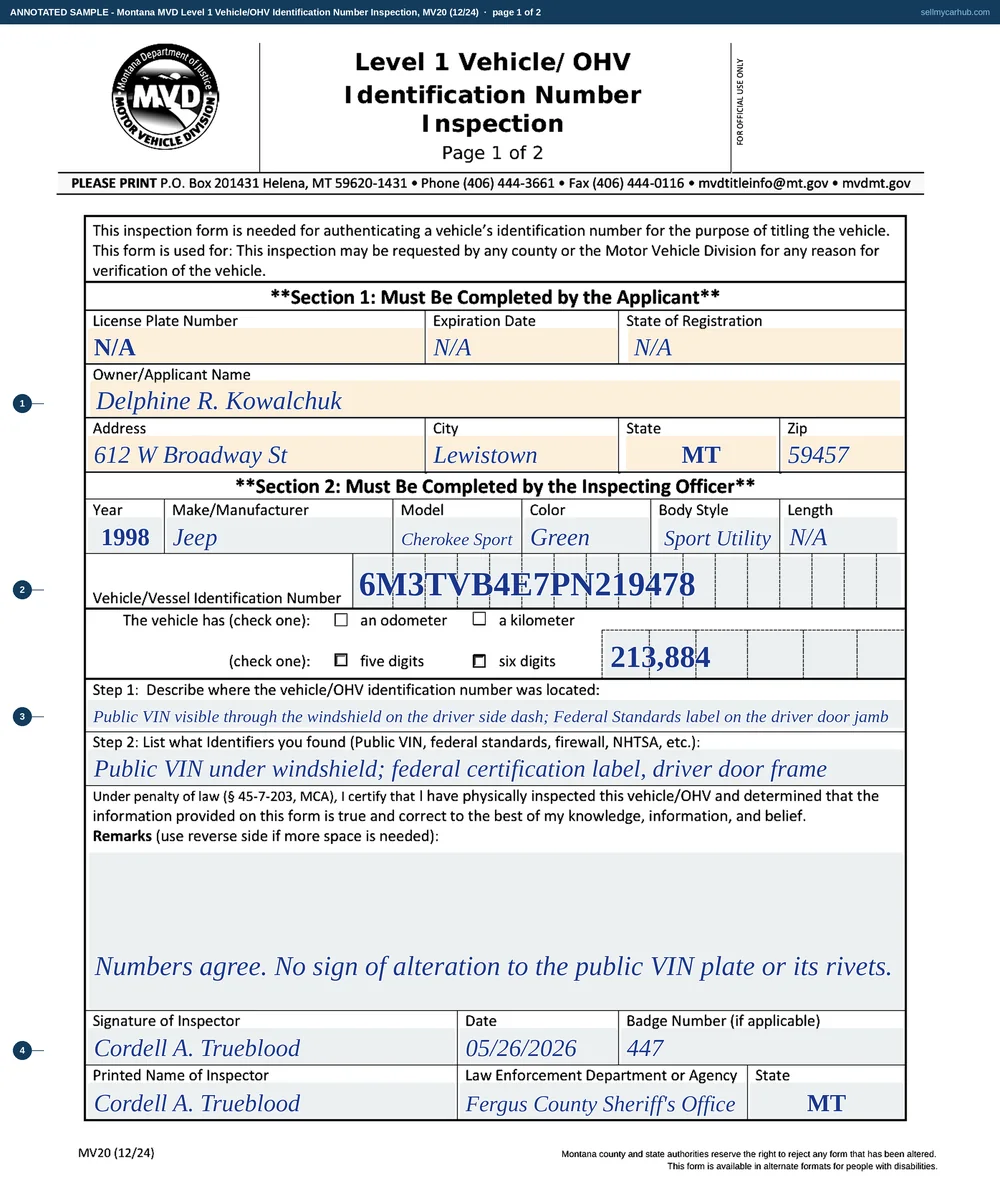
Montana runs no emissions programme and no periodic safety inspection, so this is the only inspection in the titling system - and it inspects the number, not the car. A law enforcement officer physically compares the VIN on the vehicle against the ownership paperwork and certifies where they found it and what they found it on. An ordinary sale between two Montanans on an existing Montana title never triggers one. It comes out for vehicles arriving from another state or country, for break/bond applications on a vehicle ten years old or newer, for a rebuilt salvage vehicle going back on the road, and any time a county or the division wants a number verified.
Two documents, and they are not the same thing. Take the blank MV20 from the mvdmt.gov copy so you get the revision that is current today, then print our MV20 guide and keep it beside you while you fill theirs in.
Written against MV20 (12/24), issued under prescribed by the Motor Vehicle Division; certified by the inspecting officer under MCA 45-7-203.
The MVD re-issued this form in August 2026 and the download button above opens that revision; the filled-in sample and the box-by-box notes below were built from the previous revision (checked 2026-09-06). Section 2 is not yours to fill in, however helpfully you might mean it. The certification above the inspector's signature says they have physically inspected this vehicle, and a form arriving with the vehicle description already completed in a different hand is the fastest way to have an officer start again on a fresh sheet.
Last updated .
Filled in
What a completed one looks like
This is all 2 pages of the actual MV20, rendered from the PDF the Montana Department of Justice, Motor Vehicle Division, Vehicle Services Bureau publishes and completed end to end: letterhead, every field, and the blocks at the foot.
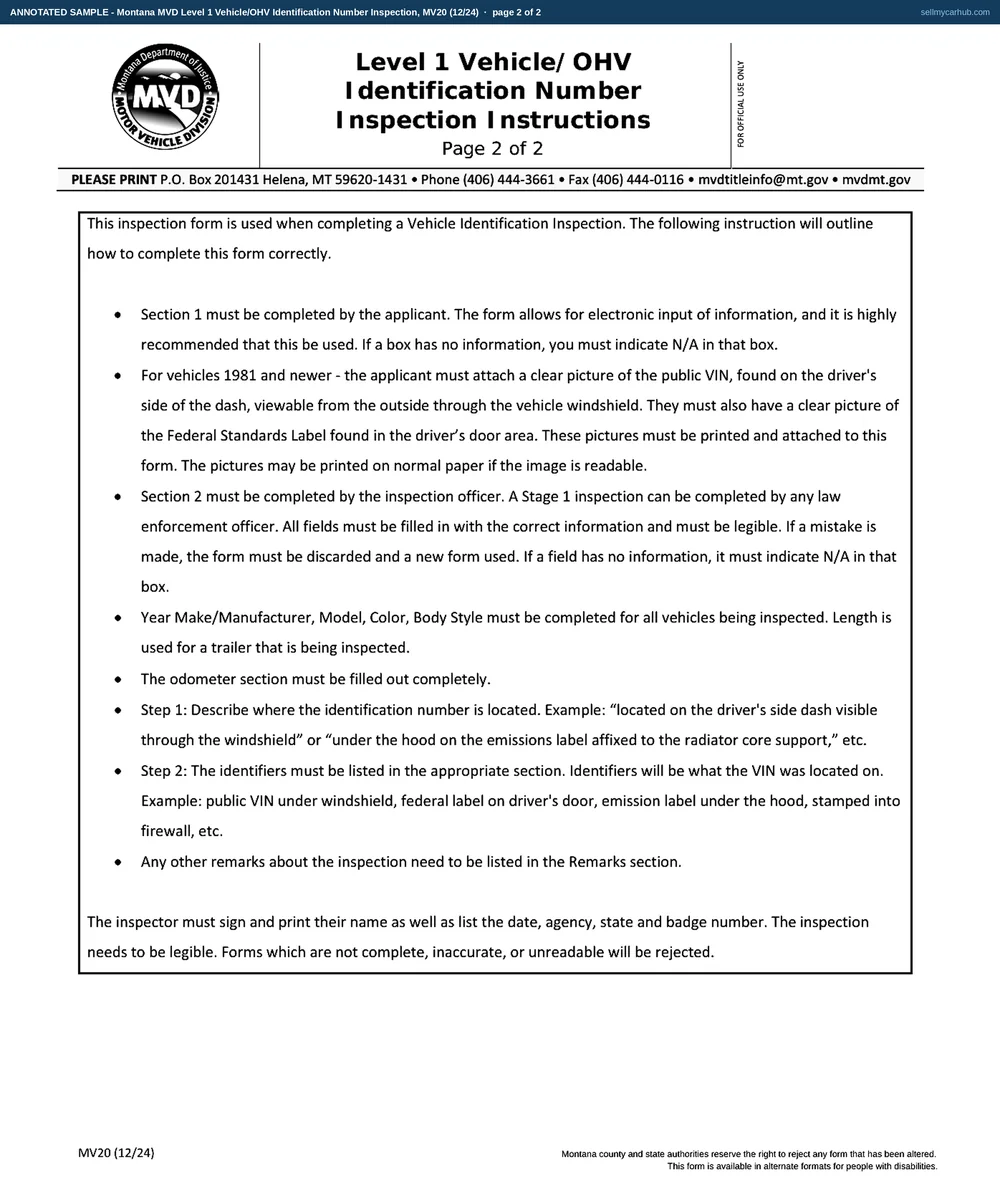
Page 1 of 2. Section 1 in the applicant's hand, section 2 in the officer's - including where the number was found and what it was found on.Page 2 of 2. The instruction page, shown unmarked: the N/A rule, the photograph requirement and the discard-and-restart rule all live here.
Field by field
Every line, in the order you meet it
1
You fill this in
Section 1: the applicant's half
Plate, expiration date, state of registration, and the owner's name and address.
Watch out: Write N/A rather than leaving anything blank. On a vehicle with no plate and no registration that is three N/As in a row, and the instructions ask for them.
2
The vehicle verifier fills this in
The number itself
The officer records the vehicle or vessel identification number after physically comparing it with the paperwork.
Watch out: This is the whole transaction. If it does not match the ownership document, everything downstream stops here rather than at a county counter later.
3
The vehicle verifier fills this in
Where the number was, and what it was on
Step 1 describes the location; step 2 lists the identifiers - public VIN, federal standards label, firewall, NHTSA label.
Watch out: Two independent identifiers are what makes an inspection persuasive. A single dash plate on a thirty-year-old vehicle often is not enough on its own.
4
The vehicle verifier fills this in
The officer signs and identifies their agency
Signature, date, badge number where applicable, printed name, department or agency and state.
Watch out: Any law enforcement officer can do a Level 1, but the agency and badge have to be legible. An unreadable inspection is a rejected inspection, and the form has to be redone rather than corrected.
At a glance
What goes where
On the form
What to put in it
The purpose line
This inspection form is needed for authenticating a vehicle's identification number for the purpose of titling the vehicle, and may be requested by any county or the Motor Vehicle Division for any reason for verification of the vehicle.
Section 1, completed by the applicant
Licence plate number, expiration date, state of registration, the owner or applicant's name and full address. The instructions require N/A rather than a blank in any box that has no information.
Section 2, completed by the inspecting officer
Year, make or manufacturer, model, colour, body style and length, then the vehicle or vessel identification number, an odometer or kilometer tick, a five- or six-digit tick and the reading.
Step 1
Describe where the vehicle identification number was located - the instructions' own examples are located on the driver's side dash visible through the windshield, and under the hood on the emissions label affixed to the radiator core support.
Step 2
List what identifiers you found: public VIN, federal standards label, firewall, NHTSA and so on.
Remarks
A free block, with the reverse side offered for more space.
The inspector's block
Signature, date, badge number where applicable, printed name, the law enforcement department or agency, and the state - all under a certification of physical inspection.
The photograph requirement
For vehicles 1981 and newer the applicant must attach a clear printed picture of the public VIN visible through the windshield and of the Federal Standards Label in the driver's door area.
What gets this one rejected
•A blank box. The instructions say it twice: if a box has no information, you must indicate N/A in that box.
•A correction. The instructions are unforgiving - if a mistake is made, the form must be discarded and a new form used - and the manual bars a statement of fact from fixing an error on a VIN inspection.
•Missing photographs on a 1981-or-newer vehicle. Both pictures are required, printed and attached, and normal paper is acceptable if the image is readable.
•An incomplete odometer section. The instructions require it to be filled out completely, which means the odometer or kilometer tick and the digit count as well as the reading.
•An illegible form. Forms which are not complete, inaccurate, or unreadable will be rejected - the instruction page says so in those words.
Rules that decide whether it is accepted
•Any officer can do a Level 1. The instructions: a Stage 1 inspection can be completed by any law enforcement officer. It does not have to be a specialist unit or a particular county.
•Ten years or newer, on a break/bond. The manual: when a vehicle or vessel is 10 years or newer, a VIN inspection must be completed by a Montana law enforcement officer before a break/bond title can issue.
•It is also the camper and state-assigned-VIN route. The manual requires an MV20 for a camper with no manufacturer's identification number, and a stage 1 inspection verifying that no VIN exists before a state-assigned number is issued on an MV10B.
•Rebuilt salvage vehicles need one. The manual has a whole section on VIN inspection requirements for rebuilt salvage vehicles, which is how a branded car gets back onto the road.
•There is a vessel version. MV20V is the same document for a vessel identification number - a distinction worth knowing before printing the wrong one.