Not a form you fill in, and not one you can stop. It is the sworn certificate a lender files after repossessing a Delaware vehicle and selling it on, and it is what transfers the debtor's rights, title and interest to the next buyer without the debtor ever signing a certificate. It is on this list because a Delaware owner falling behind on payments goes looking for a repossession form and finds this one.
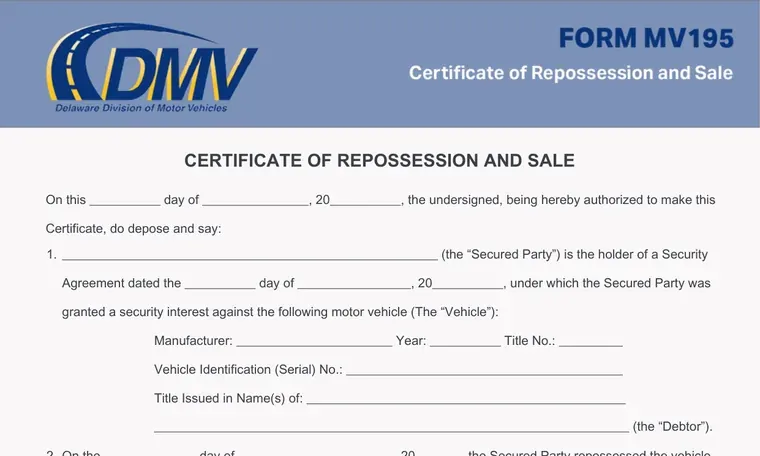
Written against MV195 (Rev 8/2024), issued under the secured party under the security agreement, which is who deposes on it - this is a lender's document from its first numbered paragraph. If a lender or a repossession agent puts this form in front of you to sign, stop and read who the signatory is. The undersigned on an MV195 is the party being authorized to depose that a repossession and sale complied with Delaware law - a statement no former owner is in a position to make about their own car being taken.
Two documents, and they are not the same thing. Take the blank MV195 from the dmv.de.gov copy so you get the revision that is current today, then print our MV195 guide and keep it beside you while you fill theirs in.
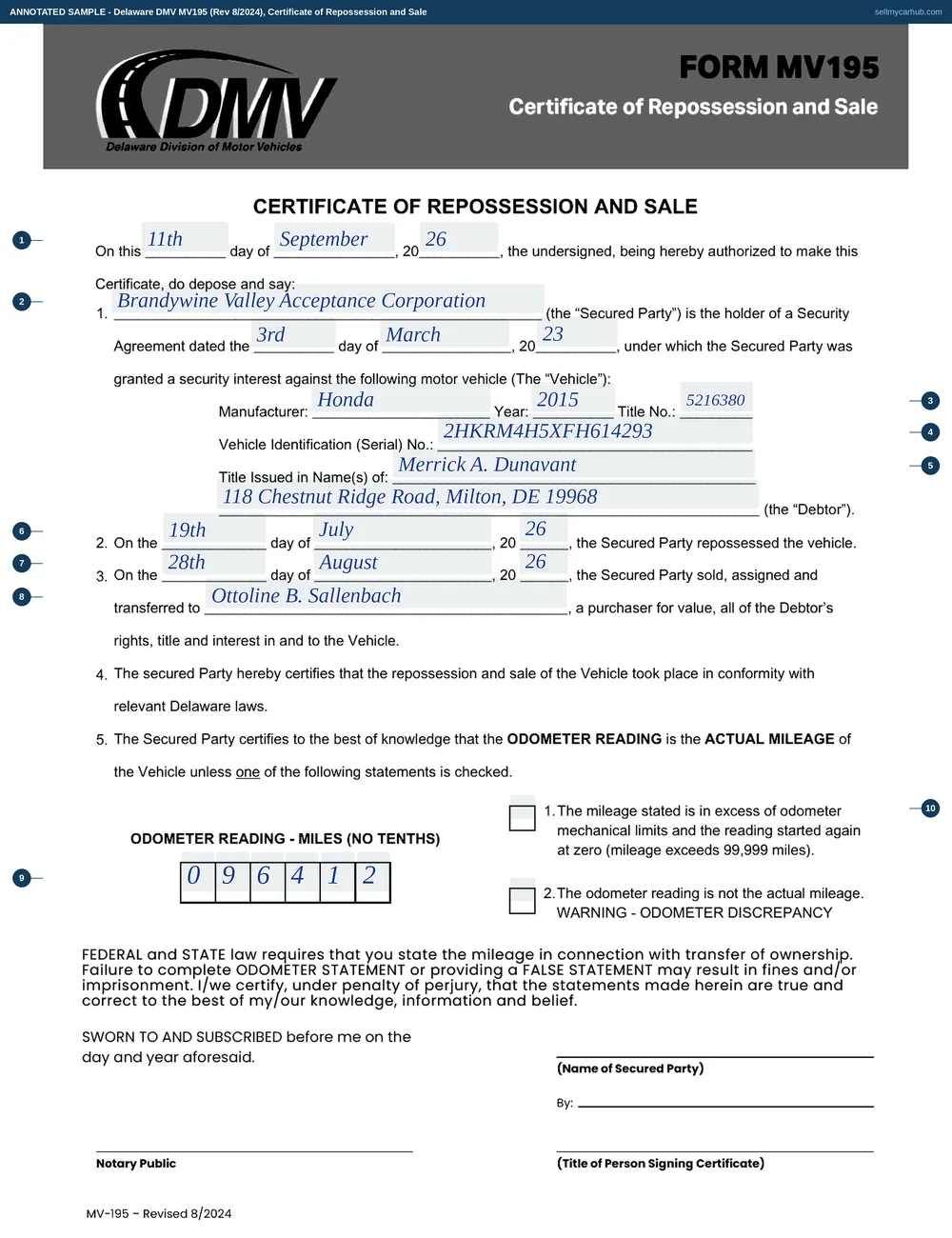
This is the actual MV195, rendered from the PDF the Delaware Division of Motor Vehicles publishes and completed end to end: letterhead, every field, and the blocks at the foot.
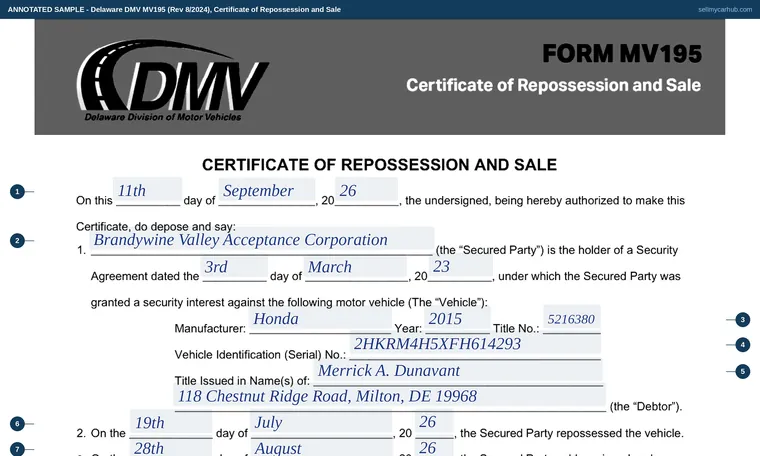
Day, month and year at the top, completing the sentence that turns the page into a sworn statement.
Watch out: This is the date the lender swore to the contents, not the date of the repossession or the sale. All three appear on the form and all three are different.
Paragraph 1: the lender's name, and the date of the agreement that granted it a security interest.
Watch out: That agreement date is the beginning of the whole chain. A repossession with no security agreement behind it has nothing to certify.
The vehicle block. Delaware wants the title number here as well as the VIN.
Watch out: The title number ties the certificate to a specific Delaware record. It is the number printed on the front of the certificate the lender has been holding.
The seventeen characters, on their own line under the manufacturer row.
Watch out: This is the identifier a buyer should check against the car itself before accepting a repossession sale.
The former owner's name and address, over two lines - and the point at which the form starts calling that person the Debtor.
Watch out: This is the one block where a Delaware owner appears on this page. Everything else is between the lender and the next buyer.
Paragraph 2: the day the Secured Party repossessed the vehicle.
Watch out: Worth checking against your own record if you ever see one of these. The dates in paragraphs 2 and 3 are the timeline of what happened to your car.
Paragraph 3: the day the Secured Party sold, assigned and transferred to a purchaser for value all of the Debtor's rights, title and interest.
Watch out: A purchaser for value is a term of art - it is what makes the transfer stick against the former owner. There is no seller's signature anywhere on this page.
Paragraph 4: the Secured Party certifies that the repossession and sale took place in conformity with relevant Delaware laws.
Watch out: No box, no signature line of its own - just a sentence the lender is signing under. It is the paragraph any dispute about the repossession is really about.
Six printed cells, filled a character at a time, with the certification printed above them.
Watch out: A repossessed car still needs a federal mileage disclosure. Where the lender cannot vouch for the reading, the not-actual box beside it is the honest answer and it brands the next certificate.
Mileage stated is in excess of odometer mechanical limits, and odometer reading is not the actual mileage.
Watch out: If you are looking at a repossession car as a buyer, read these two boxes before you read anything else on the page.
| On the form | What to put in it |
|---|---|
| The deposition line | On this ___ day of ___, 20___, the undersigned, being hereby authorized to make this Certificate, do depose and say. Everything below hangs off that sentence - it is an affidavit, not an application. |
| Paragraph 1, the Secured Party | The lender's name, and the date of the Security Agreement under which it was granted a security interest against the vehicle. |
| The Vehicle block | Manufacturer, year, title number, vehicle identification or serial number, and the names the title was issued in - who the form then calls the Debtor, in quotation marks, for the rest of the page. |
| Paragraph 2, the repossession date | The day the Secured Party repossessed the vehicle. |
| Paragraph 3, the sale | The day the Secured Party sold, assigned and transferred to a named purchaser for value all of the Debtor's rights, title and interest in and to the Vehicle. |
| Paragraph 4, the conformity certificate | The Secured Party certifies that the repossession and sale took place in conformity with relevant Delaware laws. One sentence, and it is the whole legal weight of the document. |
| Paragraph 5, the odometer statement | The Secured Party certifies the odometer reading is the actual mileage unless one of the two boxes is checked - the same two that appear on the certificate itself, reprinted here because federal disclosure follows the car rather than the owner. |
| The mileage comb | Six separate character boxes for the reading, one digit each. |
Every line here was read off MV195 (Rev 8/2024) itself — the PDF is here — and off the Delaware Division of Motor Vehicles pages. This is plain-language help with a form, not legal advice, and where our wording and the agency's differ, theirs governs.
Back to all Delaware seller paperwork, or what selling a car in Delaware involves.